Executive Summary & Key Takeaways
- Biofloc technology utilizes heterotrophic bacteria to convert toxic ammonia (NH3) directly into microbial single-cell protein, eliminating the need for water exchange.
- Maintaining a Carbon-to-Nitrogen (C:N) ratio of 15:1 or higher using organic carbon sources (molasses, wheat flour, tapioca) is essential to stimulate heterotrophic assimilation.
- Floc volume must be monitored daily in a 1,000 mL Imhoff cone; optimal settleable floc volume ranges between 15 and 25 mL/L for Litopenaeus vannamei.
- Continuous, uninterrupted aeration (minimum 28 to 32 HP per hectare equivalent) is mandatory to keep flocs in continuous suspension and prevent anaerobic tank bottoms.
- Shrimp graze continuously on microbial biofloc aggregates, lowering commercial feed requirements and reducing FCR by 15% to 20%.
Field Case Study: Circular HDPE Tank Nursery
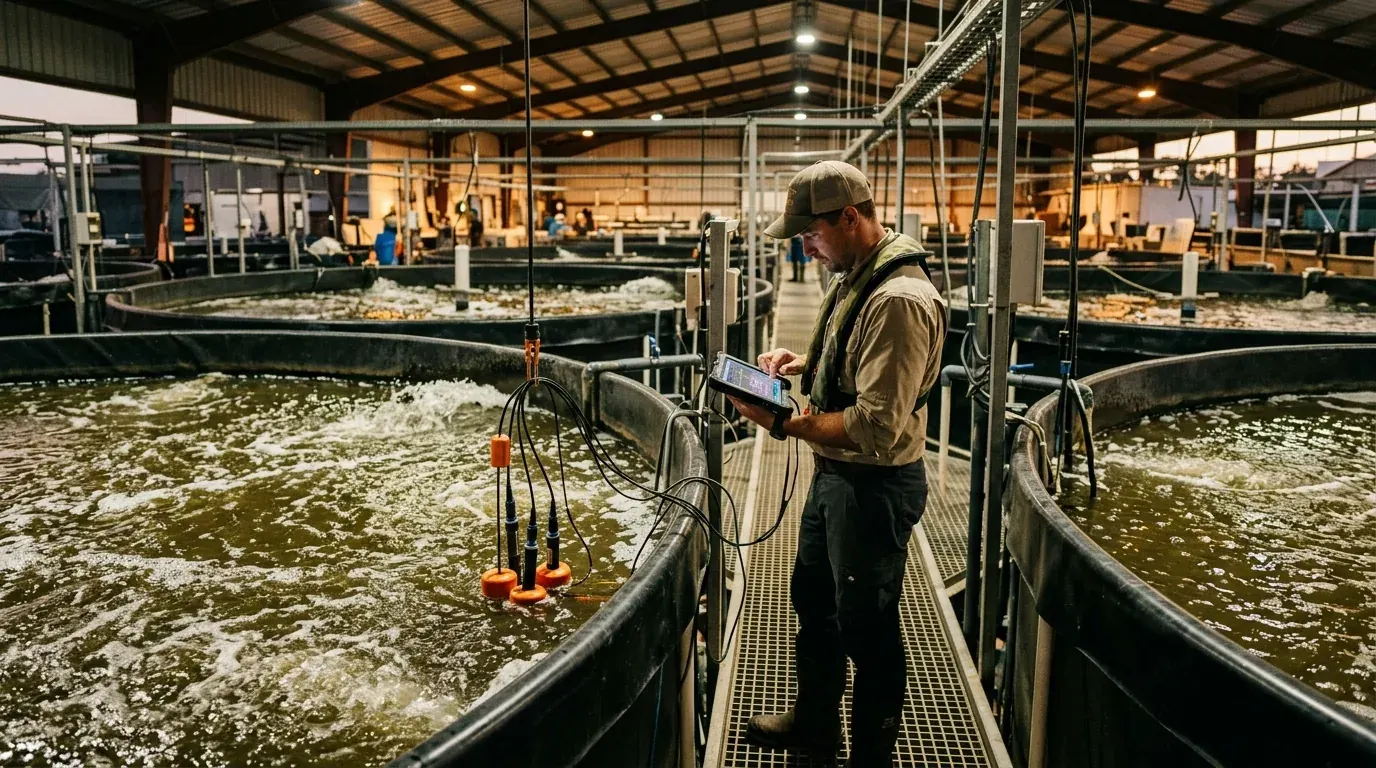
A commercial nursery operating four 10-meter diameter circular HDPE biofloc tanks maintained a strict 15:1 C:N ratio using sugarcane molasses and liquid carbon. Ammonia stayed below 0.1 ppm with zero water discharge, producing sturdy 1.8g juveniles with 96.2% survival across a 35-day nursery cycle.
1. The Biological Principles of Heterotrophic Ammonia Assimilation
In conventional aquaculture ponds, autotrophic nitrifying bacteria (Nitrosomonas and Nitrobacter) oxidize toxic ammonia into nitrite and subsequently nitrate. This process is slow, requires high alkalinity (> 150 ppm), and generates substantial nitrate accumulation requiring water discharge.
Biofloc Technology (BFT) bypasses autotrophic nitrification by cultivating dense communities of heterotrophic bacteria. When provided with an external organic carbon source, heterotrophic bacteria synthesize new cellular protein directly from dissolved ammonium ions.
Because heterotrophic bacteria reproduce up to 10 times faster than autotrophic nitrifiers (generation time of 30 minutes vs 24 hours), total ammonia nitrogen (TAN) is stripped from the water column within hours of carbon administration.
2. The Mathematical 15:1 Carbon-to-Nitrogen (C:N) Ratio Calculation
Commercial shrimp feeds contain 32% to 38% crude protein. Since protein is approximately 16% nitrogen by weight, every 100 kg of feed introduced releases roughly 3.8 to 4.2 kg of nitrogen into the culture system.
Heterotrophic bacteria require approximately 15 to 20 grams of organic carbon for every 1 gram of nitrogen assimilated into microbial biomass. To maintain this balance, add organic carbon (such as sugarcane molasses containing 40% carbon) alongside daily feed rations.
Standard Practical Rule: For every 1.0 kg of 35% protein commercial feed administered, add 0.6 to 0.7 kg of jaggery/molasses dissolved in pond water to maintain the C:N ratio above 15:1.
| Carbon Source | Carbon Content (%) | Solubility | Application Method & Frequency |
|---|---|---|---|
| Sugarcane Molasses | 38% – 42% | High (Instant liquid mix) | Dilute in warm pond water; broadcast midday |
| Wheat Flour | 45% – 48% | Moderate (Suspension) | Boil into slurry; apply with feed rations |
| Tapioca Starch | 44% – 46% | Moderate (Cooked) | Gelatinize in hot water before tank addition |
| Rice Bran (Fermented) | 35% – 40% | Slow release | Ferment with yeast 24 hrs before dosing |
3. Imhoff Cone Floc Volume Monitoring & Sludge Purging
Monitoring microbial density is critical to prevent biofloc systems from over-thickening. Collect 1,000 mL of pond water in a graduated Imhoff cone and allow it to settle undisturbed for exactly 30 minutes.
The target settleable floc volume for Vannamei culture is 15 to 25 mL/L. If floc volume drops below 10 mL/L, increase carbon dosing. If floc volume exceeds 30 mL/L, the microbial biomass consumes excessive dissolved oxygen and clogs shrimp gills. In high-floc conditions, operate central bottom drain purges or external settling clarifiers to remove surplus sludge.
4. Tank Aeration Engineering & Continuous Suspension
Biofloc particles must remain in continuous suspension throughout the water column. If water velocity drops below 0.12 m/s, flocs settle onto the tank floor, creating dense anaerobic mats that generate lethal hydrogen sulfide (H2S) gas.
Circular HDPE tanks utilize a combination of continuous bottom air-diffuser grids (Roots blowers supplying 1.5 to 2.0 CFM per m² of tank floor) and directional Venturi injectors to maintain rotational kinetic velocity.
5. Starter Inoculum Preparation & Maturation Timeline
Do not stock shrimp post-larvae into raw, unconditioned water. Prepare a starter biofloc inoculum in a 1,000-liter conditioning tank 7 days prior to stocking.
Mix 500 liters of sterilized sea water, 5 kg of jaggery, 100 grams of Bacillus subtilis probiotic powder, and 1 kg of shrimp feed. Aerate vigorously for 5 to 7 days until water turns rich golden-brown with an Imhoff floc volume of > 5 mL/L before inoculating the main culture tanks.
6. Commercial Economics: Biofloc Tanks vs Traditional Earthen Ponds
While circular biofloc tanks require higher initial capital investment (HDPE liners, Roots blowers, and greenhouse roofing), they achieve production densities of 8 to 15 kg per cubic meter (equivalent to 40 to 80 tons per hectare).
With zero water exchange, biofloc facilities eliminate viral contamination risks from coastal tidal creeks, enabling reliable multi-crop harvesting year-round.
Summary Operational Action Checklist
Frequently Asked Questions
Q: Can biofloc technology be implemented in standard earthen ponds?
Yes, but with modifications. Earthen ponds require full HDPE plastic lining and high-capacity aeration grids to prevent bottom mud from mixing with the microbial bioflocs.
Q: Why does biofloc lower commercial feed consumption?
Biofloc aggregates contain 28% to 34% crude protein, minerals, and vitamins. Shrimp graze continuously on suspended microbial flocs 24 hours a day, reducing reliance on formulated pelleted feed and dropping FCR by up to 20%.
Team AquaSangham
Aquaculture Research & Technical Desk
Contributing Senior Technical Writer & Aqua Consultant at AquaSangham.
Recommended Farming Guides
Western Blue Shrimp (Penaeus stylirostris) Intensive Culture: Lessons from New Caledonia
Read Article →Farming TechGreen Tiger Prawn (Penaeus semisulcatus) Culture Protocols for Gulf of Mannar Coastal Ponds
Read Article →Farming TechKuruma Prawn (Penaeus japonicus) Culture in Sandy Substrates: High-Value Export SOP
Read Article →Get Live Farm Advice on AquaSangham Mobile App
Download India's #1 Aquaculture Super App for real-time market prices, precision tools, and community advice.
Download Free Android App