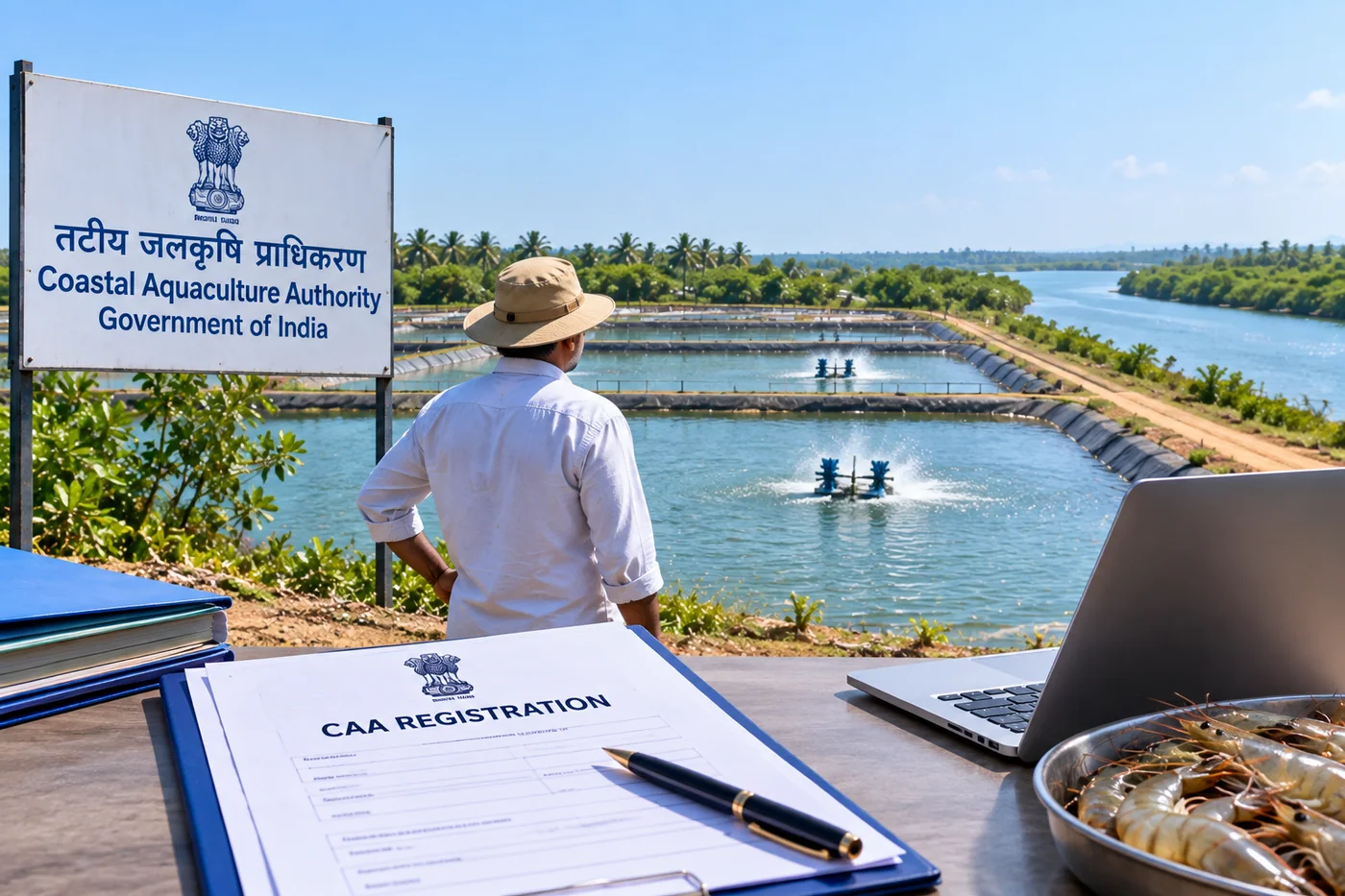
Executive Summary & Key Takeaways
- Under the Coastal Aquaculture Authority Act 2005 and its landmark 2023 Parliamentary Amendments, any coastal aquaculture establishment operating within 2 kilometers from the High Tide Line (HTL) of seas, estuaries, creeks, or backwaters without valid CAA registration is classified as an illegal operation subject to power disconnection, civil penalties up to ₹1 Lakh per hectare, and potential pond demolition.
- Statutory setback rules require a minimum 100-meter buffer from the High Tide Line of seas and major coastal waterways, 100 meters from designated mangrove forests and national parks, 100 meters from human habitations, and 300 meters from public freshwater drinking sources to prevent salinization of community aquifers.
- Farms with an aggregate water spread area (WSA) exceeding 5.0 hectares (12.35 acres) are legally mandated to dedicate at least 10% of their water area to a functional three-stage Effluent Treatment System (ETS) incorporating sedimentation, biological bio-remediation, and secondary aeration before releasing wastewater.
- The MPEDA Pre-Harvest Certificate (PHC) and Export Inspection Agency (EIA) clearance are strictly conditioned on producing an active CAA registration number; uncertified farms cannot sell to licensed export processors and are forced to accept crippling distress discounts of ₹60–₹100/kg in informal gray markets.
- CAA registration is issued in Form-II with an initial statutory validity of 5 years, requiring renewal applications to be submitted at least 60 days before expiration via the state fisheries District Level Committee (DLC).
- AquaSangham integrates automated CAA compliance tools, GPS setback verifiers, and digital document vaults directly into the mobile app, enabling farmers to preserve their certificates, monitor renewal deadlines, and maintain certified antibiotic-free crop logs.
CAA Regularization & Power Restoration Case Study: Overcoming Setback Queries for a 4.2-Hectare Farm
A commercial shrimp farmer operating a 4.2-hectare Litopenaeus vannamei farm along Nizampatnam creek faced an immediate power disconnection notice and export Pre-Harvest Certificate (PHC) freeze due to an unregistered farm boundary allegation under the revised Coastal Aquaculture Authority (Amendment) Act 2023. Working with AquaSangham regulatory advisors, the farmer: (1) Conducted a DGPS (Differential GPS) cadastral survey establishing exact high tide line (HTL) coordinates, proving the outer pond bund maintained an undisputed 112-meter setback from the natural creek edge; (2) Redesigned the farm water management system by converting an idle 0.4-hectare nursery pond into a dedicated biological sedimentation and Effluent Treatment System (ETS) with bio-filtration trenches; (3) Assembled an unassailable Form-I application packet containing mutation extracts, no-objection certificates (NOC) from the Gram Panchayat, electrical load sanctions, and groundwater salinity certifications; (4) Navigated the joint field verification inspection conducted by the District Level Committee (DLC)—comprising the Assistant Director of Fisheries, Revenue Divisional Officer (RDO), and Pollution Control Board engineer; and (5) Secured the official CAA Registration Certificate valid for 5 years, restoring subsidized power tariffs (saving ₹3.40 Lakhs annually compared to commercial diesel pumping) and unlocking unhindered export harvest clearances.
1. The Legal Mandate: CAA Act 2005 & The 2023 Amendments
In the high-stakes arena of commercial Indian shrimp aquaculture, biological proficiency alone does not safeguard an investment. A farmer may maintain a flawless feed conversion ratio (FCR) of 1.22, zero pathogen mortality, and pristine biosecurity across twelve earthen ponds, yet wake up to an administrative disaster: a notice of summary electrical disconnection from the state distribution company (DISCOM), a frozen bank credit line, or a magistrate order mandating the destruction of pond dykes. The legal foundation of coastal aquaculture in India is anchored in the Coastal Aquaculture Authority Act, 2005, enacted by Parliament following the landmark 1996 Supreme Court ruling (S. Jagannath v. Union of India) to regulate coastal aquaculture activities, preserve fragile coastal ecosystems, and prevent the uncontrolled conversion of agricultural wetlands.
Under Section 13 of the Act, every commercial aquaculture activity situated within the defined coastal zone—specifically within 2 kilometers from the High Tide Line (HTL) of seas, estuaries, creeks, and backwaters—must hold a valid Certificate of Registration issued by the Coastal Aquaculture Authority (CAA), headquartered in Chennai under the Department of Fisheries, Ministry of Fisheries, Animal Husbandry and Dairying. Operating without this registration transforms a legitimate multi-lakh agribusiness into an unauthorized coastal encroachment under Indian law.
The regulatory landscape underwent its most profound modernization with the enactment of the Coastal Aquaculture Authority (Amendment) Act, 2023 (Act No. 20 of 2023). This amendment introduced sweeping structural shifts: while it decriminalized operational infractions by removing obsolete imprisonment penalties (which previously deterred institutional bank lending and international equity), it dramatically strengthened administrative civil enforcement. The amended statute empowers designated adjudicating officers to levy severe civil penalties up to ₹1,00,000 per hectare for unauthorized coastal culture, issue summary stop-work directives, order the forfeiture of harvested biomass, and direct the district administration to cut three-phase electrical power connections without prior judicial injunction.
Crucially, CAA registration is the non-negotiable gateway to the international seafood market. The Marine Products Export Development Authority (MPEDA) and the Export Inspection Agency (EIA) enforce strict traceability protocols: no processing plant or cold storage exporter can legally issue a Pre-Harvest Certificate (PHC) or purchase shrimp from an uncertified farm. An unregistered grower is systematically barred from competitive export processing plants in Visakhapatnam, Kakinada, Kochi, or Surat, forcing them into the hands of predatory local commission agents who slash purchase prices by ₹60 to ₹100 per kilogram. On a standard 5-hectare farm harvesting 25 metric tons of 30-count Vannamei, operating without CAA registration inflicts an instantaneous revenue loss of ₹15,00,000 to ₹25,00,000 per crop cycle.
Never begin earthwork excavation or invest capital in pond dykes, HDPE liners, or pumping infrastructure prior to securing an In-Principle Approval or verifying land cadastral coordinates against official Coastal Regulation Zone (CRZ) maps. The CAA Act explicitly bans post-facto regularization for ponds constructed in prohibited CRZ-I ecological zones.
2. Statutory Setback Norms: HTL, Creeks, Mangroves & Aquifers
The primary engineering and legal hurdle in securing CAA approval lies in strict compliance with statutory setback distances. Setbacks are spatial buffer zones established to isolate intensive aquaculture from public water sources, coastal vegetation, agricultural soils, and human settlements. These buffers serve a dual ecological purpose: they protect surrounding communities and sensitive biomes from hyper-saline effluent seepage, while simultaneously safeguarding the shrimp farm itself from terrestrial runoff, agricultural pesticides, and industrial sewage.
The benchmark setback is measured from the High Tide Line (HTL), defined as the line on the land up to which the highest water line reaches during the spring tide. Under the Coastal Aquaculture Authority Rules, culture ponds must maintain an absolute minimum setback of 100 meters from the HTL of seas and outer coastlines. In ecologically sensitive coastal stretches categorized under CRZ-I (such as marine national parks, coral reefs, and nesting grounds of endangered olive ridley sea turtles), the prohibited buffer zone extends up to 200 meters or is placed under an outright culture ban.
Equally critical are setback norms from tidal creeks, estuaries, and village infrastructure. Ponds constructed adjacent to saline creeks must preserve an adequate riparian corridor—typically 50 to 100 meters depending on creek width and state-specific coastal management plans—to ensure natural tidal exchange is not choked by dyke construction. Furthermore, to eliminate the catastrophic risk of saline intrusion into community drinking water tables, the CAA mandates a strict 300-meter buffer zone from any public freshwater source, including municipal drinking water borewells, irrigation canals, and village drinking ponds.
Comprehensive Statutory Setback Distance Matrix
Before submitting an application, farm promoters must engage a licensed government surveyor to map outer boundary coordinates using Differential Global Positioning System (DGPS) receivers. The table below delineates the statutory setbacks enforced during District Level Committee inspections:
| Ecological / Civic Feature | Mandatory Minimum Setback | Regulatory Basis (CAA & CRZ Guidelines) | Field Inspection Enforcement Point |
|---|---|---|---|
| High Tide Line (HTL) of Sea / Outer Coast | 100 meters (200m in CRZ-I zones) | CAA Act Sec. 13 / CRZ Notification 2019 | Measured from outer toe of seaward pond dyke to spring tide water mark |
| Tidal Creeks, Estuaries & Backwaters | 50 to 100 meters (State DLC rules) | State Coastal Zone Management Authority (CZMA) | Ensures unrestricted natural flood discharge and public fishing boat passage |
| Designated Mangrove Forests & Tidal Halophytes | 100 meters continuous green belt | Forest Conservation Act & CAA Wetland Norms | Absolute ban on felling or dyke encroachment; zero saline drainage into roots |
| Public Drinking Water Sources (Wells/Canals) | 300 meters radial clearance | Groundwater Protection & CGWA Directives | Must verify zero saline seepage into drinking water aquifers via piezometer tests |
| Village Habitats & Urban Settlements | 100 meters minimum buffer | State Pollution Control Board Environmental Rules | Prevents noise/exhaust from 50+ kVA diesel generators and odor complaints |
| Adjacent Arable Paddy / Agricultural Land | 50 meters + Peripheral Drainage Ditch | Agricultural Land Protection Regulations | Requires impervious bunding and separate drainage canal to prevent crop salinization |
Always construct a peripheral drainage interception trench (minimum 1.5m depth and 1.0m width) between your shrimp pond dykes and adjacent agricultural land. This trench intercepts sub-surface lateral saline seepage, directing it harmlessly into the drainage canal and preventing neighboring farmers from filing crop salinization damage petitions.
3. Step-by-Step CAA Form-I Application & Documentation Checklist
Obtaining CAA registration is a systematic statutory procedure that requires meticulous assembly of legal, revenue, and environmental dossiers. The entire administrative process begins with Form-I (Application for Registration of Coastal Aquaculture Farm), prescribed under Rule 7 of the Coastal Aquaculture Authority Rules. The application is filed directly with the Member Secretary of the District Level Committee (DLC), who is almost universally the Assistant Director of Fisheries (ADF) of the respective maritime district.
The application packet must establish three foundational truths: (1) undisputed legal possession of the land, (2) technical suitability of the site without environmental hazard, and (3) compliance with all civil engineering and biosecurity norms. For freehold land, the applicant must submit verified copies of the Registered Sale Deed, Patta / Khata passbook, and an updated 30-year Non-Encumbrance Certificate (EC) issued by the Sub-Registrar. For leased land, the applicant must furnish a Registered Lease Agreement with an unexpired term of at least five years, accompanied by an explicit No-Objection Affidavit from the registered landowner permitting commercial coastal aquaculture.
Engineering documentation is equally stringent. Applicants must supply a comprehensive Cadastral Field Measurement Book (FMB) sketch certified by the local Mandal Revenue Inspector or Tahsildar, showing exact Survey Numbers, sub-division boundaries, and GPS coordinates (Latitude/Longitude) of all corner pillars. In addition, an engineering layout drawing—scaled at 1:1000—must delineate the water intake source, intake pump station, inlet supply canals, water spread area (WSA) of individual culture ponds, central drainage flumes, sedimentation tanks, waste disposal pits, and administrative quarters.
The Mandatory 8-Point Form-I Document Checklist
Ensure every document in the following checklist is stamped, notarized, and compiled into four complete physical dossiers before digital submission:
| Document Item | Issuing Authority / Source | Specific Mandatory Detail Required | Verification Pitfall to Avoid |
|---|---|---|---|
| Form-I Application Form | CAA Online Portal / Dept of Fisheries | Complete farmer bio-data, GPS coordinates, species proposed (P. vannamei / P. monodon) | Discrepancy between stated water spread area (WSA) and revenue land area |
| Land Title / Registered Lease Deed | Sub-Registrar Office (Revenue Dept) | Must prove continuous 5+ year legal possession; clear survey numbers | Unregistered lease agreements or unregistered family partition deeds are rejected |
| Cadastral Map & FMB Sketch | Mandal Surveyor / Tahsildar Office | Clearly demarcated boundaries, HTL distance, and surrounding survey numbers | Failure to show adjacent water bodies, roads, or agricultural fields |
| DGPS Survey Coordinate Certificate | Empaneled Cadastral Surveyor | Geo-referenced WGS-84 coordinates for all boundary corner markers | Inaccurate coordinates overlapping with CRZ-I zones or government poramboke |
| Gram Panchayat NOC | Panchayat Secretary / Village Head | Resolves that farm does not obstruct village pathways, drainage, or drinking water | Expired village council tenure or missing formal resolution number |
| Source Water Quality Test Certificate | NABL Accredited / CIBA / MPEDA Lab | Complete salinity (ppt), pH, heavy metal screen (Lead, Cadmium, Arsenic), and BOD/COD | Submitting freshwater borewell test results without approved brackishwater source |
| Electrical Load Feasibility Sanction | State Electricity Distribution Co. (DISCOM) | In-principle power sanction letter for 3-phase agricultural/industrial aquaculture tariff | Operating heavy aerators on unauthorized domestic connections triggers immediate seizure |
| Challan / Bharatkosh Fee Receipt | Govt. Treasury / Bharatkosh Portal | ₹500/ha (up to 5 ha); ₹1,000/ha (> 5 ha) under Head of Account 0405-Fisheries | Wrong Head of Account or unverified transaction reference |
When filing online via the coastal fisheries portal, always cross-check that the sum of your individual pond water spread areas (WSA) does not exceed 75% of your total registered land area. The remaining 25% must be visibly allocated to dykes, internal roads, drainage canals, generator sheds, and mandatory effluent settlement basins.
4. District Level Committee (DLC) Field Inspection Protocols
Once Form-I and its supporting dossiers successfully clear preliminary administrative scrutiny at the district fisheries office, the file is scheduled for a mandatory joint physical inspection by the District Level Committee (DLC). The DLC is a multi-disciplinary regulatory body established to ensure that no single official can arbitrarily approve or reject a coastal aquaculture permit. The committee is chaired by the District Collector (or Joint Collector) and comprises the Assistant Director of Fisheries as Member Secretary, along with designated representatives from the Revenue Department (Tahsildar/RDO), State Pollution Control Board (Environmental Engineer), and technical experts from ICAR-CIBA or MPEDA.
The joint inspection is not a casual walk-through; it is an intensive technical audit. The inspection team arrives on-site equipped with GPS receivers, handheld salinity refractometers, and measuring tapes to verify every metric declared in Form-I against ground reality. If the farmer claimed a 110-meter setback from a mangrove creek, the revenue surveyor physically pulls the chain from the outer toe of the pond embankment to the root zone of the nearest Avicennia or Rhizophora stand. A shortfall of even five meters can trigger an immediate rejection or mandate costly dyke reconstruction.
The committee evaluates four primary engineering benchmarks: (1) Hydraulic independence: The farm must possess distinct, non-intersecting intake and outfall channels. Discharging pond water back into the same shallow inlet canal from which neighboring farms draw water is an immediate compliance violation. (2) Dyke integrity and freeboard: Earthen dykes must demonstrate adequate slope stability (minimum 1:1.5 inside slope, 1:1 outside slope) and maintain at least 0.5 meters of freeboard above maximum operating water depth (1.2m to 1.5m) to prevent catastrophic overtopping during cyclonic downpours. (3) Ground water protection: The team inspects the pond bottom to ensure no deep borewells have been drilled inside the pond basin to extract freshwater for salinity dilution—a severe offence under Central Ground Water Authority (CGWA) guidelines.
Following inspection, the DLC compiles a formal Inspection Report with geo-tagged photographs. If the farm satisfies all statutory criteria, the DLC forwards its positive recommendation to the State Level Committee (SLC), headed by the Secretary of Fisheries. The SLC reviews the district recommendations and formally transmits the approved list to the Coastal Aquaculture Authority in Chennai for the final issuance of the Form-II Certificate of Registration.
Prior to the DLC inspection, erect permanent concrete boundary corner pillars (painted bright yellow with survey numbers stenciled in black) at all DGPS coordinate points. Clear all weeds, discarded chemical cans, and plastic rubbish from pond bunds. A clean, meticulously maintained farm layout signals disciplined management and drastically expedites inspector sign-off.
5. The 10% Effluent Treatment System (ETS) Mandate (> 5 Hectares)
Under the revised Coastal Aquaculture Authority regulations, environmental protection is no longer an afterthought; it is an enforceable operational condition. The most significant structural engineering requirement applies to medium and large-scale farms: any coastal aquaculture holding with a total Water Spread Area (WSA) exceeding 5.0 hectares (12.35 acres)—whether held as a contiguous single property or operated as a cluster of interconnected ponds under common ownership—is legally mandated to construct, commission, and maintain a functional Effluent Treatment System (ETS).
The statutory mandate is unambiguous: the operational area of the ETS must equal at least 10% of the total water spread area of the farm. For a 10-hectare shrimp farm, exactly 1.0 hectare of water surface must be permanently allocated to wastewater treatment, leaving a maximum of 9.0 hectares for commercial culture. Attempting to bypass this rule by registering individual 2-hectare parcels in the names of family members while sharing a single intake/drainage network is actively identified by DLC satellite audits as a regulatory evasion tactic, resulting in joint cancellation of all associated licenses.
A compliant ETS is engineered as a three-stage progressive biological and physical treatment facility designed to reduce nutrient loads, strip suspended organic sludge, and eliminate pathogenic Vibrio blooms before water re-enters public marine creeks. The system consists of: (1) Stage 1 Primary Sedimentation Basin, where harvest drainage or water exchange effluent is retained for 24 to 48 hours to allow heavy unconsumed feed particles, molted shrimp carapaces, and benthic silt to settle; (2) Stage 2 Biological Bio-Remediation Basin, stocked with bio-filter organisms such as green mussels (Perna viridis), edible oysters (Crassostrea madrasensis), seaweeds (Gracilaria spp.), or herbivorous finfish such as Milkfish (Chanos chanos) and Grey Mullet (Mugil cephalus) which actively consume suspended organic matter and microalgae; and (3) Stage 3 Post-Aeration & Oxygenation Canal, where mechanical paddlewheels or venture aerators re-elevate dissolved oxygen levels to a minimum of 5.0 ppm prior to discharge.
CAA Effluent Discharge Standards vs. Raw Shrimp Pond Drainage
The table below contrasts raw, untreated pond harvest effluent against the mandatory statutory water discharge limits enforced by the Central Pollution Control Board (CPCB) and Coastal Aquaculture Authority:
| Effluent Parameter | Raw Harvest Pond Water (Untreated) | CAA Mandatory Discharge Standard | Environmental Mitigation Mechanism |
|---|---|---|---|
| pH Range | 6.8 – 9.2 (Highly fluctuating) | 7.5 – 8.5 (Neutral buffered) | Calcium carbonate buffering and organic acid stabilization in retention basin |
| Total Suspended Solids (TSS) | 250 – 600 mg/L | < 100 mg/L | 48-hour gravity sedimentation stripping fecal matter and flocculated clays |
| Biochemical Oxygen Demand (BOD5) | 80 – 160 mg/L | < 50 mg/L | Biological assimilation of dissolved carbohydrates and proteins by finfish/algae |
| Chemical Oxygen Demand (COD) | 200 – 450 mg/L | < 100 mg/L | Oxidation of refractory organic molecules via cascade waterfalls and aerators |
| Dissolved Oxygen (DO) | 1.5 – 3.0 ppm (Near hypoxia) | > 5.0 ppm (Saturated) | Continuous paddlewheel aeration in stage-3 channel prevents creek fish kills |
| Free Ammonia (NH3-N) | 0.8 – 2.5 ppm | < 0.1 ppm | Biological nitrification and seaweed nitrogen uptake in bio-remediation zone |
Do not view the 10% ETS allocation as wasted, non-revenue land. By stocking the secondary bio-remediation pond with Grey Mullet (Mugil cephalus) or Asian Seabass (Lates calcarifer) at low densities (1,500 fingerlings/ha), coastal farmers routinely harvest 2.5 to 3.5 tons of premium table fish per year from the ETS without providing a single gram of commercial feed—generating ₹4,00,000 to ₹7,00,000 in bonus secondary farm revenue.
6. Zero-Tolerance Chemical Protocol: 20 Banned Antibiotics & Penalties
A cornerstone of the Coastal Aquaculture Authority's statutory mandate is upholding the international biosecurity reputation of Indian seafood exports. In intensive shrimp farming, the temptation to dose chemical bactericides and human-grade antibiotics to halt virulent Vibrio outbreaks (such as Luminescent Vibrio harveyi or Acute Hepatopancreatic Necrosis Disease - AHPND) has historically led to disastrous cargo rejections at European Union (EU), United States FDA, and Japanese customs ports. Under Section 14 of the CAA Act and Ministry of Commerce directives, the government enforces an absolute zero-tolerance protocol against 20 pharmacologically active veterinary drugs and chemical compounds.
The prohibition is unconditional: these substances cannot be stored on farm premises, blended into custom feeds, top-dressed with binding gels, or applied to pond water under any circumstances. During routine surveillance audits, state fisheries officers and MPEDA quality inspectors collect random tissue and water samples. Testing is conducted using Ultra-High-Performance Liquid Chromatography-Tandem Mass Spectrometry (UHPLC-MS/MS), capable of detecting microscopic drug residues at parts-per-billion (ppb) and parts-per-trillion (ppt) thresholds—even when applied weeks prior to harvest.
The consequences of a positive antibiotic detection are catastrophic. Under the Coastal Aquaculture Authority (Amendment) Act 2023, the adjudicating authority executes: (1) Immediate suspension and permanent cancellation of the CAA Certificate of Registration; (2) Compulsory biological destruction and burial of the entire standing shrimp crop at the farmer's expense under the supervision of a revenue magistrate; (3) Civil penalties up to ₹3,00,000; and (4) Blacklisting of the farm's survey numbers across the MPEDA PHC online national registry, permanently barring future owners from exporting seafood from that parcel of land.
The 20 Pharmacologically Active Substances Strictly Prohibited by CAA
Every farm technician, feed supervisor, and consultant must memorize the official list of 20 banned antibiotics and dyes detailed below:
| Banned Chemical / Drug Class | Specific Prohibited Compounds | Minimum Required Performance Limit (MRPL) | Biological Damage / Export Ban Reason |
|---|---|---|---|
| Nitrofurans | Furazolidone, Furaltadone, Nitrofurazone, Nitrofurantoin (Metabolites: AOZ, AMOZ, SEM, AHD) | 0.5 – 1.0 ppb (tissue bound) | Known mutagenic, genotoxic carcinogen; causes immediate 100% EU border rejection |
| Chloramphenicol | Chloramphenicol and related amphenicol analogs | 0.1 ppb | Causes fatal aplastic anemia in humans; strictly banned in all food-producing animals globally |
| Fluoroquinolones | Ciprofloxacin, Enrofloxacin, Oxolinic acid, Nalidixic acid, Norfloxacin | 0.1 – 2.0 ppb | Critical reserve antibiotics for human hospital medicine; causes microbial drug resistance |
| Nitroimidazoles | Metronidazole, Dimetridazole, Ronidazole, Ipronidazole | 1.0 ppb | Suspected human carcinogen; causes chronic DNA damage and neurological disorders |
| Triphenylmethane Dyes | Malachite Green, Leucomalachite Green, Crystal Violet, Gentian Violet | 0.5 ppb | Persistent fungal dip; extreme organ toxicity, bioaccumulates in benthic sediment for years |
| Sulfonamides & Others | Sulfamethoxazole, Trimethoprim, Neomycin, Colistin, Dapsone, Chlorpromazine | 10.0 ppb | Severe allergic reactions, nephrotoxicity, and rapid emergence of superbug bacterial strains |
Beware of dubious unbranded 'gut probiotics', 'liver tonics', or 'growth boosters' sold in loose plastic jerrycans by unlicensed input dealers. Independent lab screenings reveal that over 30% of these counterfeit concoctions are secretly laced with crushed ciprofloxacin or furazolidone powder. Only purchase inputs certified with an official CAA registration number stamped on the commercial container.
7. License Renewal, Ownership Transfer & AquaSangham Digital Tools
Securing your Form-II Certificate of Registration is a massive operational milestone, but compliance is a continuous corporate responsibility. A standard CAA registration certificate is issued with a statutory validity of five years from the date of approval. Allowing your registration to lapse into expiration strips your farm of its legal status overnight, automatically voiding your subsidized agricultural electricity connection and freezing your MPEDA Pre-Harvest Certificate portal login.
The statutory renewal protocol requires the registered farmer to submit Form-I (marked 'Application for Renewal of Registration') to the District Level Committee at least 60 days before the expiration of the five-year validity period. The renewal process is significantly streamlined compared to initial registration: provided that the farm layout, total water spread area, intake source, and cultured species remain strictly unchanged, and no environmental violations or unauthorized dyke expansions were recorded during the initial term, the DLC can recommend renewal without requiring a full re-survey of the high tide line or re-verifying title deeds.
In instances where farm ownership changes through land sale, inheritance, or execution of a new long-term registered lease, the incoming operator must apply for a Transfer of Certificate of Registration. This requires submitting the original Form-II certificate, the registered transfer deed or succession certificate, a joint affidavit signed by both transferor and transferee, and a nominal administrative transfer fee of ₹200. Operating an aqua farm under the name of a deceased relative or former leaseholder without formal transfer is an administrative infraction subject to immediate license suspension.
To insulate commercial farmers and corporate aquaculture estates from compliance lapses, AquaSangham provides an enterprise-grade digital regulatory suite built directly into the mobile and web platforms. Farmers can upload high-resolution digital copies of their Form-II registration, cadastral maps, and lab water tests to an encrypted compliance vault. The platform's automated engine monitors statutory deadlines, dispatching proactive renewal alerts 180, 90, and 30 days prior to license expiry, while our interactive GPS Siting Tool enables developers to simulate boundary coordinates against satellite CRZ layers before investing a single rupee in civil excavation.
Always file your renewal dossier exactly 90 days before the expiry date stamped on your Form-II certificate. If government office backlogs delay your physical renewal inspection, Rule 11 of the CAA guidelines grants an automatic provisional extension provided you hold an official stamped receipt proving timely submission prior to the 60-day statutory window.
Summary Operational Action Checklist
Frequently Asked Questions
Q: Can an existing freshwater fish pond or paddy field in a coastal area be converted into a shrimp farm without CAA approval?
No. Under the Coastal Aquaculture Authority Act and State Land Revenue codes, converting any land use to coastal aquaculture within 2 km of the High Tide Line without prior CAA registration and District Collector land conversion clearance is strictly prohibited. Unauthorized conversion can lead to restoration orders under Section 13, disconnection of agricultural power lines, and civil penalties up to ₹1,00,000 per hectare.
Q: What happens if a farm's water spread area is 4.8 hectares—is it completely exempt from the Effluent Treatment System (ETS) mandate?
Farms with a water spread area (WSA) below 5.0 hectares are not legally mandated to construct a full 10% separate biological ETS pond. However, they must still maintain adequate sedimentation facilities or pond-side drainage trenches to ensure that discharged water does not exceed Central Pollution Control Board (CPCB) standards (TSS < 100 mg/L, BOD < 50 mg/L). Furthermore, if multiple small ponds operate under common hydraulic infrastructure totaling over 5 hectares, the DLC evaluates them as a single cluster requiring an ETS.
Q: How long does it typically take to obtain a CAA Form-II Certificate of Registration from the date of Form-I submission?
Under standard administrative timelines, the entire process takes between 60 to 90 days. The District Level Committee (DLC) is required to conduct the physical field inspection within 30 days of receiving a complete application. Following DLC recommendation, the file is forwarded to the State Level Committee (SLC) and subsequently transmitted to the Coastal Aquaculture Authority in Chennai for formal certificate issuance.
Q: Can I use groundwater or deep borewells to lower salinity in my coastal brackishwater shrimp ponds?
No. The Coastal Aquaculture Authority guidelines and the Central Ground Water Authority (CGWA) strictly prohibit the extraction of fresh groundwater via borewells or tube-wells for commercial aquaculture in coastal zones. Drawing freshwater accelerates coastal saltwater intrusion into drinking aquifers, collapses surrounding water tables, and constitutes grounds for immediate CAA license cancellation and sealing of borewell pump heads.
AquaSangham Policy Desk
Aquaculture Regulatory Affairs & CAA Compliance Division
Contributing Senior Technical Writer & Aqua Consultant at AquaSangham.
Recommended Farming Guides
The 3 AM Oxygen Trap: Why Fish and Shrimp Die at Dawn (And The 4.0 ppm Rule That Saves Them)
Read Article →Water QualityWhy Sudden Monsoon Rain Wipes Out Shrimp Overnight (And The 30-Minute Emergency Lime Protocol That Saves Your Pond)
Read Article →Market AnalysisEU & US Seafood Traceability Audits: Keeping Digital Farm Logs to Secure ₹15-₹20/kg Premium from Exporters
Read Article →Get Live Farm Advice on AquaSangham Mobile App
Download India's #1 Aquaculture Super App for real-time market prices, precision tools, and community advice.
Download Free Android App