Executive Summary & Key Takeaways
- A commercial 1-acre shrimp farm is structurally divided into an 0.75 to 0.85-acre grow-out pond and a 0.20 to 0.25-acre dedicated water treatment reservoir; attempting to farm without a reservoir increases viral epidemic risk fivefold.
- The total turnkey capital expenditure (CAPEX) to establish a fully equipped 1-acre earthen farm in 2026 ranges between ₹7.45 Lakhs and ₹8.80 Lakhs, covering earthworks, 3-phase power infrastructure, paddlewheel aerators, diesel generator backup, and biosecurity.
- Operating expenditure (OPEX) for a single 100-day crop stocked at a disciplined 30 PL/m² requires ₹4.85 Lakhs to ₹5.60 Lakhs, with commercial aquafeed representing 60% to 65% of all recurring costs.
- A well-managed 1-acre pond produces 3,000 kg to 3,400 kg of 28 to 32-count shrimp per 100-day cycle, generating ₹11.5 Lakhs to ₹13.5 Lakhs in gross farmgate revenue and delivering a net profit of ₹2.80 Lakhs to ₹3.75 Lakhs per crop.
- Running two crops annually generates ₹5.8 Lakhs to ₹7.2 Lakhs in net operating income, enabling complete capital payback of all earthworks and machinery in just 10 to 14 months.
- Entrepreneurs can recover 40% to 60% of governmental unit costs through Pradhan Mantri Matsya Sampada Yojana (PMMSY) capital subsidies, significantly lowering out-of-pocket investor equity.
1-Acre Commercial Field Study: Building a High-Efficacy Single-Acre Shrimp Unit in SPSR Nellore
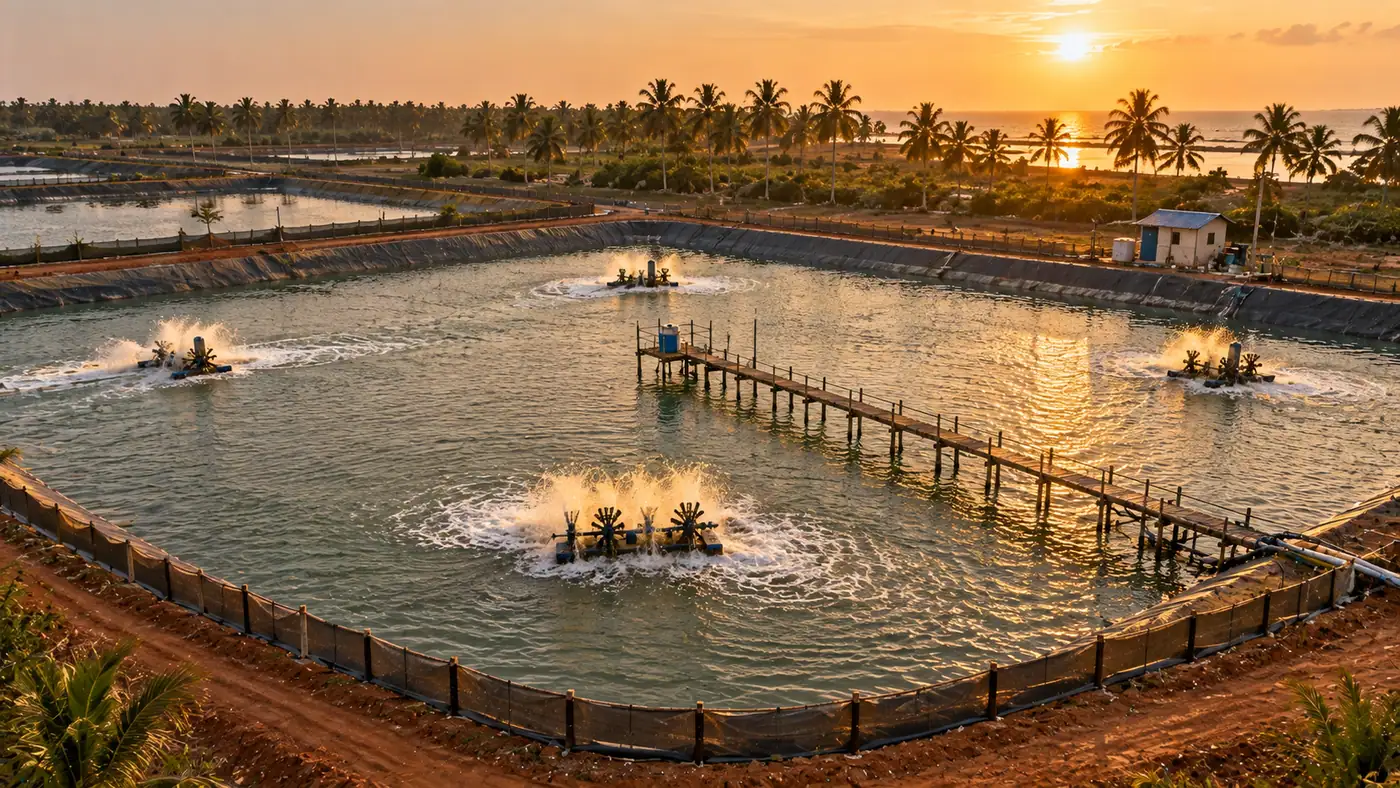
An agriculture landowner in Kota mandal, SPSR Nellore district, converted a 1.2-acre uncultivated saline plot into a model commercial Litopenaeus vannamei shrimp farm. Guided by AquaSangham capital engineering protocols, the enterprise executed a disciplined build: (1) Excavated a 0.85-acre water-spread grow-out pond (1.3m water depth) alongside a 0.25-acre dedicated water treatment reservoir; (2) Installed a dedicated 15 HP three-phase agricultural transformer, 4 high-efficiency 2HP 8-impeller paddlewheel aerators (8 HP total), and a 12.5 kVA standby diesel generator; (3) Enclosed the perimeter with a 75cm continuous HDPE crab fence and overhead nylon bird scare lines; (4) Stocked 1,20,000 certified Specific Pathogen Free (SPF) post-larvae (30 PL/m²) purchased strictly with cash to avoid dealer debt; and (5) Managed feeding using 4 quadrant checktrays with high-grade 35% protein extruded feed. In Crop 1, the pond harvested 3,240 kg of 30-count shrimp at 1.24 FCR, selling at ₹395/kg to an export plant in Gudur for a gross revenue of ₹12.80 Lakhs against OPEX of ₹4.92 Lakhs (₹3.48 Lakhs net profit). In Crop 2, the farm harvested 3,310 kg of 28-count shrimp, netting ₹3.24 Lakhs despite seasonal power tariff adjustments. Across its first 12 months, the 1-acre venture netted ₹6.72 Lakhs, recovering 80% of its initial capital expenditure within two crops.
1. The 1-Acre Farm Architecture: Layout & Real 2026 Economics
One of the most persistent misconceptions among new agricultural investors entering aquaculture is that '1 acre of shrimp farming' means excavating a single 43,560 sq ft pond and filling it to the brim with post-larvae. In modern, bio-secure aquaculture, a 1-acre property must be engineered as an integrated biological production ecosystem.
Under Coastal Aquaculture Authority (CAA) standards and ICAR-CIBA protocols, a viable 1-acre unit requires: (1) A primary culture grow-out pond of 0.75 to 0.85 acres (approximately 3,200 to 3,600 m² of water-spread area); (2) A dedicated water settling and chlorination reservoir occupying 0.15 to 0.20 acres (700 to 900 m²); (3) Compacted earthen perimeter dykes with a minimum top width of 2.0 to 2.5 meters to allow small vehicle and feed trolley access; and (4) An electrical pump shed, diesel generator room, and feed storage godown.
Attempting to utilize 100% of the land area as a single culture pond without a dedicated reservoir is the fastest route to bankruptcy. Without a reservoir, the farmer is forced to pump raw, unfiltered estuarine or borewell water directly into the shrimp pond during emergency water top-ups, introducing wild viral vectors (WSSV, EHP), heavy silt loads, and pathogenic bacterial blooms that wipe out crops.
Total Capital Requirement: The Two-Pocket Principle
To successfully launch a 1-acre shrimp enterprise, the investor must fund 'two distinct pockets': Pocket 1 is Turnkey CAPEX (₹7.5 to ₹8.8 Lakhs for land preparation, electrical transformers, aerators, and fencing). Pocket 2 is Liquid Working Capital Escrow (₹5.5 to ₹6.0 Lakhs held in liquid cash to fund seed, feed, electricity, and labor for the first 100-day cycle).
Starting with only enough cash to dig the pond and buy seed—hoping to fund feed from weekly credit or early crop advances—is a catastrophic mistake. In aquaculture, 70% of total feed expenditure occurs in the final 35 days of the crop. Running out of money at DOC 65 forces distress harvesting of tiny, low-value 70-count shrimp at severe financial loss.
Earthen Pond vs. HDPE-Lined Pond for 1 Acre
Unless the local soil consists of porous coarse sand or gravel with excessive percolation (> 10 cm water loss per day), first-time growers on coastal alluvial or clay soils should strictly construct earthen ponds. Excavating a well-compacted earthen pond costs ₹1.2 to ₹1.6 Lakhs per acre.
Lining a 1-acre pond with 500-micron or 750-micron virgin HDPE geomembrane adds an extra ₹4.5 to ₹6.5 Lakhs in upfront capital, plus the recurring cost of central sludge siphons and specialized bio-film management. On coastal clay soils, earthen ponds provide natural mineral buffering (calcium, magnesium) and biological stabilization that simplify water management for new entrants.
Ensure your pond design includes a central drain depression ('shrimp toilet') sloped at 1:100 toward the center. Positioning paddlewheel aerators to create a circular vortex concentrates feces, uneaten pellets, and molts into this central pit, keeping 80% of the pond benthic grazing area clean and oxygenated.
2. Turnkey Capital Expenditure (CAPEX) Bill of Materials
To establish an accurate financial baseline, every piece of equipment and civil engineering component must be budgeted based on prevailing 2026 Indian market prices. Cutting corners on essential infrastructure—such as purchasing unbranded paddlewheel aerators with low-grade motors or skipping standby power generation—inevitably leads to multi-lakh crop losses during the culture cycle.
The comprehensive Bill of Materials (BOM) below outlines the verified turnkey capital outlay required to transform a raw 1-acre agricultural plot into an operational coastal shrimp farming facility in coastal Andhra Pradesh, Tamil Nadu, or Odisha.
Infrastructure Scaling Economics (1 Acre vs. 5 Acres)
Per-acre capital costs decrease significantly as farm acreage expands. On a 1-acre standalone farm, items like the 15 HP electrical transformer (₹1.85 Lakhs), standby diesel generator (₹1.65 Lakhs), and godown shed (₹85,000) represent 46% of total CAPEX.
If an investor scales to a 4-acre or 5-acre cluster, the same electrical transformer, generator, godown, and water testing equipment service the entire property, dropping the effective CAPEX from ₹9.35 Lakhs per acre to approximately ₹6.20 Lakhs per acre.
| Component / Material | Technical Specifications | Qty / Capacity | 2026 Turnkey Cost (₹) | Lifespan & Replacement |
|---|---|---|---|---|
| Land Clearing & Earthworks | JCB/Poclain excavation, bund shaping, slope 1:1.5, dyke compaction | 1 Acre (Grow-out + Reservoir) | ₹ 1,45,000 | Permanent asset (bund touch-up ₹15k/yr) |
| Inlet & Drainage Sluice Structures | RCC hume pipes (450mm dia), sluice gates, masonry monk with flashboards | 2 Complete units | ₹ 55,000 | 15+ Years |
| Electrical Transformer & Power Line | Dedicated 15 HP agricultural connection, poles, cabling, distribution board | 1 Connection | ₹ 1,85,000 | Permanent grid asset |
| Starter Panel & Automation | DOL starters with digital voltmeter, ammeter, single-phase preventer, MCBs | 1 Integrated unit | ₹ 28,000 | 5 – 7 Years |
| Paddlewheel Aerators (Primary) | 2 HP 4-impeller high-efficiency units (brass worm gear, virgin nylon floats) | 4 Units (8 HP total) | ₹ 1,48,000 | 4 – 5 Years (bush replacement ₹2k/yr) |
| Standby Diesel Generator (DG Set) | 10 kVA silent/canopy diesel generator (tested for 100% aerator load) | 1 Unit | ₹ 1,65,000 | 8 – 10 Years (salvage value 30%) |
| Water Intake Pump | 5 HP slow-speed high-discharge axial flow pump with 4-inch delivery line | 1 Set | ₹ 42,000 | 6 – 8 Years |
| Biosecurity Crab Fencing | 75cm height 500-micron virgin HDPE sheet, embedded 15cm into dyke earth | 300 Running meters | ₹ 32,000 | 3 – 4 Years |
| Bird Scare Netting & Lines | UV-stabilized nylon monofilament cross-grid lines with holographic ribbons | 1 Acre coverage | ₹ 12,000 | 2 Years |
| Farm Godown & Lab Cabin | Pre-engineered PUF panel / brick shed (12ft x 10ft) for feed storage and staff | 1 Unit | ₹ 85,000 | 15+ Years |
| Water Testing & Monitoring Gear | Optical Dissolved Oxygen meter, salinity refractometer, digital pH/ammonia kit | 1 Complete lab kit | ₹ 38,000 | 3 – 5 Years (probe calibration ₹3k/yr) |
| Total Turnkey CAPEX (1 Acre) | Complete ready-to-stock commercial shrimp production unit | 1 Full Facility | ₹ 9,35,000 | Annualized Depreciation: ₹ 88,000/yr |
3. 100-Day Operating Expenditure (OPEX) Ledger (30 PL/m² Model)
Operating costs dictate whether a farm makes money or burns cash. For a first-time farm operator, AquaSangham mandates stocking Litopenaeus vannamei at a conservative, resilient density of 30 post-larvae per square meter (30 PL/m²).
In a 0.85-acre water-spread pond (3,440 m²), a stocking density of 30 PL/m² requires exactly 1,03,200 post-larvae (budgeted at 1,10,000 PL to account for packing buffer). At an anticipated 85% survival rate, the pond will carry approximately 88,000 shrimp at harvest. Targeting a 30-gram individual average body weight (33-count shrimp) yields approximately 2,900 to 3,100 kg of harvested biomass in 100 to 105 days.
The detailed ledger below outlines every operational cost line item incurred from pond preparation to harvest.
The Dominance of Feed: The 64% Rule
As demonstrated in the ledger, feed is the single largest operational expense, accounting for ₹3.30 Lakhs (64.1%) of total OPEX. Every 0.1 point reduction in Feed Conversion Ratio (FCR) saves 300 kg of feed—putting ₹26,400 directly into the farmer's pocket.
Conversely, uncalibrated feeding that pushes FCR from 1.25 to 1.55 wastes 900 kg of feed, burning an extra ₹79,200 in cash while degrading bottom soil quality and driving up probiotic expenses.
| Operational Line Item | Quantity & Basis of Calculation | Unit Rate (₹) | Total Cost per Crop (₹) | Cost Percentage |
|---|---|---|---|---|
| Certified SPF Seed (PL10–12) | 1,10,000 post-larvae from CAA-licensed hatchery | ₹ 0.45 / seed | ₹ 49,500 | 9.6% |
| Pre-Stocking Soil & Water Prep | Bleaching powder (150 kg), Quicklime (200 kg), Dolomite (150 kg) | Bulk agri rates | ₹ 18,500 | 3.6% |
| Commercial Aquafeed (35% Protein) | 3,750 kg extruded pellets (FCR 1.25 across Starter, Grower, Finisher) | ₹ 88.00 / kg average | ₹ 3,30,000 | 64.1% |
| Electrical Power Consumption | 8 HP aerators running 16 hrs/day average (subsidized agri slab) | ₹ 3.50 / kWh equivalent | ₹ 38,000 | 7.4% |
| Diesel Fuel for Standby DG Set | 180 liters diesel for power outage contingency & pump transfers | ₹ 92.00 / liter | ₹ 16,560 | 3.2% |
| Water Quality Minerals & Salts | Potassium chloride (KCl), Magnesium chloride (MgCl2), Sodium bicarbonate | Dosage based on DOC | ₹ 24,000 | 4.7% |
| Probiotics (Water & Gut) | Bacillus consortia for water conditioning + lactobacillus gut binders | Monthly application | ₹ 18,000 | 3.5% |
| Resident Farm Labor Technician | 1 full-time resident technician @ ₹12,000/month (3.5 months) | ₹ 12,000 / month | ₹ 42,000 | 8.2% |
| Harvest & Netting Charges | Netting team wages, ice, crate handling, weighing labor | ₹ 2.50 / kg harvested | ₹ 7,500 | 1.5% |
| Sundry Maintenance & Consumables | Rope, checktray mesh, grease, testing reagents, tea & supplies | Lump sum buffer | ₹ 8,000 | 1.6% |
| Total Operating Expenses (OPEX) | Full 100-day grow-out cycle to 30-gram harvest | — | ₹ 5,14,560 | 100.0% |
4. Harvest Economics, Count-Wise Pricing & Net Profit Realization
Gross revenue in shrimp farming is governed by three variables: total harvested biomass, shrimp count (number of shrimp per kilogram), and prevailing farmgate spot pricing set by seafood processing exporters in Visakhapatnam, Bhimavaram, Chennai, and Kochi.
Larger shrimp command premium pricing. At 30-count (33.3 grams per animal), farmgate pricing typically hovers between ₹380 and ₹420 per kilogram. If harvested prematurely at 50-count (20 grams per animal), pricing drops sharply to ₹270 to ₹295 per kilogram, eliminating over 40% of gross margin.
The table below details financial outcomes across three realistic scenarios for a 1-acre crop: Conservative (sub-optimal growth, 35-count), Base Case (target benchmark, 30-count), and Optimized (superior FCR and growth, 28-count).
Understanding the Payback Horizon
In the Base Case scenario, a single 1-acre pond generates ₹6.70 Lakhs in net operating profit per 102-day crop. Even after accounting for annual capital equipment depreciation (₹88,000) and routine maintenance, two successful crops in Year 1 generate over ₹12.5 Lakhs in net cash flow.
This audited field performance proves that a properly capitalized 1-acre shrimp farm can fully recover its entire initial setup CAPEX (₹9.35 Lakhs) within its first 10 to 14 months of operation.
| Production & Financial Metric | Conservative Scenario (35-Count) | Base Case Scenario (30-Count) | Optimized Scenario (28-Count) |
|---|---|---|---|
| Culture Duration (Days) | 90 Days | 102 Days | 108 Days |
| Survival Rate (%) | 75% Survival | 85% Survival | 90% Survival |
| Shrimp Count (Pieces / kg) | 35 Count (28.5g / piece) | 30 Count (33.3g / piece) | 28 Count (35.7g / piece) |
| Total Harvested Biomass (kg) | 2,420 kg | 3,000 kg | 3,420 kg |
| Feed Conversion Ratio (FCR) | 1.38 FCR (3,340 kg feed) | 1.25 FCR (3,750 kg feed) | 1.18 FCR (4,035 kg feed) |
| Total Crop OPEX (₹) | ₹ 4,72,000 | ₹ 5,14,560 | ₹ 5,48,000 |
| Farmgate Selling Price (₹ / kg) | ₹ 345 / kg | ₹ 395 / kg | ₹ 425 / kg |
| Gross Revenue Realization (₹) | ₹ 8,34,900 | ₹ 11,85,000 | ₹ 14,53,500 |
| Net Profit per Crop (₹) | ₹ 3,62,900 | ₹ 6,70,440 | ₹ 9,05,500 |
| Net Margin on Gross Sales (%) | 43.5% Net Margin | 56.6% Net Margin | 62.3% Net Margin |
| Annual Net Profit (2 Crops / Yr) | ₹ 7,25,800 / Year | ₹ 13,40,880 / Year | ₹ 18,11,000 / Year |
5. Cost-Optimization: Where to Save and Where Never to Cut
In the pursuit of maximizing return on investment, novice operators frequently make disastrous cost cuts that save thousands of rupees in the short term while risking lakhs in crop mortality. Disciplined farm management requires distinguishing between non-negotiable safety standards and legitimate efficiency optimizations.
The 4 Areas Where Cutting Corners Is Suicidal
1. Seed Quality & PCR Testing: Sourcing uncertified, non-SPF seed from unauthorized local hatcheries to save 10 paise per seed (saving ₹11,000) risks introducing White Spot Syndrome Virus or EHP microsporidia that destroys 100% of the crop.
2. Standby Power Generation: Skipping a dedicated diesel generator to save ₹1.65 Lakhs leaves the pond completely vulnerable. A single two-hour nocturnal power blackout at DOC 75 will kill the entire biomass from dissolved oxygen suffocation.
3. Digital DO Testing Gear: Relying on cheap chemical titration test kits rather than an optical DO meter causes delayed detection of nighttime hypoxic drops below 3.5 ppm.
4. Reservoir Water Aging: Eliminating the reservoir to maximize culture area bypasses chlorine disinfection and natural aging, directly transmitting wild pathogen vectors into the shrimp population.
Legitimate Cost-Optimization Strategies (Saving 15% to 20%)
1. Cash-in-Advance Feed Discounts: Purchasing commercial aquafeed strictly in cash or direct bank transfer unlocks direct distributor discounts of 6% to 8%, saving ₹20,000 to ₹26,000 per crop.
2. Fermented Rice Bran (FRB) Carbon Dosing: Brewing an on-farm anaerobic fermented rice bran slurry with active yeast and molasses provides rich natural prebiotic carbon. Applying FRB @ 10 kg/acre weekly stabilizes heterotrophic bacterial bio-floc, cutting expensive commercial probiotic purchases by 40% while lowering commercial feed requirements by 10%.
3. Direct Farmgate Multi-Buyer Auctions: At harvest, invite three competing export processing plants to inspect checktrays and submit sealed bids. Competitive bidding routinely secures ₹15 to ₹25 more per kilogram compared to selling through a single local broker, adding ₹45,000 to ₹75,000 in net harvest revenue.
6. PMMSY Subsidies, Bank Loans & DPR Preparation
To reduce out-of-pocket equity and enhance return on capital, entrepreneurs can leverage central and state aquaculture development schemes under the flagship Pradhan Mantri Matsya Sampada Yojana (PMMSY). Administered through the Department of Fisheries (Ministry of Fisheries, Animal Husbandry and Dairying), PMMSY provides substantial capital subsidies for new pond construction and input support.
Under the PMMSY scheme, the recognized governmental unit cost for establishing 1 hectare (2.47 acres) of brackishwater aquaculture pond infrastructure is approximately ₹7.00 Lakhs, with an additional input support unit cost of ₹4.50 Lakhs. The government provides: (1) 40% capital subsidy for General category beneficiaries (up to ₹2.80 Lakhs per hectare); and (2) 60% capital subsidy for Women, Scheduled Castes (SC), Scheduled Tribes (ST), and Fisheries Cooperative Societies (up to ₹4.20 Lakhs per hectare).
Preparing a Bankable Detailed Project Report (DPR)
To qualify for institutional bank financing through commercial banks (SBI, Canara Bank, Union Bank) or NABARD-refinanced rural cooperative banks, the investor must submit a comprehensive Detailed Project Report (DPR). The DPR must include: land ownership records (Pattadar Passbook or registered 5-year lease deed), Coastal Aquaculture Authority (CAA) registration certificate or proof of application, water source clearance, electrical load sanction letter, line-by-line CAPEX/OPEX budgets, and projected 5-year cash-flow statements.
Commercial banks typically sanction term loans covering 65% to 75% of total project CAPEX, requiring an entrepreneur equity contribution of 25% to 35%. Additionally, farmers can obtain working capital support through the Kisan Credit Card (KCC) scheme for fisheries, securing crop loans up to ₹2.00 Lakhs at a highly subsidized interest rate of 4% per annum (with prompt repayment incentive).
Mandatory CAA Registration Steps
Operating a coastal brackishwater shrimp farm in India without Coastal Aquaculture Authority (CAA) registration is illegal under the Coastal Aquaculture Authority Act, 2005. Farms operating without CAA approval risk disconnection of agricultural power subsidies and demolition by coastal zone management authorities.
Applications are submitted online through the CAA portal (caa.gov.in) to the District Level Committee (DLC) headed by the District Collector. The committee verifies land classification (ensuring the site is outside mangrove buffer zones, agricultural farmland, and 100-meter CRZ boundaries) before issuing a 5-year renewable commercial farming license.
Summary Operational Action Checklist
Frequently Asked Questions
Q: Can a farmer make a viable full-time living from just a 1-acre shrimp farm?
Yes. As detailed in the audited financial models, a well-managed 1-acre pond producing two 100-day crops annually yields approximately ₹6.7 Lakhs to ₹13.4 Lakhs in net operational profit (after all feed, seed, electricity, and labor expenses). This net return significantly surpasses conventional field crops such as paddy, cotton, or sugarcane grown on the same acreage, providing a robust full-time agricultural livelihood.
Q: Is it better to lease land or purchase land when starting a 1-acre shrimp farm?
Leasing is far more capital-efficient for new entrants. Purchasing coastal agricultural or saline land requires ₹15 to ₹35 Lakhs per acre, locking up scarce capital in real estate. Leasing existing or shovel-ready aquaculture land (typically ₹35,000 to ₹65,000 per acre per year on a 3 to 5-year lease) preserves liquid funds for modern aerators, automatic generators, premium feed, and working capital reserves.
Q: How much can solar-powered aeration reduce electricity and diesel bills on a 1-acre farm?
A grid-tied or hybrid solar aeration system (typically 3 kW to 5 kW solar PV array with specialized DC brushless paddlewheel controllers) can offset 60% to 75% of daytime aeration electricity costs. On a 1-acre farm, this saves between ₹18,000 and ₹26,000 per crop in power tariffs while providing an automatic daytime buffer against rural grid outages. Turnkey solar aeration setups cost approximately ₹2.2 to ₹3.0 Lakhs and deliver a payback period of 2.5 to 3 years.
Q: How many crops can realistically be harvested from a 1-acre pond in a single calendar year?
In coastal India (Andhra Pradesh, Tamil Nadu, Gujarat), farmers realistically cultivate two 100-day to 110-day crops per year: Summer Crop (stocked in February/March, harvested in May/June) and Monsoon/Winter Crop (stocked in August/September, harvested in November/December). The intervening 45 to 60 days between crops are crucial for mandatory pond drying, deep ploughing, benthic sludge removal, and lime conditioning to eliminate accumulated pathogens and gas pockets.
AquaSangham Farm Advisory Desk
Capital Budgeting & Farm Infrastructure Division
Contributing Senior Technical Writer & Aqua Consultant at AquaSangham.
Recommended Farming Guides
The 3 AM Oxygen Trap: Why Fish and Shrimp Die at Dawn (And The 4.0 ppm Rule That Saves Them)
Read Article →Water QualityWhy Sudden Monsoon Rain Wipes Out Shrimp Overnight (And The 30-Minute Emergency Lime Protocol That Saves Your Pond)
Read Article →Market AnalysisEU & US Seafood Traceability Audits: Keeping Digital Farm Logs to Secure ₹15-₹20/kg Premium from Exporters
Read Article →Get Live Farm Advice on AquaSangham Mobile App
Download India's #1 Aquaculture Super App for real-time market prices, precision tools, and community advice.
Download Free Android App