Executive Summary & Key Takeaways
- Over 70% of ultimate crop failures and elevated FCRs trace back directly to errors committed during the first 48 hours of post-larval seed release, leading to 'Invisible Seed Mortality Syndrome'.
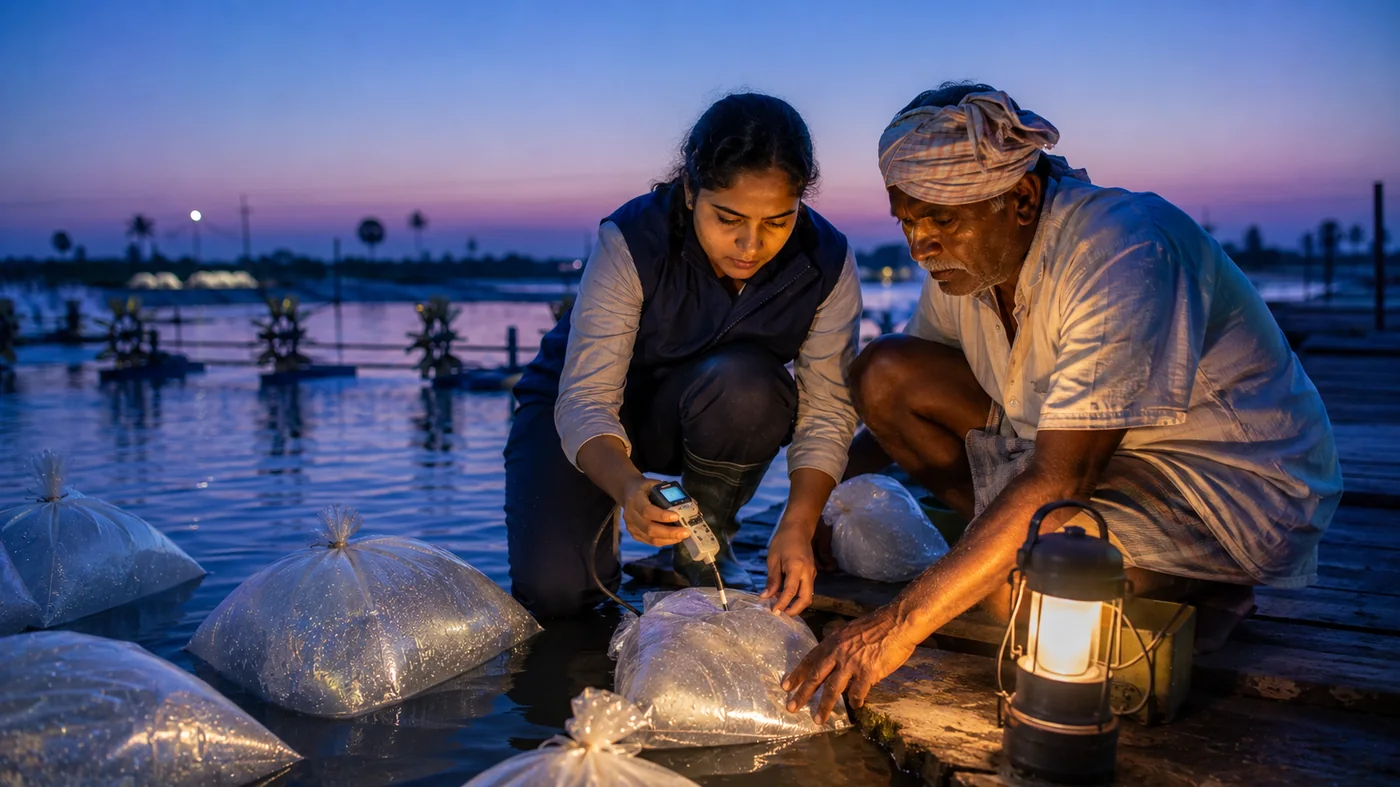
- The temperature differential between transport bags and receiving pond water must be strictly less than 1.0°C; float sealed bags for 45 to 60 minutes to prevent acute thermal shock and cardiac paralysis.
- In alkaline pond water (pH >8.2), opening transport bags and immediately dumping seed causes 'Ammonia-pH Toxic Shock' as non-toxic ammonium in the bag instantly converts to lethal un-ionized ammonia gas (NH3).
- Total residual chlorine must test at absolute 0.00 ppm using a digital DPD colorimeter; even 0.02 ppm of free available chlorine chemically scorches post-larval gills within 15 minutes of release.
- Plating pond water on TCBS agar must confirm a total Vibrio count <1,000 CFU/mL with an absolute threshold of ZERO green colonies (virulent Vibrio parahaemolyticus and V. harveyi).
- Always deploy two fine-mesh (100-mesh) floating survival hapas stocked with exactly 100 PL to verify 48-hour baseline survival (>90%) before committing to full 30-day blind feeding quantity curves.
Field Case Study: 12-Pond Pre-Stocking Audit & Survival Uplift
A 12-pond commercial enterprise in Prakasam District historically experienced unexplained 30% to 50% early mortality during maiden crop stockings. Prior to stocking 3.6 million PL11, the estate implemented the AquaSangham 20-Parameter Day-of-Stocking Audit. The pre-stocking test revealed two critical hidden hazards: Ponds 4 and 7 contained 0.08 ppm residual chlorine from delayed reservoir neutralization, while Pond 11 exhibited an afternoon pH of 8.9 and 0.04 ppm un-ionized ammonia. Stocking in Ponds 4, 7, and 11 was immediately placed on hold: Ponds 4 and 7 were dosed with Sodium Thiosulfate (0.1 kg/ha) to clear residual chlorine to 0.00 ppm, and Pond 11 was conditioned with fermented molasses to lower pH to 8.1. When seed bags arrived at 05:00 AM under stable weather, temperature and salinity acclimation was executed over 90 minutes. A 48-hour survival hapa test recorded 94.6% survival across all 12 ponds (compared to the farm's historical 68%), saving an estimated ₹8.4 Lakhs in seed replacement costs and setting the foundation for an 84-ton total farm harvest.
1. The First 48 Hours: The Anatomy of Invisible Seed Mortality
In commercial Penaeus vannamei and Penaeus monodon aquaculture, the day of stocking is the single most critical inflection point of the entire 120-day production cycle. Over decades of industrial farming across the coastal mariculture belts of Andhra Pradesh, Gujarat, Tamil Nadu, Odisha, and West Bengal, veterinary epidemiologists and farm managers have observed a sobering truth: more than 70% of ultimate crop failures, stunted harvest sizes, and elevated Feed Conversion Ratios (FCR) are directly traceable to errors committed during the first 48 hours of post-larval seed release.
When millions of fragile, hatchery-reared post-larvae (PL10 to PL12, measuring merely 8 to 11 mm in length and weighing less than 0.008 grams) arrive at the farm gate, their physiological defenses are stretched to the brink. They have endured 12 to 24 hours of packing stress, chilled transportation temperatures (18°C–22°C), ammonia accumulation inside plastic transport bags, and fluctuating oxygen pressures. When these stressed post-larvae are released into a pond whose limnology, water chemistry, or microbial ecology has not been meticulously calibrated, the result is catastrophic: Invisible Seed Mortality Syndrome.
Unlike juvenile or adult shrimp that float to the surface or congregate along dykes when distressed, dying post-larvae simply sink into the benthic sediment or are rapidly consumed by benthic bacteria and inter-cohort cannibalism. The farmer, completely unaware that 40% to 60% of his stocked seed died within 48 hours of release, continues to calculate daily feed rations based on 100% estimated survival. Over the subsequent 30 days, massive mounds of unconsumed feed decompose on the pond floor, generating lethal plumes of un-ionized ammonia and hydrogen sulfide that poison the remaining survivors.
The physiology of post-larval Penaeus vannamei during transit and arrival is exceptionally delicate. During transport, seed is packed in sealed oxygenated polythene bags at densities ranging from 2,500 to 4,000 PL per liter of chilled seawater (18°C–22°C). Although ice slows metabolic respiration, the confined environment rapidly accumulates toxic metabolic waste products: excretion of total ammonia nitrogen drives bag ammonia up to 3.0–5.0 ppm, while respiration generates dissolved carbon dioxide that lowers bag water pH down to 6.8–7.1. In this acidic transport water, the vast majority of ammonia exists in the non-toxic ionized form (NH4+). However, if an inexperienced technician opens the bags and immediately pours unacclimated seed into alkaline pond water (pH 8.2–8.5), the sudden rise in pH instantly shifts the non-toxic ammonium into lethal un-ionized ammonia (NH3), chemically scorching the delicate gill filaments of the post-larvae within seconds. This lethal phenomenon—known in clinical pathology as 'Post-Transport Ammonia-pH Toxic Shock'—is responsible for massive invisible mortalities that occur before the post-larvae even swim to the pond bed.
To eliminate seed mortality and guarantee a minimum 85% to 92% survival rate, farm managers must treat the day of stocking with the rigorous discipline of an aerospace flight launch. Stocking must never be treated as a casual chore. Every pond must pass an exhaustive 20-Parameter Pre-Flight Audit. If even a single parameter fails the Go/No-Go tolerance threshold, seed release must be immediately aborted or postponed until chemical and biological correction is verified.
The Three Critical Failure Modes on Stocking Day
1. Thermal-Osmotic Shock: Releasing chilled post-larvae (20°C) into warm pond water (30°C) across a temperature differential > 2.0°C triggers cardiac arrest and muscular paralysis.
2. Ammonia-pH Shock: High pond pH (>8.4) instantly transforms non-toxic bag ammonium into lethal un-ionized ammonia gas (NH3), burning fragile gill lamellae.
3. Pathogen Ambush: Releasing seed into water populated by virulent green Vibrio colonies or blue-green algae leads to acute hepatopancreatic destruction within 24 hours.
Never purchase seed without demanding a certified PCR diagnostic certificate confirming SPF (Specific Pathogen Free) status for WSSV, EHP, IHHNV, IMNV, and AHPND/EMS. Test a random sample of 100 PL on-site with a 30-minute stress test (100 ppm formalin or 50% freshwater drop) prior to bag acclimation.
2. Physical & Optical Parameters: Temperature, Depth & Secchi Disk
Physical and optical conditions dictate the thermal stability and photosynthetic health of the culture ecosystem:
- Parameter 1: Water Depth: Minimum 1.2 meters, with an optimal depth of 1.4 to 1.6 meters. Shallow water (<1.0 m) heats up rapidly during daytime hours, causing thermal spikes that shock post-larvae, while deep water provides thermal and light insulation.
- Parameter 2: Temperature Differential (Delta T): The temperature difference between the water inside the seed transport bags and the receiving pond water must be strictly less than 1.0°C (Delta T < 1.0°C). Releasing PL across a temperature delta > 2.0°C causes acute thermal shock, inducing rigid muscle paralysis and heart failure.
- Parameter 3: Secchi Disk Visibility (Turbidity): Must measure strictly between 30 and 40 centimeters. A Secchi reading < 25 cm indicates an excessively dense, unstable algal bloom prone to nocturnal oxygen collapse; a reading > 45 cm indicates clear, sterile water lacking the natural live feed and shading required by juvenile shrimp.
- Parameter 4: Water Color and Bloom Character: Water must display a rich golden-brown, light yellowish-brown, or tea-green hue, indicating a healthy, stable diatom bloom dominated by Bacillariophyceae. Ponds showing bright fluorescent grass-green (blue-green algae), dark reddish-brown (toxic dinoflagellates), or milky-white turbidity must be rejected.
- Parameter 5: Surface Scum and Organic Foam: The surface of the pond, particularly downwind dyke corners, must be 100% free of greasy algal scum, dead planktonic foam, and oily surfactant slicks.
| Category | Parameter & Metric | Testing Method | Safe Tolerance Threshold | Lethal Limit / Abort | Field Remediation Action |
|---|---|---|---|---|---|
| Physical | 1. Water Depth | Staff gauge / Measuring rod | 1.3 – 1.6 Meters | < 1.1 Meters | Top up from biosecure reservoir |
| Physical | 2. Temp Delta (ΔT) | Dual digital probe | < 1.0°C Difference | > 2.0°C Difference | Float bags 45–60 mins to equalize |
| Physical | 3. Secchi Transparency | Standard 20cm Secchi disc | 30 – 40 cm Visibility | < 20 cm or > 50 cm | Inoculate diatoms or flush with reservoir |
| Physical | 4. Water Color / Bloom | Visual jar observation | Golden-brown / Tea-green | Dark green / Red-brown | Apply probiotics + carbon; delay release |
| Chemical | 5. Dissolved Oxygen (DO) | Optical DO sensor | 6.0 – 8.0 mg/L | < 5.0 mg/L | Run all paddlewheels 4 hrs prior |
| Chemical | 6. Predawn pH (06:00 AM) | Calibrated glass pH probe | 7.8 – 8.1 | < 7.5 or > 8.4 | Buffer with Sodium Bicarbonate (25 kg/ha) |
| Chemical | 7. Diurnal pH Swing (ΔpH) | Dawn vs 15:30 check | < 0.5 pH Units | > 0.7 pH Units | Dose Dolomite (100 kg/ha) to stabilize buffer |
| Chemical | 8. Total Alkalinity | Titration test kit | 120 – 150 ppm CaCO3 | < 100 ppm CaCO3 | Broadcast NaHCO3 @ 30–50 kg/ha |
| Chemical | 9. Un-Ionized NH3 | Photometer + pH conversion | < 0.01 mg/L | > 0.03 mg/L | Dose Yucca extract + molasses + probiotics |
| Chemical | 10. Nitrite (NO2-) | Naphthylamine photometer | < 0.05 mg/L | > 0.15 mg/L | Exchange water or apply biofilter seed |
| Chemical | 11. Hydrogen Sulfide (H2S) | Methylene blue test kit | 0.00 mg/L (Zero) | > 0.005 mg/L | Aerate intensely; abort stocking |
| Chemical | 12. Residual Chlorine | DPD digital colorimeter | 0.00 ppm (Zero) | > 0.01 ppm | Neutralize with Sodium Thiosulfate @ 1 kg/ha |
| Ionic | 13. Salinity Delta (ΔS) | Optical refractometer | ± 1.5 ppt of bag water | > 3.0 ppt Difference | Execute step-down drip acclimation |
| Ionic | 14. Potassium (K+) | Photometer / Titration | > 100 ppm (>30 ppm/ppt) | < 60 ppm | Dose Potassium Chloride (KCl @ 80 kg/ha) |
| Ionic | 15. Magnesium (Mg2+) | EDTA Titration / ICP | > 300 ppm (Mg:Ca > 3:1) | < 180 ppm (Mg:Ca < 2:1) | Dose Magnesium Chloride (MgCl2 @ 150 kg/ha) |
| Biological | 16. Diatom Dominance % | Microscope wet mount (40x) | > 70% Chaetoceros/Navicula | < 40% (Cyanobacteria) | Broadcast silicate fertilizer + diatom seed |
| Biological | 17. Total Vibrio Count | TCBS agar plate culture | < 1,000 CFU / mL | > 3,000 CFU / mL | Apply multi-strain Bacillus @ 2 kg/ha |
| Biological | 18. Green Vibrio Colonies | TCBS sucrose-negative | 0 CFU / mL (Zero) | > 50 CFU / mL | ABORT STOCKING; disinfect or bio-prime |
| Meteorology | 19. Rain & Squall Forecast | Barometer / Satellite radar | Clear sky for 36 hours | Monsoon rain expected | Postpone seed delivery by 24–48 hours |
| Verification | 20. 48-Hour Hapa Survival | 100-mesh floating hapa cages | > 90% Survival at 48h | < 75% Survival at 48h | Conduct toxicology; adjust feed curves |
Always measure Secchi disc depth at 10:00 AM with your back to the sun to eliminate water surface glare. If Secchi depth is >45 cm on stocking eve, do not stock. Transparent water exposes post-larvae to bird predation and promotes toxic benthic filamentous algae blooms.
3. Chemical Water Quality Thresholds: Ammonia, Nitrite, pH & Chlorine
Chemical parameters represent the direct physiological environment of the post-larvae. Because PL gills are thin and non-calcified, dissolved toxins penetrate directly into their bloodstream:
- Parameter 6: Dissolved Oxygen (DO): Minimum 6.0 mg/L at the time of stocking, maintaining > 5.5 mg/L at the pond bottom. Run aerators for at least 6 hours prior to stocking to ensure complete water saturation.
- Parameter 7: Water pH (Predawn and Midday): Predawn pH (06:00 AM) must be between 7.8 and 8.1; afternoon pH (15:30 hrs) must not exceed 8.3. The diurnal pH fluctuation between dawn and dusk must be strictly less than 0.5 units (e.g., dawn 7.9 to dusk 8.3). A diurnal pH swing > 0.6 indicates poor bicarbonate buffering and violent carbonate equilibrium shifts.
- Parameter 8: Total Alkalinity: Strictly between 120 and 150 mg/L as CaCO3 (minimum floor: 110 ppm). High alkalinity provides the necessary bicarbonate osmotic buffer to protect delicate post-larvae against pH shock and fuels stable microalgal photosynthesis.
- Parameter 9: Total Ammonia Nitrogen (TAN) & Un-Ionized Ammonia (NH3): Total Ammonia Nitrogen must be < 0.5 mg/L, and toxic un-ionized ammonia (NH3) must be strictly < 0.01 mg/L (calculated based on water pH, temperature, and salinity). At high pH (>8.4), even trace TAN converts into lethal NH3 that burns delicate post-larval gill filaments.
- Parameter 10: Nitrite (NO2-): Strictly < 0.1 mg/L (optimal: 0.00 mg/L). Nitrite binds with crustacean hemocyanin, destroying its oxygen-carrying capacity and causing brown blood syndrome.
- Parameter 11: Hydrogen Sulfide (H2S): Absolute 0.00 mg/L (zero tolerance). Even 0.01 ppm of dissolved H2S causes immediate 100% mortality in post-larvae.
- Parameter 12: Residual Chlorine (FAC): Absolute 0.00 ppm verified via digital DPD colorimeter. If reservoirs or ponds were bleached during preparation, even 0.02 ppm of residual free available chlorine will chemically oxidize and burn post-larval gills within 15 minutes of release.
Understanding the chemical dynamics of nitrogenous toxins at stocking is vital for survival. Total Ammonia Nitrogen exists in two thermodynamic states in aqueous equilibrium: ionized ammonium (NH4+) and un-ionized ammonia (NH3). The percentage of lethal NH3 is governed strictly by temperature and pH. At 30°C and pH 7.8, only 3.8% of TAN is in the toxic NH3 form. But if pond pH climbs to 8.6, the toxic NH3 fraction leaps to 21.5%—nearly a six-fold increase. For delicate post-larvae whose gill surface area is tiny and uncalcified, ambient un-ionized ammonia concentrations as low as 0.02 mg/L cause cellular hypertrophy of gill lamellae, excessive mucus excretion, and secondary bacterial infections by opportunistic Vibrio. Similarly, dissolved Nitrite (NO2-) enters the shrimp hemolymph via branchial chloride transport mechanisms, competing with oxygen and paralyzing respiratory enzymes. Total Alkalinity represents the life-support buffer of the pond: a minimum alkalinity of 120 ppm as CaCO3 guarantees that diurnal photosynthetic carbon dioxide uptake by microalgae will not cause wild pH fluctuations that stress post-larvae during their vulnerable maiden molts.
Never rely on chlorine test strips or smell checks. Always use a calibrated digital photometer with DPD-1 reagents to verify residual chlorine. If DPD reagents turn even the faintest pink (indicating >0.01 ppm chlorine), dissolve Sodium Thiosulfate @ 1.0 kg/ha per 0.1 ppm residual chlorine and re-test after 2 hours until the reading displays 0.00 ppm.
4. Ionic Balance & Mineral Equilibrium: Salinity, Hardness, K+ & Mg2+
Post-larvae are particularly sensitive to osmotic pressure and mineral cofactors:
- Parameter 13: Salinity Differential (Delta S): The salinity difference between the hatchery transport bag water and the pond water must not exceed ± 2.0 ppt. If the difference is > 3.0 ppt, on-farm step-down acclimation must be extended over several hours.
- Parameter 14: Potassium (K+): Minimum 100 to 120 ppm in brackish water (or 30–35 ppm per ppt salinity in low-salinity systems). Potassium powers the branchial Na+/K+-ATPase pump; deficiency triggers immediate white muscle cramping.
- Parameter 15: Magnesium (Mg2+): Minimum 300 to 350 ppm in brackish water, maintaining a strict Magnesium-to-Calcium (Mg:Ca) ratio of at least 3.0:1.
- Parameter 16: Total Hardness: Minimum 1,000 to 1,200 mg/L as CaCO3 in coastal water, ensuring adequate divalent cations for post-larval exoskeleton synthesis.
Dose Potassium Chloride (KCl @ 25 kg/ha) and Magnesium Chloride (MgCl2 @ 50 kg/ha) into the pond 24 hours prior to stocking. This ensures free dissolved cations are evenly distributed throughout the water column before post-larvae arrive.
5. Biological Ecosystem Health: Plankton Diversity & Vibrio Counts
Before post-larvae are introduced, the pond's microscopic ecosystem must be dominated by beneficial microflora:
- Parameter 17: Phytoplankton Composition: Microscopic wet-mount inspection (40x) must verify that beneficial marine diatoms (Chaetoceros, Thalassiosira, Skeletonema, Navicula) constitute at least 70% of total phytoplankton biomass. Toxic cyanobacteria (Oscillatoria, Microcystis) and dinoflagellates must be completely absent.
- Parameter 18: Total Vibrio Bacterial Count: Tested on Thiosulfate-Citrate-Bile Salts-Sucrose (TCBS) agar plates. Total Vibrio count must be < 1,000 CFU/mL.
- Parameter 19: Green vs. Yellow Vibrio Colony Ratio: Yellow colonies (sucrose-fermenting, predominantly beneficial or benign Vibrio alginolyticus) should represent > 90% of total plate count. Virulent, sucrose-negative Green Vibrio colonies (Vibrio parahaemolyticus and Vibrio harveyi) must be strictly ZERO (0 CFU/mL).
- Parameter 20: Natural Live Feed (Zooplankton): Water must teem with live natural food organisms—rotifers (Brachionus spp.), copepod nauplii, and ciliates. Natural zooplankton provides essential polyunsaturated fatty acids (EPA, DHA) that jump-start post-larval growth during the first 10 days.
The microbiological landscape of the receiving pond must be rigorously audited before seed release. In intensive aquaculture, the microalgae bloom serves as both an optical sunscreen and a living biofilter. Marine diatoms—such as Chaetoceros muelleri, Thalassiosira weissflogii, and Skeletonema costatum—produce golden-brown pigments (fucoxanthin) that filter harsh solar ultraviolet radiation while releasing polyunsaturated fatty acids that nourish grazing post-larvae. If the bloom crashes or is displaced by filamentous blue-green algae (Oscillatoria, Phormidium), post-larvae ingest toxic cyanobacteria, developing fatal acute hepatopancreatic necrosis. Simultaneously, the bacterial flora must be screened on TCBS selective agar. Vibrio alginolyticus (which forms distinct yellow colonies by fermenting sucrose) is a benign or beneficial competitive exclusion organism. However, sucrose-negative green colonies—specifically Vibrio parahaemolyticus and luminescent Vibrio harveyi—possess hemolysins and metalloproteases that destroy the shrimp hepatopancreatic tubules. An absolute threshold of ZERO green Vibrio colonies must be confirmed prior to stocking.
Inoculate your pond with a mature commercial multi-strain Bacillus probiotic (B. subtilis, B. licheniformis, B. megaterium @ 1.5 kg/ha) combined with fermented rice bran and molasses 72 hours before stocking. The dense probiotic population competitively occupies TCBS receptor niches, ensuring green Vibrio colonies cannot establish.
6. Meteorological & Astronomical Go/No-Go Criteria
Environmental and astronomical factors directly impact post-larval behavior:
- Rain and Storm Forecast: Stocking must be cancelled if rain or squalls are forecast within 36 hours. Heavy downpours drop surface salinity and temperature, triggering lethal halocline stratification.
- Stocking Time Window: Release must be executed exclusively during cool, low-light hours: early morning (05:00 to 06:30 AM) or late dusk (18:00 to 20:00 hrs). Never stock between 10:00 AM and 16:00 hrs under direct tropical solar ultraviolet radiation.
- Lunar Phase Timing: Avoid scheduling stocking exactly on the day of the new moon or full moon. Coastal tidal swings trigger natural molt cycles; stocking newly arrived, stressed post-larvae during a synchronized molt peak increases mortality.
Schedule seed delivery so that bags arrive at the farm dyke at 05:00 AM. Acclimation can proceed under the cool, tranquil predawn blue hour, allowing post-larvae to swim downward and settle onto the pond bed just as the first gentle dawn light appears.
7. The 48-Hour Survival Hapa Protocol & Seed Verification SOP
Never release millions of post-larvae across an open pond without a certified survival baseline.
1. Deploy two fine-mesh (100-mesh / 150 µm) floating survival hapa cages (1.0m × 1.0m × 1.2m depth) in opposite quadrants of the pond, positioned near aerators.
2. Transfer exactly 100 fully acclimated post-larvae into each hapa cage from the transport bags.
3. Provide micro-starter feed (50–100 microns) inside the hapas twice daily.
4. Count surviving post-larvae after 24 hours and 48 hours.
- Interpretation: If 48-hour survival in the hapas exceeds 90%, the stocking is certified successful and baseline pond survival is confirmed. If survival is < 75%, immediate environmental triage is required before blind feeding calculations are locked in.
If 48-hour survival in your test hapas is below 80% while water parameters appear normal, suspect sub-lethal transport stress or latent pathogen infection. Collect a sample of 50 PL from the hapas, preserve in 95% ethanol, and dispatch to a PCR lab for pathogen screening before ordering nursery feed.
Summary Operational Action Checklist
Frequently Asked Questions
Q: What is 'Invisible Seed Mortality Syndrome' and how does it ruin crop economics?
'Invisible Seed Mortality Syndrome' occurs when delicate post-larvae (PL10–PL12) die within the first 48 hours of stocking due to thermal shock, ammonia toxicity, or trace chlorine. Unlike adult shrimp, dead post-larvae do not float; they sink into the benthic mud and are rapidly digested by bacteria or eaten by surviving cohorts. Because the farmer sees no dead shrimp on the surface, he falsely assumes 100% survival and feeds the pond based on the full stocked seed count. Over the next 30 days, 40% to 60% of the expensive starter feed goes uneaten, accumulating as rotting black sludge that generates toxic ammonia, spikes FCR, and leads to disease outbreaks.
Q: Why does opening seed bags and dumping PL into high-pH pond water cause immediate ammonia toxicity?
During 12 to 24 hours of sealed transport, post-larvae excrete ammonia while respiring carbon dioxide. The dissolved CO2 lowers the bag water pH to 6.8–7.1. In this acidic environment, virtually all ammonia exists in the non-toxic ionized ammonium form (NH4+). However, when the bag is opened and seed is dumped directly into pond water with an afternoon pH of 8.4 to 8.7, the sudden jump in pH instantly converts the non-toxic ammonium into lethal, un-ionized ammonia gas (NH3). This chemical shock scorches the delicate gill lamellae of post-larvae within seconds, causing massive invisible mortality.
Q: What is the difference between yellow and green colonies on TCBS agar, and why is zero green colonies non-negotiable?
TCBS (Thiosulfate-Citrate-Bile Salts-Sucrose) agar is the standard selective microbiological medium for isolating Vibrio bacteria. Yellow colonies are sucrose-fermenting strains, predominantly Vibrio alginolyticus, which are generally benign or beneficial competitive exclusion bacteria. Green colonies are sucrose-negative strains, specifically pathogenic Vibrio parahaemolyticus (the causative agent of AHPND/EMS) and luminescent Vibrio harveyi. These green strains secrete potent toxins that destroy the shrimp hepatopancreas. Releasing post-larvae into water containing green Vibrio leads to acute early mortality, which is why an absolute threshold of zero green colonies is mandatory.
Q: How does a 48-hour survival hapa test save thousands of rupees in wasted feed?
A survival hapa test involves placing two 100-mesh fine net cages in the pond and stocking exactly 100 acclimated post-larvae into each cage. Counting survivors after 48 hours provides a mathematically certified percentage of actual post-stocking survival (e.g., 92% vs 65%). If survival is 92%, the farmer can confidently apply standard feeding curves. If survival is only 65%, the farmer immediately adjusts the daily feed quantity downward by 35%, preventing thousands of kilograms of wasted feed from rotting on the pond floor and saving ₹40,000 to ₹80,000 per hectare in feed costs alone during the first month.
Q: Why should shrimp stocking be immediately cancelled if rain is forecast within 36 hours?
A heavy downpour drops large volumes of cold freshwater onto the warm saline pond. Because freshwater is less dense than saltwater, it forms an unmixed buoyant freshwater lens floating on top of the pond, creating a sharp halocline and thermocline that blocks vertical oxygen transfer. Newly stocked post-larvae are trapped in cold, anoxic bottom water where dissolved oxygen drops below 2.0 ppm. Furthermore, sudden salinity drops trigger involuntary molting; post-larvae that molt under post-rain osmotic shock suffer severe cramped-tail mortality. Postponing seed delivery by 24 to 48 hours until weather stabilizes guarantees seed survival.
AquaSangham Technical Advisory
Hatchery Biosecurity & Stocking Protocols Desk
Contributing Senior Technical Writer & Aqua Consultant at AquaSangham.
Recommended Farming Guides
Total Ammonia Nitrogen (TAN) Mass Balance Math: Sizing Biofilters in Commercial RAS
Read Article →Farming TechThe Recirculating Aquaculture System (RAS) Master Guide: Design, Hydraulics & Mass Balance
Read Article →Farming TechIndigenous Magur (Clarias batrachus) Induced Breeding & Nursery Rearing SOPs
Read Article →Get Live Farm Advice on AquaSangham Mobile App
Download India's #1 Aquaculture Super App for real-time market prices, precision tools, and community advice.
Download Free Android App