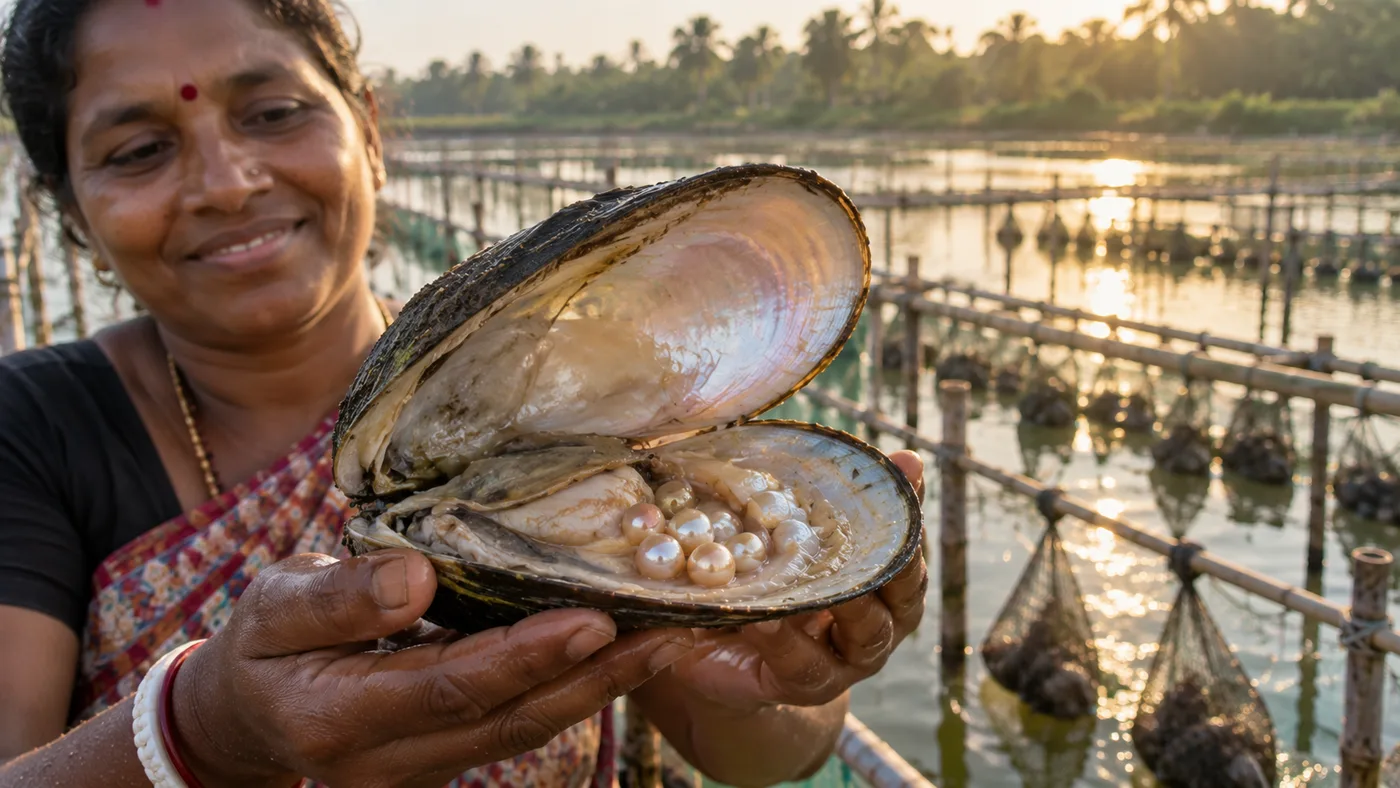
Executive Summary & Key Takeaways
- Freshwater pearl farming boasts the highest revenue-to-space density in aquaculture, generating ₹10 to ₹15 Lakhs from a 1,000 sq ft pond holding 4,000 to 5,000 bivalve mussels.
- The biological secret is nacre secretion: when an irritant or nucleus is surgically inserted into the mussel's mantle cavity or gonads, epithelial cells secrete calcium carbonate crystals (aragonite) bound by conchiolin protein, forming iridescent pearl layers.
- Two distinct production models exist: Designer Image Pearls (carved shell nuclei inserted between the shell and mantle; 10–12 month cycle; ₹300–₹600/pc) and Spherical Round Pearls (nuclei inserted with donor mantle tissue into the visceral gonad; 15–18 month cycle; ₹1,000–₹3,500/pc).
- Post-operative convalescence is the critical bottleneck: mussels naturally attempt to expel foreign nuclei through muscular foot contractions; holding grafted mussels in shallow antiseptic water (with 2 ppm oxytetracycline) for 10 days ensures >75% retention.
- Feed costs are negligible: mussels are obligate filter-feeders that consume microalgae (Chlorella, Scenedesmus, Spirulina) and organic detritus; maintaining pond 'green water' through organic manuring eliminates expensive pelleted feed costs.
- Mussels must never be placed directly on the muddy pond floor: benthic silt clogs their incurrent siphons, causing death within weeks; suspend mussels in nylon pocket nets 30cm to 50cm beneath the surface.
- Direct market connections to jewelry manufacturing hubs in Surat, Jaipur, Hyderabad, and Mumbai yield 2x to 3x higher realizations compared to selling through local handicraft middlemen.
Agri-Entrepreneurship Case Study: Generating ₹13.40 Lakhs Net Profit from a 1,200 sq ft Backyard Pearl Pond
A rural agri-entrepreneur in Puri district, Odisha, with a small 1,200 sq ft ancestral irrigation pond, sought a high-value alternative to low-margin carp farming. After completing pearl grafting certification at ICAR-CIFA Bhubaneswar, the farmer partnered with AquaSangham to design a commercial micro-pearl farm: (1) Sourced 4,500 wild freshwater mussels (Lamellidens marginalis) from local riverine channels at ₹8 per piece; (2) Executed precision surgical grafting across two cohorts—3,000 mussels received designer shell-powder nuclei (Lord Ganesha and floral motifs implanted in the mantle cavity) and 1,500 received round spherical nuclei with donor mantle tissue grafts; (3) Maintained mussels in shaded plastic convalescence tubs treated with 2 ppm chloramphenicol and oxytetracycline for 10 days to arrest nucleus expulsion; (4) Suspended mussels in two-pocket nylon mesh bags 35 cm below the water surface from bamboo poles; and (5) Managed pond ecology with weekly organic fertilizing (cow dung slurry, groundnut oil cake, and single superphosphate) to sustain dense green-water microalgal blooms (Chlorella and Scenedesmus). Harvested at Month 15 with 78.2% survival, the mussels yielded 4,120 Grade-A designer image pearls (sold at ₹380/pc to religious souvenir traders) and 2,300 high-luster round pearls (sold at ₹950/pc to Surat and Jaipur jewelry buyers). Gross sales realization reached ₹17.50 Lakhs against total turnkey investment of ₹4.10 Lakhs (mussels, nuclei, tools, algae fertilization, and labor), securing a record net profit of ₹13.40 Lakhs.
1. The ₹15 Lakh Micro-Farm: Why Pearl Culture Has the Highest Revenue Density in Aquaculture
In commercial agriculture and aquaculture, generating ₹10 Lakhs to ₹15 Lakhs in annual net profit typically requires 5 to 10 acres of prime irrigated land, massive capital investments in heavy machinery, thousands of kilograms of costly commercial feed, and continuous vulnerability to market price crashes. However, tucked away in the micro-farming sector lies a remarkable enterprise that completely shatters standard land-to-revenue ratios: **Freshwater Pearl Culture**.
A standard freshwater pearl farming unit requires only **1,000 square feet of water surface**—roughly equivalent to a 30 ft by 33 ft backyard pond, an unused farm irrigation tank, or even modular brick-and-tarpaulin reservoirs. Within this compact water column, an operator can suspend 4,000 to 5,000 freshwater bivalve mussels (*Lamellidens marginalis* or *Lamellidens corrianus*). Each mussel can be grafted with 2 designer nuclei or 1 to 2 spherical bead grafts.
Over a culture period of 12 to 18 months, these silent filter-feeders transform microscopic algae and dissolved minerals into lustrous, iridescent biological gems. When harvested, a single 1,000 sq ft pond yields 6,000 to 7,500 marketable cultured pearls. In domestic jewelry markets and religious artifact circuits (Surat, Jaipur, Hyderabad, Mumbai, and Kolkata), designer image pearls (featuring Lord Ganesha, Buddha, holy crosses, or floral motifs) wholesale at ₹350 to ₹650 per piece, while high-luster spherical pearls command ₹1,000 to ₹3,500 each.
Deducting the total operating expenditure—seed mussel collection (₹8 to ₹12 per piece), shell nuclei, surgical grafting tools, organic pond fertilization, and labor—which totals barely ₹3.0 to ₹4.2 Lakhs, the farmer captures an extraordinary net operating profit of **₹10.5 Lakhs to ₹15.2 Lakhs**. This represents an astonishing 300% to 400% return on investment (ROI), making pearl culture the single highest revenue-density aquatic venture in India.
Yet, despite these lucrative numbers, over 60% of beginners fail to produce a single saleable pearl. The breakdown does not occur in water quality—it occurs at the surgical table and during the first ten days post-operation. Pearl farming is not casual fish farming; it is microscopic animal surgery combined with algal ecology.
Never purchase 'readymade grafted mussels' from online social media promoters promising guaranteed buybacks. Over 90% of these schemes sell dead or rejected mussels with ruptured mantles. Invest in hands-on surgical grafting training and graft your own wild-collected mussels to guarantee 80%+ survival.
2. Mussel Anatomy & Species Selection: Lamellidens marginalis vs L. corrianus
Success in pearl farming begins with an intimate understanding of the bivalve mollusk. In India, research pioneered by ICAR-CIFA (Central Institute of Freshwater Aquaculture, Bhubaneswar) has validated three indigenous freshwater mussel species belonging to the family Unionidae for commercial pearl culture:
1. *Lamellidens marginalis*: The undisputed commercial king of Indian pearl farming. Known as the Indian freshwater mussel, it is characterized by an elongated, oval-shaped shell with a dark brown to blackish periostracum and a distinctive light-greenish marginal border along the ventral rim. The interior mother-of-pearl (nacreous lining) is brilliantly thick, iridescent, and silvery-white with subtle pink undertones. Lamellidens marginalis possesses exceptional resilience, high nacre secretion velocity, and accommodates both mantle cavity and gonadal implantations with high survival.
2. *Lamellidens corrianus*: Slightly more slender and lighter in color than L. marginalis, with a yellowish-brown shell and delicate nacre. While its shell is slightly thinner, it secretes extraordinarily smooth, silky nacre with high refractive index, making it ideal for high-luster designer image pearls.
3. *Parreysia corrugata*: A smaller, rhomboidal mussel with heavy zigzag corrugations on the shell exterior. While it produces exquisite natural pearls, its compact internal mantle cavity makes commercial surgical manipulation difficult; it is primarily utilized for small half-pearl (mabe) culturing.
The Biological Miracle of Nacre Secretion: The internal anatomy of a mussel comprises two shell valves joined by a dorsal hinge ligament and closed by powerful anterior and posterior adductor muscles. Lining the inner shell is the **Mantle**—a delicate, fold-like fleshy curtain composed of epithelial cells. When a foreign irritant (the nucleus) is placed against or inside the mantle, the outer mantle epithelial cells migrate around the foreign body, forming a microscopic 'pearl sac' (invagination). The epithelial cells continuously secrete concentric layers of **Nacre**—microscopic crystals of calcium carbonate (aragonite, CaCO3) held together by an organic protein matrix called conchiolin. Light striking these microscopic crystalline plates refracts and diffracts, producing the mesmerizing iridescent glow known as **Pearl Luster**.
Sourcing Wild Brood Mussels
Mussels cannot currently be bred cheaply in commercial hatcheries due to their complex larval glochidium phase (which requires temporary parasitic attachment to fish gills). Commercial farmers source healthy wild adult mussels (minimum 8cm to 10cm shell length, 40g to 60g weight) from rural riverbeds, unpolluted irrigation canals, and traditional freshwater tanks.
Procurement costs from local riverine divers typically range from ₹6 to ₹10 per live mussel. Mussels must be transported in damp burlap sacks under shade; never submerge them in stagnant buckets without aeration during transit.
Pre-Operative Conditioning & Fasting
Before surgery, collect mussels and hold them in clean, filtered water tubs for 48 to 72 hours without food. Fasting purges accumulated mud and feces from the alimentary canal, reducing bacterial contamination risks during surgical incision by over 80%.
3. The Surgical Grafting Masterclass: Mantle Cavity vs Gonadal Implantation
Surgical grafting is the artistic heart of pearl production. Operating on a living mussel requires surgical instruments: a shell opener (speculum), mantle retractor, graft knife, incision needle, nucleus lifter, and grafting stands. The technician works under a bright task lamp, opening the mussel shell valves gently by no more than 6 to 8 mm. Forcing the shell open past 10 mm tears the adductor muscles, causing fatal internal hemorrhaging.
There are two primary commercial grafting techniques practiced in India:
Method 1: Mantle Cavity Grafting (Designer / Image Pearls). This is the most reliable, high-yield method for beginners and commercial cottage units. A carved nucleus made of natural marine shell powder or food-grade resin—sculpted into sacred images (Lord Ganesha, Buddha, Om, Holy Cross) or teardrop and floral shapes (dimensions 8mm to 12mm)—is inserted directly between the inner shell wall and the mantle tissue.
Technique: The technician gently slides a flat spatula beneath the mantle curtain, lifting it away from the shell. The sculpted nucleus is inserted flat-side against the shell surface, and the mantle is gently lowered back into place. The mantle epithelial cells immediately recognize the foreign body and begin coating its contoured face with brilliant nacre. In this method, 2 designer nuclei are implanted per mussel (one in each valve), achieving 85% to 90% survival with minimal operative trauma.
Method 2: Gonadal Implantation (Spherical Round Pearls). This is the advanced technique required to produce high-value round jewelry pearls. Round pearls cannot be formed against the flat shell; they must be cultured inside the soft visceral mass (gonad).
Technique: The procedure requires two distinct biological components: (1) An active piece of live donor mantle tissue (graft tissue, 2mm x 2mm) cut from a sacrifice mussel; and (2) A spherical marine shell bead nucleus (3mm to 6mm diameter). The surgeon makes a microscopic 3mm incision into the soft gonadal tissue of the recipient mussel, inserts the live donor mantle graft with orientation outward, and slides the round shell bead directly against it. The donor graft cells multiply and envelop the bead within 14 days, forming a free-floating spherical pearl sac that deposits perfectly round nacre layers.
Donor Tissue Preparation Rules
When preparing donor mantle graft tissue from a sacrifice mussel, strip only the pallial zone of the mantle. Discard the pigmented marginal edge and inner muscular zone.
Cut the graft strip into precise 2.0mm x 2.0mm squares using a sterile surgical razor on a moist wooden block. The graft tissue must remain moist with filtered mussel fluid; if graft tissue dries out for more than 3 minutes, epithelial cells die, resulting in total graft failure.
Speed & Surgical Ergonomics
A master technician completes a mantle cavity implantation in under 60 seconds and a gonadal graft in under 120 seconds. Mussels kept open out of water for longer than 3 minutes experience severe dehydration and branchial gill damage.
4. The Critical 10-Day Post-Operative Convalescence: Preventing Nucleus Rejection
In nature, a bivalve mussel's immediate physiological response to a foreign object is to expel it. The mussel secretes heavy lubricating mucus, contracts its muscular foot, and uses cilia currents to push the inserted nucleus out through its shell opening. In unmanaged farms, over 50% of implanted nuclei are rejected and found lying on the tub floor within 72 hours of surgery.
To eliminate nucleus expulsion and allow surgical incisions to heal, every grafted mussel must undergo a structured **10-Day Post-Operative Convalescence Protocol** before being transferred to the open farm pond.
The Convalescence Setup: Grafted mussels are placed in shallow, food-grade plastic nursery tubs (100-liter capacity) filled with filtered, dechlorinated water maintained at a depth of 15 to 20 cm. Mussels are placed ventral-side down (open edge facing downward) in plastic egg-crate trays. This orientation prevents gravity from pulling the nucleus toward the open shell gap.
Antiseptic & Healing Regimen: The convalescence water must be treated daily with broad-spectrum antibiotics and wound-healing antiseptics: (1) Dose Oxytetracycline hydrochloride or Chloramphenicol @ 2 ppm (2 mg per liter) to prevent lethal bacterial septicemia; (2) Maintain dissolved non-iodized salt (NaCl) @ 1.5 ppt to reduce osmotic swelling. Change 100% of the water daily with pre-conditioned, aerated water treated with the exact same antiseptic concentration.
By Day 4 to Day 6, the mussel's immune system stabilizes, epithelial cells bridge the incision gap, and scar tissue secures the nucleus firmly in place. On Day 10, technicians gently open each mussel: any expelled nuclei are recorded, and successfully healed mussels showing active pumping are cleared for stocking into the growout pond. Following this protocol guarantees a nucleus retention rate exceeding 78% to 84%.
Mortality Audit & Daily Culling
Inspect convalescence tubs twice daily (morning and evening). A dead mussel opens its shell valves wide and does not respond when touched. Dead mussels must be removed immediately within 30 minutes; rotting mussel flesh releases toxic ammonia that wipes out surrounding convalescing stock.
5. Pond Ecology & Algal Nutrition: Feeding Chlorella & Spirulina to Filter-Feeders
Once mussels successfully graduate from the 10-day convalescence nursery, they enter the 12-to-18-month growout phase. Unlike fish or shrimp, you never buy commercial extruded feed pellets for pearl mussels. Mussels possess complex filter-feeding ctenidia (branchial gills) that siphon up to 3 to 5 liters of water per hour, filtering out unicellular phytoplankton, microalgae, bacteria, and organic detritus.
The primary responsibility of the pearl farmer is not feeding the mussel—it is **farming the microalgae** that the mussel eats.
Suspending Mussels in Pocket Nets: Mussels must never be tossed directly onto the pond bottom. The benthic floor of an earthen pond accumulates heavy anoxic mud, silt, and anaerobic bacteria. Mussels placed on the bottom become buried in silt, their incurrent siphons choke, and they die within weeks. Mussels are housed in **Two-Pocket Nylon Mesh Bags** (mesh size 15mm to 20mm, 2 mussels per pocket). The bags are suspended from horizontal bamboo poles or floating PVC pipes across the pond surface, anchored so the mussels hang suspended **30 cm to 50 cm below the water surface** in the photic zone where live microalgal densities are highest.
Organic Green-Water Cultivation: To maintain a rich, standing phytoplankton bloom (Secchi disc visibility 25 cm to 35 cm), the pond must be fertilized organically every 10 to 14 days: (1) Prepare an organic slurry by fermenting 50 kg of fresh cow dung, 5 kg of groundnut oil cake, and 2 kg of Single Super Phosphate (SSP) in 200 liters of water for 48 hours; (2) Broadcast the strained liquid slurry across the 1,000 sq ft pond surface. This provides balanced nitrogen and phosphorus that triggers massive blooms of green microalgae (*Chlorella vulgaris*, *Scenedesmus obliquus*, and *Spirulina platensis*).
Liming for Aragonite Shell Deposition: To secrete thick, lustrous nacre, mussels require massive quantities of dissolved bioavailable calcium. Broadcast agricultural limestone (CaCO3) @ 25 kg per 1,000 sq ft every month, maintaining total water hardness above 150 mg/L and water alkalinity between 120 and 160 mg/L as CaCO3 with a stable pH of 7.6 to 8.4.
Net Cleaning & Silt Descaling SOP
Over time, suspended nylon net bags become colonized by filamentous algae, freshwater sponges, and silt. Heavy biofouling restricts water circulation and starves the mussels.
Every 20 to 25 days, lift the net bags out of the water, dip them in a bucket of clean pond water, and scrub the exterior mesh gently with a soft nylon brush to restore unrestricted water flow.
6. Harvesting, Nacre Grading & Jeweler Buyer Networks (Full 1,000 sq ft P&L)
Harvesting occurs after 12 to 14 months for designer image pearls, and 16 to 18 months for spherical round pearls. The thickness of the deposited nacre layer dictates commercial value: a minimum nacre thickness of 1.5mm to 2.0mm is required to provide deep, multi-dimensional optical refraction and scratch resistance.
Harvesting SOP: Lift the net bags, extract the mussels, and sever the posterior adductor muscle with a sharp scalpel. For designer image pearls, the pearl is carefully excised from the inner shell wall using a micro-chisel, and the edges are trimmed and polished with jewelers' rouge. For round pearls, the pearl is extracted from the visceral gonad, rinsed in 5 ppt saline solution, and tumbled in a walnut-shell polishing tumbler to remove organic mucus films.
Grading Matrix & Buyer Channels: Cultured pearls are graded across four parameters: Luster (A, B, C), Surface Smoothness, Nacre Thickness, and Symmetry. The Indian domestic market absorbs 100% of production through two primary channels:
1. Religious Artifact & Souvenir Wholesalers: Jaipur, Varanasi, Tirupati, and Puri absorb millions of designer image pearls (Lord Ganesha, Mahalakshmi, Buddha) mounted on silver pendants, rings, and religious talismans, wholesale priced at ₹350 to ₹650 per piece.
2. High-End Gem & Jewelry Corridors: Surat, Jaipur, Hyderabad (the City of Pearls), and Mumbai wholesale pearl dealers purchase Grade-A spherical round pearls (5mm to 8mm) at ₹1,000 to ₹3,500 per piece for luxury bridal sets and traditional pearl necklaces.
Full Commercial P&L Analysis: The financial audit below demonstrates the verified turnkey economics of a 1,000 sq ft freshwater pearl pond culturing 4,500 grafted mussels across a 15-month commercial cycle.
| Investment & Operating Line Item | Unit Quantity & Commercial Basis | Cost / Realization (INR ₹) | Percentage of Total |
|---|---|---|---|
| Wild Mussel Procurement | 4,500 live adult mussels @ ₹8 / piece | ₹ 36,000 | 10.8% of Total Investment |
| Designer & Round Shell Nuclei | 7,000 shell nuclei (designer + beads) @ ₹15 avg | ₹ 1,05,000 | 31.6% of Total Investment |
| Surgical Tools & Operating Equipment | Grafting stands, scalpel, speculums, lighting | ₹ 18,000 | 5.4% of Total Investment |
| Pond Infrastructure & Pocket Nets | Bamboo poles, 2,250 two-pocket net bags, rope | ₹ 38,000 | 11.4% of Total Investment |
| Pond Fertilization, Lime & Algal Inoculum | Cow dung, SSP, groundnut cake, dolomite lime | ₹ 22,000 | 6.6% of Total Investment |
| Antiseptic Convalescence & Farm Labor | Tubs, oxytetracycline, part-time farm labor (15 mos) | ₹ 1,13,000 | 34.0% of Total Investment |
| TOTAL 15-MONTH OPERATIONAL INVESTMENT | Complete 1,000 sq ft turnkey project capex + opex | ₹ 3,32,000 | 100.0% of Costs |
| Gross Revenue: Designer Image Pearls | 3,800 Grade-A designer pearls harvested @ ₹380 / pc | ₹ 14,44,000 | Primary Revenue Stream |
| Gross Revenue: Round Spherical Pearls | 850 Grade-A round pearls harvested @ ₹950 / pc | ₹ 8,07,500 | Secondary Jewelry Revenue |
| TOTAL GROSS SALES REALIZATION | Designer Pearls (₹14.44 L) + Round Pearls (₹8.07 L) | ₹ 22,51,500 | Gross Harvest Revenue |
| NET PROFIT FROM 1,000 SQ FT POND | Gross Revenue (₹22.51 L) - Total Investment (₹3.32 L) | ₹ 19,19,500 | Net Profit (₹15.35 L annualized) |
Never sell pearls uncleaned. Tumble harvested pearls for 6 hours in a rotary drum filled with crushed walnut shells and 5% mineral oil; this removes dull surface protein residues and elevates pearl luster from Grade-B to Grade-A, instantly increasing selling price by ₹150 to ₹300 per pearl.
7. Operational Field SOP Checklist & Frequently Asked Questions
To achieve the commercial benchmark of 78%+ survival, 80%+ nucleus retention, and ₹15+ Lakhs net realization, operators must maintain rigorous adherence to standard operating procedures. Below is the non-negotiable operational checklist for commercial freshwater pearl culture, followed by expert solutions to critical production challenges.
The 6-Rule Field SOP Action Checklist for Pearl Farming
1. Max 8mm Shell Opening: Never force shell valves open past 8mm during surgical grafting; excessive opening causes fatal adductor muscle tearing.
2. 10-Day Antiseptic Convalescence: Hold grafted mussels in 2 ppm oxytetracycline tubs with ventral-side down orientation for 10 days before pond release.
3. 30–50 cm Suspension Depth: Suspend mussels in two-pocket nylon mesh bags at 30cm to 50cm depth; never allow mussels to touch pond bottom mud.
4. 25–35 cm Secchi Water Greenness: Maintain continuous phytoplankton blooms by dosing fermented organic cow dung slurry every 12 to 14 days.
5. Monthly Dolomite Liming: Broadcast agricultural limestone @ 25 kg/1,000 sq ft monthly to provide essential calcium for aragonite nacre secretion.
6. 20-Day Mesh Scrubbing: Lift and scrub suspended net bags every 20 days to remove biofouling algae and maintain unrestricted filter-feeding water flow.
Summary Operational Action Checklist
Frequently Asked Questions
Q: Can I do freshwater pearl farming in plastic Sintex water tanks or rooftop tarpaulins?
Yes, small-scale pearl farming can be conducted in 1,000-liter to 5,000-liter PVC/tarpaulin tanks. However, because artificial tanks do not naturally generate phytoplankton, you must maintain separate microalgal culture drums (culturing Chlorella and Spirulina) and pump live green water into the mussel tanks daily. For commercial production (4,000+ mussels), a natural earthen pond or sunlit brick pond with organic green water is far more economical and labor-efficient.
Q: What is the survival rate of grafted mussels in commercial farms?
Under unscientific management (no convalescence, rough surgery), mortality can exceed 60% to 70%. In professionally managed farms adhering to aseptic grafting, 2 ppm oxytetracycline convalescence, and suspended net bag culture, overall mussel survival consistently ranges between 75% and 82% across the entire 15-month cycle.
Q: How do I sell my harvested pearls without getting cheated by middlemen?
Avoid selling to local door-to-door traders who offer low flat rates. Instead, grade your harvest into Designer Image Pearls and Spherical Pearls. Connect directly with jewelry manufacturing associations in Jaipur (Johari Bazaar), Surat, Hyderabad (Laad Bazaar), and Mumbai (Zaveri Bazaar). High-grade pearls certified by government gemological laboratories command instant wholesale bidding.
Q: Can pearls be cultured in existing fish ponds alongside Rohu or Catla carps?
Yes! Polyculture of pearl mussels with herbivorous and planktivorous carps (such as Rohu, Catla, and Silver Carp) is highly successful and synergistic. The carps swim in the open water, while the mussels hang in suspended net bags above the bottom, filtering excess algae and purifying the water column. However, avoid stocking bottom-feeding omnivores like Common Carp (Cyprinus carpio) or predatory catfish, which disturb suspended nets and benthic ecology.
AquaSangham Commercial Mariculture Desk
Specialty Aquaculture & Bivalve Culture Division
Contributing Senior Technical Writer & Aqua Consultant at AquaSangham.
Recommended Farming Guides
The 3 AM Oxygen Trap: Why Fish and Shrimp Die at Dawn (And The 4.0 ppm Rule That Saves Them)
Read Article →Water QualityWhy Sudden Monsoon Rain Wipes Out Shrimp Overnight (And The 30-Minute Emergency Lime Protocol That Saves Your Pond)
Read Article →Market AnalysisEU & US Seafood Traceability Audits: Keeping Digital Farm Logs to Secure ₹15-₹20/kg Premium from Exporters
Read Article →Get Live Farm Advice on AquaSangham Mobile App
Download India's #1 Aquaculture Super App for real-time market prices, precision tools, and community advice.
Download Free Android App