Executive Summary & Key Takeaways
- Producing 100 kg/m³ of GIFT Tilapia requires a minimum continuous dissolved oxygen level of 5.5 to 6.0 mg/L supported by rotary blowers sized at 8 to 10 CFM per 10 m³ water volume.
- Incorporate a 5% to 7% concave bottom slope towards a central double-pipe standpipe drain to harness the 'tea-cup effect', flushing settled heavy sludge in 10-second pulses without draining biofloc.
- Eliminate toxic ammonia spikes by maintaining a heterotrophic Carbon-to-Nitrogen (C:N) ratio of 15:1 to 20:1 using pre-fermented sugarcane jaggery, molasses, or wheat flour starch.
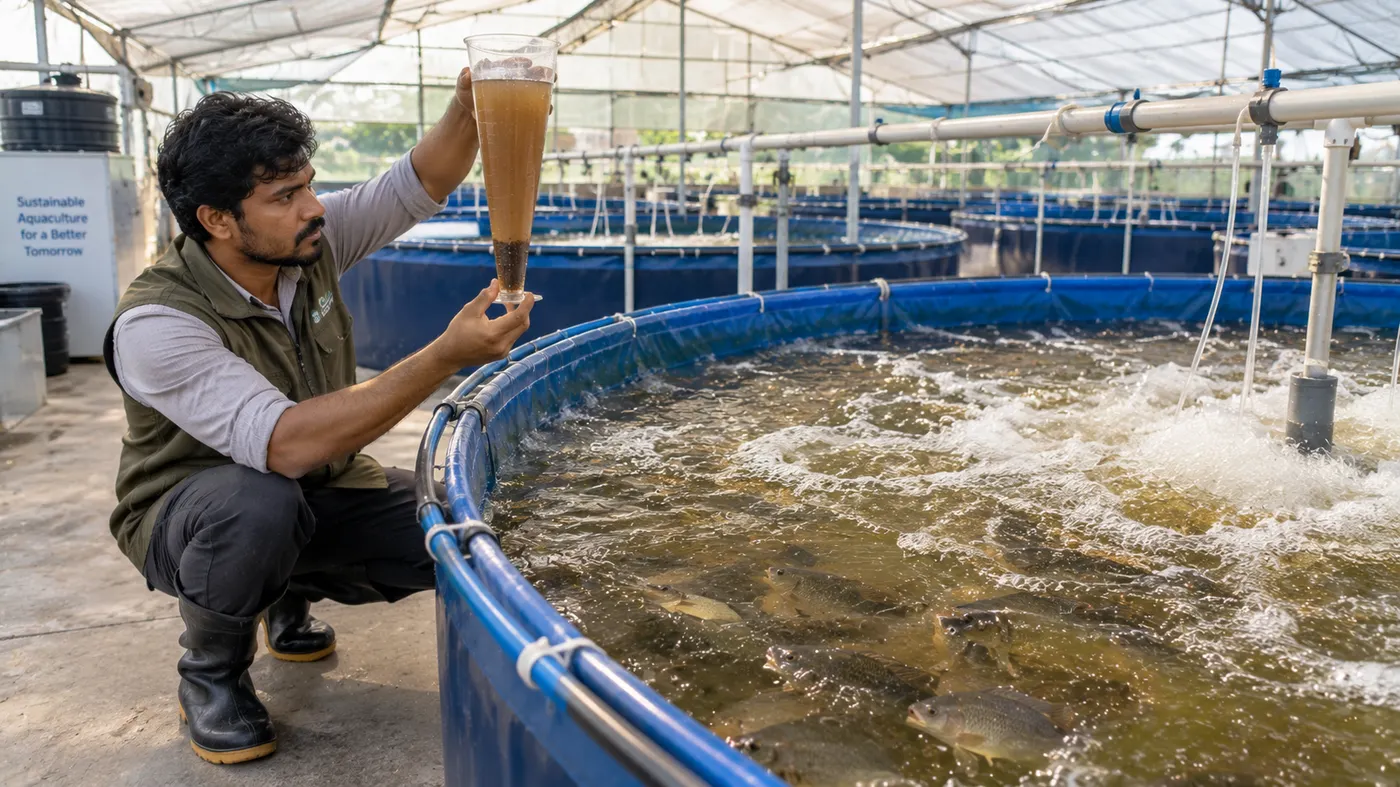
- Monitor Floc Volume (FV) daily using 1000ml Imhoff cones: keep Tilapia floc between 25 and 40 ml/L; purge excess suspended solids via settling cones when FV exceeds 45 ml/L to protect fish gills.
- Biofloc nitrifiers and heterotrophic bacteria consume 3.57 to 7.14g of alkalinity (as CaCO3) per gram of ammonia assimilated; replenish alkalinity continuously with dolomite and sodium bicarbonate to prevent lethal pH crashes.
- GIFT Tilapia continuously graze on suspended bacterial flocs, recycling microbial protein and microbial poly-β-hydroxybutyrate (PHB) to lower commercial FCR down to 1.05–1.15.
- Execute mandatory 24 to 48-hour clear-water purging prior to marketing to eliminate muddy/earthy geosmin and 2-methylisoborneol (MIB) off-flavors, securing top-tier commercial retail pricing.
Field Case Study: 8-Tank Commercial Polyhouse Biofloc Enterprise
A commercial aquaculture enterprise established an eight-tank circular HDPE tarpaulin biofloc facility (5-meter diameter, 1.2-meter water depth, 23.5 m³ effective capacity per tank) enclosed within a 400 m² polyhouse canopy. Utilizing a 5 HP twin-lobe rotary Roots blower coupled to bottom Aero-Tube diffuser rings and airlift manifolds, continuous DO was maintained above 5.8 mg/L. Staged with 3,000 graded GIFT tilapia fingerlings (20g size) per tank (128 fish/m³), the farm dosed sugarcane jaggery daily based on the AquaSangham C:N 15:1 Algorithm to convert total ammonia nitrogen directly into microbial protein. Imhoff cone floc volumes were maintained tightly between 25 and 35 ml/L, with agricultural dolomite and sodium bicarbonate dosed twice weekly to anchor alkalinity at 140 mg/L CaCO3. At Day 130, each tank yielded 1,950 kg of uniform 650g fish (103.8 kg/m³ survival-adjusted density). Fish were depurated for 36 hours in clear aerated freshwater tanks to completely purge geosmin, and sold live to urban supermarket chains and seafood hubs at ₹165/kg, generating ₹25.7 Lakhs in gross revenue against ₹12.9 Lakhs in total operational costs, delivering a 49.8% operating margin.
1. The Hyper-Intensive Revolution: 100 kg/m³ Yields vs Traditional Ponds
Traditional earthen pond aquaculture of finfish in India has historically been characterized by low production densities, vast land footprints, and extreme vulnerability to uncontrollable environmental variables. Conventional semi-intensive pond culture of GIFT Tilapia (Genetically Improved Farmed Tilapia, Oreochromis niloticus) yields between 5 to 10 metric tons per hectare over a 6-month cycle—requiring 10,000 square meters of land and hundreds of thousands of liters of daily water exchange to dilute toxic metabolic nitrogenous wastes.
In stark contrast, hyper-intensive Biofloc Technology (BFT) deployed within circular High-Density Polyethylene (HDPE) tarpaulin tanks represents an epochal leap in land-use productivity and biosecure water stewardship. By condensing the entire aquatic ecosystem into engineered, closed-loop circular vessels operating under zero-water-exchange regimes, modern biofloc systems routinely harvest 80 to 100 kilograms of live finfish per cubic meter (kg/m³) of water volume. An array of just six 5-meter diameter tanks (total water volume ~140 m³) occupying less than 350 square meters of footprint under a polyhouse can produce 12 to 14 metric tons of marketable fish in a single 130-day crop cycle—equivalent to the annual output of a 3-acre commercial earthen farm.
The fundamental biological premise of biofloc farming rests upon microbial immobilization. Rather than discharging ammonia-laden water into local drainage canals or relying on slow autotrophic algae blooms, biofloc culturists cultivate a dense suspension of heterotrophic bacteria directly within the water column. By continuously adjusting the Carbon-to-Nitrogen (C:N) stoichiometry via supplemental carbohydrate dosing, heterotrophic bacteria rapidly assimilate toxic total ammonia nitrogen (TAN) and nitrite (NO2-) directly into edible, proteinaceous bacterial cell mass. This bacterial biomass agglomerates with microalgae, protozoans, and organic detritus into suspended macroscopic aggregates known as 'flocs', which GIFT Tilapia actively filter-feed upon around the clock.
However, operating at hyper-densities approaching 100 kg/m³ is not forgiving. At these extreme biomass thresholds, a single mechanical failure, an undetected drop in dissolved oxygen, or an unbuffered alkalinity crash can trigger catastrophic, total-crop mortality within 45 minutes. Successful commercial execution requires mastery over structural hydraulics, mechanical aeration sizing, microbial biochemistry, and water chemistry diagnostics. This master blueprint establishes the comprehensive operational protocols for high-density GIFT Tilapia biofloc enterprises.
Core Advantages of Circular Biofloc Tanks
1. 10x Land-Use Efficiency: Harvest up to 100 kg/m³ (1.5 to 2.4 tons per 4m/5m tank) compared to just 0.5 to 1.0 kg/m³ in conventional earthen ponds.
2. Zero Pathogen Intrusion: Polyhouse roofing and closed tarpaulin structures eliminate wild bird vectors, crab burrowing, predatory fish, and agricultural pesticide runoffs.
3. 30% Feed Cost Reduction: Continuous grazing on suspended microbial floc recycling reduces commercial pellet FCR from 1.50 down to 1.08–1.15.
Stock certified Genetically Improved Farmed Tilapia (GIFT) fingerlings exclusively. GIFT strains have been bred across 15+ generations for rapid feed conversion, deep somatic body conformation, and disease resilience under hyper-crowded dissolved solids regimes.
2. Circular Tank Engineering: 650 GSM Liners, Slopes & Self-Cleaning Drains
The mechanical integrity and hydraulic performance of a biofloc production facility begin with precision tank architecture. Rectangular or square tanks are fundamentally incompatible with high-density biofloc culture because water circulation naturally forms sluggish 'dead zones' in the corners where organic detritus settles, goes anaerobic, and produces lethal hydrogen sulfide (H2S) gas. Circular geometry is strictly mandatory to establish uniform vortex hydrodynamics.
For commercial operations, circular tanks with diameters between 4 meters (water volume ~15 m³) and 5 meters (water volume ~23.5 m³) represent the optimal engineering sweet spot between structural cost, aeration efficiency, and manageable harvesting logistics. Tanks with diameters exceeding 7 meters require disproportionately massive blowers to prevent central sludge deposition and present severe harvesting difficulties.
The structural framework consists of hot-dip galvanized iron (GI) welded wire mesh (8 to 10 gauge thickness, 4-inch by 4-inch grid spacing) standing 1.2 to 1.3 meters tall, reinforced by high-tensile steel tensioning bands encircling the circumference. Inside this cage sits a multi-layer, UV-stabilized, food-grade virgin HDPE or PVC tarpaulin liner with a minimum thickness of 650 GSM (grams per square meter) to 750 GSM. Lighter 450 GSM agricultural tarpaulins are prone to puncture from dorsal fin spines, fingernails, or structural abrasion.
The earth base beneath the liner must never be flat. Prior to liner installation, the soil or PCC floor must be meticulously graded into an inverted cone profile with a consistent 5% to 7% slope running from the outer perimeter down to a central drainage sump. As water is driven along the tank perimeter by directional aeration diffusers, centrifugal vortex physics (the classic 'tea-cup effect') continuously draws dense settled fecal solids, unconsumed mineral binders, and expired flocs directly into the central vortex.
The central drain must incorporate a dual-standpipe self-cleaning siphon assembly. An outer perforated PVC sleeve (4-inch diameter with vertical 8mm slots starting 5 cm above the bottom) prevents live fish from being sucked down the drain while permitting heavy benthic sludge to enter. Inside this sleeve, a removable solid inner standpipe (3-inch diameter) regulates water depth. By lifting or rotating the inner standpipe for 10 to 15 seconds twice daily, the hydraulic head pressure of the tank instantly purges the concentrated anaerobic core into the external drainage canal without dumping beneficial suspended flocs.
To guarantee environmental control, commercial tanks must be sheltered under a steel-framed polyhouse structure clad with 200-micron UV-diffused agricultural polythene and 50% green agro-shade netting. This roof structure prevents torrential monsoon downpours from diluting salinity, washing out flocs, or causing thermal shock, while moderating extreme midday solar irradiance that would otherwise stimulate uncontrolled, unstable cyanobacteria blooms.
| Tank Diameter (m) | Total Height (m) | Operating Water Depth (m) | Effective Water Volume (m³) | Stocking @ 130 fish/m³ | Biomass @ 100 kg/m³ Yield | Recommended Airflow (CFM) |
|---|---|---|---|---|---|---|
| 3.0 meters | 1.20 m | 1.00 m | 7.1 m³ | 920 fingerlings | 710 kg | 6.5 – 7.5 CFM |
| 4.0 meters | 1.25 m | 1.15 m | 14.5 m³ | 1,880 fingerlings | 1,450 kg | 12.0 – 14.5 CFM |
| 5.0 meters | 1.30 m | 1.20 m | 23.5 m³ | 3,050 fingerlings | 2,350 kg | 19.0 – 23.5 CFM |
| 6.0 meters | 1.35 m | 1.20 m | 33.9 m³ | 4,400 fingerlings | 3,390 kg | 28.0 – 34.0 CFM |
Before laying the HDPE tarpaulin on the concrete or soil base, install a 10mm thick non-woven geotextile cushion pad. This prevents coarse aggregate or ground gravel from abrading the liner underside during the hydraulic stress of filling and aeration vibration.
3. Aeration Dynamics: Sizing Blowers, CFM Delivery & Diffuser Grids
In a biofloc tank supporting 100 kg of Tilapia per cubic meter, the water is not merely housing fish; it is a hyper-concentrated biological suspension containing millions of respiring heterotrophic and nitrifying bacteria per milliliter. The biological oxygen demand (BOD) of the microbial community routinely equals or exceeds the respiration rate of the fish biomass itself. Consequently, dissolved oxygen (DO) must never be permitted to drop below 5.0 mg/L, with optimal targets maintained continuously between 5.8 and 7.2 mg/L.
Standard pond paddlewheel aerators and small aquarium diaphragm pumps are utterly incapable of driving this system. Commercial biofloc installations require industrial-grade rotary twin-lobe Roots blowers or continuous-duty regenerative side-channel ring blowers engineered to deliver continuous, high-volume air against 1.2 to 1.5 meters of hydrostatic water column backpressure.
The universal engineering rule for blower sizing in finfish biofloc is 8.0 to 10.0 CFM (cubic feet per minute) of clean, oil-free air for every 10 cubic meters of active water volume. In electrical power terms, this equates to 30 to 45 Watts of continuous aeration power per cubic meter. For a standard 8-tank commercial cluster (total water volume ~188 m³), a 7.5 HP (5.5 kW) three-phase Roots blower operating at 40 to 45 kPa pressure is required, paired with an identical 7.5 HP standby blower piped in parallel with check valves.
Because a power outage exceeding 25 to 30 minutes at peak biomass (100 kg/m³) results in 100% asphyxiation mortality, the facility must incorporate an automatic transfer switch (ATS) coupled to a diesel generator set (DG) that starts automatically within 10 seconds of grid failure. In addition, an emergency 12V DC auxiliary aerator ring powered by deep-cycle tubular batteries should be hardwired into each tank as a fail-safe secondary defense.
Inside the tank, air delivery is achieved through a hybrid distribution network. Circular aeration rings constructed from weighted, micro-porous aeration tubing (such as Aero-Tube or Unicoil, 16mm ID / 25mm OD) or 9-inch EPDM fine-bubble membrane disc diffusers are positioned symmetrically on the tank floor. These diffusers are placed approximately 30 to 40 cm away from the tank wall to initiate a circular upward rolling convection current that keeps flocs continuously suspended without scouring settled solids out of the central drain. In addition, 2 to 4 vertical PVC airlift pumps (2-inch diameter) installed along the perimeter provide directional circular momentum, driving the continuous rotational sweep of the water column.
Install an analog pressure gauge and pressure relief valve on the main air header manifold. If backpressure exceeds 45 kPa, micro-pores in aeration hoses are scaling up with calcium carbonate or bio-slime; soak diffuser hoses in a 5% muriatic acid bath for 30 minutes to restore full airflow.
4. Microbial Biochemistry: The C:N (15:1 to 20:1) Carbon Dosing Math
In conventional aquaculture, fish excrete up to 75% of the nitrogen contained in their feed into the water as toxic Total Ammonia Nitrogen (TAN, comprising unionized NH3 and ionized NH4+). In standard systems, autotrophic nitrifying bacteria (Nitrosomonas and Nitrobacter) oxidize TAN to nitrite (NO2-) and eventually to nitrate (NO3-). However, autotrophic nitrifiers reproduce extremely slowly (doubling time of 24 to 36 hours), rendering them vulnerable to washouts and sudden load spikes.
Biofloc technology circumvents this bottleneck by stimulating heterotrophic bacteria (such as Bacillus subtilis, Bacillus licheniformis, and Pseudomonas stutzeri). Heterotrophic bacteria reproduce explosively (doubling time of 20 to 30 minutes) and can assimilate ammonium directly into microbial protein in a matter of hours—provided they are supplied with an abundant, readily available organic carbon source. The bacterial cell structure requires an elemental Carbon-to-Nitrogen ratio of approximately 5:1, but because bacteria respire a significant portion of carbon as CO2, an operational C:N ratio of 15:1 to 20:1 must be maintained in the water column.
To calculate the exact quantity of supplemental carbon required daily, farm managers must execute the standard Biofloc Stoichiometric Carbon Algorithm. Consider a 20 m³ tank where fish receive 3.0 kg of 30% crude protein (CP) commercial feed daily:
Step 1: Calculate Nitrogen Input. Protein is approximately 16% elemental nitrogen by weight. Total Nitrogen in feed = 3,000 g × 0.30 (CP) × 0.16 (N fraction) = 144 g of Nitrogen.
Step 2: Calculate Excreted Nitrogen. Approximately 50% of the ingested nitrogen is retained in fish muscle tissue or excreted as solid feces; the remaining 50% is excreted directly as TAN through the gills. Excreted TAN = 144 g × 0.50 = 72 g of Nitrogen.
Step 3: Determine Required Carbon for C:N 15:1. To achieve a 15:1 ratio for 72 g of Nitrogen, the system requires: 72 g N × 15 = 1,080 g of pure organic Carbon.
Step 4: Factor Carbon Content of the Carbon Source. Different carbohydrate sources possess varying carbon percentages: Sugarcane Jaggery (Gur) contains ~55% carbon; Commercial Blackstrap Cane Molasses contains ~45% carbon; Wheat Flour or Rice Flour contains ~40% carbon. If utilizing sugarcane jaggery: Required Jaggery = 1,080 g / 0.55 = 1,963 grams (~1.96 kg) of jaggery.
Never dump raw, unrefined molasses or jaggery directly into the biofloc tank. Raw carbohydrates can create localized oxygen sags, promote clumping, and feed pathogenic Vibrio or fungal molds. The gold-standard operational practice is the 24-Hour Fermented Probiotic Inoculum SOP: Dissolve the required jaggery in 10 liters of clean, aerated water in an auxiliary drum. Add 10 grams of multi-strain Bacillus commercial aquaculture probiotic and 50 grams of active dry baker's yeast. Aerate vigorously with an air stone for 24 hours until the mixture froths heavily and emits a rich, pleasant, sweet-yeasty aroma. Broadcast this pre-fermented heterotrophic liquor evenly across the tank surface during mid-morning hours when DO is peak.
| Daily Feed Input (kg) | Feed Protein (%) | Daily TAN Excreted (g N) | Carbon Required @ 15:1 (g C) | Daily Jaggery Dosing (@ 55% C) | Daily Molasses Dosing (@ 45% C) | Target Imhoff FV (ml/L) |
|---|---|---|---|---|---|---|
| 1.0 kg | 30% CP | 24 g N | 360 g C | 655 grams | 800 grams | 20 – 25 ml/L |
| 2.0 kg | 30% CP | 48 g N | 720 g C | 1,310 grams | 1,600 grams | 25 – 30 ml/L |
| 3.0 kg | 28% CP | 67 g N | 1,005 g C | 1,827 grams | 2,233 grams | 28 – 35 ml/L |
| 4.0 kg | 28% CP | 90 g N | 1,350 g C | 2,455 grams | 3,000 grams | 30 – 38 ml/L |
| 5.0 kg | 26% CP | 104 g N | 1,560 g C | 2,836 grams | 3,467 grams | 32 – 40 ml/L |
Use the AquaSangham Biofloc C:N Tank Calculator to instantly recalculate daily jaggery additions when shifting between feed protein tiers (e.g. from 32% juvenile crumbles to 26% finisher pellets) or during temperature drops when feed rations fluctuate.
5. Floc Volume Management: Imhoff Cone Testing (25–40 ml/L) & Sludge Purging
The operational health of a biofloc ecosystem is determined not by the clarity of the water, but by the density and structural quality of the suspended microbial aggregates. The primary clinical diagnostic tool for monitoring floc density on a commercial farm is the 1000 ml glass or polycarbonate Imhoff cone.
To execute the Standard Imhoff Sedimentation Assay: Collect a 1000 ml water sample from the mid-depth of the tank (avoiding surface scum and bottom sediment). Place the cone on a level vibration-free test stand. Allow the sample to settle undisturbed for exactly 15 minutes. Record the volume of settled floc in milliliters at the apex of the cone. Gently tap the sides of the cone to dislodge flocs clinging to the walls, wait an additional 15 minutes (total 30 minutes), and record the final Floc Volume (FV in ml/L).
For GIFT Tilapia grow-out culture, the optimal Floc Volume target is strictly 25 to 40 ml/L. If the FV falls below 15 ml/L, heterotrophic biomass is insufficient to assimilate daily TAN excretion, leading to ammonia spikes. Conversely, if FV exceeds 45 to 50 ml/L, severe pathological hazards arise: excessive microbial respiration drives night DO down, water viscosity increases, and dense flocs physically coat and clog the delicate secondary gill lamellae of the tilapia, causing respiratory distress, branchial necrosis, and secondary bacterial infections.
In conjunction with Imhoff cone readings, Total Suspended Solids (TSS) should be analyzed periodically using a portable turbidimeter or filtration drying test, maintaining TSS between 250 and 450 mg/L. When TSS exceeds 500 mg/L or Imhoff FV exceeds 40 ml/L, carbohydrate dosing must be temporarily halted, and mechanical sludge harvesting initiated.
Excess floc solids are controlled through two primary mechanisms: (1) Bottom Central Purging: Actuating the central drain standpipe for 15 seconds twice daily ejects the densest settled bio-sludge from the cone apex. (2) External Gravity Settlers / Clarifiers: For hyper-intensive tanks, divert a continuous side-stream (2 to 5% of tank volume per hour) via an airlift pump through an external conical sedimentation vessel. The heavy floc settles into the cone apex for easy disposal as organic agricultural fertilizer, while clarified floc-reduced water flows by gravity back into the main tank.
Regular microscopic examination (100x to 400x magnification) provides invaluable insights into floc maturity. A prime, healthy biofloc displays dense, compact brown aggregates populated by diverse stalked ciliates (Vorticella, Epistylis), free-swimming ciliates, and rotifers. These micro-grazers consume free-living bacteria, keeping water clear between flocs and enhancing floc digestibility for grazing tilapia. The sudden proliferation of filamentous bacteria or colonial blue-green algae (cyanobacteria) indicates organic overload or excessive phosphorus accumulation, necessitating immediate corrective clarifier action.
When sampling water for the Imhoff cone, always sample at the exact same hour daily (ideally 09:00 AM, 2 hours after the first morning feeding). This ensures consistent comparisons unaffected by post-feeding diurnal turbidity spikes.
6. Water Chemistry: Alkalinity Depletion, pH Buffering & Salinity Priming
The most insidious cause of mass mortality in intensive biofloc tanks is an undetected alkalinity crash. Both heterotrophic assimilation and autotrophic nitrification are highly acidifying biochemical processes that relentlessly consume carbonate and bicarbonate ions from the water column.
During biological nitrification, the oxidation of 1.0 gram of Total Ammonia Nitrogen consumes approximately 7.14 grams of alkalinity (expressed as CaCO3 equivalent) and releases hydrogen ions (H+). Heterotrophic assimilation of ammonia consumes approximately 3.57 grams of alkalinity per gram of TAN. In a 20 m³ tank feeding 3 kg of feed daily, the microbial population can devour 250 to 450 grams of dissolved CaCO3 alkalinity every single day.
Total Alkalinity must be maintained strictly between 120 and 180 mg/L as CaCO3, and tested every 24 to 48 hours using a calibrated titration kit. If alkalinity drops below 80 mg/L, the buffering capacity of the water collapses entirely. The pH, which normally stabilizes between 7.2 and 7.8, will suddenly plummet below 6.2 overnight. At this acidic threshold, nitrification halts instantly, ammonia spikes rapidly, and the floc matrix collapses into a toxic putrefying slime.
To counter continuous alkalinity consumption, commercial biofloc managers must implement a routine dual-reagent buffering strategy: (1) Slow-Release Maintenance Buffering: Dose agricultural dolomite (CaMg(CO3)2) or fine agricultural limestone (CaCO3) at a rate of 200 to 300 grams per kilogram of daily feed consumed. Dolomite provides essential calcium and magnesium ions while slowly releasing carbonate buffers. (2) Rapid Corrective Buffering: When titration tests reveal alkalinity below 120 mg/L or daily morning pH dips below 7.2, dissolve technical-grade Sodium Bicarbonate (NaHCO3) at 50 to 100 grams per m³ directly into the aeration stream. Sodium bicarbonate raises alkalinity immediately without driving pH to dangerously alkaline levels.
Another vital chemical intervention is Salinity Priming. Although GIFT Tilapia are freshwater fish, maintaining a baseline salinity of 2.0 to 4.0 ppt (parts per thousand) using pure solar sea salt (NaCl) in biofloc tanks provides two immense physiological benefits: First, dissolved chloride ions (Cl-) competitively inhibit the uptake of toxic nitrite (NO2-) through the fish gill chloride cells, preventing the formation of lethal methemoglobin ('brown blood disease'). Second, mild salinity reduces the osmoregulatory energy expenditure of the tilapia by matching the osmotic pressure of fish blood (~9 ppt), allowing metabolic energy to be channeled 100% into rapid somatic muscle growth.
Never use quicklime (calcium oxide, CaO) or slaked lime (calcium hydroxide, Ca(OH)2) for routine buffering in active biofloc tanks. Their caustic hydroxide ions (OH-) cause violent, lethal pH spikes (>9.0) that strip gills and kill both fish and beneficial bacteria. Use only Sodium Bicarbonate (NaHCO3) and Dolomite.
7. Staged Stocking, High-Density Nutrition & Achieving 1.1 FCR
Achieving commercial yields of 100 kg/m³ without stunted growth requires a rigorous two-stage nursery-to-growout staging protocol. Stocking micro-fry (0.5g size) directly into a high-density 20 m³ grow-out tank is economically disastrous due to size disparity, variable feeding efficiency, and inability to maintain precise biomass tracking.
Phase 1: Controlled Nursery Staging. Grade-A certified all-male GIFT Tilapia fry (0.5 to 1.0g size) are initially stocked into dedicated 3-meter nursery tanks at 500 to 800 fish per m³. For the first 35 to 40 days, fry are fed a 40% crude protein extruded micro-crumble feed (0.5mm to 1.2mm) at 8% to 12% of body weight daily, partitioned across 5 to 6 feedings. Floc volume in nursery tanks is kept low (10 to 15 ml/L). At Day 40, fingerlings reach 20 to 25 grams with over 95% survival.
Phase 2: Hyper-Intensive Grow-Out Transfer. The 20g fingerlings are mechanically graded through bar graders to ensure strict size uniformity and transferred into the 4m or 5m grow-out tanks at final commercial densities: 120 to 150 fingerlings per cubic meter of water volume. Accounting for an anticipated 90% to 92% grow-out survival, this density achieves exactly 100 to 110 kg/m³ when fish reach the 600g to 750g target harvest weight.
In biofloc grow-out culture, dietary feed formulation differs significantly from conventional earthen ponds. Because GIFT Tilapia continuously graze on protein-rich microbial flocs (which contain 28% to 38% crude protein, essential fatty acids, and natural digestive enzymes on a dry matter basis), the crude protein content of commercial pelleted feed can be safely reduced from 32% down to 26%–28% without compromising growth rates.
Extruded floating pellets (2.0mm transitioning to 3.0mm and 4.0mm) must be fed 3 to 4 times daily (08:00, 11:30, 15:00, and 18:00 hrs). Feeding rates are adjusted weekly based on sample weighing: starting at 4.5% of biomass daily for 30g fish, tapering down to 2.2% at 250g, and finishing at 1.4% to 1.6% of biomass during the final 30 days. Trays placed near the tank perimeter are inspected 45 minutes post-feeding; if unconsumed pellets remain, the subsequent ration is cut by 25% immediately to prevent organic overload.
By combining commercial extruded feed with continuous microbial floc grazing, GIFT Tilapia achieve an exceptional Feed Conversion Ratio (FCR) of 1.05 to 1.15 in optimized biofloc tanks—compared to 1.45 to 1.70 in traditional earthen ponds. This 30% reduction in feed consumption represents the single greatest operating cost advantage of biofloc mariculture.
Growth Milestones & Feed Calibration Schedule
1. Nursery Stage (Day 1–40): 0.5g to 20g; 40% CP crumble; 8–10% body weight daily; 500–800 fry/m³.
2. Early Grow-Out (Day 41–75): 20g to 150g; 30% CP (2.0mm pellet); 4.0–4.5% body weight daily; 130 fish/m³.
3. Mid Grow-Out (Day 76–105): 150g to 350g; 28% CP (3.0mm pellet); 2.5–3.0% body weight daily; 130 fish/m³.
4. Final Finishing (Day 106–130): 350g to 650g+; 26% CP (4.0mm pellet); 1.4–1.8% body weight daily; FCR locked at 1.10.
Install feeding rings constructed from 1-inch flexible HDPE pipe floating on the water surface. Broadcasting floating pellets inside these rings prevents aeration surface currents from blowing pellets against the tank walls where they break down into fines.
8. Off-Flavor Purging, CAPEX/OPEX Financials & Commercial Scaling
The commercial downfall of many inexperienced biofloc operators is neglecting the critical issue of 'earthy-muddy' off-flavor. In recirculating and biofloc systems, certain cyanobacteria and actinomycetes residing within the dense biofloc community produce secondary metabolites known as Geosmin and 2-Methylisoborneol (MIB). These lipophilic chemical compounds are rapidly absorbed through the gills and skin of GIFT Tilapia, depositing in the adipose fatty tissue and imparting a pungent muddy taste that causes commercial fish buyers and fine-dining restaurants to reject harvests.
To guarantee pristine, ocean-clean culinary taste and command top-tier retail prices, every commercial biofloc farm must operate a Dedicated Pre-Harvest Depuration / Purging Facility. The Purging SOP is strictly enforced: 48 hours prior to harvest, stop all feed and carbohydrate additions to the culture tank. Net the market-size fish and transfer them into clean, sanitized fiberglass or plastic depuration tanks supplied with continuous, clear running freshwater (or 2 ppt saline water) with vigorous pure-air aeration. No feed is administered during this purging window. Within 24 to 36 hours, geosmin and MIB naturally desorb from the tilapia muscle tissue and are eliminated via the gills. Fish harvested from depuration tanks feature clean, firm, white flesh with zero off-flavor, certified for premium retail supermarkets and live-fish restaurant tanks.
Commercial Viability & Financial Return Model: Consider an 8-tank commercial polyhouse biofloc installation utilizing 5-meter diameter circular HDPE tanks (23.5 m³ effective water volume per tank; total facility water volume 188 m³).
CAPEX (Capital Expenditure): Galvanized iron mesh structures, 750 GSM HDPE liners, polyhouse canopy (400 m²), 7.5 HP Roots blower system with backup blower, diesel generator with ATS, plumbing, central drains, and aeration diffusers total approximately ₹8.5 to ₹9.5 Lakhs.
OPEX per 130-Day Crop Cycle: Sourcing 24,000 graded GIFT fingerlings @ ₹5.50 = ₹1.32 Lakhs; 16.5 Metric Tons of extruded floating feed (1.1 FCR) @ ₹52/kg = ₹8.58 Lakhs; Sugarcane jaggery (7.5 tons) @ ₹38/kg = ₹2.85 Lakhs; Electricity and diesel backup = ₹1.45 Lakhs; Dolomite, sodium bicarbonate, salt, and probiotics = ₹0.65 Lakhs; Labor and testing diagnostics = ₹1.20 Lakhs. Total Operating Cost per cycle = ₹16.05 Lakhs.
Revenue & Net Profit: Assuming 91% survival, the facility harvests 21,840 fish averaging 680 grams each, generating 14.85 Metric Tons (14,850 kg) of live fish (equivalent to 79.0 kg/m³ across the entire installation, with peak individual tanks exceeding 100 kg/m³). Sold to live-seafood markets and premium urban retailers at ₹165/kg, gross revenue equals ₹24.50 Lakhs. Net operating profit per 130-day crop is ₹8.45 Lakhs—delivering an extraordinary annual net return of ₹20+ Lakhs across 2.5 cycles, amortizing initial CAPEX within the very first 10 months of full production.
To eliminate guesswork, optimize carbohydrate dosing, calculate precise blower CFM requirements, and track daily Imhoff cone readings, commercial operators rely on the AquaSangham Biofloc Tank Calculator—the industry-standard digital advisory engine powering India's next-generation hyper-intensive aquaculture entrepreneurs.
Sell fish live using aerated transport tanks rather than iced fish in styrofoam crates. Live GIFT Tilapia commands a ₹30 to ₹45 per kg price premium in tier-1 and tier-2 Indian metropolitan markets, instantly boosting net profit per tank by over 30%.
Summary Operational Action Checklist
Frequently Asked Questions
Q: How much blower CFM and aeration power is required for a 20 m³ circular biofloc tank?
A 20 m³ circular biofloc tank supporting 80 to 100 kg/m³ of GIFT Tilapia requires a continuous air volume of 16 to 20 CFM (cubic feet per minute) at 40 to 45 kPa pressure. In electrical power terms, this requires 600 to 900 Watts of continuous aeration (approx. 30 to 45 Watts per cubic meter). This is best delivered via a central industrial Roots blower feeding weighted micro-porous Aero-Tube rings and EPDM membrane disc diffusers placed symmetrically along the perimeter.
Q: What is the exact carbon-to-nitrogen dosing formula when using sugarcane jaggery?
The formula is: Daily Jaggery (grams) = [Daily Feed (g) × Crude Protein % × 0.16 (N content) × 0.50 (excreted TAN fraction) × 15 (target C:N ratio)] / 0.55 (carbon purity of jaggery). For example, if feeding 3,000g of 30% CP feed daily: 3,000 × 0.30 × 0.16 × 0.50 = 72g Nitrogen. Required Carbon = 72g × 15 = 1,080g Carbon. Required Jaggery = 1,080 / 0.55 = 1,963 grams (~1.96 kg) of jaggery.
Q: Why does water alkalinity crash so quickly in biofloc tanks?
Nitrifying and heterotrophic bacteria consume large quantities of dissolved inorganic carbon (bicarbonates and carbonates) during nitrogen assimilation. Autotrophic nitrification consumes approximately 7.14 grams of alkalinity (as CaCO3) per gram of ammonia oxidized, while heterotrophic assimilation consumes approximately 3.57 grams per gram of ammonia. In an intensive tank, the bacterial biomass can deplete 250 to 450 grams of alkalinity daily, causing pH to collapse below 6.2 overnight if not replenished with agricultural dolomite and sodium bicarbonate.
Q: What should I do if the Imhoff cone Floc Volume exceeds 45 ml/L?
When Floc Volume exceeds 40–45 ml/L, immediately suspend all carbohydrate (jaggery/molasses) additions for 24 to 48 hours. Reduce fish feed by 20% to 30%. Actuate the central bottom drain for 20–30 seconds to flush heavy settled solids, and run an external side-stream conical settling clarifier to harvest suspended microbial solids until the Imhoff reading settles back to the safe zone of 25 to 35 ml/L.
Q: How do you eliminate the muddy or earthy off-flavor from biofloc-reared tilapia?
Off-flavor is caused by geosmin and 2-methylisoborneol (MIB), organic compounds produced by certain actinomycetes and blue-green algae within the floc. To completely eliminate off-flavor, transfer harvest-size tilapia into clean, running freshwater depuration tanks with continuous pure-air aeration for 24 to 48 hours with zero feeding prior to sale. This purges geosmin from the fish tissue, resulting in clean, sweet, firm white fillets.
AquaSangham Technical Advisory
Intensive Aquaculture Engineering & Biofloc Systems Desk
Contributing Senior Technical Writer & Aqua Consultant at AquaSangham.
Recommended Farming Guides
Total Ammonia Nitrogen (TAN) Mass Balance Math: Sizing Biofilters in Commercial RAS
Read Article →Farming TechThe Recirculating Aquaculture System (RAS) Master Guide: Design, Hydraulics & Mass Balance
Read Article →Farming TechIndigenous Magur (Clarias batrachus) Induced Breeding & Nursery Rearing SOPs
Read Article →Get Live Farm Advice on AquaSangham Mobile App
Download India's #1 Aquaculture Super App for real-time market prices, precision tools, and community advice.
Download Free Android App