Executive Summary & Key Takeaways
- GIFT Tilapia grows 40% to 60% faster than wild Nile tilapia, reaching a prime marketable harvest size of 700g to 900g in just 120 to 140 days with an exceptional 1.20–1.30 FCR.
- Never stock mixed-sex tilapia seed; females divert energy into early egg production and mouthbrooding, overpopulating ponds with stunted 150g runts. Demand >98% certified all-male monosex fingerlings.
- Nurse 1g–3g fry in fine-mesh (40-mesh) hapa cages until reaching 25g–30g; execute mechanical size-grading every 10 days to eliminate territorial cannibalism before grow-out pond stocking.
- Feed exclusively 100% extruded floating pellets; avoid sinking mash feeds that rot into toxic ammonia. Apply a 3-phase crude protein step-down: 32% starter (2mm) -> 28% grower (3mm) -> 24% finisher (4mm).
- Deploy 3 to 4 HP of paddlewheel aeration per acre to maintain nocturnal dissolved oxygen > 3.5 ppm; chronic hypoxia triggers feeding depression and fatal Streptococcus iniae outbreaks.
- Purge market-ready tilapia in clean, running water holding tanks for 24 to 48 hours prior to harvest to completely depurate muddy geosmin and MIB off-flavors, securing premium fillet prices.
Field Case Study: 10-Acre GIFT Tilapia Commercial Model
A traditional carp farmer transitioning to commercial GIFT Tilapia stocked 160,000 all-male fingerlings (average weight 15g) across two 5-acre earthen ponds equipped with 16 HP paddlewheel aeration. The farm implemented the AquaSangham 3-phase feeding protocol: transitioning from 32% CP (1.5mm) starter to 28% CP (3mm) grower, and finishing with 24% CP (4mm) floating pellets timed around twice-daily feeding windows (08:30 and 16:30 hrs). To prevent water quality deterioration from heavy fish excretion, the pond was conditioned with multi-strain Bacillus probiotics and molasses every 10 days to maintain heterotrophic assimilation of total ammonia nitrogen. At Day 135, the farm harvested 38.6 tons of uniform 820g fish. With average farmgate prices of ₹125/kg against production costs of ₹84/kg, the operation generated a net profit of ₹15.82 Lakhs in under 5 months, proving that intensive GIFT Tilapia generates 2.4x the annual return per acre compared to traditional Indian Major Carp polyculture.
1. The Rise of GIFT Tilapia: Genetics, Biology & Commercial Superiority
Across the expansive freshwater and low-salinity aquaculture landscapes of India—from the historic carp-farming heartlands of Andhra Pradesh (Kolleru Lake, Krishna, and Godavari deltas) to the progressive inland aquaculture belts of West Bengal, Odisha, Maharashtra, Punjab, and Tamil Nadu—a profound commercial transition is underway: the rapid rise of Genetically Improved Farmed Tilapia (GIFT / Oreochromis niloticus). For decades, Indian freshwater aquaculture was dominated by Indian Major Carps (Catla, Rohu, Mrigal). However, long culture durations (10 to 14 months to achieve 1.2 kg), unpredictable market price volatility, susceptibility to parasitic argulosis, and poor feed conversion ratios (FCRs typically exceeding 1.8 to 2.2 on traditional mash feeds) have severely squeezed farmer profitability.
Enter GIFT Tilapia: the product of over three decades of systematic pedigree selection and selective breeding initiated by the WorldFish Center. Through rigorous multi-generational selection across diverse African and Asian founder strains, GIFT Tilapia has been genetically optimized for commercial performance: exhibiting an extraordinary 40% to 60% faster somatic growth rate than wild Nile tilapia, superior carcass fillet yield (35% to 38% clean edible muscle), exceptional resistance to handling stress, broad salinity tolerance (0 to 18 ppt), and remarkable adaptation to high-density commercial pond culture.
Under professional management, all-male GIFT Tilapia fingerlings stocked at 15 to 25 grams achieve a prime marketable harvest weight of 700 to 900 grams in just 120 to 140 days (4.0 to 4.5 months) with an exceptional Feed Conversion Ratio of 1.20 to 1.30 when fed extruded floating pellets. This rapid cycle turnover allows commercial farm operators to harvest 2.5 crops per year from the same pond infrastructure, generating 2.5 to 3.0 times higher annual net revenue per acre compared to traditional carp farming.
However, commercial success with GIFT Tilapia is not automatic. The very biological traits that make tilapia hardy—their aggressive territorial feeding behavior, high metabolic throughput, prolific early reproduction, and heavy excretion—create acute management challenges in intensive earthen ponds. Stocking mixed-sex seed results in uncontrolled reproduction, stunting the entire pond population into unmarketable 150-gram dwarfs. Overfeeding poor-quality sinking mash creates catastrophic ammonia spikes and muddy off-flavor fillets, while neglecting nocturnal dissolved oxygen leads to chronic streptococcal disease outbreaks. This comprehensive master guide provides the definitive, scientifically verified standard operating procedure for commercial GIFT Tilapia pond management.
Biological Advantages of GIFT Tilapia over Traditional Carps
1. Accelerated Turnaround: Reaches 800g marketable weight in 130 days, compared to 300+ days required for Rohu or Catla to reach equivalent commercial size.
2. Superior Feed Efficiency: Converts extruded floating feed at 1.22–1.28 FCR, slashing feed costs by 35% compared to mash-fed carp polyculture.
3. Robust Salinity Adaptability: Thrives in freshwater (0 ppt) as well as brackish coastal waters up to 15 ppt, making it ideal for diversified mariculture estates.
Never procure tilapia seed from uncertified local river catchments or informal village hatcheries. Only purchase seed from state-certified hatcheries with documented pedigree traceability confirming genuine GIFT strains with >98% all-male monosex conversion.
2. Nursery Phase Management: Fry Nursing, Size Grading & Hapa Systems
Commercial tilapia culture fails or succeeds at the nursery gate:
- The Monosex Imperative: Tilapia reach sexual maturity at merely 2 to 3 months of age (40 to 60 grams). If female fish are present in a grow-out pond, energy is diverted into gonad development and egg production. Furthermore, female tilapia incubate fertilized eggs in their mouths (maternal mouthbrooding), releasing thousands of wild fry into the pond every 25 days. The pond rapidly becomes overcrowded with hundreds of thousands of competing juveniles, causing the entire population to stunt. Therefore, commercial grow-out ponds must be stocked exclusively with certified all-male monosex GIFT fingerlings with a verified male purity exceeding 98% (produced through methyltestosterone sex reversal or YY supermale genetics).
- The Nursery Hapa System: Never stock small 1-gram to 3-gram fry directly into an open, 5-acre grow-out pond. In open ponds, small fry face heavy predation from wild birds, frogs, and aquatic insects, resulting in 40% to 60% invisible mortality. Instead, install nursery hapa cages constructed from 40-mesh nylon netting (dimensions: 5m length × 3m width × 1.5m depth) suspended from bamboo poles inside the pond, positioned near gentle aerator water currents. Stock hapas at 200 to 300 fry per cubic meter.
- Mechanical Size Grading: As tilapia grow, natural genetic variance and social hierarchies create dominant fast-growers and suppressed runts. Larger fish will aggressively attack and cannibalize smaller cohorts. Every 10 to 12 days, pass the nursery fish through a floating mechanical bar-grader box (with adjustable aluminum spacing). Grade the stock into uniform size categories: small (5–10g), medium (10–18g), and large (18–25g). Only when fingerlings reach a uniform, robust 20 to 30 grams should they be vaccinated and released into the grow-out pond.
During size grading in the nursery hapas, add agricultural salt (NaCl @ 3 kg per 1,000 liters) to the sorting tubs. The saline bath restores fish mucus coat integrity, minimizes handling stress, and prevents opportunistic Saprolegnia fungal infections.
3. Grow-Out Pond Preparation, Water Depth & Stocking Density Models
Proper grow-out pond architecture and carrying capacity planning ensure rapid growth:
- Pond Preparation Protocol: Prior to stocking, drain the pond completely and allow the benthic soil to bake under direct sunlight for 10 to 14 days until cracks reach 5 cm depth. Plowing the pond bottom exposes accumulated organic matter to atmospheric oxygen. Apply Agricultural Limestone (CaCO3) @ 500 to 750 kg per hectare to buffer soil pH above 7.5. Fill the pond through a fine 80-mesh filter screen to exclude wild predatory fish (Channa, Clarias, Glossogobius). Maintain an operational water depth of 1.5 to 1.8 meters; deep water stabilizes temperature and provides swimming volume for high biomass.
- Stocking Density Models: 1. Semi-Intensive Earthen (Minimal Aeration): 2.5 to 3.0 fingerlings per m² (10,000 to 12,000 per acre). Produces 8 to 10 tons per hectare in 130 days with minimal mechanical aeration. 2. Intensive Commercial Aerated: 4.5 to 6.0 fingerlings per m² (18,000 to 24,000 per acre). Demands 4 HP of paddlewheel aeration per acre and continuous feeding management. Yields 16 to 22 tons per hectare per cycle. 3. Hyper-Intensive Concrete / Lined: 15 to 25 fish per m³ in dedicated circular lined tanks with pure oxygen injection or high-rate biofloc.
Maintain pond water depth strictly between 1.5 and 1.8 meters. Shallow ponds (<1.2m) heat up past 34°C during summer afternoons, suppressing voluntary feeding and concentrating algal blooms that trigger nocturnal oxygen crashes.
4. Extruded Floating Feed Nutrition: Protein Step-Down & Feeding SOPs
Feed represents 65% to 70% of total operating costs in commercial tilapia culture:
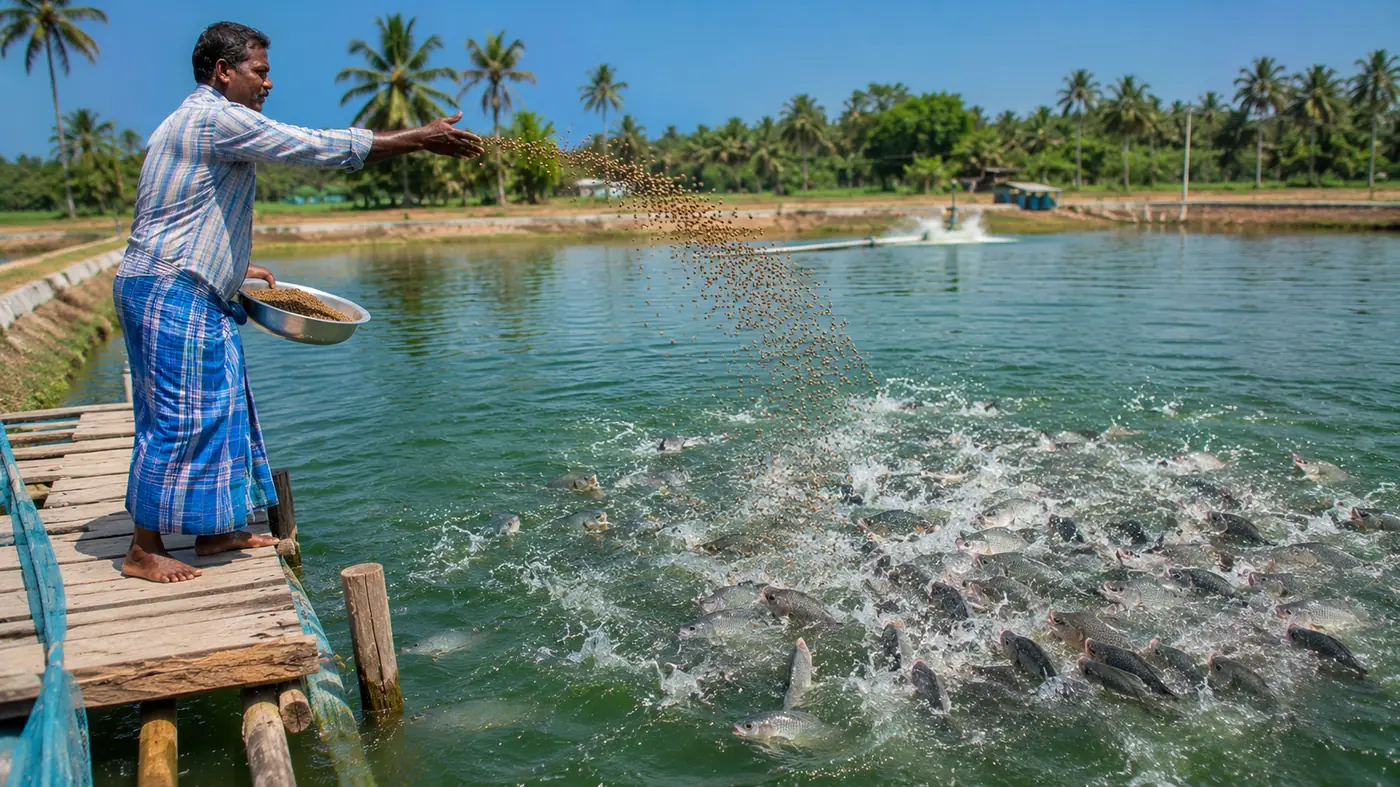
- Sinking Mash vs. Floating Extruded Pellets: Traditional carp farmers often attempt to feed tilapia low-cost sinking mash (rice bran + groundnut oil cake). This is an economic disaster. Tilapia are pelagic column and surface feeders; sinking mash rapidly settles into the bottom mud, where it ferments into toxic un-ionized ammonia and hydrogen sulfide, driving FCRs above 2.0. Commercial tilapia must be fed 100% extruded floating pellets. Extruded pellets undergo high-temperature, high-pressure cooking that gelatinizes starches, boosting digestibility to >85% and allowing farm operators to visually verify that 100% of the feed is consumed within 20 minutes.
- The 3-Phase Protein Step-Down Schedule: As tilapia grow, their dietary crude protein (CP) requirement declines, while their absolute daily intake increases. Following a strategic protein step-down minimizes feed costs without compromising muscle synthesis: 1. Starter Phase (20g to 100g): Feed a 32% Crude Protein, 6% lipid extruded pellet (size: 1.5mm to 2.0mm). Daily feeding rate: 4.5% to 3.5% of total pond biomass, split across 3 daily meals (08:30, 12:30, and 16:30 hrs). 2. Grower Phase (100g to 400g): Feed a 28% Crude Protein, 5% lipid extruded pellet (size: 2.5mm to 3.0mm). Daily feeding rate: 3.2% dropping to 2.4% of biomass, split into 2 daily meals (08:30 and 16:30 hrs). 3. Finisher Phase (400g to Harvest 800g+): Feed a 24% to 26% Crude Protein, 4% lipid extruded pellet (size: 4.0mm to 5.0mm). Daily feeding rate: 2.2% dropping to 1.6% of biomass, fed twice daily.
| Culture Phase | Fish Weight Range (g) | Feed Pellet Size (mm) | Feed Crude Protein (%) | Daily Feed Rate (% Biomass) | Feeding Frequency (Meals/Day) | Target FCR | Aeration Requirement (HP/Acre) |
|---|---|---|---|---|---|---|---|
| Nursery Hapa Stage | 1.0 – 5.0 g | 0.8 – 1.2 mm Crumble | 38% – 40% CP | 8.0% – 6.0% | 4 Meals / Day | 1.05 – 1.15 | Gentle aerator wake |
| Pre-Growout / Starter | 20 – 100 g | 1.5 – 2.0 mm Floating | 32% – 34% CP | 5.0% – 3.8% | 3 Meals / Day | 1.15 – 1.22 | 2 HP / Acre |
| Grower Phase | 100 – 400 g | 2.5 – 3.0 mm Floating | 28% – 30% CP | 3.2% – 2.4% | 2 Meals / Day | 1.22 – 1.28 | 3 – 4 HP / Acre |
| Finishing Phase | 400 – 850 g+ | 4.0 – 5.0 mm Floating | 24% – 26% CP | 2.2% – 1.6% | 2 Meals / Day | 1.25 – 1.32 | 4 HP / Acre (Night peak) |
Never feed tilapia during the first 30 minutes after sunrise. Wait until 08:30 AM when water dissolved oxygen has climbed above 4.5 ppm through photosynthetic activity. Feeding under low morning oxygen causes poor nutrient absorption and feed wastage.
5. Water Quality Limnology: Dissolved Oxygen, Ammonia & Aeration
Maintaining strict water chemistry parameters is critical for rapid growth:
- Dissolved Oxygen (DO): While tilapia can gulp surface air to survive severe hypoxia, chronic exposure to DO levels below 3.0 ppm causes feeding cessation, immune suppression, and stunted growth. Maintain daytime DO > 4.5 ppm and nocturnal DO > 3.5 ppm. Deploy long-arm paddlewheel aerators configured to generate a circular perimeter current, keeping feed floating in the water column and concentrating fish feces into the central drain pit.
- Nitrogenous Metabolites: Un-ionized ammonia (NH3) must remain strictly < 0.05 ppm, and Nitrite (NO2-) < 0.2 ppm. Because tilapia excrete large quantities of nitrogenous waste, apply multi-strain Bacillus probiotics (B. subtilis and B. licheniformis @ 1.0 kg/acre) fermented with 10 kg of jaggery or molasses every 10 days. The heterotrophic bacteria assimilate excess ammonia into microbial protein, maintaining sparkling water quality.
- Turbidity & Bloom Balance: Maintain Secchi disc visibility at 30 to 40 cm. An emerald-green chlorophyte and diatom bloom provides natural shading and supplementary live feed. If visibility drops below 20 cm, flush 15% water and pause organic fertilization.
Position your paddlewheel aerators 5 meters away from the dyke edge, angled slightly inward (15 degrees). This creates a continuous elliptical gyre that keeps the feeding zone clear of floating weeds and moves fish feces directly toward the center drain.
6. Health Management & Disease Triage: TiLV, Streptococcus & Columnaris
Biosecurity protocols to protect high-density tilapia crops:
- Tilapia Lake Virus (TiLV): A devastating syncytial orthomyxo-like viral pathogen that causes massive mortality (up to 80%) in naive stocks. Clinical symptoms include lethargy, skin erosions, darkened body coloration, abnormal swimming, and bilateral eye cataracts. Prevention: Procure seed exclusively from certified TiLV-free hatcheries with valid negative RT-PCR screening certificates. Quarantine new fingerlings in isolated hapas for 14 days before pond stocking.
- Streptococcosis (Streptococcus iniae & S. agalactiae): The primary bacterial killer in warm water (>30°C) with elevated organic loads. Affected fish display erratic spiral swimming, curved spines (scoliosis), pronounced bulging eyes ('pop-eye' / exophthalmia) with corneal opacity, and hemorrhaging around the anus and fin bases. Treatment: Do not use indiscriminate antibiotics. Immediately reduce daily feeding by 50%, increase continuous aeration to push DO > 5.5 ppm, flush 20% water, and top-dress remaining feed with a combination of Organic Acids (formic/propionic acid @ 3 g/kg), Vitamin C (@ 5 g/kg), and natural garlic oil extract (allicin @ 2 g/kg) for 7 consecutive days.
- Columnaris Disease (Flavobacterium columnare): Appears as yellowish-white erosive lesions on the mouth, skin, and back (classic 'saddleback' lesion) accompanied by ragged, rotting gill filaments. Treat by broadcasting agricultural salt (NaCl) @ 1,000 kg/ha combined with Potassium Permanganate (KMnO4) @ 2.0 ppm across the pond.
If water temperature exceeds 32°C during peak summer months, preemptively top-dress feed with multi-strain Bacillus probiotics and organic acids (3 g/kg) for 5 days. This strengthens the intestinal barrier against Streptococcus translocation into the bloodstream.
7. Harvesting Protocols, Muddy Odor Purging & Commercial Profitability
Executing harvest and maximizing commercial returns:
- Eliminating Muddy Off-Flavor: The primary market objection to pond-cultured freshwater fish is an earthy, muddy odor caused by geosmin and 2-methylisoborneol (MIB)—organic compounds produced by benthic blue-green algae (Anabaena, Oscillatoria) and actinomycete bacteria. Purge market-ready fish 48 hours prior to harvest: stop feeding and transfer fish to clean, running-water concrete holding tanks or net pens flushed with fresh borewell water. Within 24 to 48 hours, geosmin molecules are completely depurated across the gills, producing sweet, pristine white fillets.
- Count-Wise Marketing: GIFT Tilapia commands top market prices when graded into uniform 750g to 900g live fish for urban fresh-fish markets, or 1.0kg+ for filleting plants. With a farmgate price of ₹120 to ₹135 per kg and production costs of ₹80 to ₹88 per kg, intensive GIFT Tilapia farming delivers exceptional net profit margins of 35% to 42%, establishing it as the most profitable finfish enterprise in modern Indian aquaculture.
Harvest fish between 04:00 AM and 07:00 AM while water and ambient air are coolest. Transport market fish in live hauling trucks equipped with liquid oxygen diffusers (maintaining DO > 10 ppm); live tilapia command a ₹20 to ₹30/kg premium over iced fish in major wholesale fish mandis.
Summary Operational Action Checklist
Frequently Asked Questions
Q: Why is stocking mixed-sex tilapia seed the single biggest mistake in commercial farming?
Tilapia reach sexual maturity at just 2 to 3 months of age (40–60g). In mixed-sex ponds, female tilapia divert heavy metabolic energy into egg production and mouthbrooding rather than muscle growth. Furthermore, every female reproduces every 20 to 30 days, releasing thousands of wild fry into the pond. Within 60 days, the pond becomes overcrowded with over 200,000 competing juveniles, depleting dissolved oxygen and stunting the entire pond population into unmarketable 150g fish. Commercial farming requires certified >98% all-male monosex fingerlings, where all energy is channeled into rapid somatic growth.
Q: Why are extruded floating pellets mandatory for commercial GIFT Tilapia instead of sinking feeds?
Tilapia are surface and water-column feeders. Sinking mash feeds (rice bran and groundnut cake) rapidly sink into the benthic mud, where over 35% of the feed is lost to decay. This rotting organic sludge consumes dissolved oxygen and generates toxic un-ionized ammonia and hydrogen sulfide, driving FCR above 2.0. Extruded floating pellets stay buoyant for hours, allow farm operators to visually verify complete feed consumption within 20 minutes, and feature gelatinized cooked starches with over 85% digestibility, locking in an FCR of 1.20 to 1.30.
Q: What causes 'Pop-Eye' and spiraling swimming in tilapia, and how can it be cured without antibiotics?
Exophthalmia ('pop-eye') and erratic spiraling swimming are hallmark clinical signs of Streptococcosis, caused by Streptococcus iniae or Streptococcus agalactiae. It is triggered by high water temperatures (>30°C), elevated ammonia, and low nocturnal dissolved oxygen (<3.0 ppm). Instead of using illegal antibiotics that fail export testing, treat by immediately slashing feeding by 50%, running continuous aeration to push DO above 5.5 ppm, flushing 20% water, and top-dressing feed with a combination of Organic Acids (formic/propionic acid @ 3 g/kg), Vitamin C (@ 5 g/kg), and natural garlic extract (allicin @ 2 g/kg) for 7 consecutive days.
Q: How can farmers completely eliminate the muddy off-flavor (geosmin) from harvested tilapia fillets?
The muddy, earthy odor in pond-cultured fish is caused by geosmin and 2-methylisoborneol (MIB), volatile metabolites synthesized by benthic cyanobacteria (Anabaena, Oscillatoria) and actinomycetes. These molecules dissolve in fish lipid tissues. To completely eliminate them, hold market-ready fish in clean, flowing borewell water concrete tanks or net hapas for 24 to 48 hours without feed prior to harvest. In clean water, the geosmin molecules naturally diffuse out of the fish's bloodstream across the gill membranes, yielding sweet, pristine white meat that commands top prices in premium markets.
Q: How does the economic profitability of GIFT Tilapia compare to traditional Indian Major Carps (Rohu/Catla)?
GIFT Tilapia delivers significantly higher annual profitability. Indian Major Carps require 10 to 14 months to reach 1.2 kg with an FCR of 1.8–2.2, yielding one crop per year with average net profits of ₹1.5 to ₹2.0 Lakhs per acre. In contrast, GIFT Tilapia reaches 800g in just 130 days with an FCR of 1.25. This enables 2.5 crops per year from the same pond infrastructure, generating 35 to 45 tons per hectare annually and delivering ₹4.5 to ₹6.0 Lakhs in net profit per acre annually—more than 2.5 times the return of traditional carp farming.
AquaSangham Technical Advisory
Finfish Nutrition & Intensive Pond Engineering Desk
Contributing Senior Technical Writer & Aqua Consultant at AquaSangham.
Recommended Farming Guides
Total Ammonia Nitrogen (TAN) Mass Balance Math: Sizing Biofilters in Commercial RAS
Read Article →Farming TechThe Recirculating Aquaculture System (RAS) Master Guide: Design, Hydraulics & Mass Balance
Read Article →Farming TechIndigenous Magur (Clarias batrachus) Induced Breeding & Nursery Rearing SOPs
Read Article →Get Live Farm Advice on AquaSangham Mobile App
Download India's #1 Aquaculture Super App for real-time market prices, precision tools, and community advice.
Download Free Android App