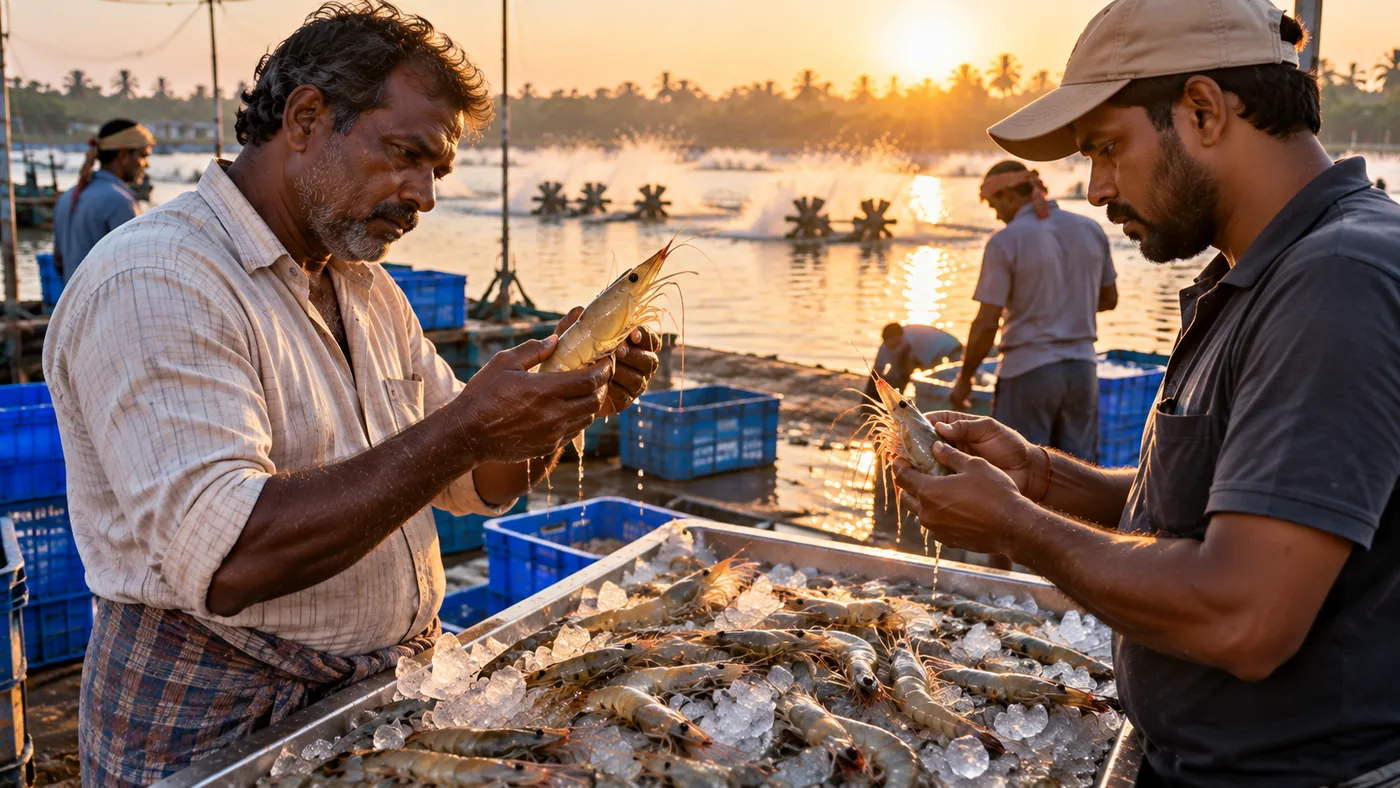
Executive Summary & Key Takeaways
- Head-On Shell-On (HOSO) and Headless Shell-On (HLSO) represent fundamentally distinct international commodity markets: China, Spain, and Italy pay massive premiums for intact, flawless carapaces, whereas the United States, Japan, and Northern Europe consume over 80% of their shrimp in headless, peeled, or value-added formats.
- The physical deheading process removes the cephalothorax (head, hepatopancreas, gills, and antennae), resulting in an inevitable 33% to 36% biomass reduction, leaving an industry standard meat recovery yield of 64% to 67%.
- Because cephalothorax weight is eliminated, the number of shrimp required to make one kilogram drops dramatically; mathematically, a 30-count head-on shrimp converts directly into an elite 19/20-count headless grade (Count_HL ≈ Count_HO × 0.65).
- To make headless processing profitable for the producer, the factory purchase price for HLSO must exceed the HOSO spot price by a minimum factor of 1.515 to 1.540; whenever the market pays higher than this multiplier, selling headless yields substantial financial upside.
- Carapace firmness and hepatopancreas stability dictate form viability: during lunar molting cycles or under acute summer heat stress, weak carapaces tear during harvest, forcing sudden factory downgrades—making immediate headless contract diversion the single best way to avoid rejection.
- Using AquaSangham's Export Count Pricing Tool, farmers can simulate exact deheading recovery yields on pond-side test samples before harvest, locking in pre-harvest contracts that systematically extract ₹35 to ₹62 per kilogram in additional profit.
Commercial Yield Optimization: Bhimavaram Cluster Reclaims ₹14.8 Lakhs in Farmgate Value by Shifting from Mandi HOSO to Direct HLSO Factory Contracts
In the Godavari delta aquaculture belt of West Godavari, a cooperative farming group managing 4 intensive earthen ponds was preparing to harvest 28 metric tons of large Penaeus vannamei averaging 35.7 grams (28 count head-on). Regional commission agents at the local mandi offered a flat rate of ₹385/kg HOSO, claiming export demand had softened and threatening further deductions for early morning carapace fragility. Instead of accepting the intermediary's offer, the farm group executed an AquaSangham standard 100-piece pre-harvest deheading yield audit across 4 checktray stations. The lab audit demonstrated an exceptional 66.2% meat recovery yield, converting the 28-count HOSO shrimp into an elite 18/19-count HLSO grade. Leveraging AquaSangham's Export Trade Analytics Desk, the farmers bypassed local intermediaries and secured a direct procurement contract with an MPEDA-registered processing plant in Visakhapatnam for IQF HLSO at ₹645/kg factory gate. After factoring in ice transport, deheading processing fees, and weight conversion, the group realized an effective equivalent farmgate price of ₹437.80/kg HOSO—an audited net gain of ₹52.80/kg over the broker's ₹385/kg bid. Across the 28-ton harvest, the cluster secured ₹14,78,400 in direct cash surplus transferred straight to their accounts within 72 hours.
1. Anatomy of the Cut: HOSO vs HLSO Global Market Dynamics
In the commercial shrimp trade across Andhra Pradesh, Tamil Nadu, Odisha, and Gujarat, harvest night is dominated by a single, high-stakes decision: should the crop be sold as Head-On Shell-On (HOSO) or converted to Headless Shell-On (HLSO)? For most Indian farmers, this choice is surrendered entirely to commission agents and mandi brokers who cite vague 'market demand' conditions to manipulate pricing. Yet behind the processing plant gates, HOSO and HLSO represent two entirely distinct global commodity ecosystems governed by rigid export destination preferences, differing tariff regimes, and massive price spreads.
The United States—India's largest historical export customer—is predominantly a headless and value-added market. Over 82% of all frozen shrimp imported through American ports (New York, Los Angeles, Savannah, Houston) arrives as block-frozen or Individually Quick Frozen (IQF) HLSO, peeled tail-on (PTO), or peeled deveined (PD). American retail chains and food-service operators like Sysco, US Foods, and Red Lobster reject head-on shrimp because end consumers refuse to clean or dehead crustaceans in home kitchens. In stark contrast, East Asian destinations (especially mainland China, Vietnam, and Hong Kong) and Mediterranean European markets (Spain, Italy, Portugal, France) demand pristine, unbroken HOSO shrimp. In Chinese culinary traditions, the orange lipid-rich hepatopancreas ('head fat' or 'tomalley') and intact natural antennae are non-negotiable symbols of peak freshness and auspicious dining.
This structural divergence means that Indian export processing plants in Visakhapatnam, Kakinada, Bhimavaram, Kochi, and Surat do not operate on fixed price ratios. When Chinese lunar new year purchasing surges between October and January, export factories bid aggressive premiums for intact 20-to-30 count HOSO. Conversely, when US retail buyers place massive summer grill-season contracts between March and June, factory deheading lines run 24 hours a day, and plants offer premium pricing for headless raw material that meets tight count tolerances. A farmer who enters harvest without knowing which market is bidding at a premium routinely surrenders between ₹3,50,000 and ₹6,50,000 in uncaptured margin on a standard 10-metric-ton crop.
The Anatomy of Cephalothorax Value
Biologically, the shrimp body is divided into the cephalothorax (the head, containing the brain, stomach, hepatopancreas, heart, gills, and feeding appendages) and the abdomen (the muscular tail and telson). In live, healthy Penaeus vannamei, the cephalothorax accounts for 33% to 36% of the animal's total wet body weight.
When a processing plant purchases HOSO shrimp, it pays for this head weight. However, when the plant converts that shrimp into HLSO, the entire cephalothorax is sheared off at the first abdominal segment. The plant discards or renders the heads into low-value chitin, chitosan, or shrimp meal, losing more than one-third of the paid biomass. To recoup that loss and cover line labor, the plant must sell the remaining headless tails at an elevated price per kilogram—which fundamentally alters how they value incoming raw material.
The Intermediary Arbitrage Trap
Local mandi brokers exploit this mathematical complexity. If an export plant is desperately hunting for 16/20-count HLSO for an urgent US container and offering ₹660/kg, an agent will approach an unsuspecting farmer harvesting 28-count HOSO and offer ₹380/kg. The agent transports the iced shrimp 40 kilometers down the highway to a peeling shed, deheads the lot with casual labor, and delivers the 18-count headless product to the plant, capturing a gross trading arbitrage of over ₹50 per kilogram—money that rightfully belonged to the farmer who bore 100 days of biological and financial risk.
Before setting your harvest date, demand that your procurement partner disclose whether your lot is destined for HOSO packing (China/EU) or HLSO block processing (USA). If the factory is packing HLSO, request payment pegged directly to the plant's headless raw material grade sheet rather than a discounted mandi HOSO flat rate.
2. The Mathematical Yield Equation: 65% Recovery & Count Transitions
To negotiate with processing plants on equal footing, every commercial aquaculturist must master the two immutable mathematical laws of deheading: the Recovery Yield Equation and the Count Inversion Principle. Without these formulas, assessing whether an exporter's HLSO offer is superior to a competing HOSO bid is pure guesswork.
The fundamental deheading recovery percentage (also referred to as HL yield or tail recovery) is calculated as the ratio of post-deheading tail weight to original intact head-on weight: Yield_HL (%) = (Weight_HL / Weight_HO) * 100. In commercial Penaeus vannamei processing across India, this figure typically ranges between 64.0% and 66.5% for well-nourished, hard-shelled shrimp. For Black Tiger (Penaeus monodon), which possesses a slightly heavier, calcified carapace and larger rostrum, recovery yields are marginally lower, averaging 62.5% to 65.0%. Conversely, emaciated, starved, or soft-shelled shrimp yield as low as 60% to 62%, because water loss and tissue rupture during deheading destroy tail meat integrity.
The second mathematical reality is the Count Inversion Principle. In international trade, shrimp 'count' is defined as the number of individual shrimp per unit weight—measured either per kilogram in metric markets or per pound (lbs) in the United States and Japan. Because deheading removes roughly one-third of each shrimp's weight, fewer headless tails are required to make up a kilogram. The formula for the resulting headless count is: Count_HL = Count_HO * (Yield_HL / 100). Therefore, a pond producing 30-count HOSO shrimp with a 65% recovery yield will produce tails that grade at: 30 * 0.65 = 19.5 (rounded to 19/20 count headless per kilogram).
The Exponential Value Jump Across Count Brackets
In seafood export economics, price curves are non-linear. As shrimp get larger (lower count numbers), price per kilogram increases exponentially. The transition across psychological count thresholds—such as crossing from 31/40 count into 21/25 count, or from 21/25 into 16/20 count—carries substantial price premiums in the international spot market.
When your 30-count head-on shrimp transforms into a 20-count headless tail, it jumps into an entirely higher tier of consumer purchasing power. In US food service, 16/20 and 21/25 headless shrimp command premium white-tablecloth restaurant menus, while 31/40 and 41/50 counts are relegated to buffet lines and frozen retail stir-fry mixes. This count step-jump is the fundamental reason why exporters are able—and willing—to pay substantially more per kilogram for headless shrimp than the simple physical weight loss suggests.
The 100-Prawn Pondside Deheading Audit
Never rely on a factory's declared deheading recovery yield after your shrimp have entered their receiving dock. Perform your own pondside audit 48 hours before harvest. Sample 100 active shrimp from 4 feeding trays, pat them dry with a clean towel, and weigh them together on a calibrated digital scale (e.g., 3,330 grams for a 30-count lot). Carefully dehead all 100 shrimp using clean finger-shear technique, breaking the carapace cleanly at the first abdominal joint without tearing the tail meat.
Weigh the resulting 100 headless tails. If the tails weigh 2,198 grams, your farm-specific yield is exactly (2,198 / 3,330) * 100 = 66.0%. If the factory's receiving audit claims a 62.5% recovery, you possess undeniable empirical evidence that their line deheaders are tearing tail meat or that the receiving lot is being misgraded.
A 1.5% difference in deheading recovery yield on a 10-ton harvest equates to 150 kilograms of headless export meat. At ₹640/kg, that single percentage point is worth ₹96,000 in net cash. Always witness and record the pondside deheading audit before trucks leave the farm gate.
3. The Exporter Pricing Arbitrage: Calculating the Breakeven Multiplier
When an export factory or processing buyer presents two quotes—say, ₹390/kg for Head-On versus ₹610/kg for Headless—how does an aquaculture farmer determine which deal yields higher net bank deposits? The answer lies in calculating the Breakeven Price Multiplier (BPM).
The theoretical breakeven multiplier is simply the inverse of the recovery yield: Multiplier_Theoretical = 100 / Yield_HLSO. For a standard 65% yield, 100 / 65 = 1.5385. This means that if head-on shrimp are priced at ₹400/kg, the headless price must be at least ₹400 * 1.5385 = ₹615.40/kg for the farmer to achieve absolute parity, assuming zero additional processing costs.
However, real-world seafood contracting includes operational frictions: transport ice loss, peeling shed deheading labor (typically ₹12 to ₹18 per kg of raw material), factory grading charges, and freezing drip loss. Therefore, the Practical Breakeven Multiplier (PBM) must account for net landed costs: Price_HL_Breakeven = (Price_HO + Direct_Costs_per_kg) / (Yield_HLSO / 100). If processing and transport add ₹15/kg to your overhead, the required headless price for a ₹400/kg HOSO crop becomes: (400 + 15) / 0.65 = ₹638.46/kg. If the factory offers ₹660/kg, selling headless earns you a net surplus of ₹21.54 per equivalent kilogram—generating an additional ₹2,15,400 on a 10-ton harvest.
The Impact of International Glaze Deductions
In export packaging, frozen shrimp are coated with a protective water glaze (typically 8% to 20% by weight) to prevent freezer burn, protein oxidation, and moisture sublimation during months of refrigerated ocean transit. A critical distinction between HOSO and HLSO contracts lies in how glaze is treated on the invoice.
Under USFDA regulations, imported headless shrimp must be declared and sold at Net Drained Weight (NDW)—meaning glaze weight is 100% deducted, and the buyer pays only for the thawed shrimp meat. Conversely, certain Asian HOSO contracts operate on gross weight with specified glaze allowances. If an export plant quotes an attractive HLSO price but quietly factors a 12% glaze deduction back onto the farmer's raw material intake weight, your effective realization collapses. Always specify that farmgate settlements are calculated on Raw Pondgate Biomass prior to glazing.
When HOSO Beats HLSO: The Chinese Festive Premium
There are specific seasonal windows where selling Head-On is vastly more profitable than Headless. Leading up to the Chinese Golden Week (October) and Chinese Spring Festival (January/February), Chinese importers flood the Indian market with purchase orders for pristine 25-to-35 count HOSO, bidding within 15% to 20% of the headless price. When the HOSO price rises to ₹430/kg while HLSO sits at ₹620/kg, the ratio is only 620 / 430 = 1.44—substantially below the 1.538 breakeven threshold. In this scenario, deheading the shrimp destroys ₹42/kg in net value. Farmers who monitor live export trade bulletins on AquaSangham capture this premium by refusing to dehead during festive Asian surges.
Use the 1.54 Rule: Whenever the factory's quoted Headless price is more than 1.54 times their Head-On price, selling Headless is mathematically superior. If the ratio drops below 1.50, always sell Head-On.
4. Biological Determinants: Molting, Hepatopancreas & Head Breakage
Even when the mathematical spreadsheet indicates that Head-On sales are more profitable, pond biology may dictate otherwise. Export buyers will only accept HOSO shrimp if the product meets stringent visual and histological standards: unbroken carapaces, tightly attached heads, clear glassy eyes, full antennae, and clean, firm hepatopancreas organs without black or yellow leakage.
The primary biological enemy of HOSO export grading is hepatopancreatic autolysis. The hepatopancreas is rich in proteolytic and lipolytic digestive enzymes. When a shrimp dies, or experiences extreme thermal stress during a botched harvest, these powerful enzymes immediately begin digesting surrounding muscle tissue, a process known as autolysis. This rapidly dissolves the delicate connective membrane securing the cephalothorax to the first abdominal segment, causing 'loose heads' or 'head dropping'.
At the processing plant inspection belt, lots with more than 3% to 5% loose heads are automatically rejected for premium HOSO packing. The plant supervisor immediately downgrades the entire consignment to headless raw material, but with a severe financial penalty: they deduct 10% to 15% from the purchase price for 'damaged raw material' while charging the farmer for emergency peeling labor. Understanding the biological triggers of carapace weakness enables farm operators to either prevent head detachment or proactively execute a headless harvest before penalties hit.
The Lunar Molt Cycle and Cuticle Hardness
Penaeus vannamei undergo ecdysis (molting) every 5 to 9 days depending on age, water temperature, and lunar phase. During the new moon and full moon tidal surges, a synchronized molting event typically sweeps through the pond. In the early post-molt stages (Stages A and B), the cuticle is paper-thin and soft, and the connection between the carapace and abdomen has zero tensile strength.
Harvesting during a synchronized molt guarantees a high percentage of broken heads during net brailing, washing, and crating. If a farmer must harvest during a molt window due to impending disease, water shortages, or power failure, attempting to sell HOSO is financial suicide. The crop should be booked in advance as an HLSO harvest, where soft carapaces are sheared off cleanly without jeopardizing tail meat value.
Melanosis and Enzymatic Black Spot Prevention
Melanosis—the formation of unsightly black spots along the head margins, rostrum, and tail fan—is caused by the enzyme polyphenol oxidase (PPO), which synthesizes melanin in the presence of oxygen. While harmless to human health, melanosis destroys consumer appeal and results in immediate export container rejection in Europe and China.
Because PPO enzymes are heavily concentrated in the cephalothorax and blood hemolymph, Head-On shrimp are 5 times more vulnerable to rapid melanosis than Headless tails. Preventing black spot requires immediate immersion in an ice-slurry bath containing food-grade sodium metabisulfite (or modern 4-hexylresorcinol formulations) within 90 seconds of leaving the pond water. If a farm lacks adequate slurry ice or proper dipping tanks, committing to an HLSO sale eliminates the head-borne enzyme reservoir, protecting the farmer from severe post-harvest quality claims.
Conduct a 50-shrimp 'Stress Shake Test' 6 hours before harvest. Place 50 iced shrimp in a plastic bucket and swirl vigorously for 30 seconds. If more than 2 heads detach or show blood leakage, immediately instruct your harvest coordinator to switch the sale contract from HOSO to HLSO.
5. Real-World Field Data: Count-Wise Financial Matrix & Payout Scenarios
To illustrate the exact financial stakes of the HOSO versus HLSO decision, the table below provides an audited comparative financial breakdown across six standard commercial count brackets for Penaeus vannamei. All figures reflect verified Andhra Pradesh coastal farmgate transactions, MPEDA benchmark conversion yields, and standard factory processing parameters.
Notice how the net profit differential shifts dramatically across count brackets. In the jumbo categories (20 to 25 count HOSO), deheading converts the product into ultra-rare 13-to-16 count headless tails, which command extraordinary price premiums in the international steakhouse and Japanese tempura sectors. For these large counts, selling headless frequently captures an extra ₹50 to ₹62 per kilogram. Conversely, in the smaller sizes (60 to 70 count HOSO), the resulting 39-to-45 count headless product enters a brutally competitive global commodity market dominated by Ecuadorian mass production, where the price multiplier rarely justifies the 35% weight loss.
Review the detailed numerical breakdown below to identify the exact count tipping point for your current crop biomass:
Analyzing the 60-Count Loss Anomaly
Observe the final row of the matrix: for 60-count shrimp, selling Headless actually caused a net loss of ₹36,000 across a 10-ton harvest. Why did this occur? Because the ratio between the HLSO factory price (₹385) and the HOSO mandi price (₹250) was only 385 / 250 = 1.540. Once factory deheading charges, ice loss, and minor line breakages were deducted, the net realization slipped below the intact head-on farmgate value.
This empirical data proves a universal operational rule for Indian aquaculture: For large counts (20 to 35 count), always aggressively pursue HLSO contracts unless Chinese buyers offer a massive festive HOSO premium. For medium counts (40 to 50 count), calculate the Breakeven Multiplier with extreme precision. For small counts (60 count and above), almost always sell Head-On to avoid deheading losses.
| HOSO Count (pcs/kg) | Avg Weight (g/pc) | HLSO Yield (%) | Resulting HL Count | HOSO Mandi Rate (₹/kg) | HLSO Factory Gate (₹/kg) | Net Realized HO Value (₹/kg) | Net Gain per 10T Crop (₹) |
|---|---|---|---|---|---|---|---|
| 20 Count | 50.0 g | 66.5% | 13/14 Count | ₹ 480 | ₹ 810 | ₹ 538.65 | + ₹ 5,86,500 |
| 25 Count | 40.0 g | 66.0% | 16/17 Count | ₹ 420 | ₹ 710 | ₹ 468.60 | + ₹ 4,86,000 |
| 30 Count | 33.3 g | 65.5% | 19/20 Count | ₹ 375 | ₹ 635 | ₹ 415.90 | + ₹ 4,09,000 |
| 40 Count | 25.0 g | 65.0% | 26 Count | ₹ 320 | ₹ 530 | ₹ 344.50 | + ₹ 2,45,000 |
| 50 Count | 20.0 g | 64.5% | 32/33 Count | ₹ 280 | ₹ 445 | ₹ 287.00 | + ₹ 70,000 |
| 60 Count | 16.7 g | 64.0% | 38/39 Count | ₹ 250 | ₹ 385 | ₹ 246.40 | - ₹ 36,000 (Loss) |
Bookmark this table on your phone before sitting down with harvest brokers. If a broker offers ₹375/kg for your 30-count crop, open the table and show them that the identical lot is worth ₹415.90/kg at the processing plant gate as HLSO. Use the ₹40/kg spread as leverage to push their HOSO offer up to ₹395–₹400/kg.
6. The Farmer's Negotiation Playbook: 6 Rules for Harvest Contracting
Armed with mathematical clarity and biological insights, aquaculture producers must execute a disciplined contracting playbook. The days of accepting verbal promises from local agents who drop prices at 2:00 AM while your cast nets are in the water must come to an end. Professional commercial farming requires binding, transparent harvest agreements that protect every rupee of your crop's biological potential.
The following six rules form the core operational SOP for negotiating Head-On versus Headless sales with processing plants and commission traders across India:
Rule 1: Mandate Written Dual-Quote Purchase Orders
Never sign a single-price procurement contract. Demand that the buyer provide formal, written quotes for both options: an HOSO rate and an HLSO rate for your target count. By having both figures in writing 72 hours prior to harvest, you can calculate the exact Breakeven Price Multiplier and choose the most lucrative route with zero time pressure.
Rule 2: Lock the Deheading Yield Tolerance Range
If you opt for an HLSO contract, the purchase order must specify a minimum guaranteed deheading recovery percentage (e.g., 'Settlement based on audited yield, minimum guaranteed 65.0% for undamaged hard-shell stock'). This prevents the factory from arbitrarily claiming a 61% yield due to inefficient manual labor on their peeling line.
Rule 3: Enforce Ice-Slurry Cold Chain from Pond to Dock
Whether selling HOSO or HLSO, maintaining core muscle temperature at 0°C to 1°C is paramount. Insist on a 1:1 ice-to-shrimp ratio during transport. Warm shrimp (above 4°C) undergo accelerated enzymatic breakdown, leading to loose heads in HOSO and torn meat in HLSO, triggering severe dock deductions.
Rule 4: Conduct Witnessed Sample Grading at Factory Intake
Send a trusted farm supervisor or technical consultant to the processing plant's receiving dock to witness the count sampling, weight verification, and deheading line trial. Never allow a plant to grade your consignment without an authorized farm representative signing off on the tally sheet.
Rule 5: Define Rejection and Downgrade Protocols in Advance
Specify in writing what percentage of soft shells or loose heads triggers a downgrade, and establish a pre-agreed secondary rate. For example: 'If loose heads exceed 5%, the affected portion shall be converted to HLSO at the agreed HLSO rate minus ₹15/kg processing fee, rather than suffering a blanket 20% lot discount.'
Rule 6: Trade Direct via AquaSangham 0% Commission Desk
Bypass predatory local commission agents entirely. By listing your harvest lot on AquaSangham's verified trading platform 5 days before your target date, MPEDA-approved export processing plants bid directly for your crop in an open, competitive auction. You receive transparent HOSO and HLSO bids, eliminate the 3% to 5% broker fee, and secure direct RTGS bank settlement within 48 to 72 hours of factory delivery.
Always retain a frozen 2-kilogram reference sample in your farm's deep freezer, packed in sealed plastic with the harvest supervisor's signature across the tape. If an export plant attempts an unjustified quality deduction days later, that reference sample serves as legal evidence for MPEDA dispute resolution.
Summary Operational Action Checklist
Frequently Asked Questions
Q: What is the standard deheading recovery percentage for Penaeus vannamei and Black Tiger?
For healthy, hard-shelled Penaeus vannamei, commercial deheading recovery yield typically ranges between 64.0% and 66.5% (meaning 1,000 kg of head-on shrimp yields 640 to 665 kg of headless tails). For Black Tiger (Penaeus monodon), recovery is slightly lower at 62.5% to 65.0% due to a heavier, thicker carapace and larger rostrum. Soft-shelled or poorly nourished shrimp yield significantly less, often dropping to 60%–62%.
Q: Why does the United States market prefer Headless (HLSO) while China prefers Head-On (HOSO)?
The divergence is driven by consumer culinary habits. In the United States, shrimp is consumed primarily through retail grocery packs and food service (restaurants), where consumers and line cooks demand convenience, zero kitchen cleaning, and minimal mess, making headless and peeled formats dominant. In China and Mediterranean Europe, whole head-on shrimp is prized for festive dining, where intact carapaces, bright red boiled color, and the rich flavor of the hepatopancreas ('head fat') are seen as essential marks of culinary luxury.
Q: At what count size does shifting from Head-On to Headless generate the highest net profit?
The greatest financial upside occurs in the large count brackets—specifically 20, 25, and 30 count HOSO. When deheaded, these jump into elite 13/14, 16/17, and 19/20 headless categories, which command massive premiums in Western steakhouse and premium seafood markets, often yielding an additional ₹40 to ₹62 per kilogram. For small shrimp (60 count and smaller), deheading rarely justifies the weight loss, and selling Head-On is almost always more profitable.
Q: What should a farmer do if a sudden molt occurs 24 hours before a scheduled Head-On harvest?
If more than 10% of the population undergoes an unexpected molt right before harvest, attempting to proceed with a Head-On sale will result in massive factory rejections and price penalties due to loose or torn heads. The farmer should immediately contact their procurement partner or use the AquaSangham platform to switch the sale contract from HOSO to an HLSO block-frozen contract. In headless processing, soft carapaces are removed at the plant, completely neutralizing the visual defect.
AquaSangham Market Intelligence
Seafood Trade Economics & Export Analytics Division
Contributing Senior Technical Writer & Aqua Consultant at AquaSangham.
Recommended Farming Guides
The 3 AM Oxygen Trap: Why Fish and Shrimp Die at Dawn (And The 4.0 ppm Rule That Saves Them)
Read Article →Water QualityWhy Sudden Monsoon Rain Wipes Out Shrimp Overnight (And The 30-Minute Emergency Lime Protocol That Saves Your Pond)
Read Article →Market AnalysisEU & US Seafood Traceability Audits: Keeping Digital Farm Logs to Secure ₹15-₹20/kg Premium from Exporters
Read Article →Get Live Farm Advice on AquaSangham Mobile App
Download India's #1 Aquaculture Super App for real-time market prices, precision tools, and community advice.
Download Free Android App