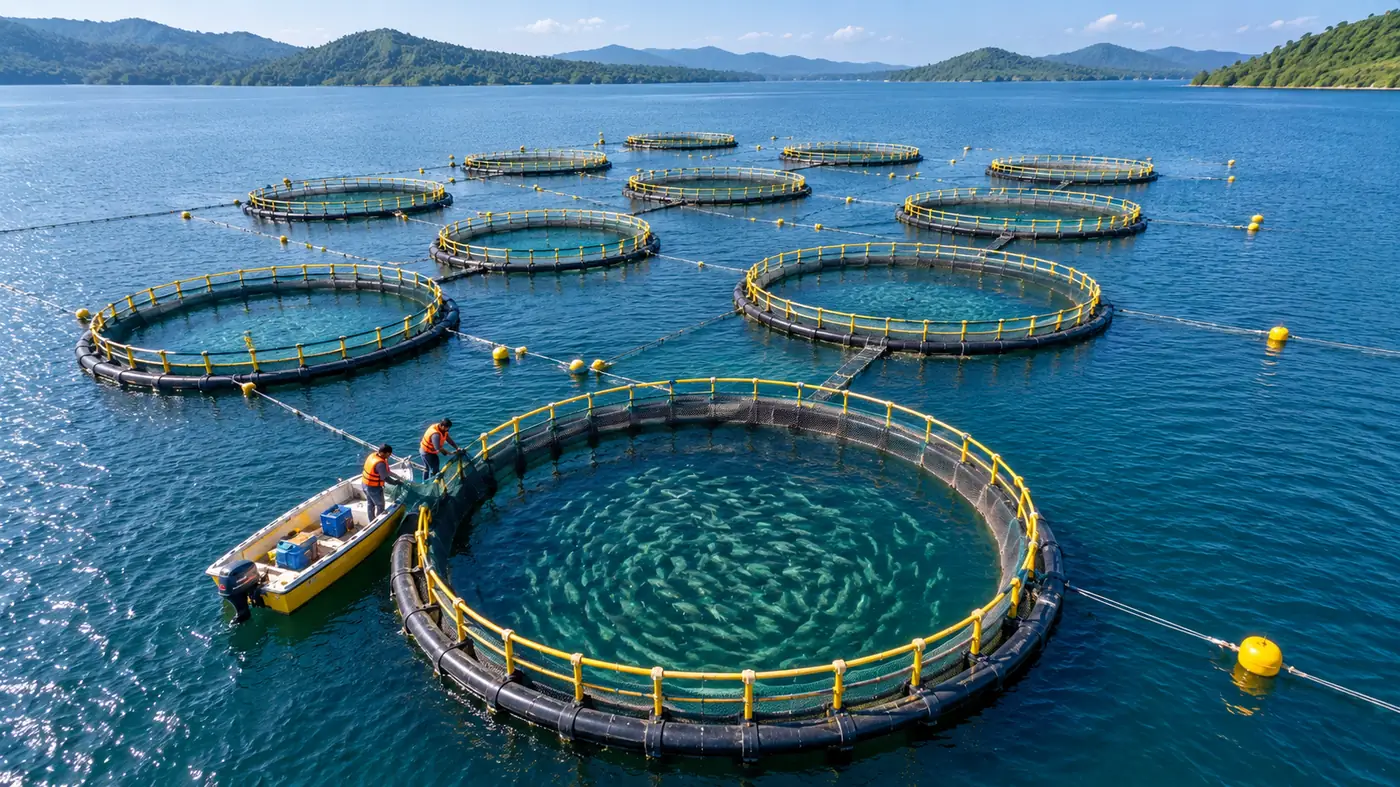
Executive Summary & Key Takeaways
- High-density cage aquaculture unlocks multi-ton commercial finfish production in public dams and reservoirs without requiring expensive agricultural land acquisition or groundwater pumping.
- Circular HDPE PE100 dual-pipe cages (16m–20m diameter) provide extraordinary wave-absorbing flexibility, withstanding 2.0m open-water swells and offering a 15-to-20-year structural lifespan.
- Mooring lines must maintain a 3.5:1 to 5:1 catenary scope ratio with 10–15m of heavy ground chain; concrete deadweight anchors lose 42% of their effective weight underwater due to buoyancy.
- Never allow cage net bottoms to penetrate into deep reservoir thermoclines; maintain net depth strictly within the oxygen-rich epilimnion (>3m above anoxic hypolimnetic layers).
- Stock exclusively robust, pre-nursed fingerlings exceeding 35 grams to eliminate escape through 18mm mesh and prevent predation by wild reservoir piscivores (Wallago, Channa).
- Attach internal 1.0m floating feed skirts to prevent extruded pellets from drifting outside cages; rotate and sun-solarize nets every 30 to 45 days to eliminate biofouling and maintain water exchange.
Field Case Study: 24-Cage Commercial Reservoir Enterprise Turnaround
An inland commercial cooperative operating in a 30-meter deep irrigation reservoir faced frequent cage drift, mooring line breaks during monsoon squalls, and severe winter fish mortalities due to unmanaged thermal stratification. Under AquaSangham structural and biological advisory: 1) Re-engineered the mooring array from individual point anchors to a submerged transverse grid mooring system using 2,200 kg reinforced concrete deadweight sinkers with heavy-link ground chains and 32mm braided polypropylene lines at a 4:1 scope ratio, 2) Stocked graded 35g all-male GIFT fingerlings at 65 fish/m³ in circular 16m HDPE cages (net depth 5.0m), and 3) Installed continuous optical dissolved oxygen profilers across the water column to detect reservoir turnover and thermocline shifts, timing supplemental diffused aeration during autumn overturns. Across 24 cages, the operation achieved 142 metric tons of annual harvest with an average FCR of 1.28, generating ₹1.78 Crores gross revenue and proving the immense scalability of open-water reservoir cage farming in India.
1. The Open-Water Frontier: Reservoirs as India's Finfish Engines
Across the vast geographic expanse of India, freshwater aquaculture has historically been anchored to terrestrial earthen ponds. However, rapid industrialization, urbanization, escalating agricultural land prices (often exceeding ₹25 to ₹40 Lakhs per acre in prime delta districts), and declining groundwater aquifers have created severe structural constraints on the expansion of land-based fish farming. At the same time, India possesses an immense, largely untapped natural resource: over 3.15 million hectares of medium and large inland reservoirs, multipurpose irrigation dams, and deep water bodies distributed across Jharkhand, Odisha, Madhya Pradesh, Maharashtra, Andhra Pradesh, Telangana, Karnataka, and Rajasthan.
In these deep public and private water bodies, High-Density Floating Cage Culture represents the ultimate modern frontier for commercial finfish production. By suspending high-strength mesh enclosures from engineered floating collars in deep, open water, cage aquaculture transforms public reservoirs into prolific aquatic protein engines without purchasing a single square meter of agricultural land. The environmental and economic advantages are immense: continuous natural water currents provide free, unpowered dissolved oxygen exchange; metabolic waste products are diluted into vast hydrological volumes; and capital turnaround is twice as fast as traditional pond systems.
Under commercial management, Genetically Improved Farmed Tilapia (GIFT / Oreochromis niloticus) cultured in deep reservoir cages achieves stocking densities of 50 to 80 fish per cubic meter—producing 35 to 45 kilograms of premium harvest biomass per cubic meter of cage volume. A single standard 16-meter diameter circular HDPE cage (holding approximately 1,000 m³ of net volume) yields 35 to 45 metric tons of 800-gram market fish in a single 130-day crop cycle, equivalent to the annual production of a 5-hectare land-based pond estate.
However, open-water cage farming is an uncompromising engineering discipline. Open reservoirs are dynamic, high-energy environments subject to violent monsoon wind squalls, heavy wave action, dramatic seasonal water level fluctuations (often rising or falling by 10 to 15 meters between monsoon and summer), thermal stratification, and lethal autumn lake turnovers. Under-sizing anchor blocks leads to catastrophic cage drift and net tear-out during storms; placing nets into anoxic hypolimnetic thermoclines causes nocturnal mass fish suffocation; and neglecting biofouling net maintenance restricts water exchange, triggering acute parasitic outbreaks. This comprehensive technical master guide provides the complete engineering, hydrodynamic, and biological standard operating procedure for designing, mooring, stocking, and managing commercial tilapia cage batteries in reservoirs and dams.
Strategic Advantages of Open-Water Cage Mariculture
1. Zero Land Acquisition Capital: Operates on long-term public water leases (₹1,500 to ₹3,000/ha/year) rather than high-cost agricultural real estate.
2. Zero Pumping Energy Costs: Natural thermal convection and wind currents continuously refresh dissolved oxygen and flush metabolic waste.
3. Rapid Scalability: Modular cage batteries can be scaled from 4 cages to 48 cages within weeks, adjusting carrying capacity to market demand.
Before securing a reservoir cage farming lease, request historic 20-year hydrological records from the State Irrigation Department. Ensure the reservoir maintains a minimum conservation water pool depth of at least 10 meters during peak summer drought.
2. Cage Structural Engineering: Circular HDPE vs Modular Steel Batteries
Selecting the appropriate structural framework is the primary engineering decision:
- Circular HDPE PE100 Floating Collars: The global gold standard for medium-to-high energy open-water reservoirs with long fetch lengths (>2 km). Constructed from high-density polyethylene pipes (Grade PE100, PN8 or PN10, outer diameter 250mm to 315mm) welded into dual concentric rings with solid injection-molded polyethylene brackets. The double-pipe design provides redundant buoyancy (even if one pipe is punctured, the cage remains floating) and extraordinary mechanical flexibility, absorbing 1.5 to 2.0-meter breaking waves without structural fatigue. Dimensions: 16-meter diameter (effective circumference 50m, volume ~1,000 m³) to 20-meter diameter (volume ~1,570 m³). Service life exceeds 15 to 20 years.
- Modular Square Galvanized Steel Batteries: Preferred in sheltered, low-energy reservoir bays and coves with short fetch lengths (<1.0 km). Constructed from hot-dip galvanized structural steel box frames (dimensions: 6m length × 6m width × 4m net depth, volume 144 m³) supported by rotationally molded virgin polyethylene floats and fitted with anti-slip fiberglass grating walkways. Multiple square cages are linked into battery blocks (e.g., 2 × 6 cages = 12-cage grid). While offering superior walking stability and easier mechanical grading, steel frames are rigid and susceptible to stress cracking if exposed to heavy swell.
| Engineering Specification | 16m Circular HDPE PE100 Cage | 20m Circular HDPE PE100 Cage | Modular Square Steel Battery (6m × 6m) | Safety Standard / Critical Threshold |
|---|---|---|---|---|
| Circumference / Perimeter | 50.26 Meters | 62.83 Meters | 24.0 Meters per cell | Welded PE100 butt-fusion joint |
| Effective Net Volume (m³) | 1,005 m³ (5.0m net depth) | 1,570 m³ (5.0m net depth) | 144 m³ per cell | Net bottom strictly > 3m above thermocline |
| Floating Pipe Specifications | Dual 250mm OD (PN8/PN10) | Dual 315mm OD (PN10) | Hot-dip galvanized + PE floats | Virgin HDPE with carbon black UV stabilizer |
| Max Wave Height Tolerance | 1.5 – 2.0 Meters wave | 2.0 – 2.5 Meters wave | 0.8 – 1.2 Meters wave | HDPE flexible rings absorb wave kinetic energy |
| Mooring Grid Tensile Rating | 85 – 110 kN Breaking Load | 120 – 150 kN Breaking Load | 65 – 85 kN Breaking Load | 32mm braided polypropylene with steel thimbles |
| Concrete Sinker Block (Air) | 1,800 – 2,200 kg / block | 2,500 – 3,000 kg / block | 1,200 – 1,500 kg / block | Submerged weight = 58% of dry air weight |
| Catenary Mooring Scope Ratio | 3.5:1 to 4.5:1 (Line : Depth) | 4.0:1 to 5.0:1 (Line : Depth) | 3.0:1 to 4.0:1 (Line : Depth) | Prevents vertical uplift on anchor shank |
| Stocking Capacity (GIFT 35g) | 50,000 – 75,000 Fingerlings | 80,000 – 115,000 Fingerlings | 7,500 – 11,000 Fingerlings | 50 to 75 fish / m³ net volume |
| Harvest Biomass Yield / Crop | 35 – 45 Metric Tons | 55 – 70 Metric Tons | 5.5 – 7.5 Metric Tons | 35 to 45 kg / m³ at 800g average harvest |
Fill the outer HDPE floating pipe with closed-cell expanded polystyrene (EPS) beads or polyurethane foam during butt-fusion welding. This guarantees 100% positive buoyancy even if an errant motorboat propeller punctures the pipe.
3. Hydrodynamic Mooring Physics: Drag Forces, Scope & Anchor Sizing
The mooring system is the life-support umbilical of an open-water cage farm. It must withstand maximum drag forces generated by water currents and hurricane-force wind squalls:
- Calculating Total Hydrodynamic Drag Force: The total hydrodynamic load (Ft) acting on a cage array is the sum of net drag (Fn), floating collar wave drag (Fc), and mooring line drag (Fm). Net drag dominates the equation: Fn = 0.5 × rho × Cd × A × V², where rho is water density (1,000 kg/m³), Cd is the drag coefficient of the netting (which increases by 200% to 300% when biofouled with algae and sponges), A is the projected frontal net area, and V is the peak water velocity (current speed + wave orbital velocity). In a 16m cage exposed to a 0.6 m/s current and 65 km/h squall winds, total horizontal thrust exceeds 22 to 28 kilonewtons (kN) per cage.
- Submerged Transverse Grid Mooring Array: Never moor cages using individual, slack ropes tied to trees or random dykes. Deploy a submerged, tensioned orthogonal grid network: four main perimeter mooring lines forming a tensioned box at 3 to 4 meters water depth, with cages tethered inside the grid cells. This isolates individual cages from direct wave shock and ensures uniform load distribution across all anchors.
- Anchor Sizing and Specifications: 1. Reinforced Concrete Deadweight Sinkers: Ideal for rocky, hard, or uneven reservoir beds. Concrete loses roughly 42% of its weight when submerged in water due to Archimedes' buoyancy: Submerged Weight = Air Weight × (1 - 1/Specific Gravity of Concrete). With concrete density at 2.3 g/cm³, a 2,000 kg sinker exerts only 1,130 kg of effective holding friction. Therefore, corner anchor blocks must weigh at least 2,000 to 2,500 kg (in air), cast with bottom steel gripping cleats. 2. Steel Danforth / Stockless Drag-Embedment Anchors: Superior for deep reservoirs with thick silt or clay bottoms. Flukes penetrate deep into the sediment under tension, providing a holding power ratio of 8:1 to 12:1 relative to anchor weight. A 150 kg Danforth anchor provides holding power equivalent to a 1,500 kg concrete block.
- The Catenary Scope Rule: The mooring line length must equal 3.5 to 5.0 times the maximum reservoir water depth (Scope Ratio 3.5:1 to 5.0:1). A heavy-link galvanized stud-link ground chain (10 to 15 meters length, 24mm diameter) must be inserted between the anchor and the 32mm braided polypropylene line. The heavy chain rests on the reservoir bed, absorbing shock loads and ensuring the pulling force on the anchor shank remains strictly horizontal, preventing anchor lifting.
Install spherical high-buoyancy mooring buoys (500L to 1,000L volume) at each grid junction where the anchor line connects to the horizontal bridle. The buoy supports the weight of the steel chain, maintaining horizontal tension regardless of seasonal water level fluctuations.
4. Reservoir Limnology: Thermoclines, Anoxia & Autumn Turnover Management
Deep reservoirs are not uniform bodies of water; they undergo profound seasonal limnological transformations:
- Thermal Stratification & The Anoxic Hypolimnion: Between April and September, solar heating warms the surface water (28°C–32°C), creating a buoyant, oxygenated upper layer (Epilimnion) extending down to 5 to 7 meters. Below this layer lies the Metalimnion (Thermocline), where water temperature drops precipitously by 1.5°C per meter. Below 10 meters depth lies the Hypolimnion: cold (20°C–22°C), completely dark, devoid of light, and 100% anoxic (0.0 ppm DO), saturated with lethal dissolved hydrogen sulfide (H2S), methane, and reduced iron.
- The Critical Net Depth Rule: Net enclosures must never extend deeper than 4.5 to 5.0 meters below the surface. The bottom of the net must maintain a minimum clearance of at least 3.0 meters above the thermocline and at least 5.0 meters above the reservoir bottom sediment. If a cage net penetrates into the thermocline, fish swimming in the lower half of the cage will suffocate in anoxic water.
- The Autumn Turnover Crisis: In October/November, cooler ambient weather cools the surface epilimnion. When surface water temperature drops below hypolimnetic temperature, water density increases, causing the surface water to sink. This triggers an explosive 'Lake Turnover', where anoxic, H2S-laden bottom water surges to the surface within hours. To prevent catastrophic mass mortality during turnover events, farm managers must monitor dissolved oxygen daily across a 10-meter depth profile and install tractor-driven or floating electrical paddlewheels to inject localized surface aeration around cage collars during the turnover window.
Deploy a digital optical dissolved oxygen probe on a 15-meter marked cable. Log DO and temperature readings at 1-meter intervals weekly. If you observe the 4.0 ppm DO boundary rising above 6 meters depth, prepare emergency cage aeration systems immediately.
5. High-Density Stocking Protocols & Extruded Feeding in Open Cages
Achieving superior FCR and rapid growth in high-density cage environments:
- The 35g Stocking Rule: Never stock small 5g or 10g fingerlings directly into open reservoir cages. Small fish escape through standard 18mm predator nets, face high mortality from wild predatory fish (Channa, Wallago attu, Notopterus), and suffer stress in wave chop. Nurse fry in land-based ponds or shallow sheltered nursery hapas until they reach a robust 35 to 40 grams before stocking into grow-out cages.
- Stocking Density Models: 1. Standard Semi-Intensive: 40 to 50 fingerlings per m³ (40,000 to 50,000 fish per 16m cage). Target harvest: 30 to 35 tons per cage. 2. High-Density Intensive: 65 to 80 fingerlings per m³ (65,000 to 80,000 fish per 16m cage). Target harvest: 45 to 55 tons per cage with active net cleaning protocols.
- Floating Feed Collars & Feeding SOPs: Because open reservoirs experience surface wind drift and wave action, broadcasting standard floating pellets directly into cages results in 20% to 30% feed drifting out through the side meshes before fish can consume it. Every cage must be fitted with an internal Floating Feed Skirt (a 1.0m deep, fine 4mm mesh or PVC tarpaulin skirt attached inside the collar). The skirt traps floating pellets within the feeding ring while allowing fish to feed voraciously from below. Feed twice daily at 08:30 and 16:30 hrs at 2.8% body weight, stepping down to 1.6% at harvest to achieve a verified 1.25 to 1.30 FCR.
Install solar-powered automatic demand feeders on the central service pontoon. Broadcasters equipped with directional flingers distribute feed evenly across the cage center, preventing dominant fish from monopolizing the feeding zone and ensuring uniform harvest sizes.
6. Biofouling Control & Net Maintenance Protocols
Biofouling is the silent enemy of cage aquaculture:
- The Mechanics of Net Clogging: In freshwater reservoirs, aquatic biofoulers—primarily filamentous green algae (Spirogyra), freshwater sponges (Spongilla), bryozoans (Plumatella), and silt—rapidly colonize net meshes. Within 14 days, biofouling reduces the effective open aperture of netting by 60% to 80%, choking off natural water currents. Dissolved oxygen inside the cage drops by 2.5 to 3.5 ppm compared to surrounding open water, suppressing fish appetite and inducing bacterial gill rot.
- Net Maintenance Protocol: 1. In-Situ High-Pressure Washing: Deploy a mobile service barge equipped with a diesel-driven high-pressure sea-washer (3,000 PSI) with rotating cleaning heads. Clean the upper 2 meters of netting every 10 to 14 days without removing the fish. 2. Bi-Weekly Net Rotation: Keep a spare net for each cage collar. Every 30 to 45 days, drop the spare net inside the collar, crowd and transfer the fish, remove the fouled net, and hang it on the dyke or service jetty under direct sunlight for 48 hours. Solarization completely kills biofouling organisms, allowing dried algae and sponges to be shaken off easily.
Never use copper-based or chemical antifouling paints on freshwater cage netting. Chemical paints leach toxins into public drinking water reservoirs and are strictly banned by State Water Resource Authorities. Use mechanical high-pressure washing and sun-solarization exclusively.
7. Commercial Economics, Harvest Logistics & ROI per Cage
Commercial economics and return on investment:
- Capital Expenditure (12-Cage HDPE Battery): Capital investment for twelve 16m circular HDPE PE100 cages, heavy grid mooring array, 30-ton concrete anchors, service catamaran barge, automated feeders, and warehouse infrastructure totals approximately ₹65 to ₹75 Lakhs.
- Operational Expenditure & Harvest Revenues: Over a 130-day culture cycle, twelve cages produce 420 to 480 metric tons of prime 800g GIFT Tilapia. With feed costs at ₹68/kg and farmgate sales prices averaging ₹125 to ₹135/kg, annual gross revenues exceed ₹5.2 to ₹6.0 Crores, generating net annual profits exceeding ₹1.6 to ₹2.1 Crores. This confirms that reservoir cage farming is among the highest-yielding agribusiness investments in India today.
Construct a floating crowd net (sweep net) that slides horizontally across the bottom of the circular cage. Pulling the sweep net upward concentrates 10 tons of market fish into a shallow 1-meter brailing pocket within 15 minutes, cutting harvest labor by 70%.
Summary Operational Action Checklist
Frequently Asked Questions
Q: Why is cage culture in reservoirs more cost-effective than building land-based fish ponds?
Land-based aquaculture requires high capital expenditure to buy or lease agricultural land (often ₹25–₹40 Lakhs/acre), earthmoving costs to excavate dykes, and ongoing electric power costs to pump groundwater and run mechanical aerators. In open reservoirs, cage farming operates on low-cost long-term government water surface leases (₹1,500 to ₹3,000/ha/year). Furthermore, natural wind-driven wave action and convective thermal currents continuously flush dissolved oxygen through the cages for free, completely eliminating daytime aeration energy costs and lowering production costs per kilogram by 25% to 30%.
Q: What causes sudden mass fish mortality during 'Lake Turnover' in autumn, and how is it prevented?
In deep tropical reservoirs, warm water floats on top (Epilimnion) while cold, dense, completely anoxic water accumulates at the bottom (Hypolimnion), saturated with toxic hydrogen sulfide (H2S) and methane. In autumn, cooler ambient air chills the surface water until it becomes denser than the bottom water, causing the surface layer to sink. This triggers a rapid, violent 'Lake Turnover' where anoxic, sulfide-rich bottom water surges to the surface within hours. It is prevented by ensuring cage nets do not penetrate within 3m of the thermocline, and operating floating mechanical aerators around cage collars during the turnover window.
Q: How do concrete deadweight anchors lose 42% of their holding weight underwater, and how is it compensated?
Under Archimedes' Principle, any object submerged in water experiences an upward buoyant force equal to the weight of the water displaced. Concrete has an average specific gravity of 2.3 g/cm³. When submerged in water (density 1.0 g/cm³), the effective submerged weight of concrete is: Submerged Weight = Air Weight × (1 - 1/2.3) = 0.565 (or ~58% of its dry weight). A 2,000 kg concrete block weighs only 1,160 kg underwater. To compensate, marine engineers size concrete deadweight anchors with dry weights of at least 2,000 to 2,500 kg, cast bottom gripping cleats, and insert heavy ground chains to maximize seabed friction.
Q: Why are circular HDPE cages far superior to square galvanized steel frames in open reservoirs?
Circular HDPE PE100 cages are built from flexible, high-tensile polyethylene pipes that bend and flex with wave motion, absorbing the kinetic energy of 2.0-meter open-water swells without structural fatigue. Their circular geometry distributes hydrodynamic drag forces symmetrically in all current directions. In contrast, square galvanized steel frames are rigid structures connected by pin hinges; when exposed to heavy reservoir waves, the rigid steel members undergo extreme cyclic fatigue, leading to welded joint cracking, hinge shearing, and pontoon puncture.
Q: How do floating feed skirts prevent 20% to 30% feed loss in open-water cage culture?
Tilapia are fed extruded floating pellets that remain buoyant on the water surface. In open reservoirs, surface wind shear and orbital wave action create rapid surface water drift. When pellets are broadcast into an open mesh cage, surface currents push the floating pellets through the side netting into open water within 5 to 10 minutes, where they are lost to wild fish. A floating feed skirt is an impermeable 1.0m-deep fine-mesh or PVC curtain attached to the inner perimeter of the collar. It traps floating pellets within the feeding ring while allowing fish to swim up from below to feed voraciously.
AquaSangham Technical Advisory
Open-Water Aquaculture Engineering & Limnology Desk
Contributing Senior Technical Writer & Aqua Consultant at AquaSangham.
Recommended Farming Guides
Total Ammonia Nitrogen (TAN) Mass Balance Math: Sizing Biofilters in Commercial RAS
Read Article →Farming TechThe Recirculating Aquaculture System (RAS) Master Guide: Design, Hydraulics & Mass Balance
Read Article →Farming TechIndigenous Magur (Clarias batrachus) Induced Breeding & Nursery Rearing SOPs
Read Article →Get Live Farm Advice on AquaSangham Mobile App
Download India's #1 Aquaculture Super App for real-time market prices, precision tools, and community advice.
Download Free Android App