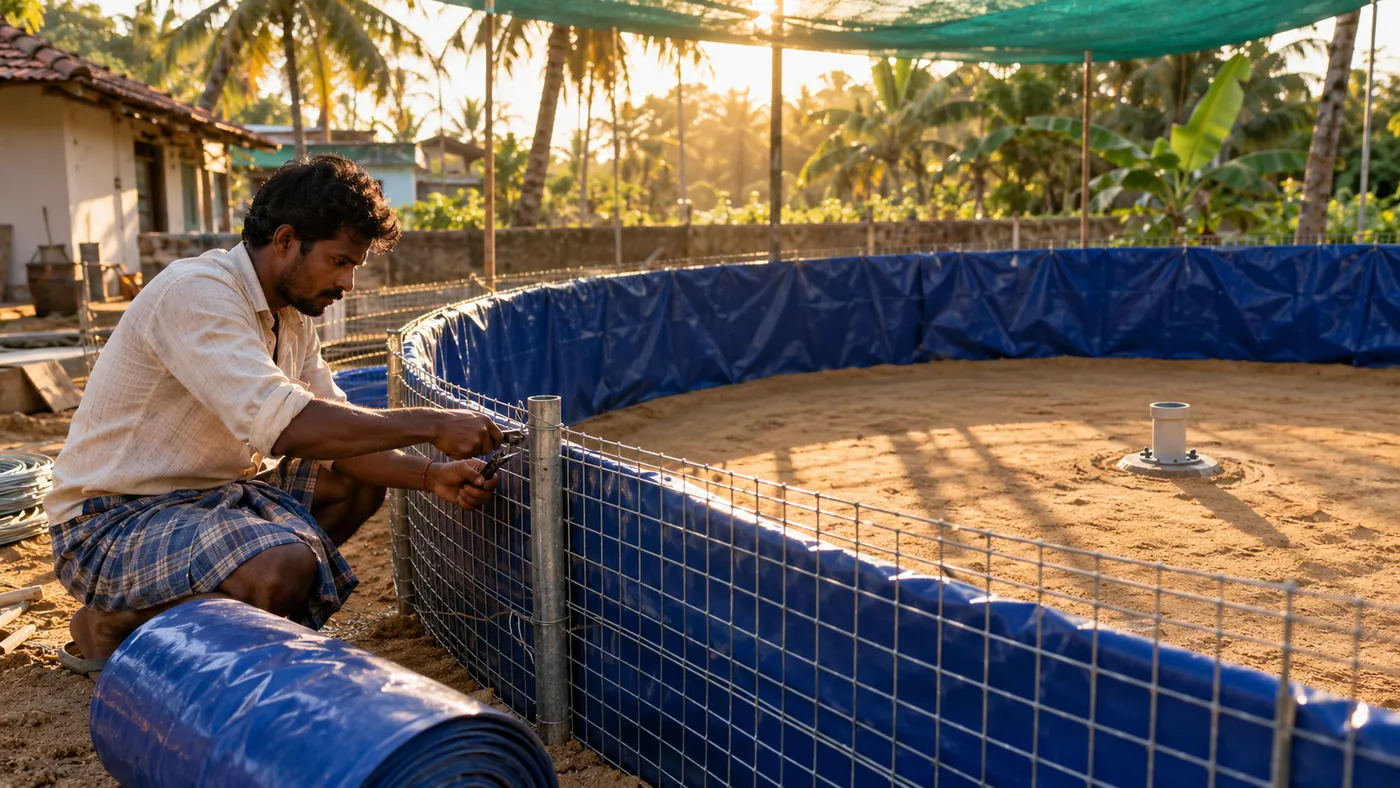
Executive Summary & Key Takeaways
- Commercial turnkey biofloc agencies routinely charge ₹80,000 to ₹1,20,000 for a single 10,000-liter tank, imposing a 150% to 250% middleman markup that cripples small-scale farmer unit economics before water is even filled.
- By procuring industrial raw materials directly—hot-dip galvanized GI weldmesh from steel stockists and 650 GSM virgin PVC tarpaulin from technical textile fabricators—a farmer can build an industrial-grade 4-meter tank for ₹31,850 to ₹34,500.
- The civil foundation is the most critical structural component: a 1:10 to 1:12 central conical slope (10 to 12 cm drop from edge to center) lined with 250 GSM non-woven geotextile is mandatory to create a natural vortex for sludge evacuation.
- Never compromise on liner quality: cheap 250–350 GSM HDPE Silpaulin degrades under UV exposure, punctures easily under 10 metric tons of hydrostatic load, and cannot be repaired underwater, whereas 650 GSM virgin PVC delivers 7 to 10 years of puncture-proof service.
- Central bottom toilet plumbing using Schedule 40 PVC and an exterior telescopic standpipe allows complete expulsion of settled anaerobic sludge in 45 seconds without water-level drops or biofloc collapse.
- A 10,000-liter biofloc unit requires an uninterrupted 100 to 120 LPM diaphragm air pump (consuming 65–80W) coupled with an automatic 12V inverter battery backup to prevent lethal heterotrophic bacterial oxygen suffocation during midnight power outages.
Backyard Biofloc Cluster Turnaround: Srikakulam Farmer Slashes Tank Capex by 63% and Harvests 4.5 Tons of GIFT Tilapia
A rural agri-entrepreneur in north coastal Andhra Pradesh sought to establish an intensive 60,000-liter backyard fish farming unit. Turnkey aquaculture engineering agencies quoted ₹5,30,000 (over ₹88,000 per tank) for supply and installation of six 4-meter tanks. Confronted with crushing capital debt that would require three successive successful crops merely to achieve capital break-even, the promoter partnered with AquaSangham's High-Density Engineering Advisory to execute an in-house procurement and fabrication model. Using local steel stockists, he sourced 4.0mm hot-dip galvanized GI weldmesh (₹38,400 for six rolls), procured certified 650 GSM virgin UV-stabilized PVC tarpaulins with pre-welded 110mm bottom drainage flanges directly from Surat manufacturers (₹43,200 total), laid 250 GSM non-woven geotextile underlay over compacted sand cones, and installed three 120 LPM electromagnetic diaphragm air pumps running parallel 16mm micro-pore aeration grids. Total construction capital came to ₹1,96,500—an audited savings of ₹3,33,500. Stocked with sex-reversed GIFT Tilapia fingerlings at 75 fish/m³ and managed under strict C:N 15:1 carbon-molasses buffering, the cluster achieved 91.2% survival, an average harvest weight of 660 grams in 140 days, and produced 4,514 kg of live fish. Sold directly to local live-market fish vendors at ₹155/kg, gross receipts reached ₹6,99,670 against total operational costs of ₹3,27,670 (seed, 32% extruded feed, electricity, and probiotics), generating a maiden net cash profit of ₹3,72,000 and completely recovering the entire capital investment in a single cycle.
The ₹85,000 Turnkey Fallacy: Why Commercial Kits Fail Farmers
Across India's burgeoning aquaculture sector, biofloc technology (BFT) has been marketed as a revolutionary silver bullet for smallholders, backyard entrepreneurs, and peri-urban landholders. Promoters promise that a 10,000-liter (10 m³) circular tank can produce 600 to 800 kilograms of fish in under five months on an insignificant footprint. Yet, when prospective culturists inquire with commercial aquaculture equipment suppliers or turn-key agencies, they are routinely handed quotations ranging from ₹85,000 to ₹1,25,000 per tank. These exorbitant turnkey packages typically include flimsy prefabricated wire mesh, low-grade imported tarpaulins, sub-standard air pumps, and an opaque 'consultancy fee' that inflates capital expenditure by 150% to 250% above actual raw material costs.
To comprehend why this capital inflation is economically fatal, one must analyze the raw biological carrying capacity and harvest revenue of a 10,000-liter tank. Operating under optimal heterotrophic conditions with GIFT Tilapia or Pangasius, the maximum sustainable harvest biomass is 60 to 80 kg per cubic meter of effective water volume. In a tank holding 10,000 liters (10 m³), this yields an absolute maximum crop of 600 to 800 kilograms. At prevailing Indian wholesale farm-gate prices of ₹140 to ₹160 per kilogram for live or fresh-iced fish, total gross revenue per crop ranges between ₹84,000 and ₹1,28,000. When operational expenditures—fingerling seed (₹3,500), 32% floating commercial feed at 1.25 FCR (₹38,000 to ₹48,000), electricity (₹2,500), probiotics and carbon source (₹4,000)—are subtracted, net operational profit per cycle rarely exceeds ₹35,000 to ₹50,000.
If a farmer invests ₹95,000 in a commercial turnkey tank setup, it requires two to three flawless, consecutive harvest cycles over a span of 12 to 18 months merely to break even on hardware capital—assuming zero disease mortality, zero power failures, and zero market crashes. A single crop wipeout in Month 3 pushes the enterprise into deep debt. Conversely, when a farmer takes direct control of procurement and civil fabrication, the exact same industrial-grade 10,000-liter setup costs between ₹31,850 and ₹34,500. Under this self-fabricated model, the entire capital infrastructure is completely paid off within the very first 140-day crop, transforming biofloc from a high-risk gamble into a highly bankable, repeatable commercial production engine.
The Phantom Value of 'Turnkey Biofloc Kits'
Commercial turnkey kit vendors capitalize on technical intimidation. Novice farmers are told that biofloc tanks require proprietary imported geomembranes, specialized structural alloys, and secret aeration nozzles. In reality, a biofloc tank is fundamentally an engineered circular retaining vessel designed to withstand hydrostatic pressure, prevent liner abrasion, channel settled solids to a central low point, and distribute dissolved oxygen uniformly across the water column.
When unpacked item by item, every component of an industrial-grade tank—from 4mm hot-dip galvanized wire mesh to 650 GSM virgin PVC tarpaulin and Schedule 40 PVC plumbing—is an off-the-shelf industrial commodity manufactured across India. Purchasing these materials directly from regional steel distributors, industrial tarpaulin fabricators, and agricultural hardware stockists eliminates agency markups and yields a structurally superior installation.
Unit Economics: DIY Self-Fabrication vs Turnkey Agency Package
The financial disparity between agency procurement and self-fabrication is stark. An agency quotation for a 4-meter diameter tank typically lists wire mesh at ₹18,000 (actual cost: ₹6,400), tarpaulin liner at ₹22,000 (actual cost: ₹7,200), aeration hardware at ₹26,000 (actual cost: ₹9,800), and plumbing/civil fittings at ₹12,000 (actual cost: ₹4,200), plus installation and freight charges of ₹12,000. Totaling ₹90,000, this setup locks the grower into an unsustainable capital structure.
By mastering the basic civil grading and assembly protocols outlined in this guide, a farmer can fabricate an identical or higher-specification tank using superior 650 GSM virgin Panama-weave PVC and 4.0mm GI mesh for exactly ₹32,850. For a modest commercial cluster of four tanks, this direct procurement strategy saves over ₹2,28,000 in day-one capital—funds that are far better allocated to working capital, high-grade extruded feeds, and automated battery inverter backups.
Never purchase 'package deals' where the vendor refuses to provide an itemized Bill of Materials with specific raw material specifications (GSM, wire gauge, zinc coating, and pump LPM). Unbundling the procurement immediately cuts your initial expenditure by half.
Civil Foundation: Soil Compaction, 1:10 Cone & Geotextile Underlay
The structural integrity and long-term biological success of a biofloc tank are determined entirely by the civil foundation below it. A 10,000-liter tank holds exactly 10 metric tons (10,000 kg) of water. This immense downward mass exerts severe hydrostatic pressure across the floor. If the underlying soil shifts, settles unevenly, or contains uncompacted pockets, the wire mesh frame can tilt, the base liner can stretch beyond its elastic threshold, and catastrophic structural failure will ensue within weeks of filling.
Furthermore, biological management dictates that the tank bottom must never be flat. In a circular water body under continuous aeration, water rotates in a gentle toroidal vortex. Solid wastes—uneaten feed dust, dense bacterial flocs, and fish feces—gravitate inward toward the center due to the 'teacup effect.' If the floor is flat, these solids scatter across the bottom, settle into stagnant dead zones, turn black within 48 hours, and produce lethal concentrations of hydrogen sulfide (H2S), toxic ammonia (NH3), and nitrite (NO2). To harness the vortex, the foundation must be excavated into an inverted cone with a strict 1:10 to 1:12 slope gradient.
For a standard 4.0-meter diameter tank, a 1:10 slope requires that the center of the base be excavated exactly 15 to 20 cm deeper than the outer perimeter rim. This ensures that every gram of settling detritus slides effortlessly down the smooth PVC cone into the central sludge toilet, where it can be purged via hydrostatic pressure in under 45 seconds without disturbing the culture volume.
Step-by-Step Civil Ground Preparation Protocol
Step 1: Ground Clearing & Marking. Select a flat, well-drained site protected from stormwater runoff. Drive a central steel rebar peg into the soil. Attach a 2.3-meter non-stretch cord and scribe a 4.6-meter diameter circle on the ground with agricultural lime. This provides a 30 cm peripheral clear zone around the 4.0-meter tank frame.
Step 2: Excavation & Slope Grading. Excavate the top 10 cm of organic topsoil across the entire circle to remove grass roots, sharp stones, and debris. From the 4.0-meter perimeter boundary, carefully slope the earth downward toward the central peg, creating a continuous, uniform conical drop of 15 cm at the center point.
Step 3: Compaction & Sand Bedding. Moisten the sub-base soil and compact it thoroughly using a 50 kg hand roller or heavy mechanical plate tamper until zero foot indentation occurs. Next, spread a 50 mm layer of washed, sieved river sand (or quarry dust free of sharp pebbles) over the compacted cone. Screed the sand with a straight-edge timber plank pinned to the central drain hub to achieve a glass-smooth, perfectly symmetrical conical surface.
The Geotextile Armor: Preventing Hydrostatic Punctures
One of the most catastrophic shortcuts taken by novice builders is laying the PVC tarpaulin directly on sand or using cheap recycled plastic flex banners as an underlay. Over months of operation, earthworms, burrowing insects, and microscopic sharp gravel particles will migrate through sand under the grinding weight of 10 tons of water, puncturing the bottom liner.
The mandatory engineering solution is non-woven, needle-punched polypropylene geotextile fabric with a minimum density of 250 GSM. Geotextile provides superior puncture resistance, distributes hydrostatic load evenly, and acts as a self-healing cushion between the earth and the waterproof PVC membrane. Cut the geotextile into overlapping segments, radiating outward from the center drain, and tape the seams securely with heavy-duty duct tape before laying the tarpaulin.
Always use a transparent water-level hose or digital laser level when grading the 4.0-meter perimeter rim. If the perimeter ring is off-level by even 3 cm, water will spill over one side while the opposite wall remains under-utilized, creating dangerous uneven hoop tension on the wire mesh.
Structural Skeleton: 4mm Galvanized GI Weldmesh & Framing
The external skeleton of a biofloc tank must withstand immense radial hoop stress generated by 10 metric tons of outward-pushing water. In a 4.0-meter circular vessel with a 1.0-meter water depth, the lateral hydrostatic pressure exerted against the bottom third of the vertical wall exceeds 9.8 kN/m² (kilonewtons per square meter). Cheap chain-link fencing or thin 2.5mm poultry wire will stretch, warp, and rupture outward under this load, causing instant liner blowouts and complete loss of stock.
The engineering standard for commercial biofloc containment is 4.0 mm diameter hot-dip galvanized iron (GI) welded wire mesh with a 3-inch by 3-inch (75 mm x 75 mm) square aperture grid. The wire must be hot-dip galvanized rather than electro-plated, carrying a minimum zinc coating of 275 g/m² to resist corrosive humid air, aerosolized water droplets, and salt exposure over a multi-year service life.
A 4.0-meter diameter tank has a circumference of exactly 12.57 meters (Circumference = π × Diameter = 3.1416 × 4.0 m). When purchasing the weldmesh roll, you must include a mandatory 45 cm structural overlap to ensure seamless structural continuity at the joint. Therefore, order an exact mesh length of 13.02 meters with a standard vertical height of 1.2 meters (allowing a 1.0-meter water operating depth plus a 20 cm safety freeboard).
Mesh Assembly, Joint Lapping & Tension Clamping
Unroll the 13.02-meter length of 4.0mm GI weldmesh and stand it vertically along the pre-marked 4.0-meter perimeter circle. Overlap the two ends by exactly 45 cm (spanning 6 complete mesh squares). Do not rely on soft binding wire to hold this joint; soft wire will shear under hydrostatic expansion.
Fasten the overlapped joint using heavy-duty 8mm stainless steel (SS304) or hot-dip galvanized U-bolt wire rope clips, spaced at 15 cm vertical intervals from bottom to top (a total of 8 clamps along the seam). Tighten each clamp evenly with a socket wrench. For added stability, drive eight 1.5-inch GI pipes (1.8 meters long) vertically 60 cm into the ground around the exterior perimeter, strapping the weldmesh firmly to these upright anchor posts with UV-resistant heavy nylon cable ties.
Top Rim Conduit & Bottom Edge Deburring
Freshly cut GI weldmesh features jagged, razor-sharp cut wire protrusions that will slice through heavy PVC tarpaulin like a blade during installation or daily operation. Every single exposed wire end along the top rim, bottom edge, and vertical seam must be carefully ground down using an angle grinder or wire cutters.
To provide absolute physical protection, take standard 1-inch flexible electrical PVC conduit pipe or rigid 25mm PVC conduit, slit it down its entire length with a utility knife, and press it firmly over the entire top rim of the wire mesh. Secure the conduit every 50 cm with zip ties. This creates a smooth, rounded protective coping that cushions the tarpaulin where it folds over the top edge, preventing friction tear under human weight and aeration movement.
Before installing the tarpaulin, wrap the entire interior face of the GI weldmesh with a single layer of 50% green agro-shade net or 150 GSM foam sheet. This prevents direct metal-to-PVC contact, eliminates pinhole chafing during thermal expansion cycles, and keeps the liner cooler during scorching summer days.
Liner Science: 650 GSM Virgin PVC vs Cheap HDPE Silpaulin
The tarpaulin liner is the singular barrier holding your valuable aquatic crop. In the Indian market, builders are constantly confronted with a major choice: cheap HDPE multi-layer laminated sheets (commonly marketed as Silpaulin, 250 to 350 GSM) versus industrial virgin PVC-coated polyester tarpaulins (550 to 750 GSM). While Silpaulin costs 50% less initially, choosing it for an intensive biofloc tank is one of the most expensive mistakes a farmer can make.
Silpaulin is composed of cross-laminated high-density polyethylene films. While excellent for temporary agricultural covers and shallow pond liners, it exhibits low puncture resistance and poor dimensional stability under point loads. When subjected to continuous aeration vibration, abrasive movement against wire mesh, and 10 tons of water weight, Silpaulin stretches permanently, forms micro-wrinkles where anaerobic sludge collects, and suffers rapid photochemical degradation under intense tropical UV radiation, typically failing within 9 to 14 months.
Conversely, industrial 650 GSM virgin PVC tarpaulin is constructed with a high-tenacity, Panama-weave polyester base fabric (1000D x 1000D thread count) encapsulated on both sides with specialized plasticized polyvinyl chloride. It delivers exceptional tensile strength (>3,000 N/5cm), superior hydrostatic puncture resistance, and an operational lifespan of 7 to 10 years in outdoor aquaculture conditions.
Technical Comparison: 650 GSM Virgin PVC vs 300 GSM HDPE Silpaulin
The engineering properties between these two polymers dictate operational reliability. 650 GSM PVC tarpaulin features: (1) Thermal hot-air welded seams that achieve 100% molecular bonding equal to or stronger than the parent sheet; (2) High elastic memory, allowing it to conform snugly into the conical bottom without folding into sludge-trapping creases; and (3) Complete chemical compatibility with specialized underwater PVC adhesive cements, permitting instant, in-situ repairs without draining the tank in the rare event of a mechanical puncture.
HDPE Silpaulin, by contrast, relies on ultrasonic or hot-wedge tape seals that easily delaminate under shear stress. Furthermore, once punctured underwater, HDPE cannot be solvent-welded; sticky tapes invariably lift off within hours under the biological activity of heterotrophic biofloc bacteria, forcing an emergency premature harvest.
Liner Sizing Dimensions & Pre-Welded Flange Specifications
A standard 4.0-meter diameter tank with a 1.2-meter wall height cannot be constructed from flat rectangular tarpaulin sheets without messy origami folding that creates fatal anaerobic pockets. The liner must be custom-fabricated as a 3D cylindrical hat with an integrated base cone.
Dimensions required when ordering from a technical textile fabricator: (A) Base Diameter: 4.0 meters; (B) Conical Drop: 15 cm deep central cone; (C) Vertical Wall Height: 1.4 meters (providing 1.2m tank height + 20 cm outer fold-over flap); (D) Factory-Welded Bottom Flange: An integrated heavy-duty 110mm (4-inch) PVC flange boot hot-air welded directly into the center of the cone. Sourcing a pre-flanged liner from the factory eliminates the single most common cause of DIY tank leakage.
Specify 'virgin food-grade resin with UV stabilizers and antimicrobial treatment' when ordering your PVC tarpaulin. Low-grade recycled PVC liners leach toxic phthalate plasticizers and heavy metals (lead/cadmium) into the water during the first 30 days, causing unexplained fingerling mortalities.
Central Sludge Toilet & Flange Plumbing: Zero-Leak Siphon Dynamics
In an intensive biofloc tank containing 800 kg of living fish fed at 2.5% of body weight daily (20 kg feed/day), the biological system generates approximately 6 to 8 kg of dry solid waste every 24 hours. While beneficial heterotrophic bacteria convert dissolved ammonia into microbial protein, refractory organic debris, dead bacterial biomass, and mineral silt settle continuously onto the floor. If this sludge is not evacuated regularly, the biological oxygen demand (BOD) spikes violently, crashing dissolved oxygen and causing catastrophic mortality overnight.
The engineering heart of self-cleaning biofloc design is the 'central sludge toilet' connected to an external hydrostatic siphon standpipe. By connecting the lowest central point of the conical floor to an exterior drain pipe, the entire bottom floor can be cleaned in 45 seconds using natural water pressure—without running pumps, without siphoning hoses manually, and without losing more than 2% of the water volume.
The plumbing assembly must utilize rigid Schedule 40 or heavy-duty 6 kg/cm² pressure-rated PVC pipes and fittings. Standard thin-walled agricultural drainage pipes will crack under the shifting earth foundation, resulting in underground leaks that wash away the sand bed and undermine the entire tank.
Installing the Central Bottom Flange Assembly
Step 1: Under-Bed Pipe Trenching. Before laying the sand foundation, dig a 15 cm wide, 25 cm deep trench running from the exact center of the tank foundation outward to an external drainage pit. Lay a 4-inch (110 mm) Schedule 40 PVC pipe at a minimum 2% downward slope. Encase this pipe in lean dry concrete (1:4 cement:sand) so it cannot deflect under the overhead water weight.
Step 2: Center Hub Connection. At the central point, install a 4-inch 90-degree long-radius sweep elbow pointing vertically upward, terminating flush with the bottom of the excavated cone. Mount a heavy-duty 4-inch PVC tank connector flange onto this pipe stub.
Step 3: Gasket Sandwiched Sealing. Cut a precise circular aperture in the geotextile underlay and PVC tarpaulin centered over the flange. Apply a generous bead of high-grade marine-grade polyurethane sealant (Sikaflex 291 or equivalent) on both sides of the liner. Clamp the upper flange ring securely using 316 stainless steel bolts, tightening in an alternating star pattern to compress the EPDM rubber gaskets uniformly. Cover the drain opening with a slotted stainless steel biofloc dome screen (with 8mm slots) to allow sludge passage while preventing fish from being sucked into the drain.
Exterior Telescopic Standpipe Mechanics
Outside the tank perimeter wall, bring the 4-inch drain pipe up vertically using a 90-degree elbow. Install an exterior double-pipe telescopic standpipe or a rotating swivel elbow assembly. The top of the exterior pipe is set exactly level with the desired operating water level inside the tank (e.g., 1.05 meters).
This creates an automated hydrostatic balance: water cannot escape during normal operation. To purge benthic sludge, the operator simply turns a 4-inch quick-release PVC butterfly valve or rotates the exterior swivel pipe downward by 20 degrees for 30 to 45 seconds. The enormous hydrostatic pressure of the 10,000-liter water column instantly forces the thick, concentrated black sludge out of the central sump and into the drainage canal. Once the discharge runs clear, the valve is closed. The entire purge consumes less than 150 liters of water while completely purging the anaerobic hazard.
Never use standard acidic silicone sealants for the bottom flange. Silicone has poor adhesion to plasticized PVC and will peel off within 60 days under underwater biofloc bacterial enzymes. Always use marine-grade polyurethane or MS polymer adhesive sealant.
Aeration Engineering: 100 LPM Diaphragm Pump & Aero-Tube Grid
In a conventional clear-water aquaculture pond, aeration is sized solely to meet the respiration requirements of the cultured fish stock (typically 1.0 to 1.5 HP per ton of biomass). In a biofloc system, however, the biological reality is radically different: the living heterotrophic bacteria that maintain water quality consume twice as much oxygen as the fish themselves. When the Floc Volume (FV) reaches its target range of 15 to 25 mL/L, total system oxygen consumption escalates to 3.5 to 5.0 mg/L per hour.
If dissolved oxygen (DO) falls below 4.0 mg/L, heterotrophic bacteria cease assimilating ammonia, nitrifying bacteria stop oxidizing nitrite into nitrate, and the culture crashes within hours. If DO drops below 2.0 mg/L, massive fish suffocation occurs. Therefore, aeration engineering is not merely an auxiliary feature; it is the non-negotiable life support system of the biofloc tank.
For a 10,000-liter (10 m³) tank, the minimum air delivery requirement is 8 to 10 liters of air per minute (LPM) per cubic meter of water. This establishes a baseline aeration volume of 80 to 100 LPM at an operating backpressure of 1.2 to 1.4 meters of water column (approx. 0.14 bar). A high-efficiency, electromagnetic diaphragm air pump consuming just 65 to 80 Watts provides the ideal balance of high volume, low electrical draw, zero oil contamination, and continuous 24/7 reliability.
Aero-Tube Radial Spider Grid vs Peripheral Ring Layout
Standard coarse-bubble air stones produce large 5mm to 10mm bubbles that rise rapidly to the surface with negligible gas transfer efficiency (less than 3% standard oxygen transfer rate). To achieve high transfer efficiency (12% to 18% SOTR), the tank must be equipped with specialized microporous aeration tubing (Aero-Tube or Aqua-Tube, 16mm outer diameter / 10mm inner diameter), which generates millions of micro-bubbles (100 to 300 microns).
The aeration grid should be fabricated as an 8-arm radial spider or a 3.2-meter circular ring positioned exactly 30 cm inward from the perimeter wall. Construct the manifold frame from 1-inch Schedule 40 PVC pipe, weighted with clean river gravel or encapsulated stainless steel rods so it sinks firmly to the bottom. Mount eight 40 cm lengths of Aero-Tube onto the manifold, connected via 16mm barbed brass or nylon tees. Suspend the aeration ring 5 cm above the tarpaulin floor using rubber spacers. This ensures vigorous upwelling along the perimeter while creating a gentle central suction that sweeps sludge into the bottom toilet without blasting settled flocs apart.
The Midnight Power Outage Trap: Battery Inverter Backup
The most common cause of complete crop loss in intensive Indian biofloc setups is an unmitigated power outage occurring between 1:00 AM and 4:00 AM, when bacterial respiration peaks. In a 10,000-liter tank stocked at 70 kg/m³, dissolved oxygen will plunge from 6.5 mg/L to a lethal 1.2 mg/L in less than 40 minutes if aeration ceases.
Because an electromagnetic diaphragm air pump draws only 65 to 80 Watts, protecting your crop requires very modest capital. Connect the air pump to a standard 600VA or 850VA pure sine-wave home inverter backed by a single 12V 100Ah or 150Ah deep-cycle tubular battery (approx. ₹11,000 investment). This automated UPS setup provides 12 to 16 hours of continuous, uninterrupted aeration during grid outages, ensuring your multi-lakh crop survives while you sleep soundly.
Install a mechanical check-valve (non-return valve) on the air delivery line immediately above the tank water level. Without a check valve, water will siphon backwards down the air hose into your diaphragm pump the instant power trips, instantly destroying the motor coils.
Complete 12-Item Bill of Materials (BOM) & Budget Breakdown
To empower farmers and investors with total commercial transparency, the table below provides the audited, itemized Bill of Materials (BOM) required to build an industrial-grade, 10,000-liter (4-meter diameter x 1.2-meter height) circular biofloc tank in India. All price points reflect real-world 2026 market rates sourced directly from regional industrial suppliers, steel stockists, and PVC fabricators across major aquaculture hubs (Andhra Pradesh, Tamil Nadu, West Bengal, and Gujarat).
Notice that the total fabrication capital stands at exactly ₹32,850. When benchmarked against commercial turnkey suppliers who demand ₹85,000 to ₹1,10,000 for equivalent capacity, this DIY fabrication protocol delivers a direct capital saving of over ₹52,000 per tank (a 61.4% reduction in capital expenditure). For an entrepreneur installing a commercial backyard cluster of 4 tanks, this methodology saves more than ₹2,08,000 in upfront investment.
Every single item specified below has been selected for heavy-duty operational longevity, ensuring a minimum maintenance-free operational life of 7 to 10 years for structural components and 3 to 5 years for continuous-duty aeration machinery.
Procurement Strategy: Where to Buy to Beat Retail Prices
To achieve the exact ₹32,850 budget target, follow strict procurement channels. Never buy wire mesh from retail hardware stores; purchase directly from wholesale welded wire mesh stockists or industrial fencing distributors who sell by the roll or metric weight.
For the 650 GSM PVC tarpaulin, place orders directly with certified technical textile manufacturers based in industrial fabrication clusters like Surat (Gujarat), Coimbatore (Tamil Nadu), or Kolkata (West Bengal). Most manufacturers maintain automated high-frequency hot-air welding machines that can fabricate a seamless 3D conical tank liner with a vulcanized center flange boot and courier it directly to your district via transport logistics within 5 business days.
| Item # | Component Description | Technical Specifications / Grade | Quantity Required | Unit Cost (₹) | Total Cost (₹) |
|---|---|---|---|---|---|
| 1 | GI Weldmesh Frame | 4.0mm Hot-Dip Galvanized Iron, 3"x3" (75x75mm) grid, 1.2m H | 13.02 Running Meters | ₹ 490 / m | ₹ 6,380 |
| 2 | Virgin PVC Tarpaulin Liner | 650 GSM Multi-layer Panama weave, UV-stabilized, 4m base + 15cm cone | 1 Custom Circular Unit | ₹ 7,400 / unit | ₹ 7,400 |
| 3 | Non-Woven Geotextile Underlay | 250 GSM Needle-Punched Polypropylene puncture armor | 20 Square Meters | ₹ 55 / m² | ₹ 1,100 |
| 4 | Civil Foundation Sand & Dust | Washed river sand (1.5 tons) + stone dust (0.5 tons) | 2.0 Metric Tons | ₹ 850 / ton | ₹ 1,700 |
| 5 | Central Drain Flange Assembly | 110mm (4") Sched-40 PVC Flange + EPDM Gaskets + SS316 Bolts | 1 Complete Set | ₹ 1,150 / set | ₹ 1,150 |
| 6 | Sludge Drainage Piping & Valves | 110mm PVC Pipes (6m), 90° Sweeps, 110mm Butterfly Flush Valve | 1 Lot | ₹ 2,450 / lot | ₹ 2,450 |
| 7 | Diaphragm Air Pump | 100 LPM Heavy-Duty Electromagnetic Diaphragm Blower (75W) | 1 Unit | ₹ 5,800 / unit | ₹ 5,800 |
| 8 | Aero-Tube Aeration Ring | 16mm/10mm Micro-Pore Aeration Hose + 1" PVC weighted manifold | 12 Meters Hose + Ring | ₹ 1,850 / lot | ₹ 1,850 |
| 9 | Top Rim & Bottom Cushioning | 1" Slit PVC Conduit Pipe (13m) + 50% Green Agro Shade Net Wrap | 1 Lot | ₹ 920 / lot | ₹ 920 |
| 10 | Structural Hardware & Clamps | 8mm SS304 U-Bolt Clamps (8 pcs), Turnbuckles (2 pcs), Ground Stakes | 1 Set | ₹ 1,100 / set | ₹ 1,100 |
| 11 | Upper Shade Net Canopy | 75% UV-Stabilized Green Shade Netting (5m x 5m) + Bamboo Poles | 25 Square Meters | ₹ 1,200 / lot | ₹ 1,200 |
| 12 | Skilled Fabrication & Civil Labor | 2 Technicians x 1.5 Days (Ground leveling, framing, liner fitting) | 3 Man-Days | ₹ 600 / man-day | ₹ 1,800 |
| — | TOTAL ESTIMATED SETUP CAPEX | Complete Industrial 10,000-Liter Biofloc Unit Ready for Water | Turnkey Functional | — | ₹ 32,850 |
When constructing multiple tanks, buy 4.0mm GI weldmesh in standard 30-meter master rolls and purchase PVC plumbing in 6-meter bundle packs. Sourcing for a 4-tank cluster lowers your per-tank CAPEX from ₹32,850 down to approximately ₹29,400.
Summary Operational Action Checklist
Frequently Asked Questions
Q: Can I use cheap 250 GSM Silpaulin instead of 650 GSM PVC to save ₹4,000?
We strongly advise against it. While 250 GSM Silpaulin saves ₹3,500 to ₹4,000 initially, it stretches permanently under 10 metric tons of hydrostatic pressure, forms anaerobic sludge wrinkles, and suffers photochemical degradation within 9 to 12 months. In contrast, 650 GSM virgin Panama-weave PVC tarpaulin lasts 7 to 10 years, resists puncture from fish spines and maintenance tools, and can be repaired underwater with PVC adhesive cement without terminating your crop.
Q: How many fish can I realistically harvest from this 10,000-liter biofloc tank?
In a properly managed 10,000-liter (10 m³) tank with continuous 100 LPM aeration and a stabilized C:N ratio of 15:1, you can comfortably stock 1,000 to 1,200 fingerlings of Genetically Improved Farmed Tilapia (GIFT). Targeting an average harvest weight of 600 to 650 grams in 130–140 days at 90% survival yields 550 to 700 kilograms of harvestable biomass (55 to 70 kg/m³). For Pangasius, production can reach 700 to 800 kilograms per cycle.
Q: What is the monthly electricity cost to run a 10,000-liter biofloc tank?
The primary continuous electrical load is the 100 LPM electromagnetic diaphragm air pump, which consumes approximately 75 Watts. Running 24 hours a day for 30 days consumes exactly 54 kilowatt-hours (units) of electricity per month (0.075 kW x 24 hrs x 30 days = 54 kWh). At standard rural or agricultural commercial tariffs of ₹7.50 to ₹9.50 per unit in India, the total monthly power bill is just ₹405 to ₹513.
Q: Why is a central slope mandatory? Can I build a flat-bottom biofloc tank?
A flat-bottom biofloc tank will fail biologically. In circular tanks, water circulation naturally concentrates fish waste, uneaten feed, and dead flocs into the center. On a flat floor, this detritus scatters into stagnant pockets that turn black and anaerobic within 48 hours, releasing lethal hydrogen sulfide (H2S) gas. A 1:10 conical slope forces all settling solids into the central drain hub, where they can be flushed via hydrostatic pressure in 45 seconds.
Q: Do I need a government subsidy to make this 10,000-liter biofloc tank profitable?
No. While the Pradhan Mantri Matsya Sampada Yojana (PMMSY) provides 40% to 60% capital subsidies for large commercial biofloc projects, the administrative delays and DPR consultancy fees often offset initial gains for smallholders. Because our self-fabrication blueprint costs only ₹32,850, the entire investment is fully recovered from the net profits of your very first 140-day harvest cycle without requiring any government subsidy.
AquaSangham Engineering Advisory
High-Density Aquaculture Infrastructure & Civil Systems Division
Contributing Senior Technical Writer & Aqua Consultant at AquaSangham.
Recommended Farming Guides
The 3 AM Oxygen Trap: Why Fish and Shrimp Die at Dawn (And The 4.0 ppm Rule That Saves Them)
Read Article →Water QualityWhy Sudden Monsoon Rain Wipes Out Shrimp Overnight (And The 30-Minute Emergency Lime Protocol That Saves Your Pond)
Read Article →Market AnalysisEU & US Seafood Traceability Audits: Keeping Digital Farm Logs to Secure ₹15-₹20/kg Premium from Exporters
Read Article →Get Live Farm Advice on AquaSangham Mobile App
Download India's #1 Aquaculture Super App for real-time market prices, precision tools, and community advice.
Download Free Android App