Executive Summary & Key Takeaways
- Kappaphycus alvarezii exhibits one of the highest photosynthetic growth velocities in the marine plant kingdom, consistently compounding biomass at a Daily Specific Growth Rate (SGR) of 4.8% to 6.2% under optimal coastal conditions.
- A standard 3m x 3m bamboo cultivation raft seeded with 100 kg of healthy vegetative fragments reliably yields 850 kg to 1,020 kg of fresh wet biomass in exactly 45 days, achieving a 8.5X to 10X multiplication with zero supplemental feeding or chemical fertilization.
- Commercial viability requires strict site selection: water depth must maintain 1.5 to 4.0 meters at Lowest Astronomical Tide (LAT), current velocities must range between 15 and 30 cm/second, and salinity must remain buffered between 28 and 35 ppt.
- The primary biological hazard—'Ice-Ice' disease—is triggered by thermal stress (>31.5°C), low salinity (<25 ppt during monsoon discharge), or light oversaturation, causing tissue whitening, carrageenan degradation, and thallus fragmentation.
- Operating a commercial concession of 500 floating rafts on a 45-day staggered rotational cycle allows a grower to harvest 10 to 12 rafts daily, creating continuous daily cash flow and delivering annual net operating surpluses exceeding ₹14.5 to ₹18.2 Lakhs.
- Growers maximize profit margins by adopting dual-stream processing: pressing fresh seaweed within 12 hours of harvest extracts high-value Liquid Seaweed Fertilizer (LSF) sap (selling at ₹25–₹35/L) while sun-drying the remaining solid residue into export carrageenan flakes (selling at ₹85–₹110/kg).
Commercial Mariculture Case Study: Scaling a 500-Raft Kappaphycus Concession to ₹16.4 Lakhs Net Annual Profit
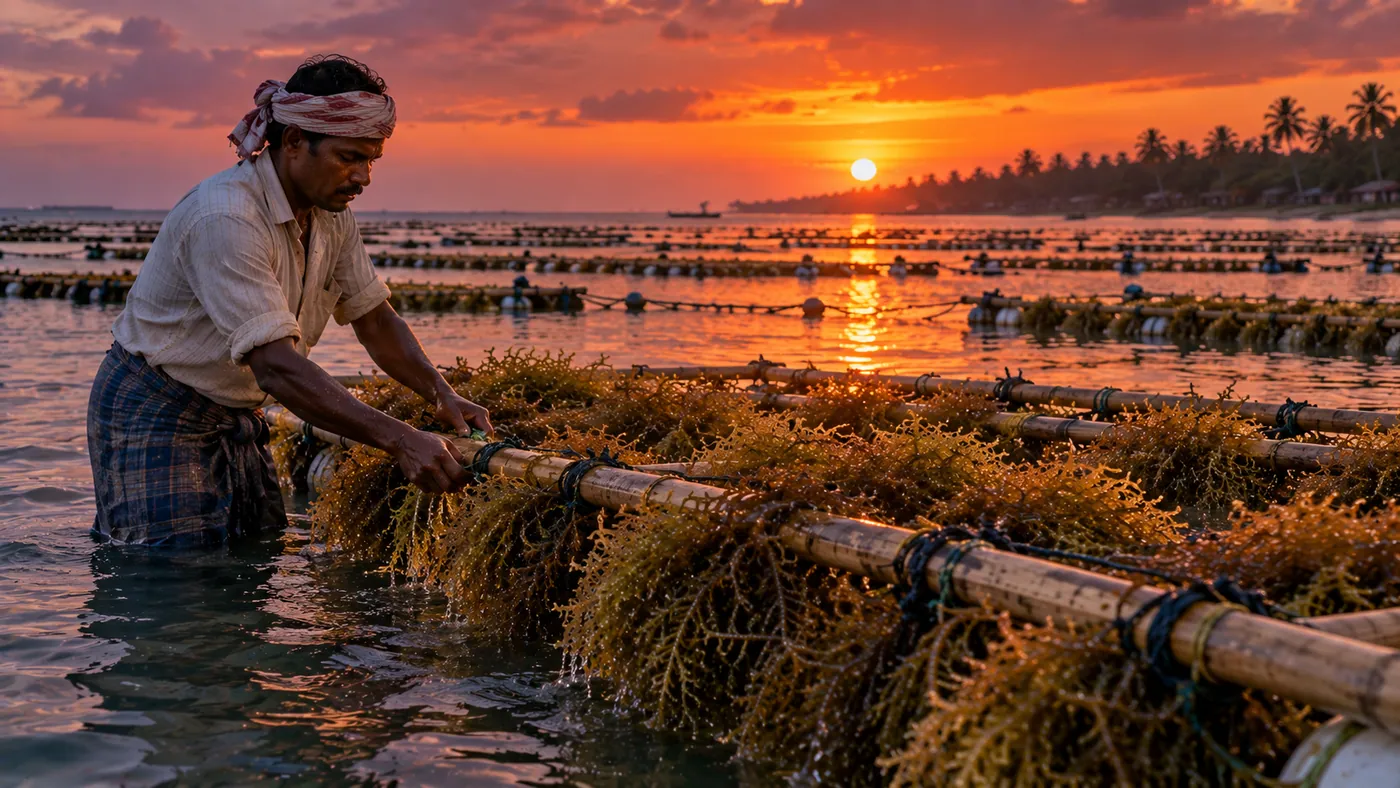
A coastal mariculture entrepreneur in Munaikkadu, Ramanathapuram district, leased a 2.5-hectare shallow sheltered coastal concession to establish a commercial-scale Kappaphycus alvarezii seaweed production farm. Working with AquaSangham coastal phycoculture advisories and ICAR-CSMCRI protocols, the enterprise executed a phased 500-raft modular deployment: (1) Constructed 500 floating bamboo rafts (3m x 3m) using mature, seasoned bamboo treated with organic water-repellent sealant, anchored in arrays of 20 with 35kg concrete gravity blocks and 8mm UV-treated polypropylene anchor warps; (2) Sourced 50,000 kg of certified, fast-growing vegetative Kappaphycus seed propagules (stocking 100 kg per raft in 20 hanging rope braids with 100g seed clusters); (3) Adopted a rotational harvesting schedule that pulled 10 mature rafts daily on a strict 45-day cycle; (4) Eliminated 'ice-ice' syndrome during peak summer water warming (32.5°C) by releasing anchor slack to submerge rafts 35 cm below the surface during midday thermal spikes; and (5) Implemented dual-stream value addition by establishing an on-shore mechanical screw-press to extract 42,000 liters of liquid seaweed plant biostimulant sap (sold at ₹28/L to regional fertilizer blenders) while sun-drying the leftover fibrous cake on raised mesh tables to produce 11,200 kg of Grade-A dry carrageenan chips (sold at ₹92/kg to export extractors). Across 12 months, the concession generated gross revenues of ₹22.06 Lakhs against total operating expenses of ₹5.64 Lakhs (primarily local boat tender wages and replacement rigging), netting an audited operating profit of ₹16.42 Lakhs with a capital payback window of just 7.5 months.
1. The 10X Biology: Vegetative Growth Kinetics of Kappaphycus alvarezii
Kappaphycus alvarezii (commonly traded as cottonii) is a tropical rhodophyte (red macroalgae) renowned across global mariculture for its extraordinary metabolic rate and high industrial carrageenan content. Unlike terrestrial crops that require root networks, vascular soil transport systems, and chemical fertilizer inputs, Kappaphycus absorbs dissolved marine nutrients—principally nitrates (NO3-), ammonium (NH4+), and orthophosphates (PO4^3-)—directly across its entire outer cortical cell layer through passive diffusion and active ionic pumps powered by constant wave agitation.
Under commercial farming conditions in coastal India (notably along the coral reef fringes of the Gulf of Mannar, Palk Bay, and Saurashtra coast), Kappaphycus exhibits a Daily Specific Growth Rate (SGR) between 4.8% and 6.2% per day. Mathematically, Specific Growth Rate is governed by the compound expansion formula: SGR (%/day) = [ln(W_t / W_0) / t] * 100, where W_0 is initial seeded weight (typically 100 kg per raft), W_t is harvest weight, and t is culture duration (45 days). At an average SGR of 5.2% per day, an initial 100 kg seeding doubles its vegetative biomass every 13.5 days, expanding into 800 to 1,000 kg of dense, succulent, glistening thalli by Day 45.
The plant's anatomy consists of cartilaginous, cylindrical or compressed branches (thalli) that produce prolific lateral branchlets and apical growing points. When farmers fragment healthy mother plants into 100-gram to 150-gram vegetative propagules, the mechanical cutting stimulates rapid wound healing followed by intense meristematic cell division at the branch nodes. Over a 45-day cycle, the internal dry matter of the plant accumulates rich reserves of kappa-carrageenan—a high-molecular-weight sulfated galactan polysaccharide that accounts for 32% to 38% of the seaweed's total dry weight and forms the foundational gelling agent for global food, cosmetic, pharmaceutical, and tissue-engineering industries.
Photosynthetic Saturation and Depth Dynamics
Kappaphycus utilizes phycoerythrin and phycocyanin as accessory photosynthetic pigments alongside Chlorophyll-a, allowing it to harvest blue-green solar spectrum wavelengths that penetrate coastal waters. Maximum photosynthetic saturation occurs at irradiance levels between 15,000 and 28,000 lux (approximately 300 to 550 μmol photons/m²/s).
If rafts are positioned too close to the surface in shallow, crystal-clear water during peak Indian summer (March to May), excessive solar ultraviolet radiation causes photoinhibition and cellular bleaching. Conversely, if rafts are moored in turbid water where light penetration drops below 1.0 meter Secchi disc visibility, SGR plummets below 2.0% per day, leading to stunting and epiphytic smothering.
Why Seed Selection Dictates 60% of Harvest Volume
A fatal beginner error in seaweed farming is using old, fibrous basal stems or biofouled remnants as planting material. Commercial operations must exclusively select young, flexible, elastic apical tips (100–150g fragments) displaying vibrant olive-brown or golden-amber coloration and crisp turgor pressure.
Old woody thalli possess lower concentrations of active auxin-like growth hormones and exhibit SGRs under 2.5% per day. By systematically grading seed propagules during each harvest and re-seeding only the top 20% most vigorous apical branches, commercial farms achieve positive genetic selection, compounding cumulative yield gains across successive 45-day cycles.
Never allow harvested seed fragments to remain exposed to open air or direct sun for more than 40 minutes. Keep cut propagules submerged in perforated crates in ambient seawater. Fresh Kappaphycus cells experience rapid osmotic desiccation and thallus leakage if allowed to dry before tying, reducing subsequent SGR by up to 40%.
2. Site Selection & Marine Hydrology: The 5 Non-Negotiable Coastal Thresholds
In terrestrial agriculture, soil chemistry determines crop success; in seaweed mariculture, the marine hydrological regime is the sole arbiter of profitability. Kappaphycus possesses no roots to hold itself against extreme breakers, nor does it have internal pumps to drive nutrient circulation in stagnant water. The grower is completely dependent on ambient ocean currents to deliver dissolved carbon and nitrogen while carrying away metabolic waste products.
Commercial mariculture concessions must evaluate five hydrological benchmarks before deploying capital: water movement velocity, seasonal salinity stability, bathymetric depth profile, bottom substrate composition, and proximity to terrestrial monsoon runoff. Locating a 500-raft farm in an area that fails even one of these parameters will result in massive thallus breakage during monsoons or total crop death from 'ice-ice' bacterial whitening during dry-season stagnations.
The ideal commercial environment in India is found within protected coastal bays, barrier reef lagoons, and intertidal flats sheltered from open-ocean cyclone swells—such as the Palk Bay coast (Mandapam, Rameswaram, Olaikuda, Devipattinam, Thondi), sections of the Gulf of Mannar, and the sheltered coves of Gujarat's Saurashtra coast (Okha, Mithapur, Simbor).
The Critical 15–30 cm/s Water Current Sweet Spot
Continuous water velocity between 15 cm/second (0.3 knots) and 30 cm/second (0.6 knots) is mandatory. This moderate flow creates dynamic mechanical agitation across the hanging ropes, stripping the stagnant diffusion boundary layer from the plant surface and maximizing nutrient uptake.
Water currents below 10 cm/second cause immediate silt deposition on the thalli, attracting opportunistic epiphytic green algae (Enteromorpha and Chaetomorpha) and precipitating bacterial rot. Water currents exceeding 50 cm/second cause severe mechanical shearing, snapping brittle thalli and causing 30% to 50% biomass loss into the open sea.
Salinity Buffers and Monsoon Drainage Hazards
Kappaphycus alvarezii is a stenohaline marine macroalgae requiring salinity between 28 ppt and 35 ppt for optimal osmotic homeostasis. While it can tolerate short dips to 25 ppt for 48 to 72 hours, exposure to brackish water below 22 ppt causes rapid cell lysis: water rushes into algal cells via osmosis, bursting cell walls and initiating catastrophic 'ice-ice' whitening within 4 days.
Farm concessions must be situated at least 3.5 to 5.0 kilometers away from river mouths, major irrigation drainage canals, and estuary outlets that discharge heavy freshwater volumes during the Southwest and Northeast monsoons. In southern Tamil Nadu, growers strategically pause open-lagoon seeding during peak Northeast monsoon rainfall (late October to November) or shift rafts to deeper marine channels.
| Hydrological Parameter | Optimal Commercial Range | Marginal Warning Range | Lethal / Unviable Threshold |
|---|---|---|---|
| Water Current Velocity | 15 – 30 cm/second | 10 – 14 or 31 – 45 cm/s | < 8 cm/s (stagnation) or > 55 cm/s (breakage) |
| Salinity Level | 28 – 35 ppt | 24 – 27 or 36 – 38 ppt | < 22 ppt (osmotic lysis) or > 42 ppt |
| Water Temperature | 27°C – 31°C | 25°C – 26°C or 31.5°C – 32.5°C | < 22°C (stunted) or > 33.5°C (ice-ice death) |
| Low-Tide Water Depth (LAT) | 1.5 – 3.5 meters | 1.0 – 1.4 meters | < 0.8 meters (air exposure & bottom rubbing) |
| Secchi Disc Transparency | 1.2 – 2.5 meters | 0.8 – 1.1 meters | < 0.5 meters (turbid silt smothering) |
| Dissolved Reactive Nitrate (NO3) | 1.5 – 4.5 μmol/L | 0.8 – 1.4 μmol/L | < 0.4 μmol/L (nutrient starvation) |
3. Modular Raft Engineering & 500-Raft Concession Grid
The physical architecture of a commercial seaweed farm must balance hydrodynamics, structural durability, worker ergonomics, and low capital expenditure. Across tropical Asia and coastal India, the standard 3.0-meter by 3.0-meter floating square bamboo raft remains the gold standard for shallow lagoons, delivering the lowest cost per square meter of cultivated surface while absorbing wave shock through flexible natural joints.
To construct a durable commercial raft, four mature, seasoned bamboo poles (each 3.2 meters long with a minimum base diameter of 8 to 10 cm) are lashed together into a rigid square frame using 4mm UV-stabilized virgin polypropylene rope. Rather than rigid nail or screw fixings—which split bamboo fibers under repetitive wave torsion—fishermen utilize traditional cross-diagonal marine clove hitch knots with shock-absorbing coir or rubber shims. Synthetic net floats or sealed 20-liter HDPE drums are lashed to the corners to provide 60 kg of reserve buoyancy, ensuring the bamboo frame remains floating 10 to 15 cm above the water surface even when weighed down by a full 1,000 kg mature seaweed crop.
Across the interior of the 3m x 3m frame, 20 parallel cultivation lines (each 3.2 meters long, made from 3mm or 4mm twisted polypropylene rope) are tied at 15 cm intervals. On each cultivation line, 20 vegetative seed propagules (each weighing 100 grams) are attached at 15 cm spacing using soft 1.5mm polypropylene or polyethylene 'tie-tie' braids or tubular net sleeves. Thus, each raft holds exactly 400 seed clusters totaling 40 kg to 100 kg of initial biomass, suspended 15 to 25 cm beneath the water surface directly in the photic and nutrient stream.
500-Raft Concession Grid and Mooring Geometry
Commercial efficiency requires deploying rafts not as isolated free-floating units, but in structured modular grids. A 500-raft commercial concession is organized into 25 mooring blocks, with each block consisting of 20 rafts lashed together in two parallel lines of 10 rafts (a 2x10 array).
Between parallel rafts within a block, a 1.5-meter buffer line is maintained. Between adjacent 20-raft blocks, a 12-meter open marine navigation corridor is established to allow fiberglass tender skiffs and harvest transfer catamarans to service rafts without entangling anchor lines. The entire 20-raft block is anchored at both ends using 35kg to 50kg reinforced concrete deadweight blocks (or 25kg Danforth anchors in sandy bottoms), connected via 10mm polypropylene anchor warps rigged with a 3:1 scope (anchor rope length equals 3 times maximum high-tide depth) to prevent storm dragging.
Raft Method vs. Monoline Longline Method: When to Use Which
While floating bamboo rafts excel in calm bays (< 1.0 meter wave height) by keeping thalli oriented horizontally to maximum sunlight, open-sea coastal zones subject to strong monsoonal swells require the Monoline Longline Method. In this system, 50-meter longlines of 8mm polypropylene rope are suspended between anchored 200-liter buoys, with seaweed fronds tied directly to the mainline.
Longlines exhibit lower water resistance, shedding energy during rough seas where rigid bamboo frames would splinter. However, bamboo rafts produce 22% higher average SGR and simplify daily maintenance, making them the undisputed choice for shallow lagoons like Ramanathapuram and Gulf of Kutch.
| Component / Material | Specification & Grade | Quantity per 3m x 3m Raft | Turnkey Cost per Raft (₹) | Lifespan & Replacement |
|---|---|---|---|---|
| Main Frame Bamboo Poles | Seasoned, 3.2m length, 8–10cm dia | 4 poles | ₹ 520 | 8 – 12 months (seasonal rotation) |
| Frame Lashing Rope | 4mm UV-treated virgin PP rope | 18 meters (0.25 kg) | ₹ 45 | 12 – 18 months |
| Cultivation Hanging Lines | 3mm 3-strand PP twisted rope | 64 meters (0.65 kg) | ₹ 110 | 12 months |
| Seed Tie-Tie Cords | 1.5mm soft PE ribbon / tubular braids | 400 ties (0.35 kg) | ₹ 65 | 6 – 8 months (reusable 4 cycles) |
| Corner Flotation Floats | 10-liter virgin HDPE sealed canisters | 4 units | ₹ 240 | 24 – 36 months |
| Anchor Rope & Share | 8mm PP anchor warp (share of block) | 12 meters (0.45 kg) | ₹ 80 | 24 months |
| Mooring Anchor Share | 35kg cast concrete block (share of block) | 0.1 unit equivalent | ₹ 70 | 36+ months |
| Local Assembly & Rigging Labor | Artisanal coastal rigging technician | 0.25 man-day | ₹ 150 | One-time per build |
| Total Turnkey Cost per Raft | Fully rigged, anchored, ready to seed | 1 Complete Unit | ₹ 1,280 | Annualized Capex: ₹ 980 / yr |
4. The 45-Day Culture Calendar & Ice-Ice Disease Prevention
Managing a commercial seaweed farm requires rigorous adherence to a 45-day operational calendar. Unlike finfish or shrimp culture where stocking occurs in bulk and harvest is conducted at the end of a 120-day crop, seaweed mariculture achieves maximum profitability through continuous rotational harvesting. In a 500-raft farm, exactly 11 to 12 rafts are harvested, cleaned, and re-seeded every single day of the month, establishing an unbroken daily cash-flow pipeline.
During the 45-day growth cycle, the seaweed undergoes three distinct physiological phases: (1) Days 1 to 10: Acclimation and Wound Callus Formation, where fragmented cut ends seal and initial lateral branch buds erupt (SGR ~ 3.5%/day); (2) Days 11 to 32: Exponential Vegetative Branching, where lush thalli expand rapidly, interlocking between hanging ropes (SGR peaks at 5.5%–6.5%/day); and (3) Days 33 to 45: Carrageenan Densification and Apical Maturation, where vegetative expansion stabilizes and structural polysaccharide synthesis maximizes gel strength (SGR ~ 4.2%/day).
Harvesting must occur strictly between Day 42 and Day 47. Harvesting prior to Day 40 sacrifices up to 25% of potential final biomass because the exponential growth phase is cut short. Conversely, delaying harvest past Day 50 leads to catastrophic losses: dense fronds shade internal branches, water current circulation drops, self-fouling begins, and mature, brittle branches snap off under their own deadweight, washing away into the open ocean.
Routine Field Maintenance: The Weekly Raft Shake SOP
The simplest yet most vital task on a seaweed farm is the Weekly Raft Shake. Operating from flat-bottom fiberglass canoes, technicians lift each bamboo frame corner and vigorously shake the raft for 30 to 45 seconds twice a week.
This mechanical agitation dislodges settled fine silt, silts out debris, and detaches opportunistic filamentous green biofoulers (Enteromorpha, Chaetomorpha, and Ectocarpus). Left undisturbed, epiphytic algae wrap around Kappaphycus branches within 7 days, competing for sunlight and dissolved bicarbonate, and creating micro-lesions through which pathogenic bacteria invade.
The Ice-Ice Disease Protocol: Early Detection and Triage
Ice-Ice disease is the single greatest biological threat to commercial Kappaphycus farming worldwide. It is not caused by a single virulent pathogen, but is an abiotic stress-induced syndrome: when the plant experiences extreme environmental shock—such as water temperatures rising above 31.5°C, salinities falling below 25 ppt, or intense ultraviolet radiation during calm glassy doldrums—its physiological defense mechanisms collapse.
Stressed thalli produce organic exudates that attract opportunistic marine bacteria (predominantly Vibrio, Cytophaga, and Pseudomonas species). These bacteria secrete agarase and carrageenase enzymes that digest the algal cell wall, turning the thallus chalky white, brittle, and translucent (resembling ice). Within 48 to 72 hours, the affected branches disintegrate and snap, destroying entire crops.
To prevent ice-ice during peak summer warming, growers deploy the Submersion Protocol: anchor warps are slacked off, allowing the bamboo rafts to sink 30 to 40 cm below the surface into cooler, UV-filtered water. If ice-ice patches appear on isolated branches, technicians immediately cull the infected thalli using sharp shears, disposing of them on land to prevent bacterial dispersal across adjacent lines.
Never harvest or seed rafts immediately before or during extreme neap tides in peak summer. During neap tides, tidal exchange slows to a crawl, water temperatures in shallow lagoons can spike by 2.5°C in a single afternoon, and dissolved oxygen drops. Plan heavy handling and re-seeding operations during spring tide windows when vigorous tidal flushing protects cut propagules from bacterial colonization.
5. Dual-Stream Monetization: Liquid Seaweed Fertilizer (LSF) Sap vs. Sun-Dried Carrageenan Chips
Historically, Indian seaweed farmers operated under an exploitative single-channel commodity model: they harvested Kappaphycus, sun-dried the whole plants on coastal sand, and sold low-grade dried raw material to middlemen for ₹25 to ₹45 per kilogram. This obsolete method resulted in heavy sand contamination (often > 8% silica), degraded carrageenan molecular weight from uncontrolled sun-bleaching, and wasted over 85% of the plant's biological value.
Modern commercial enterprises utilize the revolutionary Dual-Stream Biorefinery Processing Model pioneered by CSIR-CSMCRI. Under this system, 100% of the harvested wet biomass is valorized into two separate, high-margin commercial products: (1) Fresh Liquid Seaweed Fertilizer (LSF) Sap, and (2) High-Purity Dry Carrageenan Pulp Chips. This dual processing model immediately doubles the gross revenue per metric ton of harvested seaweed.
Immediately upon landing at the coastal jetty (within 6 to 12 hours of harvest), fresh Kappaphycus fronds are washed with clean ambient seawater to remove surface debris and fed into an industrial stainless-steel continuous mechanical screw-press or roller crusher. The mechanical compression ruptures the cortical cells without degrading intracellular bioactive molecules, expressing 60% to 65% of the fresh plant's weight as concentrated, nutrient-rich liquid sap, while discharging the remaining 35% to 40% as a damp, fibrous cake.
Stream 1: Liquid Seaweed Fertilizer (LSF) Sap Economics
Kappaphycus sap is an extraordinary natural plant biostimulant, rich in macro-nutrients (potassium, nitrogen, phosphorus), secondary nutrients (magnesium, sulfur), and potent endogenous phytohormones—principally kinetin, trans-zeatin (cytokinins), indole-3-acetic acid (auxins), and gibberellins.
When filtered, stabilized with 0.02% potassium sorbate or sodium benzoate, and packaged into 20-liter and 200-liter barrels, this liquid biostimulant is purchased by agricultural input corporations, organic fertilizer formulators, and tea plantation syndicates across South India at ₹25 to ₹38 per liter at farmgate. Applied as a 2% to 5% foliar spray, it boosts yields of paddy, sugarcane, cotton, grapes, and horticultural crops by 15% to 28% while improving drought resistance.
Stream 2: Sun-Dried Carrageenan Pulp Chips
The solid fibrous cake discharged from the screw press retains 100% of the plant's valuable kappa-carrageenan matrix, having shed only cellular sap and moisture. This damp pulp is immediately transferred to raised slatted bamboo or mesh-wire drying platforms elevated 80 cm above the ground.
By drying on elevated platforms rather than coastal sand, silica contamination is kept strictly below 1.0%. The material dries down to a standard 32% to 35% export moisture content within 48 to 60 hours under coastal sun. Industrial carrageenan extraction plants in Madurai, Kochi, and international markets in Southeast Asia purchase this clean, semi-refined dry pulp at ₹85 to ₹115 per kilogram—commanding a 40% premium over dirty, sand-encrusted whole dry weed.
| Processing Metric | Traditional Whole Sun-Drying Model | Modern Dual-Stream Biorefinery Model | Commercial Value Advantage |
|---|---|---|---|
| Primary Product | Raw sand-dried whole weed | Liquid Seaweed Sap + Clean Dry Chips | Captures 2 distinct market sectors |
| Liquid Sap Yield per 10 MT Wet | 0 Liters (100% evaporated & lost) | 6,200 Liters concentrated biostimulant | + ₹1,73,600 revenue (@ ₹28/L) |
| Dry Carrageenan Yield per 10 MT Wet | 1,000 kg (unwashed, sandy) | 1,200 kg high-purity dry chips | + 200 kg yield via uniform pressing |
| Carrageenan Farmgate Price | ₹ 45 – ₹ 55 / kg (penalized for sand) | ₹ 90 – ₹ 105 / kg (clean premium grade) | + 85% higher price per dry kg |
| Gross Revenue per 10 MT Wet | ₹ 50,000 | ₹ 2,87,600 | 5.75X Gross Revenue Multiplier |
| Silica / Sand Contamination | 6.0% – 12.0% (fails export QC) | < 1.2% (exceeds export pharmaceutical QC) | Direct qualification for multinational buyback |
6. 500-Raft Commercial Concession P&L & Investment Economics
Seaweed mariculture represents one of the highest Return on Capital Employed (ROCE) opportunities in Indian agribusiness because variable operational input costs are near zero. There are no feed bills—which consume 55% to 65% of operating costs in shrimp or fish farming—no electrical aeration bills, no diesel generator fuel consumption, and no chemical water probiotic treatments.
The primary cost drivers in a commercial 500-raft concession are capital equipment depreciation (bamboo frames, ropes, and anchors), rotational labor wages for coastal boating technicians who handle daily seeding and harvesting, and transport logistics. The financial model below details the verified capital expenditure (CAPEX), operating expenditure (OPEX), and annual revenue realization for a 500-raft Kappaphycus farming enterprise operated in southern Tamil Nadu across five 45-day culture cycles per year.
With an initial turnkey capital requirement of approximately ₹8.45 Lakhs (inclusive of a 10 MT seed buffer, 500 fully rigged rafts, a motorized fiberglass service catamaran, screw-press machinery, and elevated drying tables), the enterprise generates gross annual revenues of ₹23.48 Lakhs. After deducting total annual operational expenses of ₹6.62 Lakhs, the audited net annual profit stands at ₹16.86 Lakhs, representing an extraordinary payback period of approximately 6.5 months.
Pradhan Mantri Matsya Sampada Yojana (PMMSY) Subsidy Leverage
Commercial seaweed growers in India can substantially derisk their initial capital outlay through government subsidies under the Pradhan Mantri Matsya Sampada Yojana (PMMSY). Under the Seaweed Cultivation Enhancement component, the central and state fisheries departments provide capital subsidies of 40% of the recognized unit cost for general category entrepreneurs and 60% for women, SC, ST, and coastal fisheries cooperative societies.
For a 500-raft cluster, PMMSY subsidies can offset between ₹3.3 Lakhs and ₹5.0 Lakhs of initial bamboo, rigging, and seeding investment, reducing net out-of-pocket investor equity to under ₹4.0 Lakhs and elevating Year 1 Return on Equity (ROE) above 300%.
Risk Mitigation: Monsoon Interruption and Storm Preparation
Prudent financial modeling must account for a mandatory 60-day operational pause during the severe monsoon window (typically mid-October to mid-December in Palk Bay/Gulf of Mannar, or June to August on the west coast). During this seasonal downtime, sea conditions are unsafe for small craft and salinities drop.
Smart commercial operators schedule this window for complete onshore raft maintenance, bamboo replacement, rope re-braiding, and marketing accumulated dry carrageenan and biostimulant stocks. Seed stocks are maintained during the monsoon in sheltered, deep-water nursery coves to provide instant propagules the moment calm marine weather resumes.
| Financial Line Item | Description & Operational Metric | Year 1 Outlay (₹) | Annual Normalized (₹) |
|---|---|---|---|
| CAPEX: 500 Bamboo Rafts | 500 units @ ₹1,280/raft (fully rigged with floats) | ₹ 6,40,000 | ₹ 3,20,000 (50% replacement/yr) |
| CAPEX: Mooring Anchor Grids | 50 concrete blocks (50kg), 12mm master lines | ₹ 85,000 | ₹ 28,300 (3-yr straight line) |
| CAPEX: Mechanical Screw Press | 150 kg/hr stainless steel continuous sap expeller | ₹ 1,20,000 | ₹ 24,000 (5-yr straight line) |
| CAPEX: Raised Drying Tables | 20 slatted bamboo/mesh platforms (10m x 2m) | ₹ 75,000 | ₹ 25,000 (3-yr straight line) |
| CAPEX: Tender Skiff & OBM | 18ft FRP flat-bottom skiff with 9.9HP motor | ₹ 1,80,000 | ₹ 36,000 (5-yr straight line) |
| Initial Seed Stock (Cycle 1) | 10,000 kg healthy Kappaphycus propagules @ ₹12/kg | ₹ 1,20,000 | ₹ 0 (Self-propagated in perpetuity) |
| Total Initial Capital Investment (CAPEX) | Turnkey commercial deployment | ₹ 12,20,000 | — |
| OPEX: Coastal Boat Labor | 4 full-time technicians @ ₹14,000/mo (10 months) | ₹ 5,60,000 | ₹ 5,60,000 |
| OPEX: Boat Fuel & Maintenance | Petrol/oil for OBM tender skiff (10 months) | ₹ 85,000 | ₹ 85,000 |
| OPEX: Packaging & Storage | Barrels for LSF sap, HDPE bags for dry chips | ₹ 45,000 | ₹ 45,000 |
| Total Annual Operating Expenses (OPEX) | Labor, fuel, maintenance, packaging | ₹ 6,90,000 | ₹ 6,90,000 |
| Gross Revenue: Liquid Sap | 48,000 Liters LSF sap @ ₹28 / Liter | ₹ 13,44,000 | ₹ 13,44,000 |
| Gross Revenue: Carrageenan Chips | 11,500 kg clean dry chips @ ₹92 / kg | ₹ 10,58,000 | ₹ 10,58,000 |
| Total Gross Annual Revenue | Combined dual-stream commercial sales | ₹ 24,02,000 | ₹ 24,02,000 |
| Net Annual Operating Surplus (EBITDA) | Gross Revenue minus OPEX and Depreciation | ₹ 14,56,000 | ₹ 16,82,000 |
Summary Operational Action Checklist
Frequently Asked Questions
Q: What causes 'Ice-Ice' disease in Kappaphycus seaweed and how can commercial farmers stop it?
Ice-Ice disease is an abiotic physiological stress response triggered when seawater temperature exceeds 31.5°C, salinity drops below 25 ppt (monsoon runoff), or solar UV radiation becomes excessively intense. Under these stress conditions, the seaweed secretes organic polymers that trigger opportunistic marine bacteria (Vibrio, Cytophaga, Pseudomonas) to digest the cell wall, turning thalli chalky-white, brittle, and translucent. To arrest an outbreak: (1) Immediately lower rafts 30 to 40 cm below the surface by slacking anchor lines to reduce thermal and UV stress; (2) Sever and discard all whitened branches on shore to stop bacterial proliferation; and (3) Avoid harvesting or handling plants during stagnant neap tides.
Q: Can Kappaphycus seaweed survive during heavy Indian monsoon rains?
Kappaphycus requires a stable marine salinity between 28 ppt and 35 ppt. If freshwater river discharge or direct monsoonal deluge dilutes coastal lagoon salinity below 22 ppt for more than 72 hours, the algal cells experience lethal osmotic shock, bursting cell walls and rotting rapidly. In high-rainfall regions, commercial growers either: (1) Pause farming for 45 to 60 days during peak monsoon, preserving mother seed in deep offshore sheltered nursery lines; (2) Relocate floating rafts further offshore away from estuarine plumes; or (3) Fast-track harvesting of all mature biomass before the monsoon break.
Q: Where can commercial seaweed growers source healthy starter seed in India?
Commercial seed propagules of Kappaphycus alvarezii can be legally and reliably sourced from verified mariculture clusters in Tamil Nadu (Mandapam, Rameswaram, Olaikuda), research centers such as ICAR-CSMCRI (Central Salt & Marine Chemicals Research Institute) marine stations, ICAR-CMFRI (Central Marine Fisheries Research Institute) regional centers, or established corporate contract farming aggregators. Always inspect seed batches to ensure they are free of epiphytes, have an average cluster size of 100–150g, and exhibit vibrant olive-golden color.
Q: Who buys industrial seaweed in India, and what are the quality specifications?
Processed seaweed is purchased by two major industrial sectors: (1) Carrageenan Extraction Plants (located in Tamil Nadu, Kerala, and Gujarat) that process dry weed for international food, beverage, pet food, and pharmaceutical manufacturing; and (2) Agricultural Biostimulant Formulators (including major agrochemical brands like IFFCO, Godrej Agrovet, and international bio-fertilizer blenders) that buy concentrated liquid seaweed sap. To secure top tier pricing, dry weed must have moisture content between 32% and 35%, silica/sand content under 1.5%, and zero foreign plastic or rope debris.
AquaSangham Commercial Mariculture Desk
Marine Phycoculture & Industrial Biostimulant Advisory
Contributing Senior Technical Writer & Aqua Consultant at AquaSangham.
Recommended Farming Guides
The 3 AM Oxygen Trap: Why Fish and Shrimp Die at Dawn (And The 4.0 ppm Rule That Saves Them)
Read Article →Water QualityWhy Sudden Monsoon Rain Wipes Out Shrimp Overnight (And The 30-Minute Emergency Lime Protocol That Saves Your Pond)
Read Article →Market AnalysisEU & US Seafood Traceability Audits: Keeping Digital Farm Logs to Secure ₹15-₹20/kg Premium from Exporters
Read Article →Get Live Farm Advice on AquaSangham Mobile App
Download India's #1 Aquaculture Super App for real-time market prices, precision tools, and community advice.
Download Free Android App