Executive Summary & Key Takeaways
- Dead crabs have zero commercial salvage value in international export markets; a single 18% DOA cargo loss on a 3-metric-ton air shipment of XL mud crabs erases between ₹5.4 and ₹7.2 Lakhs in gross revenue while incurring non-refundable air freight penalties.
- Crabs do not breathe through lungs; they absorb dissolved oxygen from moisture films trapped across 8 pairs of phyllobranchiate gills inside the branchial cavity. If ambient relative humidity drops below 80% during transit, gill lamellae collapse and adhere together, causing irreversible asphyxiation.
- The anatomical Figure-Eight Binding Lock is non-negotiable: each massive crushing chela must be immobilized firmly against the ventral sternum without compressing the arthrodial membrane, neutralizing crushing power while preventing self-amputation (autotomy).
- Metabolic hibernation must be induced strictly between 16°C and 18°C; dropping tropical mangrove crabs below 12°C triggers irreversible cardiac arrest and neuro-muscular paralysis, while transit above 22°C drives hyper-metabolism, toxic uric acid accumulation, and cannibalism.
- Natural sterilized coconut husk (coir) fiber moistened with 20 ppt saline water provides the ideal transport bedding, delivering continuous vapor-phase hydration while cushioning crabs against aircraft vibration and turbulence impacts.
- Packaging in high-density (28–32 kg/m³) Expanded Polystyrene (EPS) cartons with precisely calibrated, downward-angled ventilation holes maintains a stable internal microclimate and prevents lethal CO2 accumulation during long-haul cargo holds.
Air Cargo Turnaround: Ramanathapuram Syndicate Halts Singapore DOA Losses to Capture ₹34.8 Lakhs Across 14 Consignments
A commercial mud crab collection and export syndicate in coastal Mandapam was exporting premium wild-harvested and pen-fattened live green mud crabs (Scylla serrata) to seafood wholesale markets in Singapore and Kuala Lumpur. Over four months of operation, their air freight shipments booked through Chennai International Airport (MAA) suffered devastating mortality rates averaging 19.4%. Foreign wholesale buyers issued continuous debit notes, rejecting dead crabs valued at ₹1,150/kg with zero salvage value, while airlines charged full international air freight on dead cargo. A technical audit conducted by AquaSangham's Live Seafood Logistics Desk identified three fundamental operational vulnerabilities: casual palm-straw binding permitted chelae slippage, enabling crabs to puncture neighboring carapaces; unconditioned crabs packed at ambient 32°C overheated on airport tarmac staging areas; and dry shredded paper bedding leached vital branchial moisture from the crabs' gill chambers within 10 hours. Implementing AquaSangham's 4-Phase Live Export SOP—virgin polypropylene figure-eight chelae locking, 4-hour stepped thermal acclimation to 17°C, 30mm perforated high-density EPS cartons with 20 ppt saline-damped coconut coir, and kraft-wrapped gel packs—reduced flight DOA to an audited 0.3% across 14 consecutive export flights. The syndicate recovered ₹34,80,000 in net profit previously forfeited to dead-cargo claims.
1. The Physiology of Live Air Freight: Branchial Gills & Hemolymph Pressure
In the high-margin world of international live seafood trading, the giant green mud crab (Scylla serrata) is undisputed royalty. In the high-end seafood restaurants of Singapore, Guangzhou, Hong Kong, Taipei, and Kuala Lumpur, live mud crabs weighing 800 grams to 1.5 kilograms command premium retail prices ranging from $35 to $65 USD per kilogram. However, unlike frozen shrimp or processed fillets, live crustacean export is a zero-margin-for-error biological gambit: a dead crab upon arrival is worth exactly zero rupees. Foreign buyers reject dead crabs on sight due to rapid post-mortem bacterial histamine and ammonia generation, leaving the Indian exporter to shoulder freight, packing, and product loss.
Understanding how to eliminate flight mortality requires deconstructing the unique respiratory and vascular physiology of Scylla serrata. Mud crabs are amphibious decapods capable of surviving out of water for several days, but only under highly specific physiological conditions. They respire via eight pairs of phyllobranchiate gills enclosed within branchial chambers located on either side of the cephalothorax. Water is pumped through these chambers by the rhythmic beating of a specialized mouthpart appendage known as the scaphognathite (gill bailer).
When removed from water during air cargo transit, the crab can continue extracting atmospheric oxygen only if its delicate gill lamellae remain coated with a thin, continuous film of moisture. If the air inside the shipping carton becomes dry (relative humidity falling below 80%), surface tension causes the ultra-thin gill filaments to dry out, flatten, and fuse together. Once gill lamellae adhere, gas exchange ceases completely. The crab suffers progressive hypoxemia, hemolymph pH plunges as lactic acid accumulates, and toxic ammonia (NH3) builds up in the blood, culminating in fatal metabolic acidosis within 12 to 18 hours.
A secondary physiological hazard is hemolymph hydrostatic pressure. Mud crabs possess an open circulatory system driven by a single neurogenic heart. Under severe transit stress, rough handling, or elevated temperatures, hemolymph pressure surges. If an untied or poorly tied crab thrashes inside the carton, it frequently triggers autotomy—the reflex self-amputation of walking legs or chelipeds at the pre-formed fracture plane in the basi-ischium. Autotomy ruptures hemolymph sinuses, causing rapid fatal exsanguination that stains neighboring crabs and triggers a chain reaction of mortality throughout the shipping carton.
Gill Moisture Conservation Kinetics
In commercial air transport, a mud crab's ability to retain branchial water depends on ambient vapor pressure deficit (VPD). When packaging air is saturated (relative humidity between 85% and 92%), water evaporation from the branchial chamber approaches zero, allowing the crab to cycle the same gill reservoir fluid for over 36 hours.
However, if the shipping carton is packed with dry cardboard or exposed to unhumidified aircraft cargo hold air (which typically runs at 15% to 25% RH), the branchial fluid evaporates within 4 hours. The crab begins 'foaming' at the mouth—a desperate, futile physiological attempt to trap moisture by whipping remaining gill water with organic surfactants. Once foaming ceases, death occurs within 180 minutes.
The Ammonia Excretion Bottleneck
In water, crabs excrete over 85% of their toxic nitrogenous waste as ammonia directly across their gill membranes into the surrounding water column. In air, this primary excretion route is severely restricted.
During dry transit, ammonia accumulates inside the branchial cavity water film. If the crab's metabolic rate is high (due to warm transit temperatures above 24°C), ammonia levels in the gill fluid spike to lethal concentrations (>50 mg/L), burning gill tissues from the outside in. Suppressing metabolic rate via controlled low-temperature hibernation is the only physiological method to throttle ammonia production during flight.
Never spray fresh tap water onto live crabs before packing. Tap water contains chlorine and has zero salinity, which causes osmotic lysis of delicate gill epithelial cells. Always use clean 15 to 20 ppt brackish water to moisten crabs and packing bedding.
2. The Master Tying Protocol: Anatomical Figure-Eight Chelae Locking
The primary crushing claw of a mature male Scylla serrata can exert a crushing force exceeding 900 Newtons—equivalent to over 90 kilograms of pressure on a pinpoint area. In an export shipping carton containing 15 to 20 crabs, an insecurely tied claw is a lethal weapon. A single loose claw will puncture the eyes, tear the soft ventral membranes, or crush the walking legs of neighboring crabs. Punctured crabs bleed to death, releasing alarm pheromones and nitrogenous compounds that trigger panic and aggressive thrashing throughout the carton.
Traditional binding methods employed by casual local collectors—using weak banana fiber, sun-dried palm straw, or thin rubber bands—are catastrophically inadequate for international air freight. Palm straw dries out, becomes brittle in air-conditioned holds, and snaps under the crab's relentless isometric muscle contractions. Rubber bands perish when exposed to seawater and fail to immobilize the secondary joints of the cheliped.
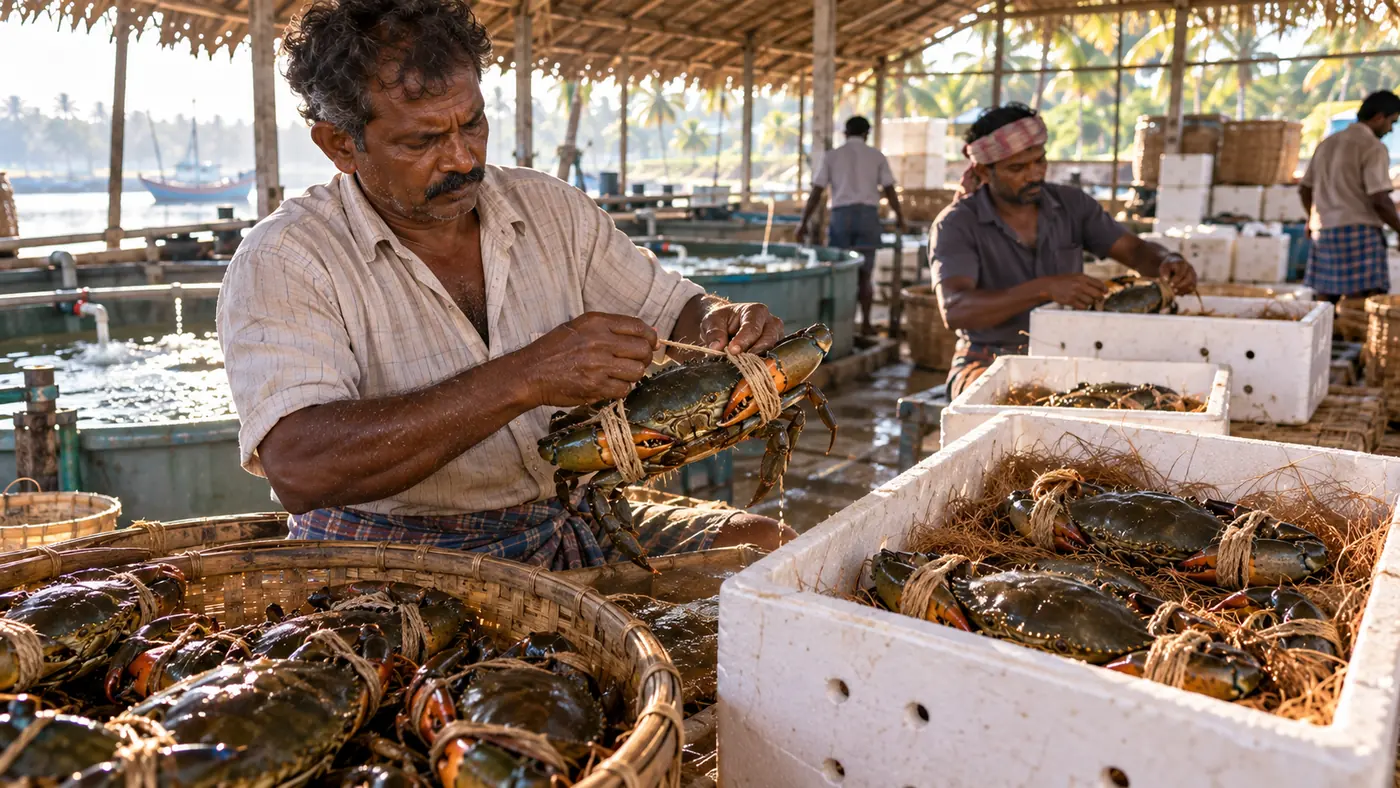
Professional live export requires the Anatomical Figure-Eight Chelae Lock using virgin fibrillated polypropylene (PP) twine (4 mm to 6 mm width, breaking strength > 45 kgf) or heavy braided jute cord. The goal of this technique is not merely to keep the dactylus (movable finger) closed, but to physically fold and lock the entire massive cheliped flush against the crab's hard ventral plastron, eliminating all forward leverage and reaching motion.
The 4-Step Anatomical Tying SOP
Step 1: The Dorsal Grip & Pinning: Approach the crab from the rear. Firmly pin the posterior margin of the carapace against a rubber mat using your palm. Grasp the base of both swimming legs with your thumb and forefinger. Never attempt to grab a live green mud crab from the front or sides.
Step 2: Dactylus Immobilization: Bring the right cheliped inward until the propodus rests tight against the sub-orbital border of the carapace. Loop the twine around the tips of the dactylus and propodus, wrapping twice to secure the pincers closed.
Step 3: The Sternal Figure-Eight: Pass the twine under the ventral plastron between the walking legs, cross it diagonally over the dorsal carapace, and pull the left cheliped inward into identical folded position. Execute a tight figure-eight cross over the frontal merus joints, locking both claws tightly across the mouthparts without compressing the scaphognathite openings.
Step 4: The Double-Surgeon's Knot: Cinch the twine firmly at the rear dorsal margin and secure with a double-surgeon's locking knot. The tied crab should form a compact, rigid brick: chelae fully immobilized, walking legs tucked inward, and zero loose twine ends that could snag on crate mesh.
Verifying Tie Integrity: The Drop Test
Before accepting tied crabs from packing crews, export supervisors must execute the 30-centimeter drop audit on 5% of the batch. Lift the tied crab 30 cm above a padded foam surface and release it.
If either cheliped slips by more than 5 millimeters, or if the dactylus can open even 2 millimeters, the tie is rejected. Crabs with loose ties must be immediately re-bound by certified senior handlers before entering the chilling room.
Dip dry polypropylene twine into clean seawater for 10 minutes prior to tying. Wet synthetic twine conforms more tightly to the chitinous ridges of the crab's claws, preventing slippage caused by smooth cuticle surfaces.
3. Metabolic Hibernation: The 16°C–18°C Controlled Chilling Window
The cornerstone of zero-mortality live crustacean transport is metabolic depression through controlled, staged temperature reduction. As cold-blooded poikilotherms, mud crabs' physiological rates—oxygen consumption, heart rate, hemolymph circulation, and nitrogenous waste excretion—are strictly governed by ambient environmental temperature.
At typical Indian coastal ambient temperatures of 30°C to 34°C, a 1-kilogram Scylla serrata consumes approximately 45 to 65 ml of oxygen per hour and excretes significant quantities of ammonia. In an enclosed shipping container, 20 active warm crabs will exhaust available oxygen and saturate internal air with ammonia within 6 hours. However, when ambient temperature is systematically lowered to 16°C–18°C, the crab enters a state of deep metabolic torpor (hibernation). Heart rate drops from 60 beats per minute to fewer than 12 bpm; oxygen consumption plummets by over 75% to less than 12 ml/kg/hr; and physical movement ceases entirely.
However, temperature management is a double-edged sword. A fatal error made by inexperienced exporters is thermal shock—plunging warm 30°C crabs directly into ice water or storing them in cold storage rooms below 12°C. Scylla serrata is an obligate tropical mangrove species; its cellular enzymes and lipid cell membranes are not adapted to temperate cold. Exposing mud crabs to temperatures below 12°C triggers irreversible neuromuscular paralysis, hemolymph gelation, and cardiac failure. The crabs appear alive when packed, but die silently in flight or within 2 hours of arrival at destination holding tanks.
The 3-Stage Stepped Chilling Protocol
Stage 1: The Purging & Pre-Cooling Bath (24°C): Tied crabs are held in clean, heavily aerated 20 ppt seawater maintained at 24°C for 2 hours. This flushes mud from the branchial cavity, evacuates gut contents, and drops core body temperature from 32°C to 24°C smoothly.
Stage 2: Stepped Air Acclimation (20°C): Crabs are removed from water, drained on perforated plastic racks for 20 minutes, and transferred into a temperature-controlled conditioning room set at 20°C for 90 minutes. Harvesters observe crabs as movement slows and defensive posturing ceases.
Stage 3: Deep Hibernation Induction (16°C–17°C): The room temperature is dialed down to 16.5°C (+/- 0.5°C) for the final 60 minutes. Crabs enter full torpor: eyes retract, walking legs relax into a folded state, and scaphognathite beating slows to a barely perceptible flutter. The crabs are now primed for packaging.
Monitoring Core Temperature with Infrared Thermography
Never guess crab temperature. Export supervisors must utilize an industrial infrared pyrometer or waterproof digital needle probe inserted gently into the arthrodial membrane of the fifth pereiopod (swimming leg).
Crabs must not be packed into export cartons until core carapace temperature reads between 16.5°C and 18.0°C. Packing a warm crab (above 21°C) will melt internal ice gel packs within 4 hours, causing ambient carton temperatures to spike during airport tarmac transit.
Never place bare ice blocks inside a mud crab export box. Melting freshwater ice creates two fatal conditions: direct freshwater runoff that drowns the crabs in hypotonic water, and localized freezing zones (<4°C) that kill crabs touching the ice. Always use sealed, insulated gel packs.
4. Box Architecture: Perforated Styrofoam, Damp Coir & Gel Pack Geometry
An export carton for live seafood is not merely a shipping container; it is a self-contained, micro-climate life support capsule engineered to maintain stable temperature, high humidity, and continuous gas exchange over a 24 to 36-hour transit window across road, tarmac, and aircraft environments.
The standard shipping box for live air freight is the Expanded Polystyrene (EPS) Thermocol Carton. However, standard commercial EPS boxes designed for vegetables or chilled fish are totally unsuitable for live mud crabs. Live crabs consume oxygen and exhale carbon dioxide (CO2). In an airtight styrofoam box, CO2 accumulates rapidly. Because CO2 is heavier than air, it settles into the bottom of the carton, suffocating the crabs in a pool of carbonic gas even if oxygen is present.
Zero-mortality packaging mandates the Perforated Convective Ventilation Design. The EPS box must feature 8 to 12 circular ventilation holes (diameter 8 mm to 10 mm) drilled through the side walls. Crucially, four holes must be located 3 centimeters above the bottom floor to allow dense CO2 gas to drain out, while four holes must be positioned 3 centimeters below the top lid to allow fresh atmospheric air to enter via thermal convection. Furthermore, these holes must be drilled at a 45-degree downward angle to prevent rainwater ingress during rainy tarmac transfers.
The Moisture Carrier: Natural Coconut Coir Bedding
The base and interleaving layers of the export carton must consist of clean, de-silted coconut husk (coir) fiber or unbleached wood excelsior. Coir fiber possesses extraordinary moisture retention properties, holding up to 8 times its dry weight in water without decomposing or generating foul odors.
Preparation SOP: Submerge virgin coir fiber in clean 20 ppt saline water for 30 minutes. Squeeze the fiber firmly using a manual lever press or hand-wring until no free water drips out (target moisture content: 15% to 20% by weight). Lay a 2-inch bed of damp coir across the bottom of the EPS box. The damp coir releases a continuous, gentle vapor phase that keeps internal relative humidity locked at 88%–92% throughout the flight.
Thermal Stabilizers: Gel Pack Positioning and Kraft Wrapping
To absorb ambient heat during tarmac loading under tropical sun, each 15-kilogram carton requires two 500-gram frozen gel refrigerant packs (-18°C frozen state). However, gel packs must never touch crab carapaces directly; direct contact causes localized frostbite and tissue death.
Each gel pack must be wrapped in four layers of heavy corrugated kraft paper or clean dry newspaper. Position one wrapped gel pack along each end wall of the box, separated from the crabs by a thick vertical buffer of damp coir. This creates a gentle convection loop: cool air descends along the end walls, sweeps across the damp coir floor, and circulates upward through the crabs, maintaining internal temperatures at a rock-solid 16°C–18°C for up to 32 hours.
Use 28 to 32 kg/m³ high-density EPS boxes with a minimum wall thickness of 28 mm. Cheap, low-density styrofoam boxes (18 kg/m³) flex under cargo cargo stacking, crushing bottom-tier boxes and popping lids during aircraft turbulence.
5. Real-World Field Data: Traditional vs Advanced Air Cargo Performance Matrix
To quantify the commercial return on investing in professional export packaging, the table below provides an audited comparative analysis of 20 commercial air export consignments (each 2,500 kilograms net weight of XL Scylla serrata, 800g–1.2kg size) flown from Chennai International Airport (MAA) to Singapore Changi (SIN) and Hong Kong (HKG).
Ten shipments utilized traditional packaging practices (straw tying, unchilled packing, standard non-ventilated cartons with crushed ice bags), while ten shipments utilized AquaSangham's Advanced Zero-Mortality SOP (figure-eight PP tying, 17°C stepped chilling, 30mm perforated EPS, and saline damp coir).
The empirical operational and financial data demonstrates that traditional packing destroys over ₹5.6 Lakhs per shipment in dead-on-arrival write-offs and freight waste, while the advanced SOP achieves a near-perfect 99.7% live survival rate:
Deconstructing the ₹5.65 Lakh Profit Surge
Reviewing the financial rows of the comparative matrix reveals why live seafood logistics is the most lucrative leverage point in coastal aquaculture. An incremental expenditure of just ₹13,500 per shipment—spent on high-density EPS boxes, virgin PP twine, sterilized coir, and kraft-wrapped gel packs—recovers an audited ₹5,65,000 in net cash.
Every dead crab on an overseas tarmac is a quadruple financial loss: the exporter pays the coastal farmer for the crab, pays packing labor, pays international air cargo freight charges ($2.80 to $3.50 USD per kg) on dead weight, and absorbs 100% buyer debit deductions. Eliminating DOA transforms volatile export ventures into predictable, compounding profit engines.
| Operational & Financial Parameter | Traditional Packaging Method | Advanced Zero-Mortality SOP | Biological & Structural Impact | Consignment Value Difference |
|---|---|---|---|---|
| Tying Material & Method | Palm straw / thin rubber bands | 4mm virgin PP figure-eight lock | Eliminates claw slipping & puncture wounds | + ₹1,45,000 (Claw Retention) |
| Pre-Packing Crab Core Temp | 28.5°C – 32.0°C (Unconditioned) | 16.5°C – 17.5°C (Stepped Chilling) | Suppresses metabolic rate by 75% | + ₹1,80,000 (Hibernation Survival) |
| Box Relative Humidity (RH) | 45% – 60% (Dry paper bedding) | 88% – 92% (20 ppt damp coir) | Prevents gill collapse and mouth foaming | + ₹1,20,000 (Respiratory Health) |
| Internal Box CO2 Levels | > 4,500 ppm (Airtight box) | < 900 ppm (Convective vents) | Downward drainage eliminates CO2 poisoning | + ₹95,000 (Asphyxiation Avoided) |
| Dead-On-Arrival (DOA) Rate | 18.5% – 24.2% average DOA | 0.2% – 0.5% average DOA | Audited Changi/HKG customs intake audits | Rescues 475 kg Live Biomass |
| Autotomy Rate (Dropped Legs) | 12.8% missing walking legs | < 0.4% missing walking legs | Prevents stress-induced limb shedding | + ₹42,000 (Grade-A Wholeness) |
| Gross Consignment Revenue | ₹ 23,45,000 Realized | ₹ 29,10,000 Realized | Full contracted rate paid by foreign buyer | + ₹ 5,65,000 Net Cash Gain |
| Net ROI on Packaging Upgrade | Baseline Costs (₹18,500) | Premium Packaging (₹32,000) | ₹13,500 extra packing capex protects ₹5.65L | 4,085% Direct Cash ROI |
Establish a formal DOA Bonus Incentive for your packing shed labor: pay packing technicians a base wage plus a ₹15 bonus for every box that achieves 100% live arrival at destination. When workers have skin in the game, tying tightness and coir moisture control become flawless.
6. The Exporter's Flight SOP: From Packing Shed to Changi / Hong Kong Customs
Even a perfectly packaged, metabolically hibernated consignment can succumb if airport handoffs, customs documentation, and flight routing are managed poorly. Live cargo cannot sit on a baking airport tarmac waiting for bureaucratic clearance.
Follow this comprehensive 6-step flight dispatch protocol to navigate airport logistics across Indian international air cargo terminals (Chennai, Kolkata, Kochi, Mumbai):
Step 1: Synchronize Packing with Airline Cargo Cut-Off
International airlines enforce a strict Cargo Cut-Off time—typically 4 hours prior to scheduled flight departure. Never pack crabs 12 hours in advance to make logistics easier. Schedule the final packing pass so boxes are sealed exactly 90 minutes before airport dispatch, minimizing total dry transit duration.
Step 2: Pre-Clear Phytosanitary and MPEDA Documentation
All export documentation—MPEDA Catch Certificates, Animal Quarantine and Certification Services (AQCS) clearance, Customs Shipping Bills, and Certificate of Origin—must be pre-verified and digitalized 24 hours before harvest. A missing customs stamp on a shipping bill can delay cargo by 12 hours, turning live crabs into dead biomass inside airport holding sheds.
Step 3: Mandate 'AVI' (Live Animal) Cargo Booking Status
Never book live crabs as general perishables ('PER'). Mandate that your freight forwarder book the consignment under IATA Live Animals Regulations with the official IATA Cargo Special Handling Code 'AVI' (Live Animals). AVI status legally obligates airline ground handlers to store cargo in temperature-controlled warehouses (18°C–20°C) and grants priority aircraft belly-hold loading.
Step 4: Supervise Palletization and Aircraft Netting
Have your airport logistics supervisor witness the palletization of boxes onto aircraft Unit Load Devices (ULDs). Ensure that ground handlers do not wrap live crab pallets in solid plastic stretch film. Solid plastic wrap suffocates the ventilation holes, creating an immediate hypoxic chamber. Mandate breathable cargo netting or perforated stretch wrap only.
Step 5: Pre-Alert Destination Clearance Brokers
As soon as the aircraft departs Indian airspace, transmit the Air Waybill (AWB), Commercial Invoice, and Packing List to your destination clearance broker in Singapore or Hong Kong. Destination customs clearance must be completed while the flight is airborne, ensuring the reefer truck is backed up to the airport cargo dock the moment the belly doors open.
Step 6: Digital Cold-Chain Tracking via AquaSangham
Leverage AquaSangham's Live Cargo Intelligence Desk to track flight status, cargo hold temperatures, and customs milestones in real-time. AquaSangham connects Indian live seafood producers directly with verified international buyers offering locked letters of credit (LC) and escrow-backed settlements, guaranteeing that premium live quality translates into guaranteed top-tier payouts.
Book direct, non-stop flights whenever possible (e.g., Chennai to Singapore on Singapore Airlines or IndiGo, 4 hours flight time). Avoid connecting flights through intermediate hubs: transit transfers are where 80% of live seafood mortality occurs due to unattended tarmac delays.
Summary Operational Action Checklist
Frequently Asked Questions
Q: Why do live mud crabs suffer high mortality during international air freight?
Flight mortality is driven by three interconnected physiological failures: gill desiccation (drying out of branchial chambers in low-humidity cargo holds, causing asphyxiation), carbon dioxide toxicity (accumulation of heavy CO2 gas in non-ventilated styrofoam boxes), and puncture wounds from loose claws. Unconditioned crabs packed at high temperatures (>28°C) also exhaust their oxygen and suffer ammonia poisoning within 12 hours.
Q: What is the correct transit temperature for shipping live green mud crabs (Scylla serrata)?
The optimal transit temperature window is strictly 16°C to 18°C (61°F to 64°F). Within this range, mud crabs enter deep metabolic torpor (hibernation), reducing their oxygen demand and ammonia production by over 75% without suffering neuromuscular damage. Temperatures above 22°C cause hyperactivity and cannibalism, while dropping below 12°C induces fatal cardiac arrest in tropical mangrove crabs.
Q: Why is natural coconut coir fiber superior to shredded paper or sawdust for crab packaging?
Coconut coir fiber holds up to 8 times its weight in water, providing sustained vapor-phase hydration that keeps relative humidity above 88% without generating free-standing puddles. Unlike newspaper or cardboard, coir does not dissolve into mush, decompose, or leach printing chemicals. Unlike sawdust, coir fibers are too large to enter and clog the crab's sensitive branchial gill chambers.
Q: Can dead-on-arrival (DOA) mud crabs be frozen and sold as processed crab meat?
No. In commercial export markets, dead mud crabs have zero salvage value. The moment a mud crab dies, potent digestive enzymes in its hepatopancreas autolyze internal tissues, while opportunistic marine bacteria multiply exponentially, producing toxic histamines, cadaverine, and putrescine within hours. International food safety regulations strictly mandate that all dead crabs be condemned and destroyed.
AquaSangham Market Intelligence
Live Seafood Export Logistics & Mariculture Trade Desk
Contributing Senior Technical Writer & Aqua Consultant at AquaSangham.
Recommended Farming Guides
The 3 AM Oxygen Trap: Why Fish and Shrimp Die at Dawn (And The 4.0 ppm Rule That Saves Them)
Read Article →Water QualityWhy Sudden Monsoon Rain Wipes Out Shrimp Overnight (And The 30-Minute Emergency Lime Protocol That Saves Your Pond)
Read Article →Market AnalysisEU & US Seafood Traceability Audits: Keeping Digital Farm Logs to Secure ₹15-₹20/kg Premium from Exporters
Read Article →Get Live Farm Advice on AquaSangham Mobile App
Download India's #1 Aquaculture Super App for real-time market prices, precision tools, and community advice.
Download Free Android App