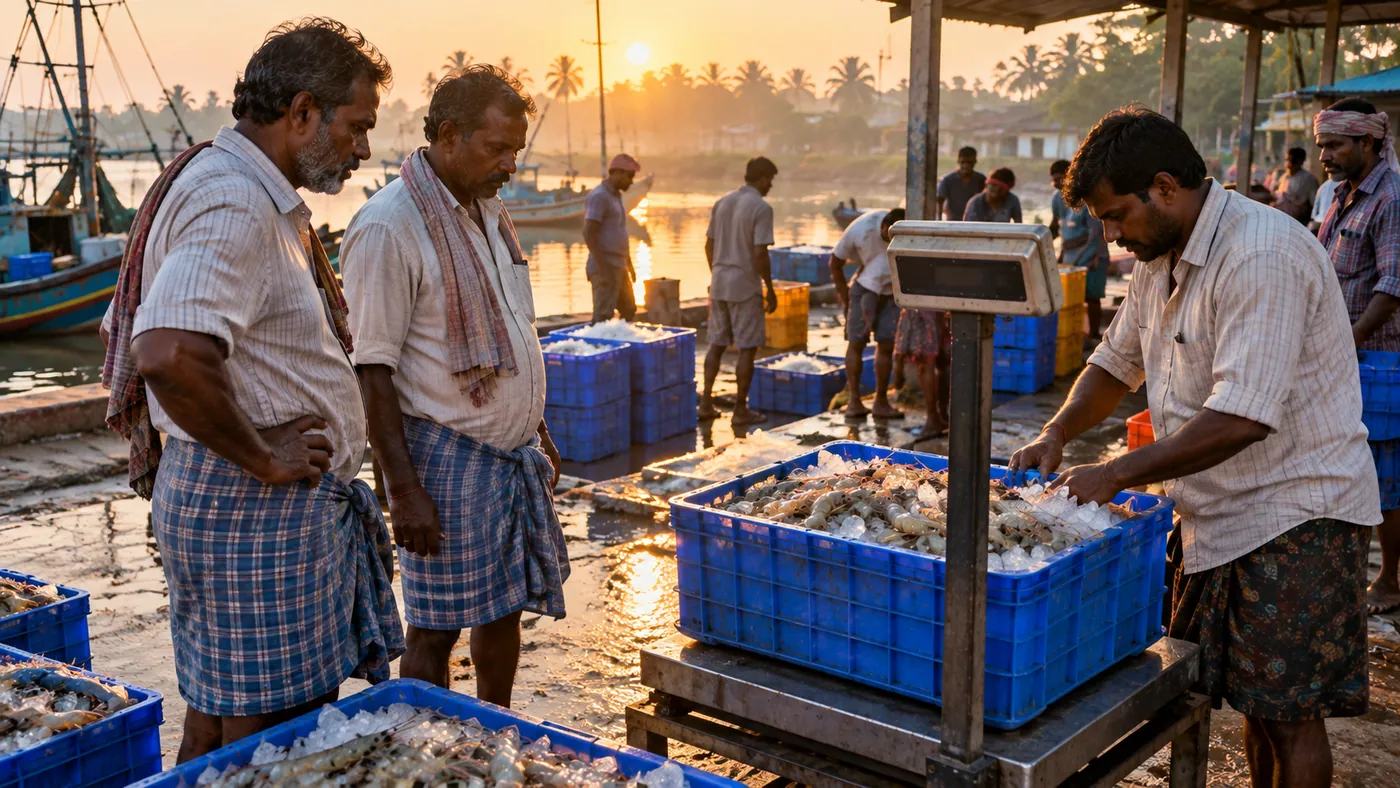
Executive Summary & Key Takeaways
- Traditional commission agents and unregulated middlemen extract between ₹4.5 and ₹7.5 Lakhs from every 10-ton shrimp harvest through five institutionalized manipulation tactics: tare inflation, phantom water deductions, count rigging, soft-shell exaggerations, and last-minute price dropping.
- The '2:00 AM Midnight Ambush' is deliberate: agents wait until the farmer has cast nets, pumped down water, and packed tons of shrimp into iced tubs—when stopping the harvest means total stock suffocation—to arbitrarily drop prices by ₹25 to ₹40/kg.
- A mere 2-gram error in pre-harvest sub-sampling shifts a 30-count shrimp lot (33.3g average) into a 33-count lot (30.3g average), triggering an immediate price drop of ₹30 to ₹40/kg that costs the farmer ₹3,00,000 to ₹4,00,000 on a 10-ton harvest.
- Crate tare manipulation is the silent thief: agents routinely claim an empty crate weighs 3.5 to 4.0 kg when standard high-density polyethylene (HDPE) crates weigh exactly 2.6 to 2.8 kg, stealing 300 to 450 kilograms of live biomass right before the farmer's eyes.
- Never initiate a commercial harvest based on verbal promises or informal WhatsApp texts; demand a signed, legally enforceable Purchase Order specifying count breakdown, fixed base price, maximum acceptable molt percentage, and verified tare weights.
- Modern digital disintermediation through AquaSangham enables farmers to sell directly to verified, MPEDA-approved export processing plants at 0% commission, capturing ₹38 to ₹55/kg in additional net profit while receiving direct, transparent RTGS bank settlements.
Mandi Exploitation Counter-Offensive: Nellore Farmer Cluster Bypasses Commission Agents to Reclaim ₹21.6 Lakhs Across 5 Commercial Ponds
A cooperative cluster of three commercial shrimp farmers in coastal Nellore was preparing to harvest five ponds containing an estimated 45 metric tons of high-grade 30-count Penaeus vannamei. At 1:30 AM on the night of harvest—just as cast nets hit the water and 40 harvest laborers began pulling seines—the primary regional commission agent called the lead farmer, claiming that European buyers had cancelled orders and the farmgate price was dropping by ₹35/kg (from ₹410/kg to ₹375/kg). Furthermore, the agent stated that incoming crates would face a standard 1.8 kg 'ice-melt water deduction' plus a 5% penalty for alleged soft shells. Recognizing a classic zero-leverage ambush, the cluster leaders halted harvest loading immediately and activated AquaSangham's Direct-to-Processor Emergency Trading Desk. Within 45 minutes, AquaSangham matched the 45-ton lot directly with an authorized export processing plant in Krishnapatnam at a confirmed, legally locked spot rate of ₹418/kg with 0% middleman commission. Factory-certified digital weighing platforms with witnessed tare verification were deployed to the pond dike. The harvest proceeded under strict protocol: exact tare weight of 2.6 kg per crate, zero water deductions, and independent biological grading confirming only 2.1% natural molt (well within normal factory tolerance). The farmers received ₹1,88,10,000 via direct RTGS bank transfer within 48 hours—an audited cash surplus of ₹21,60,000 compared to the exploitative ₹1,66,50,000 the commission agent had attempted to force upon them.
The 2:00 AM Harvest Trap: Why Farmers Lose All Bargaining Power
In commercial aquaculture, there is no moment of greater vulnerability than the night of harvest. After 100 to 120 days of relentless capital investment—spending ₹25 to ₹35 Lakhs on commercial feed, electricity, diesel generators, mineral supplements, and biosecurity—the farmer prepares to liquidate the crop. To minimize thermal shock, prevent rapid melanosis (black spot), and deliver pristine, translucent shrimp to processing plants, commercial harvests take place in the dead of night, typically between 11:00 PM and 4:00 AM.
By midnight, the pond water level has been pumped down by 50% to 70%. Up to 50 local harvest workers, net pullers, and crate loaders are actively dragging heavy bag nets through the mud. Thousands of kilograms of live Vannamei are tumbling onto sorting tables, being rapidly plunged into chilled ice slurry, and packed into plastic crates. At this exact juncture, the farmer's operational leverage drops to absolute zero.
Shrimp cannot be put back into a drained pond; once netted and iced, their biological clock is ticking against enzymatic drip loss, soft-shell autolysis, and bacterial spoilage. It is at this precise psychological and operational flashpoint—usually around 1:30 AM to 2:30 AM—that the commission agent or procurement broker executes the infamous 'Midnight Price Ambush.'
The Anatomy of the Midnight Ambush
The agent approaches the farmer with a grave expression, holding a smartphone to his ear. He claims that the processing plant's managing director in Vizag or Kochi just called: international freight rates spiked, a container ship was delayed, the US spot market softened by 20 cents, or the factory intake line broke down.
'Anna,' the agent says with feigned sympathy, 'the factory cannot accept the agreed ₹410 rate. If you want the trucks to load, you must take ₹380, or the trucks will turn around and leave.'
The farmer is trapped. If he refuses, 10 metric tons of fresh shrimp will spoil on the pond dike by dawn, representing a total capital write-off of ₹40 Lakhs. If he accepts, he instantly surrenders ₹3,00,000 in net profit. In 99% of cases, exhausted, intimidated, and cornered farmers capitulate. In reality, the processing plant never called to drop the price; the agent simply pockets the ₹30/kg delta as pure, untraced arbitrage profit.
The Illusion of the 'Local Market Mandi'
Unlike terrestrial agricultural commodities (paddy, cotton, onions) which operate under regulated Agricultural Produce Market Committee (APMC) yards with public auctions, aquaculture seafood trading in India has historically operated as an informal, unorganized shadow market. Commission agents (dalals) position themselves as indispensable financiers, often advancing loans for feed and seed during the crop cycle at usurious interest rates in exchange for exclusive harvest rights.
This credit-linked monopsony binds the farmer hand and foot. The agent controls the weighbridge, selects the sub-sampling crates, dictates the count grade, and unilaterally decides what percentage of the catch is penalized as 'soft shell' or 'broken'. To break free from this multi-lakh extraction, farmers must understand the precise mathematical mechanics behind every tactic.
Never begin draining your pond or casting the first harvest net until you hold a signed, stamped Purchase Order (PO) or an immutable digital contract confirmation on AquaSangham stating a fixed, non-negotiable floor price that cannot be altered under any circumstances once harvesting begins.
The 5 Classic Mandi Manipulation Tactics (And the Math Behind Each)
To the untrained eye, a shrimp harvest looks like an honest hive of physical labor: shouting workers, splashing water, weighing scales swinging under heavy crates, and quick chalk scribbles on wooden clipboards. But to a forensic auditor, the traditional broker-dominated harvest is a masterclass in systematic, micro-deduction theft.
Middleman brokers do not steal through single massive acts of fraud that trigger immediate police complaints; they steal through five layered, subtle percentage deductions that seem trivial individually but collectively siphon off 12% to 18% of the total crop value.
Below, we dissect the five primary tactics utilized across coastal trading belts from Nellore and Bhimavaram to Surat and Balasore, backed by the raw mathematical reality of what they cost a 10-ton producer.
Tactic 1: The 'Soft Shell' (Molt) Exaggeration Scam
Litopenaeus vannamei molts cyclically according to lunar and water-exchange rhythms. In any healthy, fast-growing population, between 2% and 4% of the shrimp will naturally be in a post-molt or soft-cuticle phase at any given moment. Processing plants routinely accept up to 5% soft shells without price penalties because peeling lines easily process them into peeled-and-deveined (P&D) products.
Commission agents, however, exploit this biological reality ruthlessly. During dike grading, the agent's sorter grabs shrimp by the fistful, squeezing them aggressively. Even freshly hardened shrimp are declared 'soft-cuticle' or 'papery'. The agent declares that 12% to 15% of the harvest is 'second-grade soft' and demands a 50% discount on that entire fraction (e.g., pricing it at ₹200/kg instead of ₹400/kg). On a 10-ton harvest, declaring an extra 10% bogus soft-shell strips ₹2,00,000 straight out of the farmer's pocket.
Tactic 2: Crate Tare Inflation and The Phantom Ice-Melt Deduction
A standard, food-grade perforated plastic harvest crate (HDPE) weighs exactly 2.6 to 2.8 kilograms. In an honest transaction, the scale is tared to zero with the empty crate on the platform, or an exact 2.7 kg deduction is recorded. Unscrupulous agents, however, insist on an arbitrary flat tare of 3.5 kg or 4.0 kg per crate.
To compound the fraud, the agent claims that because crushed ice was added to the crate during weighing, a mandatory 'water-and-ice-melt allowance' of 1.5 kg per crate must be deducted. On a 10-ton harvest packed into 350 crates, stealing 2.3 kg of extra tare and phantom ice deduction per crate robs the farmer of 805 kilograms of shrimp. At ₹400/kg, that single manipulation costs ₹3,22,000.
Tactic 3: Weighbridge Display Tampering and Mechanical Lever Bias
While most harvesting teams now use digital platform scales, mechanical lever scales and uncalibrated digital load-cells remain widespread in remote rural belts. Mobile digital scales transported on bumpy dirt tracks frequently lose load-cell calibration. Furthermore, dishonest weighing crews utilize electronic scale bypass boxes or remote calibration keyfobs that introduce a continuous 3% to 5% negative bias.
Weighing 30 kg of shrimp registers as 28.6 kg on the tampered display. The farmer, watching crates fly past at a rate of two per minute in the dark, rarely notices a 1.4 kg discrepancy per crate. On 10,000 kg, a 4% calibration bias steals 400 kilograms of product valued at ₹1,60,000.
Tactic 4: Unregulated Brokerage Commissions & 'Katta' Fees
In traditional mandi arrangements, the commission agent charges the farmer an overt commission fee ranging from 3% to 5% of gross harvest value, claiming it covers market linkage and payment collection guarantees. On a ₹40 Lakh harvest, a 4% fee is an immediate cash deduction of ₹1,60,000.
In addition to the headline commission, agents levy an array of arbitrary informal deductions: 'Hamali' (labor handling fees, even though the farmer often feeds and pays the netting gang), 'Weighbridge maintenance fee' (₹5,000), and traditional 'Katta' or 'Dharmam' charity cuts (0.5% to 1.0%). These death-by-a-thousand-cuts charges siphon an additional ₹40,000 to ₹60,000 of clean margin.
Purchase your own heavy-duty, rechargeable digital platform scale (300 kg capacity with 10-gram certified accuracy) and two Class M1 10 kg cast-iron calibration test weights (costing under ₹8,000 total). Calibrate your scale on the dike in front of the agent before weighing begins and run dual-scale verification.
Count Manipulation Artifice: How a 2-Gram Error Steals ₹30/kg
In commercial shrimp economics, price is governed by 'count'—the number of whole, head-on shrimp required to make up one kilogram of weight. Because larger shrimp command higher culinary value and yield superior meat recovery in overseas processing plants, every jump in count bracket creates a sharp price cliff. For example, 30-count shrimp sell at ₹410/kg, 35-count at ₹375/kg, and 40-count at ₹340/kg.
The mathematical sensitivity of count determination is extraordinary. In a 30-count lot, the average weight of a single shrimp is exactly 33.33 grams (1,000g ÷ 30). In a 33-count lot, the average weight is 30.30 grams. The difference between securing premium 30-count pricing versus dropping into the discounted 33-count bracket is a microscopic weight delta of just 3.03 grams per animal.
Commission agents exploit this mathematical vulnerability during pre-harvest sub-sampling through deliberate sampling bias, manipulating sample selection to artificially deflate the perceived size of your crop.
The Biased Checktray Sampling Scam
To determine the official purchase count, the agent or factory scout catches a small composite sample of shrimp (typically 1.0 kg or 50 to 100 individuals) from the pond. If the sampler scoops shrimp exclusively from the shallow pond edge or near the aerators where smaller, sub-dominant juveniles congregate, the resulting sample will be heavily skewed toward smaller sizes.
Furthermore, during manual counting on the scale, the agent may pick 30 shrimp that weigh 910 grams and declare: 'See, 30 shrimp do not reach 1,000 grams; your pond is officially 33-count.' By establishing this rigged benchmark, the agent cuts the purchase price across the entire 10,000-kilogram harvest from ₹410/kg down to ₹375/kg. That 3.0-gram sampling manipulation inflicts an instant, catastrophic loss of ₹3,50,000 on the farmer while the agent delivers the shrimp to the processing plant at true 30-count and pockets the difference.
The Standardized 500-Gram Scientific Count Protocol
To eliminate count manipulation, farmers must enforce the scientific 500-gram randomized protocol: (1) Sample must be drawn using a clean cast net from 5 distinct pond locations (four corners and the deep center) to reflect true population distribution; (2) Exactly 500 grams of live, washed shrimp are weighed on a precision digital balance; (3) The total number of whole shrimp in the 500-gram sample is counted twice by both parties; (4) Multiply the number by 2 to establish the exact count per kilogram.
If the count falls between brackets (e.g., 31.5 count), the price must be calculated using linear interpolation between the 30-count and 35-count contract rates rather than arbitrarily dropping the entire harvest into the lower bracket.
Always conduct your count determination using water-drained shrimp. If shrimp are counted wet with water dripping from their pleopods and rostrum, surface water adds 3% to 4% artificial weight to the sample, distorting the piece-to-weight calculation and costing you ₹15 to ₹25 per kilogram.
Crate Tare & Ice-Melt Theft: Auditing the Hidden 5% Weight Drain
Among all the covert deduction mechanisms operating at the farmgate, none is more brazen yet universally tolerated than crate tare and ice-melt theft. When 10 metric tons of shrimp are harvested, the product is transferred from the pond water into plastic crates, weighed on the dike, loaded onto refrigerated or insulated trucks, and transported to the processing plant. Because shrimp must remain iced to maintain core temperatures below 4°C, ice is mixed directly into each crate.
This co-mingling of shrimp, ice, and meltwater creates an operational ambiguity that dishonest procurement crews exploit to shave percentage points off the true net biomass. If a farmer does not actively police the weighing platform with a calibrated tare protocol, an astonishing 400 to 650 kilograms of premium shrimp will vanish into the 'tare deduction' column.
To protect your harvest equity, every member of your farm team must understand the physics of crate drainage, tare standardization, and ice slurry dynamics.
The Physics of Crate Drainage & The 2-Minute Rule
When shrimp are scooped out of harvest bags into perforated plastic crates, water clings to the body surface, legs, and gills. A standard harvest crate holds approximately 25 to 30 kg of shrimp. In the first 60 seconds after leaving the water, between 600ml and 900ml of water drains rapidly through the perforations. By 120 seconds (2 minutes), free gravitational drainage is 99% complete.
Dishonest weighing crews deliberately rush crates onto the scale within 15 seconds of filling, while water is still pouring out in sheets. The agent then loudly complains: 'Look at all this water! We have to take a 2.5 kg water deduction per crate!' The solution is simple: establish a 2-tier staging catwalk where filled crates rest on an elevated drainage grid for exactly 120 seconds before being placed on the weighing scale. Once drained, zero water deduction is permitted.
Standardizing HDPE Crate Tare: The 'Dry vs Wet' Audit
A dry commercial perforated HDPE fish crate weighs between 2.60 kg and 2.75 kg. When completely wet and soaked with cold water, the surface water film adds at most 80 to 120 grams, bringing total wet tare to no more than 2.85 kg.
Under no circumstances should a farmer accept a flat tare of 3.5 kg or 4.0 kg. Before the first crate of shrimp is loaded, take 10 random empty crates from the buyer's truck, wet them thoroughly with pond water, stack them on the digital scale, and divide total weight by 10. Record this exact witnessed average wet tare (e.g., 2.78 kg) on the official harvest tally sheet signed by both parties. Eliminating an unjustified 1.0 kg excess tare across 350 crates instantly saves 350 kg of shrimp—worth ₹1,40,000 at ₹400/kg.
Never allow the weighing crew to use non-perforated solid plastic tubs for weighing. Solid tubs trap hundreds of liters of ice meltwater that cannot escape, giving the buyer complete narrative control to demand arbitrary 5% to 8% water deductions.
Financial Anatomy: Traditional Broker Mandi vs Direct Factory Sale
To demonstrate the devastating financial impact of middleman manipulation in concrete terms, the audited comparative table below tracks an identical 10,000-kilogram (10-metric ton) harvest of commercial Vannamei shrimp under two divergent trading channels: (1) The Traditional Middleman / Commission Mandi Channel, and (2) AquaSangham's Direct-to-Processor Digital Trading Channel.
Both scenarios analyze the exact same physical pond biomass harvested at an authentic 30-count average in coastal Andhra Pradesh, utilizing prevailing 2026 market price benchmarks. Notice how minor deductions—a 2.5% count downgrade, an inflated 3.8 kg crate tare, a bogus 8% soft-shell penalty, and a 4% brokerage fee—strip an astonishing ₹6,24,000 (15.2% of total crop equity) from the farmer's bottom-line payout.
Under AquaSangham's direct trading model, 100% of the true biological biomass is preserved through calibrated digital load-cells, standardized tare protocols, and 0% commission direct factory settlement, transferring over ₹6.2 Lakhs of pure net cash surplus back to the producer.
The Macroeconomic Reality of Disintermediation
The data in the table above exposes an undeniable truth: the primary barrier to commercial aquaculture profitability in India is rarely feed conversion or water chemistry—it is post-harvest middleman value destruction. A farmer who battles disease, power outages, and climatic stress for 120 days to achieve a 1.25 FCR can see their entire operational profit wiped out in 180 minutes on the weighbridge.
By capturing an audited ₹9,38,284 in additional cash realization on a single 10-ton crop, a producer recovers the entire cost of commercial feed for an entire pond, transforming a breakeven season into a highly lucrative enterprise.
| Harvest Financial Parameter | Traditional Broker / Mandi Channel | AquaSangham Direct-to-Processor Desk | Farmer Impact / Financial Delta |
|---|---|---|---|
| Gross Biomass at Pond Dike | 10,000 kg (350 Crates) | 10,000 kg (350 Crates) | Identical live pond harvest |
| Assessed Count Grade | 33-Count (Biased sub-sampling) | 30-Count (Witnessed 500g protocol) | + 3 Counts (+ ₹35/kg rate delta) |
| Quoted Base Price | ₹ 375 / kg (Discounted count) | ₹ 410 / kg (Full 30-count market rate) | + ₹ 35 / kg higher base pricing |
| Crate Tare Deduction | 3.80 kg / crate (1,330 kg total) | 2.75 kg / crate (962.5 kg verified wet) | + 367.5 kg saved from tare fraud |
| Ice-Melt Water Deduction | 1.50 kg / crate (525 kg total) | 0.00 kg (Standard 2-min gravity drip) | + 525.0 kg saved from water fraud |
| Net Paid Harvest Weight | 8,145 kg (81.45% of biomass) | 9,037.5 kg (90.38% of biomass) | + 892.5 kg extra paid shrimp (+10.9%) |
| Soft-Shell Deduction Penalty | 10% penalized @ 50% discount (-₹1,52,718) | 3.0% normal tolerance (0% price penalty) | + ₹ 1,52,718 preserved margin |
| Gross Harvest Value | ₹ 29,01,657 | ₹ 37,05,375 | + ₹ 8,03,718 gross revenue increase |
| Broker / Commission Fee | 4.0% Commission (-₹ 1,16,066) | 0.0% Commission (Zero middleman fee) | + ₹ 1,16,066 saved in brokerage |
| Hamali & Weighbridge Cuts | Flat ₹ 18,500 deduction | ₹ 0 (Absorbed by processor logistics) | + ₹ 18,500 miscellaneous savings |
| FINAL NET FARMER BANK PAYOUT | ₹ 27,67,091 (Effective ₹276.7/kg) | ₹ 37,05,375 (Effective ₹370.5/kg) | + ₹ 9,38,284 NET CASH SURPLUS (+33.9%) |
Before agreeing to any harvest, input your expected biomass, count, and buyer terms into AquaSangham's Mandi Net Realization Calculator. It automatically calculates true net payouts after all hidden tare and commission deductions, exposing bad offers instantly.
The Legal Harvest Lock-In: 5 Clauses Every Farmer Must Put in Writing
In the fast-paced environment of coastal aquaculture, harvest transactions are overwhelmingly concluded on verbal trust, frantic phone calls, and informal WhatsApp chats. This lack of legal documentation is precisely what enables commission agents to repudiate prices at 2:00 AM without fear of civil litigation or regulatory enforcement. To protect your investment, every commercial harvest must be governed by a written, legally binding Harvest Purchase Agreement.
You do not need an expensive legal team to protect yourself. A simple, 1-page agreement signed on physical paper or electronically executed via digital confirmation on AquaSangham provides ironclad contractual protection. The agreement must explicitly incorporate five non-negotiable clauses before a single net touches your pond water.
Enforce the five contractual stipulations detailed below to neutralize middleman exploitation before harvesting begins.
The 5 Mandatory Contractual Clauses
Clause 1: Non-Negotiable Price Floor & Absolute Lock-In. 'The agreed price of ₹[X]/kg for [Y]-count Penaeus vannamei is an absolute, non-negotiable floor price. This rate remains unconditionally binding upon both parties from the moment water drainage commences until the final crate is loaded onto transport trucks, regardless of any subsequent global or domestic spot market fluctuations.'
Clause 2: Standardized Witnessed Wet Crate Tare. 'Tare weight shall be established on the farm dike prior to harvest by weighing 10 randomly selected, fully wetted buyer crates on a calibrated digital scale and taking the arithmetic mean. This verified figure (not to exceed 2.85 kg per crate) shall serve as the sole allowable tare deduction. Zero allowances for ice melt, ambient water, or drainage shall be deducted.'
Clause 3: Soft-Shell Tolerance Ceiling. 'The buyer agrees to accept up to 5.0% by weight of post-molt or soft-cuticle shrimp at 100% full contract price as standard commercial tolerance. Any soft-shell fraction exceeding 5.0% shall be documented by joint digital photography and physical weighing, and discounted by no more than 25% of the base contract price.'
Clause 4: 500-Gram Composite Count Determination. 'Official harvest count shall be determined by taking a 500-gram composite sample drawn from 5 distinct pond stations using a clean cast net, washed, and counted twice in the presence of both parties. Count brackets falling between 5-count intervals shall be settled via linear price interpolation.'
Clause 5: Direct Electronic Bank Settlement Timeline. '100% of final net harvest value shall be remitted directly to the farmer's designated bank account via RTGS/NEFT within a maximum of 48 hours following factory weighbridge receipt. The buyer explicitly waives any right to impose post-factory quality deductions not formally documented and signed on the pond dike tally sheet.'
Never allow buyers to write tally sheets in pencil or on loose scraps of paper. Use a bound, duplicate-carbon Harvest Tally Book with pre-printed serial numbers. At the end of weighing, both the farmer and the buyer's lead supervisor must sign every carbon page, with the farmer retaining the original top sheet.
The Disintermediation Playbook: Selling at 0% Commission on AquaSangham
The ultimate long-term solution to mandi spot price manipulation is complete structural disintermediation: connecting primary producers directly with export processing plants through transparent, real-time digital market infrastructure. For decades, commission agents justified their fees by claiming they provided critical market linkage and absorbed factory payment default risks. Today, AquaSangham's Seafood Trading Desk eliminates the middleman entirely.
AquaSangham operates a digital spot price exchange and pre-harvest booking platform connecting certified shrimp and fish farmers across Andhra Pradesh, Tamil Nadu, Odisha, and Gujarat directly with leading, MPEDA-approved seafood export processing plants. By digitizing water quality logs, feeding records, and Pre-Harvest Certificate (PHC) laboratory reports, the platform establishes verifiable farm-level traceability that export factories reward with premium pricing.
Selling direct through AquaSangham transforms the farmer from a passive price-taker at the mercy of nocturnal brokers into an empowered commercial enterprise commanding competitive bids from multiple tier-one export plants.
How AquaSangham's 0% Commission Direct Trade Works
Step 1: Digital Lot Listing (DOC 90–100). The farmer lists their upcoming crop on the AquaSangham platform, specifying projected harvest biomass (e.g. 12 metric tons), target count (e.g. 30–32 count), pond location GPS, and tentative harvest window.
Step 2: Pre-Harvest Verification & Direct Bidding. AquaSangham's field compliance team validates the pond's MPEDA CAA registration and coordinates official PHC sampling. Once certified clean, verified export processing plants bid competitively on the open lot in real time, competing transparently for high-quality biomass.
Step 3: Locked Contract & Factory Logistics. The farmer reviews incoming bids and locks the top offer with a single tap. A digital, legally binding Purchase Agreement is generated instantly. The processing plant dispatches its own insulated reefer trucks and professional harvest crew directly to the pond dike.
Step 4: Witnessed Digital Weighing & 48-Hour RTGS Payout. Weighing is conducted using AquaSangham-certified digital platform scales with calibrated tare weights and real-time cloud data logging. Zero middleman commission is charged (0% brokerage). Within 48 hours of factory intake, 100% of the settlement is transferred directly into the farmer's bank account via secure institutional RTGS.
List your harvest on AquaSangham at least 7 to 10 days before your intended harvest date. Advance listing allows multiple export processing plants to schedule their factory line capacity, sparking competitive bidding wars that consistently yield ₹15 to ₹25/kg above prevailing mandi spot rates.
Summary Operational Action Checklist
Frequently Asked Questions
Q: Why do commission agents drop shrimp prices in the middle of the night during harvest?
Commission agents exploit the farmer's absolute loss of leverage. Once a pond is drained by 70% and shrimp are netted and iced, the farmer cannot cancel the harvest without losing the entire crop to thermal spoilage. Knowing the farmer is trapped, agents fabricate last-minute claims of 'market crashes' or 'factory intake halts' to drop prices by ₹25 to ₹40/kg, pocketing the difference as pure middleman profit.
Q: How much weight do I lose if I accept an arbitrary 3.8 kg crate tare instead of true tare?
Standard perforated HDPE harvest crates weigh exactly 2.6 to 2.85 kg when fully wet. Accepting an inflated tare of 3.8 kg robs you of approximately 1.0 kg of shrimp per crate. On a standard 10-ton harvest packed into 350 crates, this tare theft steals 350 kilograms of shrimp—costing you ₹1,40,000 to ₹1,50,000 at current 30-count market prices.
Q: Can I refuse a soft-shell deduction if the agent claims my shrimp are molting?
Yes. Natural post-molt rates in healthy shrimp populations range from 2% to 4%. Standard export processing plant contracts accept up to 5% soft shells at 100% full price without penalty. You should contractually specify a 5% soft-shell tolerance threshold and demand that any disputed soft-shell fraction be physically segregated, weighed, and verified by digital photography rather than accepting arbitrary flat percentage cuts.
Q: What is the difference between selling to a local commission agent vs direct to a processing plant?
Selling through a commission agent involves multiple informal intermediaries who charge 3% to 5% brokerage fees, impose subjective tare and ice deductions, and often delay payments for weeks. Selling direct to an export processing plant (facilitated via AquaSangham) provides 0% commission, witnessed digital weighing, strict contract price lock-ins, and direct RTGS bank settlement within 48 hours.
Q: How does AquaSangham guarantee 0% commission for aquaculture farmers?
AquaSangham operates as a digital trade facilitation and technology infrastructure platform, not an extractive middleman broker. Export processing plants pay a modest institutional software licensing and traceability fee to access verified, biosecure, PHC-cleared harvest lots directly from source farms. This structure ensures farmers keep 100% of their gross harvest revenue without any commission deductions.
AquaSangham Market Intelligence
Seafood Trade Economics & Farmgate Price Analytics Division
Contributing Senior Technical Writer & Aqua Consultant at AquaSangham.
Recommended Farming Guides
The 3 AM Oxygen Trap: Why Fish and Shrimp Die at Dawn (And The 4.0 ppm Rule That Saves Them)
Read Article →Water QualityWhy Sudden Monsoon Rain Wipes Out Shrimp Overnight (And The 30-Minute Emergency Lime Protocol That Saves Your Pond)
Read Article →Market AnalysisEU & US Seafood Traceability Audits: Keeping Digital Farm Logs to Secure ₹15-₹20/kg Premium from Exporters
Read Article →Get Live Farm Advice on AquaSangham Mobile App
Download India's #1 Aquaculture Super App for real-time market prices, precision tools, and community advice.
Download Free Android App