Executive Summary & Key Takeaways
- Crab fattening is fundamentally distinct from growout culture: farmers do not rear small crablets over 4 months; they purchase large (400g–800g) post-molt 'water crabs' and feed them for just 18–24 days to harden muscle meat.
- The financial arbitrage is immense: water crabs are rejected by exporters and discounted by 60% (selling at ₹300–₹450/kg), while hardened meat crabs command ₹1,250 to ₹1,650/kg for live export.
- Because crabs do not undergo ecdysis (molting) during this 21-day window, cannibalism and molting mortality are virtually zero, allowing survival rates to routinely exceed 92% to 96%.
- Capital expenditure is remarkably low: a 200 m² tidal bamboo pen can be completely constructed using local split bamboo, casuarina poles, and HDPE netting for under ₹28,000 to ₹38,000.
- Tidal pens harness natural twice-daily lunar flushing: fresh oxygenated brackishwater enters automatically during high tide, removing metabolic wastes with zero electrical pumping costs.
- Feeding requires 7% to 10% body weight daily in high-protein fresh biomass: marine trash fish (sardinella, anchovies, ribbonfish offcuts) and crushed brackishwater clams (Meretrix casta).
- A single well-managed 200–250 m² pen can complete 12 to 14 fattening cycles annually, generating a consistent, repeatable net income of ₹1.0 to ₹1.4 Lakhs per month for coastal families.
Coastal Mariculture Case Study: Generating ₹1.18 Lakhs Every 21 Days from a 250 m² Tidal Creek Bamboo Pen
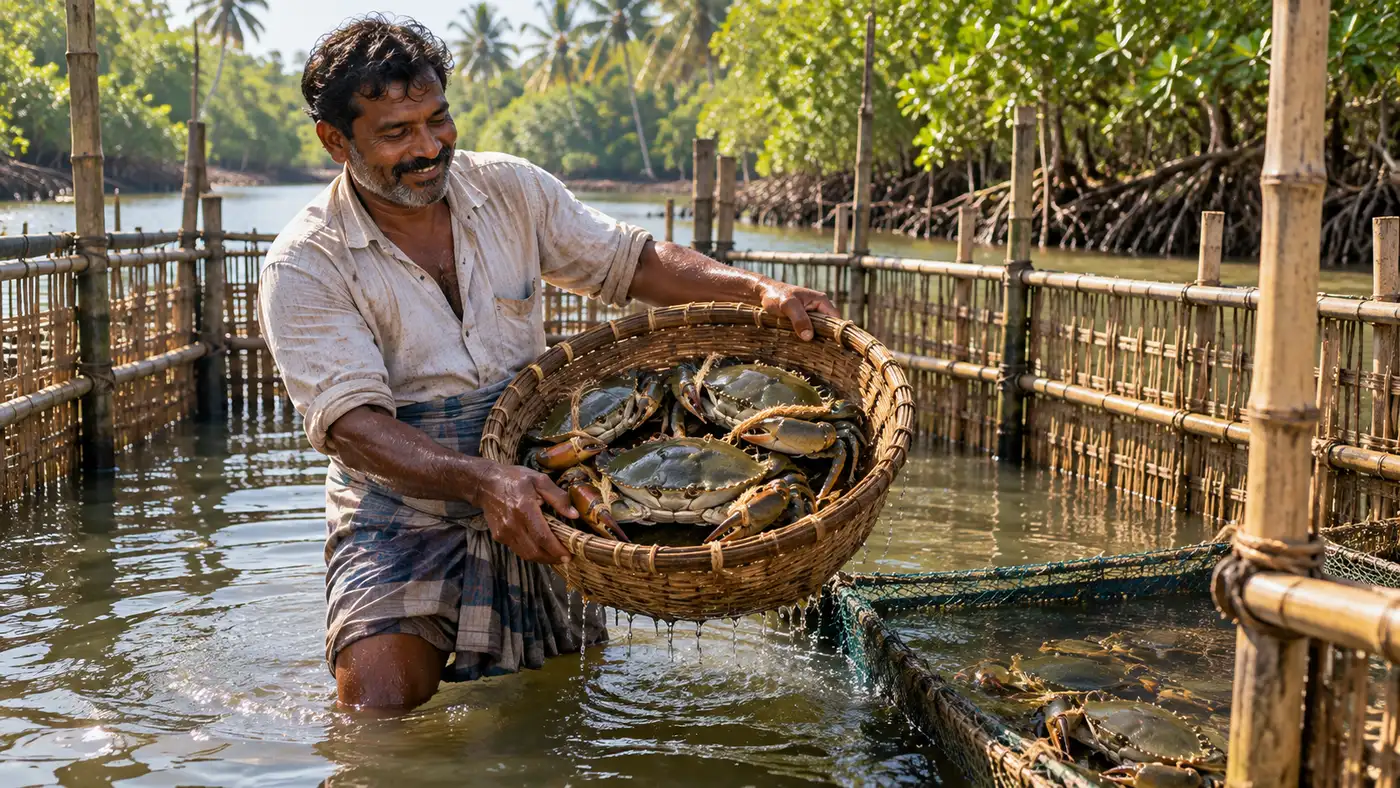
A traditional coastal fisherfolk family in the Pichavaram mangrove estuary previously sold wild-caught post-molt 'water crabs' to local middlemen for a meager ₹320 to ₹380 per kilogram. Seeking to capture the immense value addition of hard export crabs, the family partnered with AquaSangham to erect a 250 m² tidal pen in an intertidal creek channel: (1) Constructed an escape-proof perimeter using treated split-bamboo reeding lined with 26mm HDPE knotless netting, buried 50 cm into the estuarine clay bed with a 35-degree inward anti-climb overhang; (2) Installed 150 benthic shelters (cut earthen pots, split bamboo clusters, and perforated cement tiles) across the muddy pen substrate; (3) Sourced 450 wild-caught male water crabs (averaging 520 grams) from artisanal crabbers at ₹360/kg; and (4) Fed a diet of fresh marine trash fish (chopped sardines and croaker offcuts) combined with crushed estuarine bivalves fed at 8% body weight twice daily at slack high tide. Across an 18-to-22 day holding period, the crabs did not molt; instead, watery hemolymph was replaced by dense thoracic muscle and swollen hepatopancreas tissues, increasing individual crab weight by 9.4% (averaging 569g). With 93.8% survival (422 harvestable crabs yielding 240 kg), the batch was graded as Grade-XL hard meat crabs and sold to Chennai air-freight consolidators at ₹1,480/kg. Gross batch revenue reached ₹3.55 Lakhs against total cycle expenses of ₹2.37 Lakhs (seed crabs ₹84,240, feed ₹28,800, coir tying and labor ₹9,000), netting a cash profit of ₹1.18 Lakhs in just 21 days.
1. The Water Crab Arbitrage: Why Coastal Middlemen Discount Post-Molt Crabs by 65%
In the commercial marine seafood trade, timing is everything. Along India's 8,118-kilometer coastline, artisanal fishermen and estuarine crab collectors catch thousands of mud crabs (Scylla serrata and Scylla tranquebarica) every night using baited lift nets, gillnets, and hooked bamboo probes. However, when these crabs are landed at coastal auction centers, up to 30% to 40% are classified by procurement agents as 'Water Crabs' (locally called 'Thanneer Nandu' in Tamil, 'Neeti Peetha' in Telugu, and 'Jol Kankra' in Bengali).
A water crab is a healthy, live adult mud crab that has recently completed ecdysis (molting). While its outer carapace has expanded and set into its new dimensions, its internal thoracic chambers, walking legs, and large chelipeds are filled with watery hemolymph fluid rather than dense muscle meat. When cooked, the meat shrivels into a disappointing watery pulp with less than 15% edible yield. Furthermore, water crabs have thin, brittle shell membranes that easily rupture during live air-cargo shipment, causing catastrophic transit mortalities.
Consequently, seafood exporters and processing plants completely reject water crabs. Coastal commission agents penalize fishermen severely, purchasing 500g to 800g water crabs at a steep 60% to 70% discount—typically paying just ₹300 to ₹420 per kilogram. A fisherman holding a majestic 600-gram crab receives barely ₹200 for an animal that took two years to grow in the wild.
This market failure creates one of the most profitable economic arbitrage opportunities in tropical mariculture: **Mud Crab Fattening**. By purchasing these discounted, large water crabs, placing them into a protected tidal pen or partitioned pond enclosure, and feeding them high-protein trash fish and bivalves for just 18 to 24 days, the crab's hepatopancreas swells with rich lipids and its muscle tissue fills out completely. The shell becomes rock-hard, transforming the exact same animal into a Grade-A export 'Hard Meat Crab' worth ₹1,250 to ₹1,650 per kilogram—an immediate 200% to 300% price explosion achieved in three short weeks.
Unlike shrimp farming or long-cycle fish culture, crab fattening is not a speculative biological gamble. You are not waiting for vulnerable larvae to survive months of disease vectors. You are operating a high-velocity biological finishing feedlot with virtually zero mortality risk and rapid capital turnover.
Never attempt to fatten crabs in areas with zero tidal exchange. Stagnant brackishwater ponds accumulate heavy organic sludge from trash fish feeding, depressing dissolved oxygen and causing branchial gill fouling within 10 days. Siting your pen in an estuarine tidal creek with natural twice-daily lunar flushing guarantees clean water at zero electricity cost.
2. Low-Cost Tidal Pen Engineering: Materials, Siting & Anti-Escape Barriers Under ₹35,000
The primary barrier for smallholder coastal farmers entering intensive crab farming has traditionally been high infrastructure costs. Concrete tanks, plastic condo systems, and lined ponds demand heavy capital outlays. In contrast, the **Low-Cost Tidal Pen Method** utilizes indigenous, locally sourced agricultural materials to construct a robust, escape-proof mariculture enclosure directly within intertidal mangrove creeks, estuarine canals, or outer pond bunds for under ₹35,000.
A standard commercial fattening pen measures 10 meters by 20 meters (200 m²), capable of finishing 400 to 500 crabs per batch. The site must be chosen carefully: water depth at mean low tide should be at least 0.6 to 0.8 meters, rising to 1.5 to 1.8 meters during spring high tides. The substrate should be firm estuarine clay-loam with organic silt. Avoid areas with shifting sand bars, which allow crabs to burrow beneath perimeter barriers, or stagnant dead-end canals with poor flushing.
Perimeter Fencing Architecture: Mud crabs are exceptional burrowers and climbers. If fencing is poorly anchored, 80% of your stock will dig out under the mud or scale the fencing during dark, rainy nights. The perimeter fence consists of three integrated layers:
1. Foundation Posts: Seasoned Casuarina or bamboo poles (minimum 8cm diameter, 3.5m length) driven 1.0 meter deep into the estuarine bed at 1.5-meter intervals, braced externally with diagonal timber struts.
2. Subsurface Anti-Burrowing Skirt: Heavy-gauge 26mm HDPE knotless square netting (or split-bamboo reeding) buried a minimum of 40 to 50 cm vertically into the muddy clay bed. An additional 30 cm horizontal 'mud skirt' is pegged outward along the bottom and weighted down with granite stones to physically prevent crabs from tunneling under the fence line.
3. Aerial Anti-Climb Overhang: The above-water fence must extend 1.2 meters above the maximum spring high-tide level. At the top of the fence, an inward-facing 30cm to 40cm horizontal shelf (overhang) angled at 35 degrees inward toward the pen is installed, lined with smooth 250-micron UV-stabilized plastic sheeting or polished aluminum flashing. When climbing crabs reach the smooth overhanging lip, their dactyls lose grip, dropping them harmlessly back into the water.
Split-Bamboo Reeding vs HDPE Netting Longevity
Traditional split-bamboo reeded fencing (matted with coir or nylon twine) is exceptionally cheap (₹80 to ₹120 per running meter) and provides natural shade and structural stiffness. However, marine wood-boring shipworms (Teredo navalis) and fungal rot destroy untreated bamboo within 6 to 9 months of seawater immersion.
Modern commercial fattening pens combine an exterior bamboo reeding barrier for wave attenuation with an interior heavy-duty virgin HDPE extruded diamond mesh (mesh size 25mm to 30mm, 2.5mm twine). HDPE mesh is completely impervious to crab claw chewing, resistant to marine borers, and delivers a trouble-free working lifespan of 4 to 5 years.
Sluice Gate & Tidal Water Inflow Screens
If constructing the pen inside an earthen pond corner connected to a tidal creek, the water intake culvert must feature dual stainless steel or brass mesh screens (10-mesh outer, 20-mesh inner) to exclude predatory wild marine fish (such as giant trevally, seabass, and moray eels) that attack post-molt crabs.
3. Sourcing & Sorting Water Crabs: Shell Rigidity Testing and Sex Segregation
The profitability of crab fattening is won or lost at the seed procurement gate. If you stock damaged, infected, or already-hard crabs, you waste valuable feed and working capital. Sourcing requires direct partnerships with artisanal coastal crabbers who land live catches between 04:00 AM and 07:00 AM daily.
The Thumb-Press Rigidity Test: Master crab fatteners never rely on visual appearance alone. To verify that a crab is a true 'water crab' ready for fattening, hold the crab from the rear of the carapace and press your thumb firmly against the epimeral suture—the underside lateral shell plate located just above the base of the last walking leg. In a water crab, the shell feels thin, spongy, and flexes inward with minimal pressure like a ping-pong ball. If the shell is rock-solid and unyielding, the crab is already hard and should not be stocked for fattening.
Next, examine the crab's underside abdomen (plastron). In female crabs, check the abdominal flap: an immature female possesses a narrow triangular flap, while an adult mature female has a broad, semicircular dark-brown apron. Adult females with swollen carapaces are prime candidates for 'Egg / Coral Crab Fattening'—the highest-earning category in the entire crustacean export catalog.
Sex Segregation is Mandatory: Under no circumstances should male and female water crabs be stocked together in the same pen. Large adult male mud crabs (bearing massive chelipeds) are intensely territorial and aggressively harass mature females. Segregating pens into **All-Male Pens** and **All-Female Pens** reduces aggressive combat by over 80%, eliminates limb loss (autotomy), and ensures uniform feeding efficiency.
Intact Limb Verification Protocol
Reject any water crab missing one or both major claws (chelipeds). While a crab can survive without a claw, it cannot feed effectively on hard-shelled bivalves and will expend its nutritional intake regenerating limb buds rather than building thoracic meat, extending fattening time from 21 days to over 45 days.
Crabs missing one or two rear walking legs are acceptable provided the procurement price is discounted by 30%, as minor walking legs do not impair feeding or live export grading.
Acclimation & Disinfection Dip
Wild-caught crabs frequently carry external stalked barnacles (Octolasmis spp.) on their branchial gill chambers. Before release into the fattening pen, submerge crabs in a shaded 200-liter tub containing 20 ppt clean brackishwater treated with 10 ppm Potassium Permanganate (KMnO4) or 15 ppm active Formalin for 10 minutes. This purges external gill parasites and accelerates respiration recovery.
4. The 21-Day High-Protein Nutrition SOP: Trash Fish, Clams & Muscle Accretion
In a crab fattening operation, you are not feeding for skeletal growth—you are feeding for rapid lipid deposition in the hepatopancreas and dense myofibrillar protein synthesis in the thoracic and claw muscles. Mud crabs possess an intensely carnivorous digestive tract with short gut transit times and high proteolytic enzyme activities.
Feeding dry extruded shrimp pellets during fattening is an economic mistake. Pellets lack the fresh marine lipids and high moisture palatability required to trigger rapid compensatory meat filling, costing twice as much as locally available fresh biomass. The gold-standard fattening ration consists of an 8:2 ratio of fresh marine trash fish to crushed estuarine bivalves.
Trash Fish Component (80%): Chopped fresh marine sardinella (Sardinella longiceps), anchovies (Stolephorus spp.), croakers, or fish processing plant offcuts (heads, frames, and viscera). Marine pelagic fish provide essential omega-3 polyunsaturated fatty acids (EPA and DHA) and crude protein exceeding 65% on a dry matter basis.
Bivalve Clam Component (20%): Fresh brackishwater clams (Meretrix casta or Villorita cyprinoides) or green mussels (Perna viridis), lightly cracked with a wooden mallet. Clam flesh provides high concentrations of free amino acids (glycine, taurine, and arginine) that stimulate voracious feeding, while the crushed shells provide bioavailable calcium and phosphorus essential for internal cuticle reinforcement.
Feeding Dosage & Timing: Feed is administered at 8% to 10% of total crab biomass daily during Days 1 through 10 (when metabolic hunger is highest), tapering to 6% to 7% during Days 11 through 21 as crabs become fully satiated and heavy. Feed is split into two rations: 30% at 06:30 AM (morning low tide) and 70% at 06:00 PM (sunset high tide) to match their natural nocturnal foraging peaks.
Submerged Feeding Trays vs Broadcast Feeding
Never broadcast chopped raw fish randomly across the muddy bottom of the tidal pen. Uneaten fish sinks into the anoxic mangrove mud, generating deadly pockets of hydrogen sulfide (H2S) that blacken crab gills and trigger sudden nighttime mortality.
Install 1.0m x 1.0m shallow wooden feeding trays suspended 15 cm above the mud bottom using casuarina stakes, with 4 to 6 trays per 200 m² pen. Crabs climb onto the trays to feed, and technicians can lift the trays daily to inspect consumption rates, adjusting rations with mathematical precision.
The 21-Day Feeding Progression Calendar
Days 1 to 5 (Acclimation & Voracious Feeding): Feed 10% body weight in chopped oily sardines; crabs feed aggressively as digestive enzymes reactivate.
Days 6 to 15 (Peak Muscle Accretion): Feed 8% body weight (60% trash fish + 40% crushed clams); internal hemolymph thickens into dense white muscle protein.
Days 16 to 21 (Hardening & Coral Maturation): Feed 6% body weight; inspect crabs every 48 hours for rock-solid carapace rigidity and harvest readiness.
5. Daily Pen Operations: Tidal Flushing, Sludge Hygiene & Benthic Hideouts
Even though fattening crabs do not molt and are less vulnerable to cannibalism than soft juveniles, stocking 400 to 500 large, claw-bearing predatory crustaceans inside a 200 m² enclosure requires proactive behavioral management. Territorial male crabs fight aggressively over floor territory and food resources, which can lead to claw damage and lowered export grades.
Installing Benthic Shelters: To completely eliminate aggressive encounters, the pen floor must be outfitted with abundant artificial hideouts. Provide a minimum of 1.2 shelter units per stocked crab (e.g., 300 shelters for 250 crabs). Optimal low-cost shelters include: (1) 30cm lengths of 150mm PVC pipe or drainage tiles; (2) Halved earthen flowerpots or hollow roofing tiles; (3) Bundles of tied coconut palm fronds weighted with bricks; and (4) Split bamboo tubular clusters placed horizontally along the bottom. When every crab has a private, dark cavity to occupy between feeding periods, aggressive combat drops to near-zero.
Managing Tidal Siltation & Water Quality: During the 21-day holding period, inspect perimeter netting daily at low tide for snagged debris, floating mangrove leaves, and algae (Enteromorpha spp.) that choke water flow. Scrub netting panels with stiff coir brushes every 4 to 5 days to ensure unrestricted tidal flushing during incoming and outgoing tides.
Maintain water depth between 0.8m and 1.2m. During midday summer heatwaves, shade 40% of the pen surface using black 50% agro-shade netting suspended on bamboo poles 1.5 meters above the water surface. Shading keeps water temperatures below 29°C, preventing thermal stress and preserving voracious feeding behavior.
Critical Water Quality Benchmarks in Tidal Pens
Salinity: Optimal 15 to 28 ppt. In the event of heavy monsoon downpours, estuarine salinity may temporarily drop to 5 ppt; Scylla serrata easily tolerates this for 48 to 72 hours provided water exchange remains active.
Dissolved Oxygen: Must remain above 4.0 mg/L at low tide. If pen water becomes stagnant during neap tides, run a 1.5 HP portable diesel pump to draw fresh tidal water from the main creek for 2 hours at dawn.
Water pH: Maintain between 7.6 and 8.3; broadcast agricultural lime (CaCO3) @ 50 kg per 200 m² along the pen berms after heavy rains to buffer runoff acidity.
6. Harvest Timing, Cheliped Tying Protocols & Full 21-Day Commercial P&L
Harvesting a fattening pen does not occur in a single mass clearing. Crabs fatten at slightly different rates depending on their initial nutritional state upon stocking. Progressive harvesting commences on Day 17 and concludes by Day 24.
Testing Harvest Readiness: At low tide on Day 17, technicians enter the pen and sample crabs. Perform the definitive Thumb-Press Test on the epimeral suture and claw joints. If the shell is rock-solid with zero flex, hold the crab against strong sunlight or a high-intensity torch: a full meat crab is completely opaque, with dense muscle tissue filling the carapace right to the marginal spines. If light shines through the shell edges, return the crab to the pen for another 4 to 5 days.
The Commercial Tying SOP: Export consolidators will not accept loose, untied crabs. Immediately upon removal from the water, both chelipeds must be firmly bound across the ventral plastron to prevent fighting, claw loss, and injury to handlers. Use natural wet coir twine, damp split-bamboo straw, or plastic raffia ribbon. Fold the claws tightly against the body and wrap the twine securely around the carapace and over both claws in a figure-eight knot, ensuring the crab cannot extend its claws even 5 millimeters.
Live Packing for Air Export: Because mud crabs possess branchial chambers that retain moisture, they can survive out of water for 5 to 7 days if kept cool and shaded. Pack tied crabs horizontally in ventilated, wax-coated corrugated fiberboard (CFB) cartons or traditional woven bamboo baskets lined with moist mangrove leaves or damp newspaper. Never submerge live hard crabs in stagnant water during transit, as they rapidly deplete dissolved oxygen and suffocate in their own excretory waste.
Full Commercial P&L Analysis: The financial breakdown below demonstrates the audited 21-day operating economics of a standard 200 m² tidal pen fattening 400 wild-caught Scylla serrata water crabs in coastal India.
| Operating Expense / Revenue Line Item | Unit Metric & Basis | Cost / Realization (INR ₹) | Percentage of Total |
|---|---|---|---|
| Seed Crab Procurement (Water Crabs) | 400 crabs @ 500g avg (200 kg @ ₹380/kg) | ₹ 76,000 | 64.4% of Opex |
| Fresh Trash Fish & Clam Feed | 16 kg/day for 21 days (336 kg @ ₹38/kg) | ₹ 12,768 | 10.8% of Opex |
| Pen Maintenance & Coir Tying Supplies | Bamboo repair, coir twine, lime, disinfectant | ₹ 4,500 | 3.8% of Opex |
| Labor & Night Watchman Honorarium | 1 full-time technician for 21 days | ₹ 14,000 | 11.9% of Opex |
| Export Packaging & Transport to Consolidator | Waxed CFB boxes, ice packs, local tempo | ₹ 10,800 | 9.1% of Opex |
| TOTAL 21-DAY OPERATING EXPENDITURE | Full cycle operating investment | ₹ 1,18,068 | 100.0% of Costs |
| Gross Revenue (Live Grade-XL Export) | 376 hard crabs harvested (94% survival) @ 545g avg = 205 kg @ ₹1,450/kg | ₹ 2,97,250 | Gross Sales Realization |
| NET PROFIT PER 21-DAY CYCLE | Gross Sales (₹2,97,250) - Opex (₹1,18,068) | ₹ 1,79,182 | Net Operating Profit |
To maximize cash-flow velocity, construct three adjacent 100 m² pens and stagger your stocking dates by 7 days. This creates a perpetual weekly harvest cycle where you harvest, sell, and re-stock one pen every 7 days, providing regular weekly cash income rather than waiting 21 days between payouts.
7. Operational Field SOP Checklist & Frequently Asked Questions
To achieve the audited commercial benchmark of 94%+ survival and ₹1.5+ Lakhs net profit per cycle, operators must adhere to a strict daily field protocol. Below is the non-negotiable operational checklist for tidal pen crab fattening, followed by solutions to critical field questions.
The 6-Rule Field SOP Action Checklist for Tidal Pen Fattening
1. Epimeral Suture Quality Audit: Test 100% of incoming seed crabs with the thumb-press test; reject already-hard crabs or crabs with cracked carapaces.
2. Complete Sex Segregation: Never mix male and female crabs in the same pen enclosure; operate distinct All-Male and All-Female finishing cells.
3. 1.2x Benthic Shelter Ratio: Maintain a minimum of 120 dark hiding shelters (PVC pipes, earthen tiles, bamboo clusters) per 100 stocked crabs.
4. Submerged Tray Feeding: Feed chopped trash fish and crushed bivalves strictly on raised wooden feeding platforms; never broadcast raw feed into mud.
5. Low-Tide Netting Scrub: Brush perimeter HDPE netting every 4 days to eliminate macro-algal fouling and maintain maximum tidal water circulation.
6. Standard Figure-Eight Tying: Bind both chelipeds firmly against the plastron using wet coir twine immediately upon harvest before live box packing.
Summary Operational Action Checklist
Frequently Asked Questions
Q: Can I fatten crabs in freshwater ponds or inland borewell water?
No. Mud crabs (Scylla serrata and Scylla tranquebarica) are obligate brackishwater and marine crustaceans. In pure freshwater (0 ppt), crabs suffer rapid osmotic shock, cannot regulate blood hemolymph ions, refuse feed, and die within 4 to 6 days. The absolute minimum salinity required for successful fattening and rapid meat accretion is 12 ppt, with 18 to 26 ppt representing the ideal physiological range.
Q: How long can live tied mud crabs survive out of water during transport?
Healthy, rock-hard mud crabs can survive out of water for 5 to 7 days, provided they are kept in a cool, shaded environment (20°C to 24°C) with their gill chambers kept moist. Technicians line transport baskets with damp mangrove leaves, wet straw, or moist newspaper. Never submerge live tied crabs in stagnant water containers during transit; without aeration, stagnant water quickly depletes oxygen and suffocates the crabs in their own waste.
Q: What is the difference between an 'Egg Crab' and a 'Meat Crab' in market price?
A 'Meat Crab' is a hardened male or female crab whose body and claw muscles are 100% full (selling for ₹1,250 to ₹1,650/kg). An 'Egg Crab' (or 'Coral Crab') is an adult mature female whose internal ovaries have fully developed into a dense, solid, bright orange-red mass (coral) filling the entire dorsal carapace cavity. Egg crabs are the supreme delicacy in Chinese, Singaporean, and Taiwanese cuisines, commanding premium export prices of ₹1,600 to ₹2,100 per kilogram—roughly 25% to 35% higher than standard male meat crabs.
Q: Do crabs fight and break claws in a tidal pen without individual boxes?
Crabs will fight only if two conditions exist: (1) Starvation / insufficient feed; or (2) Lack of benthic floor shelters. When fed adequate rations (8% body weight daily) and provided abundant dark hideouts (1.2 shelters per crab), crabs remain docile, occupying individual shelters between feedings. Under proper management, limb loss in tidal pens is under 3% across the entire 21-day cycle.
AquaSangham Commercial Mariculture Desk
Coastal Brackishwater & Shellfish Trade Advisory
Contributing Senior Technical Writer & Aqua Consultant at AquaSangham.
Recommended Farming Guides
The 3 AM Oxygen Trap: Why Fish and Shrimp Die at Dawn (And The 4.0 ppm Rule That Saves Them)
Read Article →Water QualityWhy Sudden Monsoon Rain Wipes Out Shrimp Overnight (And The 30-Minute Emergency Lime Protocol That Saves Your Pond)
Read Article →Market AnalysisEU & US Seafood Traceability Audits: Keeping Digital Farm Logs to Secure ₹15-₹20/kg Premium from Exporters
Read Article →Get Live Farm Advice on AquaSangham Mobile App
Download India's #1 Aquaculture Super App for real-time market prices, precision tools, and community advice.
Download Free Android App