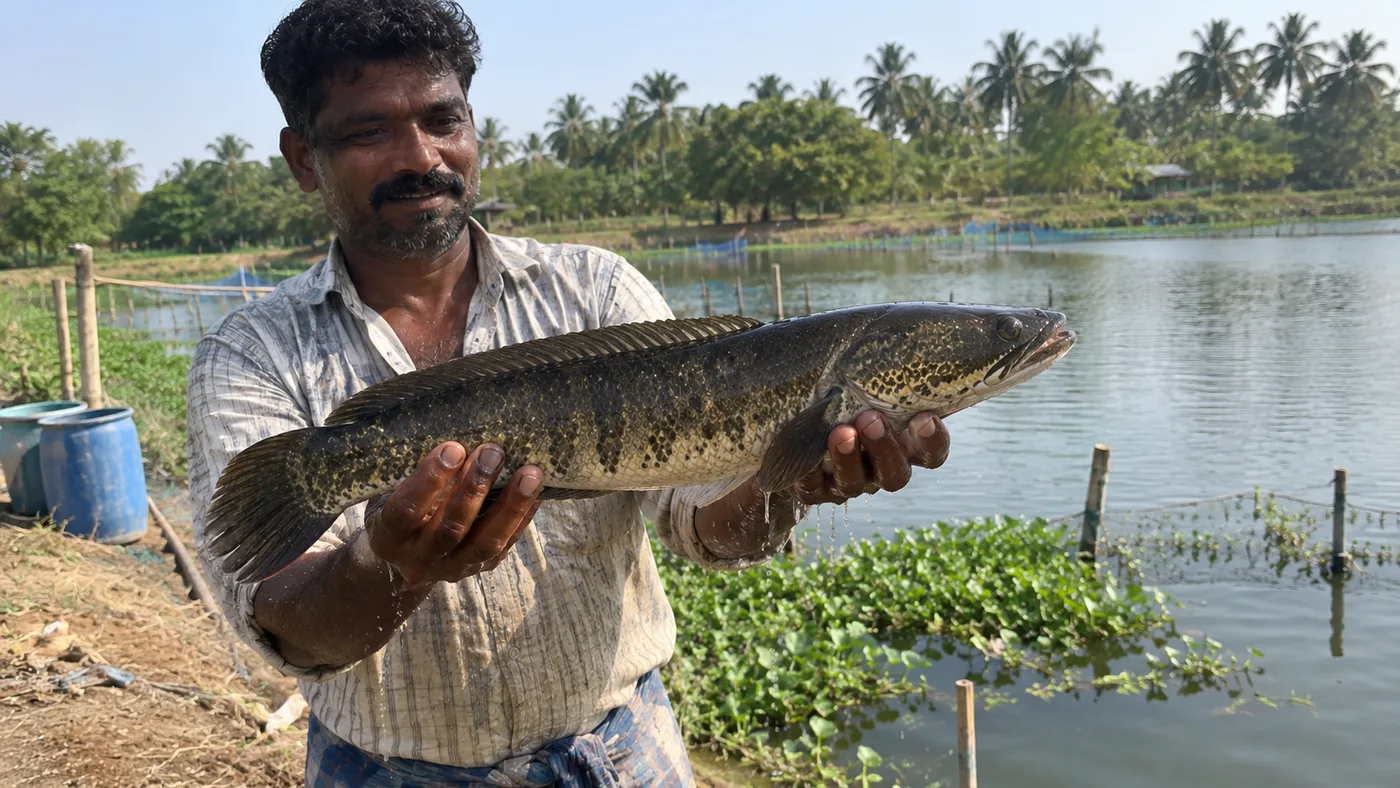
Executive Summary & Key Takeaways
- Striped Murrel (Channa striata) is India's most lucrative freshwater finfish, commanding farmgate prices 300% to 400% higher than Rohu, Catla, or Pangasius due to cultural prestige, firm boneless white fillets, and live-market consumer demand.
- The primary cause of beginner failure is nursery cannibalism: murrel are aggressive visual predators that ingest siblings up to 60% of their own body length; grading fingerlings by size every 5 days in nursery hapas is mandatory to ensure >75% survival.
- Weaning is the economic linchpin: commercial profit cannot be sustained on expensive fresh trash fish; fry must be weaned between Day 25 and Day 40 onto 42%–45% crude protein floating extruded pellets using a structured 14-day dietary transition.
- Murrel possess suprabranchial air-breathing organs, enabling them to survive in low-oxygen water (DO < 2.0 ppm) where carps suffocate; this eliminates the need for heavy, continuous paddlewheel aeration.
- Their air-breathing biology allows live transport over 500+ kilometers in shallow, damp containers with zero water aeration, fetching premium live-market prices without live-tanker trucking expenses.
- Anti-jump perimeter fencing is non-negotiable: during heavy monsoon showers, murrel exhibit powerful migratory instincts, jumping up to 1.0 meter onto pond banks; install a 1.2m fine-mesh fence with an inward overhang around all dikes.
- A well-managed 1-acre intensive pond producing 4,000 to 5,000 kg of table-size murrel (500g–800g) routinely nets ₹7.5 to ₹10.2 Lakhs per 8-to-10 month crop cycle.
Commercial Freshwater Case Study: Converting a Low-Yield Carp Pond into a ₹9.42 Lakh Net Profit Murrel Enterprise
A commercial fish farmer in Nalgonda, Telangana, struggling with razor-thin margins on Rohu and Catla carps (selling at ₹135/kg against feed and lease costs of ₹115/kg), converted a 0.8-acre earthen pond to intensive Striped Murrel (Channa striata) culture. In previous unassisted attempts, the farmer suffered 72% mortality due to nursery cannibalism and feed refusal. Partnering with AquaSangham finfish advisory, the farm implemented three scientific protocols: (1) Reared 8,000 fry (1.5-inch) inside six submerged nylon hapas (5m x 3m x 1.2m), physically grading every fish through plastic slot-graders every 5 days to eliminate predatory 'shooters'; (2) Executed a 14-day weaning progression, transitioning fingerlings from minced marine trash fish paste mixed with boiled egg yolk onto a 45% crude protein commercial floating extruded pellet (1.2mm to 2.5mm); (3) Erected a 1.2-meter perimeter HDPE anti-jump barrier with a 20cm inward lip along the pond dikes. Stocked into the growout pond at 7,500 fingerlings/acre and fed twice daily at 4% to 5% body weight inside floating feeding rings, the crop attained an average weight of 680 grams in 270 days. The farm harvested 4,680 kg of vigorous, live murrel with 78.4% survival. Sold directly to live fish restaurants and wholesale traders in Hyderabad at ₹520/kg, gross revenue reached ₹24.33 Lakhs against total operating costs of ₹14.91 Lakhs (feed ₹9.12 L, seed fingerlings ₹2.40 L, electricity, labor and lease ₹3.39 L), securing an audited net profit of ₹9.42 Lakhs in 9 months.
1. The ₹500/kg Market Reality: Why Murrel Outearns Carps and Pangasius by 400%
In the Indian freshwater aquaculture landscape, commercial fish farming has long been dominated by Indian Major Carps (Catla, Rohu, Mrigal) and exotic catfish (Pangasianodon hypophthalmus). However, over the past five years, the economics of conventional freshwater fish farming have severely eroded. Soaring commercial feed ingredient costs (de-oiled rice bran, soybean meal, and mustard oil cake) combined with localized harvest gluts have compressed carp farmgate realizations down to ₹120 to ₹155 per kilogram, leaving farmers with razor-thin operating margins of barely ₹15 to ₹25/kg.
Against this backdrop of commodity carp fatigue, Striped Murrel (Channa striata)—known colloquially as *Korrameenu* in Andhra Pradesh and Telangana, *Viral* in Tamil Nadu, *Korava* in Kerala, *Maral* in Maharashtra, and *Shol* in West Bengal—occupies an elite, high-margin category entirely of its own. Across major metropolitan consumption centers (Hyderabad, Vijayawada, Chennai, Bengaluru, Pune, and Kolkata), fresh live murrel consistently commands farmgate prices between ₹450 and ₹650 per kilogram.
This dramatic 300% to 400% price premium over carps is anchored in three powerful consumer drivers: (1) Exceptional Culinary Quality: Murrel meat is glistening white, firm, sweet, and practically boneless, containing only a central vertebral column without the troublesome intramuscular Y-bones characteristic of cyprinid carps; (2) Traditional Medicinal Reputation: In Indian Ayurvedic and modern medical folklore, murrel is prescribed for post-operative patient recovery, wound healing, and postpartum recuperation due to extraordinarily high natural concentrations of glycine, arachidonic acid, and bioactive collagen peptides; (3) Live Market Resilience: Murrel possess suprabranchial accessory respiratory organs that allow them to breathe atmospheric air directly. Retail fishmongers can display live, kicking murrel in shallow, damp plastic tubs for days without aeration pumps, allowing consumers to buy 100% fresh, live fish right at the roadside market.
For progressive fish culturists, the commercial arithmetic is compelling: producing 4,500 kilograms of carp from a 1-acre pond yields roughly ₹6.0 Lakhs gross revenue and barely ₹1.0 Lakh net profit. Producing the exact same 4,500 kilograms of Striped Murrel yields ₹23.4 Lakhs gross revenue and nets over ₹8.5 Lakhs in clear operating profit. However, capturing this lucrative return requires overcoming the two biological challenges that cause 70% of novice murrel culturists to go bankrupt: predatory nursery cannibalism and feed weaning failure.
Never market murrel as iced dead fish. An iced dead murrel sells at a 40% discount (₹280–₹320/kg) compared to a live, wriggling specimen (₹500–₹580/kg). Invest in shallow plastic crates with moist gunny bags to transport your harvest live to city wholesale auction yards.
2. Species Biology & Physiology: Channa striata vs Channa marulius
Before investing in broodstock or seed fingerlings, a commercial farmer must understand the biological distinction between the two commercial murrel species indigenous to Indian inland waters.
1. Striped Murrel (*Channa striata*): The undisputed commercial workhorse of Indian aquaculture. It is distinguished by its cylindrical, torpedo-like body, dark olive-green dorsal coloration with oblique black chevron bands, and a creamy white belly. Channa striata attains a commercial marketable size of 500 grams to 800 grams within 8 to 10 months of culture. It exhibits exceptional feed training receptivity, thrives in warm water (26°C to 32°C), adapts easily to commercial extruded floating pellets, and commands the highest consumer brand loyalty in southern and western Indian retail markets.
2. Bullseye Murrel / Great Snakehead (*Channa marulius* / *Channa aurolineata*): Known locally as *Poola Chepa* or *Boli Viral*, this species is identifiable by a conspicuous black ocular spot (ocellus) encircled by an orange ring on the upper base of the caudal fin and yellow-orange lateral streaks. Channa marulius is a true apex giant, easily growing to 1.5 kg to 3.0 kg in pond culture. While it commands premium prices, it is far more territorial, has a slower feed conversion efficiency, requires larger pond areas, and exhibits extreme aggression, making it better suited for low-density polyculture rather than intensive commercial monoculture.
The defining physiological superpower of both species is the suprabranchial organ—a pair of vascularized, folded epithelial chambers located in the dorsal skull cavity above the gills. This evolutionary adaptation allows murrel to breathe atmospheric oxygen directly from the air-water interface. As a result, murrel thrive in shallow, stagnant water bodies with dissolved oxygen levels as low as 1.5 mg/L—conditions that would trigger 100% mortality in Rohu or Catla. Consequently, murrel farming requires minimal mechanical aeration machinery, drastically slashing electricity and diesel bills.
Water Chemistry & Pond Soil Preferences
While murrel are remarkably hardy with respect to low dissolved oxygen, their predatory metabolism produces heavy nitrogenous excretion. Ponds must maintain water pH between 7.2 and 8.2, total alkalinity above 100 ppm (as CaCO3), and water temperature between 26°C and 31°C.
Murrel avoid brightly sunlit, barren concrete ponds. In earthen culture, they thrive over clay-loam bottoms with organic vegetation cover. Providing 20% to 25% pond surface coverage using floating aquatic plants (such as water hyacinth, Eichhornia crassipes, confined within floating bamboo frames) creates essential shaded resting zones that reduce stress and suppress territorial combat.
The Bimodal Respiration Dynamic
Juvenile murrel under 25 days of age rely primarily on branchial gill respiration. The suprabranchial organ only becomes fully functional when fry attain a length of 3.5 to 4.5 cm. During this critical transition window, nursery hapas must maintain high dissolved oxygen (>4.5 ppm) to prevent fry asphyxiation before atmospheric air-breathing is established.
3. The Nursery Cannibalism Crisis: Sizing Grids, Grading Protocols & Shooter Removal
In commercial murrel farming, nursery management is the battlefield where profits are won or lost. In their natural state, murrel are obligate ambush carnivores equipped with sharp, backward-pointing teeth on their vomer and palatine bones. When murrel eggs hatch, the larvae exhibit naturally asynchronous growth rates. Within 15 days, a small percentage of aggressive fry grow 20% to 30% faster than their cohorts. These rapidly growing specimens are known in aquaculture as 'Shooters' or 'Jumpers'.
A shooter murrel fingerling can swallow a smaller sibling up to 60% of its own body length whole, head-first. If a farmer stocks 20,000 un-graded 1-inch fry into a nursery pond and leaves them unattended for 45 days, the shooters will systematically consume their smaller siblings. By Day 50, the farmer will find barely 2,000 to 3,000 massive fingerlings remaining—an catastrophic 85% to 90% nursery mortality that bankrupts the operation before growout even begins.
To break this cannibalism cycle, commercial operators enforce a rigid **5-Day Mechanical Grading Protocol** throughout the 45-day nursery rearing phase. Nursery rearing must never take place in open earthen ponds; it must be conducted inside high-density polyethylene (HDPE) nursery hapas (typically 5m length x 3m width x 1.2m depth, 1mm to 2mm knotless mesh) suspended in a clean, predator-free nursery pond.
Grading Mechanics: Every 5 to 7 days, technicians lift each nursery hapa and pass all fingerlings through floating plastic or stainless-steel slot-grading boxes. The grading box features precision parallel bars set to calibrated widths (e.g., 4mm, 6mm, 8mm, and 10mm). Smaller fish slip through the bars into an adjacent hapa, while larger shooters remain on top. Fingerlings are separated into three distinct cohorts: Grade-A (Shooters/Large), Grade-B (Medium), and Grade-C (Small). When every fish in a hapa is identical in size, cannibalism drops from 80% to under 6%.
The 5-Day Grading Calendar for Murrel Nursery
Day 1 to 10 (Fry Stage / 0.5 to 1.0 inch): Stock 2,000 fry/m² in 0.5mm fine-mesh hapas; feed live Artemia nauplii and freshwater cladocerans (Moina and Daphnia) 4 times daily.
Day 11 to 25 (Early Fingerling / 1.0 to 2.0 inches): Execute First & Second Mechanical Grading; separate into 2 size groups; initiate minced trash fish and tubifex worm paste feeding.
Day 26 to 40 (Weaning Phase / 2.0 to 3.5 inches): Execute Third & Fourth Mechanical Grading; transfer onto 1.2mm commercial floating extruded pellets; stock density reduced to 400 fingerlings/m².
Day 41 to 50 (Stocking Ready / 4.0 to 5.0 inches): Final grading; select uniform 25g–35g advanced fingerlings for immediate release into growout ponds.
Tricaine / Salt Anesthetic Bath During Grading
Murrel fingerlings are excitable and suffer cutaneous abrasions when handled dry. Always grade fingerlings in floating water boxes filled with 5 ppt salt (NaCl) solution. The mild salinity calms the fish, reduces branchial osmotic stress, and forms an antiseptic shield against secondary Saprolegnia fungal infections.
4. The 14-Day Feed Weaning Master Protocol: Moving from Live Forage to 45% CP Pellets
Wild murrel feed exclusively on moving prey—live aquatic insects, shrimp, tadpoles, and smaller fish. They possess an instinctive hunting reflex triggered by movement and chemical scent. Rearing murrel to commercial market size (500g+) on live forage fish or raw marine trash fish is an economic disaster: forage fish costs ₹35 to ₹50/kg with an atrocious biological FCR of 5:1 to 7:1, meaning you burn ₹200+ in feed cost for every kilogram of murrel produced.
The golden key to commercial profitability is **Feed Weaning**—training 1.5 to 2.5-inch fingerlings to abandon live prey and eagerly consume dry, floating extruded commercial aquafeed pellets. When weaned onto pellets, murrel achieve an exceptional commercial FCR of 1.25 to 1.45, bringing feed cost down to ₹95–₹115 per kilogram of fish produced.
The 14-day weaning progression commences when fingerlings reach 3.5 cm to 4.0 cm inside nursery hapas:
Days 1 to 3 (Paste Inoculation): Fresh marine trash fish (sardines or anchovies) is finely minced through a 1mm meat grinder into a smooth paste, combined with 5% boiled chicken egg yolk and 2% fish oil. The paste is placed in small wire mesh balls suspended 5 cm beneath the water surface. Fingerlings swarm the scented paste balls.
Days 4 to 7 (Pellet Crumble Integration): Begin incorporating 1.0mm high-protein (45% crude protein) micro-extruded starter crumbles into the minced fish paste. Start at a 75% fish paste to 25% dry crumble ratio. The dry feed absorbs the fresh marine fish scent and juices.
Days 8 to 11 (Shift to Semi-Moist Pellet Dough): Shift the ratio to 30% minced fish and 70% starter pellets, moistened with water to form soft, pliable noodle-like dough strands extruded through a hand press. Murrel strike the descending noodles aggressively.
Days 12 to 14 (100% Dry Floating Pellet Transition): Withdraw all fresh fish. Broadcast 1.5mm dry floating extruded pellets directly into floating PVC feeding rings. The sound of pellets striking the water surface triggers a conditioned feeding response. Once 90%+ of the fish swarm the surface within 60 seconds of broadcast, the cohort is officially weaned and ready for growout stocking.
Nutritional Specifications for Commercial Murrel Pellets
Crude Protein: Must be strictly between 42% and 46%. Murrel are strict carnivores with minimal carbohydrate digestive capacity; feeds with crude protein below 38% cause severe hepatic lipidosis (fatty liver disease) and stunted growth.
Crude Fat / Lipid: 8% to 12% marine fish oil to provide essential EPA, DHA, and phospholipids.
Crude Fiber: Less than 4.5%; high plant fiber induces gastrointestinal inflammation and white faeces excretion.
Pellet Physical Form: 100% slow-floating extruded pellets. Sinking pellets fall into the pond silt where murrel ignore them, fouling benthic soil chemistry.
5. Growout Pond Engineering: Stocking Densities, Anti-Jump Fencing & Water Quality
Once fingerlings are graded and fully weaned onto commercial floating pellets, they are transferred to growout ponds. While murrel can be cultured in high-density biofloc tanks and circular concrete tanks, commercial earthen ponds (0.5 to 1.0 acre) yield the highest net financial return per rupee of capital invested.
Pond Dimensions & Depth: Ideal pond size is 0.5 to 1.0 acre with a flat, smooth bottom pitched toward a central harvesting sump. Water depth should be maintained between 1.0 and 1.2 meters. Excessive water depth (>1.8m) is disadvantageous because murrel must swim to the surface every few minutes to breathe atmospheric air; deep water wastes metabolic energy on vertical swimming.
Anti-Jump Perimeter Fencing (Mandatory): The legendary escape ability of the snakehead fish is an existential threat to farm profits. Murrel possess powerful caudal fin muscles and pectoral spines that allow them to jump up to 1.0 meter vertically out of water, especially on humid, rainy nights during the southwest or northeast monsoon. In unfenced ponds, farmers routinely lose 50% of their stock in a single rainy night as fish 'walk' across wet grass into nearby canals.
The pond perimeter must be enclosed with a 1.2-meter high barrier constructed of 20mm HDPE knotless mesh or split-bamboo reeding secured to Casuarina poles spaced 2.0 meters apart. The bottom of the mesh must be buried 20 cm into the inner pond dike, and the top must feature a 25cm horizontal inward overhang to prevent jumping fish from clearing the top.
Stocking Density & Feeding SOP: Stock weaned, uniform fingerlings (25g to 35g size) at a density of 6,000 to 8,000 fish per acre for intensive monoculture. Install floating feeding rings (made of 50mm PVC pipe, 3m x 3m square) anchored 3 meters from the dike. Feed twice daily: 40% of the daily ration at 07:30 AM and 60% at 05:30 PM. Never broadcast feed across the entire pond; confining pellets within feeding rings prevents wind drift and allows precise observation of feed consumption.
Benthic Soil Health & Water Refreshment
Because murrel consume high-protein feeds, organic waste accumulates on the pond floor. While they tolerate low DO, benthic accumulation of un-ionized ammonia (NH3 > 0.05 ppm) and hydrogen sulfide (H2S > 0.02 ppm) triggers chronic bacterial gill rot (Flexibacter columnaris).
Exchange 15% to 20% of pond water volume every 15 days using fresh borewell or canal water. Broadcast agricultural dolomite lime @ 100 kg/acre monthly to maintain pond water alkalinity above 120 ppm and stabilize pH.
Winter Culture Precautions in North & Central India
When water temperatures drop below 20°C in December and January, murrel cease feeding and bury themselves into the bottom silt. Reduce feeding rations by 70% during cold snaps to avoid feed decomposition on the pond floor.
6. Comprehensive 1-Acre Commercial P&L: Capex, Feed FCR, Labor & Net Realization
To provide a realistic investment framework for commercial agribusiness investors and fish culturists, we examine the fully audited 1-acre commercial budget for an intensive Striped Murrel (Channa striata) farm operating over an 8-to-10 month crop cycle in India.
The model assumes an initial stocking of 7,000 weaned advanced fingerlings (30g size) in a 1.0-acre earthen pond. With disciplined 5-day nursery grading and pellet weaning, survival is benchmarked at a conservative 80%, yielding 5,600 harvestable table fish. Reared over 270 days on a 42% crude protein floating extruded diet with a biological FCR of 1.35, the fish attain an average harvest weight of 750 grams, producing 4,200 kg of prime live murrel.
Sold at a realistic farmgate realization of ₹500/kg to live fish consolidators serving Hyderabad, Chennai, or Bengaluru urban markets, gross farm revenue reaches ₹21,00,000 (₹21.0 Lakhs). Total operational expenditure—including fingerling procurement (₹2.10 L), commercial extruded feed (₹5.38 L), pond lease, electricity, labor, and anti-jump fencing depreciation (₹3.42 L)—totals ₹10.90 Lakhs, delivering a spectacular net operating profit of ₹10.10 Lakhs per acre.
The comparative matrix below benchmarks the commercial unit economics of Striped Murrel against conventional Indian Major Carps (Rohu/Catla) and Pangasius catfish across identical 1-acre farm footprints.
| Commercial Parameter | Striped Murrel (Channa striata) | Indian Major Carps (Rohu / Catla) | Pangasius (P. hypophthalmus) | Commercial Impact on Farmer |
|---|---|---|---|---|
| Live Farmgate Price | ₹ 480 – ₹ 620 / kg | ₹ 130 – ₹ 155 / kg | ₹ 85 – ₹ 105 / kg | Murrel commands 3.5x to 5.0x higher selling price |
| Average Culture Duration | 8 – 10 Months (to 750g) | 10 – 12 Months (to 1.2kg) | 6 – 7 Months (to 1.5kg) | Rapid capital turnover with high value accretion |
| Feed Protein Requirement | 42% – 45% Crude Protein | 22% – 26% Crude Protein | 28% – 32% Crude Protein | Higher feed cost offset by massive farmgate realization |
| Dissolved Oxygen Demand | Very Low (Air-breathing) | High (> 4.0 ppm required) | Moderate (> 2.5 ppm) | Murrel requires zero continuous paddlewheel aeration |
| Live Transport Survival | 98%+ (Up to 500 km in damp crates) | Requires expensive live tanker | Requires live aerated water tanker | Drastically reduces distribution & logistics overhead |
| Gross Revenue / Acre | ₹ 21,00,000 (4.2 Tons @ ₹500) | ₹ 5,85,000 (4.5 Tons @ ₹130) | ₹ 10,80,000 (12 Tons @ ₹90) | Highest revenue density in Indian freshwater aqua |
| NET PROFIT PER ACRE | ₹ 10,10,000 / Crop | ₹ 1,15,000 / Crop | ₹ 1,45,000 / Crop | Murrel generates 7x to 8x the net profit of carp |
Stagger your harvest over 4 weeks rather than netting the entire pond in a single day. Selectively harvest the largest 800g+ fish using drag nets with 75mm mesh; removing dominant fish relieves social hierarchy pressure on smaller 600g fish, triggering rapid compensatory growth.
7. Operational Field SOP Checklist & Frequently Asked Questions
To achieve the audited benchmark of 80% survival and ₹10+ Lakhs net profit per acre, farm managers must execute operations with clinical precision. Below is the non-negotiable operational checklist for commercial murrel culture, followed by expert solutions to critical production challenges.
The 6-Rule Field SOP Action Checklist for Murrel Culture
1. 5-Day Nursery Grading: Pass all nursery fry through mechanical slot-graders every 5 days without fail to segregate shooters and eliminate cannibalism.
2. Complete Pellet Weaning: Never stock fingerlings into growout ponds until 100% of the cohort feeds voraciously on dry floating extruded pellets.
3. 1.2-Meter Anti-Jump Enclosure: Erect heavy-duty HDPE perimeter fencing with an inward overhang around all pond dikes to prevent monsoon escapes.
4. 42%+ CP Diet Adherence: Feed strictly floating extruded feed containing minimum 42% crude protein; reject low-protein carp feeds.
5. Confined Ring Feeding: Broadcast pellets strictly inside anchored floating PVC feeding rings to track daily appetite and prevent water fouling.
6. Live Transport in Moist Crates: Ship harvested fish live in perforated plastic crates lined with wet gunny sacks to capture the full ₹500+/kg live market premium.
Summary Operational Action Checklist
Frequently Asked Questions
Q: Can I culture murrel in Biofloc tarpaulin tanks or circular concrete tanks?
Yes, Striped Murrel (Channa striata) adapts exceptionally well to circular Biofloc tarpaulin tanks and concrete RAS units due to its obligate air-breathing physiology. In 50,000-liter circular tanks, murrel can be stocked at intensive densities of 60 to 80 fish per cubic meter (producing 35 to 45 kg/m³). However, tanks must have secure top netting to prevent jumping, and water circulation must be gentle; high-velocity rotational currents stress the fish and cause feed refusal.
Q: Where can farmers procure quality certified Striped Murrel fingerlings in India?
Historically, farmers relied on wild seed collected from natural irrigation tanks and rivers. Today, commercial induced breeding hatcheries certified by ICAR-CIFA (Bhubaneswar) and private commercial hatcheries across Telangana (Warangal, Karimnagar), Andhra Pradesh (Krishna and Guntur districts), Tamil Nadu (Bhavanisagar, Thanjavur), and Kerala supply induced-bred, pellet-weaned Channa striata fingerlings. Always verify that fingerlings are weaned to dry floating pellets before taking delivery.
Q: What are the common diseases affecting murrel, and how are they controlled?
The most common disease is Epizootic Ulcerative Syndrome (EUS), caused by the invasive oomycete fungus Aphanomyces invadans, typically occurring during winter months (water temp < 22°C). Symptoms include red circular erosions and deep muscular ulcers. Prevention involves broadcasting agricultural lime (CaCO3) @ 150 kg/acre and CIFAX (an ICAR-CIFA developed therapeutic) @ 1 liter per acre. The second common issue is bacterial columnaris (Flexibacter), controlled by dipping fingerlings in 5 ppm potassium permanganate.
Q: Can murrel be farmed in polyculture with Rohu, Catla, or Scampi prawns?
Polyculture with carps is possible only as a predator-prey biocontrol model at very low densities (stocking only 50 to 100 adult murrel per acre to control wild tilapia or weed fish reproduction). Never stock juvenile murrel with carps in intensive commercial systems, as murrel require 45% CP feed while carps consume 22% CP feed. For maximum commercial profits, intensive monoculture in fenced ponds is the proven commercial gold standard.
AquaSangham Freshwater Advisory
Commercial Finfish & Predator Culture Division
Contributing Senior Technical Writer & Aqua Consultant at AquaSangham.
Recommended Farming Guides
The 3 AM Oxygen Trap: Why Fish and Shrimp Die at Dawn (And The 4.0 ppm Rule That Saves Them)
Read Article →Water QualityWhy Sudden Monsoon Rain Wipes Out Shrimp Overnight (And The 30-Minute Emergency Lime Protocol That Saves Your Pond)
Read Article →Market AnalysisEU & US Seafood Traceability Audits: Keeping Digital Farm Logs to Secure ₹15-₹20/kg Premium from Exporters
Read Article →Get Live Farm Advice on AquaSangham Mobile App
Download India's #1 Aquaculture Super App for real-time market prices, precision tools, and community advice.
Download Free Android App