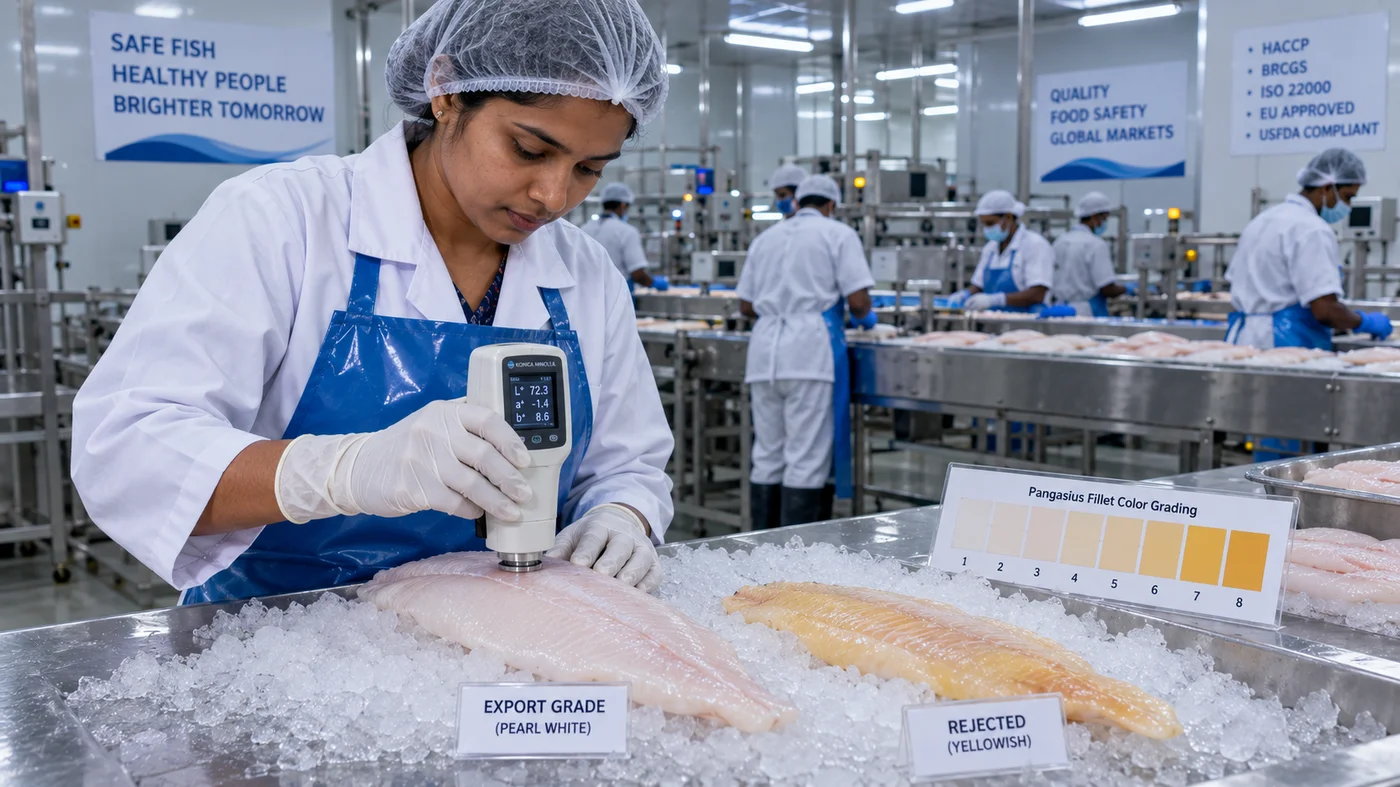
Executive Summary & Key Takeaways
- Pangasius fillet color is the single most critical price determinant in global and premium domestic markets; pristine white fillets command a ₹15 to ₹25 per kg farmgate premium over yellow meat.
- Yellow flesh discoloration is primarily caused by the dietary accumulation of oxygenated carotenoids (xanthophylls—specifically lutein, zeaxanthin, and β-cryptoxanthin) stored in muscle adipocytes.
- Strictly eliminate high-xanthophyll raw ingredients from Pangasius feeds: ban yellow corn, corn gluten meal, marigold meal, cottonseed meal, and blue-green algae (spirulina).
- Formulate white-meat finishing diets using zero-pigment carbohydrate and protein sources: polished broken rice, wheat middlings, cassava flour, and de-hulled solvent-extracted soybean meal.
- Maintain total finished feed dietary xanthophyll concentration strictly below 1.5 to 2.0 mg per kilogram of feed during the final 45 to 60 days of grow-out.
- Suppress dense cyanobacteria and green microalgal blooms in grow-out ponds; omnivorous Pangasius filter-feed on phytoplankton, absorbing significant amounts of natural algal xanthophylls.
- Execute proper live-fish bleeding (severing the caudal peduncle or ventral aorta in cold slurry ice) at harvest to prevent residual hemoglobin and myoglobin from imparting dull pink/grey discoloration.
- Verify fillet color using objective digital colorimeters: Grade-A White requires a Lightness score (CIE L*) > 52 and a Yellowness score (CIE b*) < 4.0.
Commercial Processing Case Study: Transforming a 500-Ton Farm Cluster from 42% Yellow Reject to 96% Grade-A White Fillet
A commercial Pangasius production group supplying direct export processors in Visakhapatnam suffered catastrophic downgrades when European and North American buyers rejected 42% of their harvested fillets due to severe yellow-orange pigmentation (CIE b* values ranging from +6.8 to +9.2). Local processors slashed farmgate procurement prices from ₹82/kg down to ₹58/kg for yellow-tinted fish, wiping out operating margins. The enterprise partnered with the AquaSangham Feed Formulation & Meat Whitening Advisory: nutritional audits revealed the culprit—commercial finisher feed contained 22% yellow corn and 6% corn gluten meal, delivering over 14.5 mg/kg of dietary xanthophylls. The farm executed an immediate 3-pillar intervention: (1) Replaced all corn derivatives with polished broken rice, wheat flour, and high-protein de-hulled soybean meal, dropping total dietary xanthophylls to 1.1 mg/kg; (2) Controlled dense Microcystis and Scenedesmus blooms in ponds using agricultural gypsum and weekly Bacillus bio-remediation to prevent natural algal carotenoid ingestion; (3) Implemented an emergency 45-day pre-harvest whitening wash-out diet. Upon harvesting the next 520 metric tons, factory colorimetric analysis confirmed 96.4% Grade-A white fillets (b* < 3.8, L* > 54), securing full export pricing and unlocking ₹98 Lakhs in recovered revenue.
1. Global Market Realities: White vs Yellow Fillet Economics & Price Penalties
In the international trade of whitefish fillets—dominated by cod, haddock, pollock, and Pangasius (marketed globally as Basa, Tra, or Swai)—visual aesthetic presentation is paramount. Global seafood consumers in North America, the European Union, the United Kingdom, and high-end Middle Eastern hospitality markets demand fillets that are impeccably pearl-white, uniform, and translucent. A white fillet signifies freshness, purity, clean water culture, and premium culinary quality.
Conversely, Pangasius fillets that exhibit a yellowish, creamy-yellow, or yellowish-pink hue are universally penalized. In international export specifications, fillets are strictly sorted into three visual tiers: (1) Grade-A White Fillet: Pristine pearl-white with zero color tint, commanding peak global wholesale prices ($2.80 to $3.40 per kg FOB); (2) Grade-B Light Yellow / Cream: Minor pale-yellow cast, discounted by 15% to 25%; and (3) Grade-C Yellow / Reddish: Heavy golden-yellow coloration, rejected by mainstream supermarkets, banned from export to prime Western markets, and dumped into low-value domestic canning or animal feed markets at discounts exceeding 40% to 50%.
In India, as domestic consumption matures and export processing plants expand along the coastal belts of Andhra Pradesh, Gujarat, and Kerala, this price differential directly impacts farmgate economics. Processors paying ₹80 to ₹85/kg for verified white-meat Pangasius enforce brutal penalties—docking farmgate payments down to ₹55 to ₹62/kg—for pond batches that cut yellow on the processing line. On a standard 40-ton commercial harvest, an undetected yellow fillet defect inflicts an immediate financial wipeout of ₹8 to ₹10 Lakhs in lost farmgate revenue per pond.
Overcoming the yellow fillet syndrome is not a matter of genetics; it is entirely an operational discipline governed by nutritional biochemistry, precise feed milling formulations, pond limnology, and post-harvest handling. This clinical technical manual details the exact industrial protocols to eliminate yellow pigments and guarantee 95%+ Grade-A white meat pack-outs.
Commercial Meat Color Grading & Price Matrix
1. Grade-A White (CIE b* < 4.0): Clean translucent pearl-white; 100% export eligible; premium farmgate realization (₹80–₹85/kg).
2. Grade-B Off-White / Cream (CIE b* 4.0–6.0): Faint yellow undertone; accepted by regional caterers at an 8–12% discount.
3. Grade-C Yellow (CIE b* > 6.0): Severe yellow-orange staining; rejected by export reefer lines; heavy discount (₹55–₹62/kg).
Never rely on visual inspection under dim pond dyke lighting to assess meat color. Always fillet a sample of 5 fish in bright natural daylight or use a digital colorimeter on the ventral and dorsal muscle lobes 30 days prior to commercial harvest.
2. Biochemical Etiology: How Xanthophylls Stain Catfish Muscle Adipocytes
To formulate an effective whitening strategy, aquaculture nutritionists must understand the biological mechanism of pigment deposition in Pangasianodon hypophthalmus. Unlike salmonids (Atlantic salmon and rainbow trout) that have evolved specialized beta-adrenergic receptors and actomyosin-binding sites that selectively sequester red keto-carotenoids (astaxanthin) within their skeletal muscle myofibrils, Pangasius is biologically programmed to produce white, non-pigmented muscle tissue.
Pangasius does not synthesize carotenoid pigments de novo. Any coloration that appears in the fillet is the direct result of exogenous lipid-soluble pigments absorbed from the diet and incorporated into host tissue. The chemical culprits belong to the class of oxygenated carotenoids known collectively as Xanthophylls—principally Lutein, Zeaxanthin, and β-Cryptoxanthin.
The Biochemical Deposition Cascade:
1. Ingestion & Intestinal Absorption: When Pangasius ingests feed containing yellow corn, corn gluten, or green microalgae, xanthophyll molecules dissolve into dietary lipid micelles within the gut lumen. Because xanthophylls are highly lipophilic, they pass easily through the enterocyte brush border membrane via passive diffusion and scavenger receptor class B type I (SR-BI) transporters.
2. Lipoprotein Transport: Inside the enterocytes, xanthophylls are packaged into chylomicrons and low-density lipoproteins (LDLs), which enter the mesenteric lymphatic vessels and the bloodstream.
3. Intra-Myofibrillar Adipocyte Storage: Unlike salmon where astaxanthin binds to muscle actomyosin fibers, xanthophylls in Pangasius do not bind to muscle proteins. Instead, they partition exclusively into the lipid fraction—specifically within the subcutaneous adipose tissue, the belly-flap fat reserves, and the microscopic intra-myofibrillar adipocytes interspersed between the white muscle bundles. As the fish grows and accumulates fat reserves, these xanthophyll pigments concentrate within the fat droplets, imparting a pervasive, unappealing golden-yellow to orange stain throughout the fillet.
Crucially, because xanthophylls are physically dissolved in fat stores rather than bound to structural proteins, they can be mobilized and metabolized. If dietary pigment intake is driven below the fish's metabolic clearance rate, the fish will naturally metabolize and deplete these stored xanthophylls over a 35 to 45-day washout window, restoring pristine pearl-white muscle coloration.
Fillet fat content directly correlates with yellow staining intensity. Overfeeding high-lipid finisher diets (>6% fat) accelerates xanthophyll storage in muscle adipocytes. Keep finisher feed crude fat strictly between 3.5% and 4.0% to minimize fat deposition and accelerate pigment washout.
3. Raw Ingredient Audit: Banning Yellow Corn, Gluten & Prohibited Binders
The overwhelming root cause of yellow Pangasius fillets in India is the feed mill's procurement of low-cost, high-pigment raw ingredients. Commercial feed formulators operating in multi-species feed mills frequently utilize standard poultry or carp raw ingredient baskets, blending yellow maize and corn by-products into catfish feeds. In poultry diets, yellow xanthophylls are deliberately sought after to color broiler skin and egg yolks; in Pangasius aquaculture, they are commercially lethal.
The Prohibited Raw Ingredient Blacklist for Pangasius Feed:
- Yellow Maize / Corn (Zea mays): Contains 15 to 30 mg/kg of total xanthophylls (predominantly lutein and zeaxanthin). Even a modest 15% inclusion of yellow corn in a finisher diet delivers 3.5 to 4.5 mg/kg of xanthophylls—more than double the safe threshold for white meat.
- Corn Gluten Meal (60% CP): The most dangerous ingredient in catfish nutrition. A concentrated by-product of wet-corn milling, corn gluten meal contains a staggering 200 to 350 mg/kg of xanthophyll pigments. An inclusion of just 2% corn gluten meal introduces 6.0 mg/kg of xanthophylls, guaranteeing severe Grade-C yellow fillets across 100% of the population.
- Marigold Petal Meal (Tagetes erecta): Commonly used as a natural color enhancer in layer poultry feeds; must never enter an aquatic feed mill producing Pangasius diets.
- Spirulina & Blue-Green Microalgal Powders: Rich in zeaxanthin (over 1,000 mg/kg); completely prohibited in catfish diets.
- Unrefined Red Palm Oil: High in beta-carotene; imparts strong reddish-yellow tones.
- Cottonseed Meal & Yellow Mustard Oil Cake: Impart brownish-yellow polyphenolic pigments (gossypol) and xanthophylls that discolour muscle tissue.
| Raw Feed Ingredient | Total Xanthophyll Content (mg/kg) | Suitability for Pangasius Meat Whitening | Recommended Maximum Inclusion % |
|---|---|---|---|
| Corn Gluten Meal (60% CP) | 200 – 350 mg/kg | STRICTLY PROHIBITED (Severe Yellowing) | 0.0% (Zero Tolerance) |
| Yellow Maize / Corn | 15 – 30 mg/kg | PROHIBITED in Finisher Diets | 0.0% in Final 60 Days |
| Distillers Dried Grains (DDGS) | 25 – 40 mg/kg | PROHIBITED (High Pigment Concentration) | 0.0% (Zero Tolerance) |
| Spirulina Algae Powder | 1,200 – 1,800 mg/kg | STRICTLY PROHIBITED | 0.0% (Zero Tolerance) |
| De-hulled Soybean Meal (46% CP) | 1.5 – 3.0 mg/kg | HIGHLY RECOMMENDED (Core Protein Base) | 30.0% – 45.0% |
| Polished Broken Rice | 0.2 – 0.5 mg/kg | PREMIER WHITE CARBOHYDRATE | 25.0% – 35.0% |
| Wheat Flour / Wheat Middlings | 0.8 – 1.5 mg/kg | EXCELLENT (Low Pigment & High Binding) | 20.0% – 30.0% |
| Cassava / Tapioca Starch | 0.1 – 0.4 mg/kg | IDEAL WHITE BINDER | 10.0% – 15.0% |
| De-oiled Rice Bran (DORB) | 1.0 – 2.0 mg/kg | ACCEPTABLE (Low Fat White Fiber) | 10.0% – 18.0% |
| Fish Meal (Steam Dried 65% CP) | 0.5 – 1.2 mg/kg | ACCEPTABLE (Animal Protein Booster) | 3.0% – 6.0% |
Demand a certified High-Performance Liquid Chromatography (HPLC) xanthophyll assay from your commercial feed supplier for every incoming feed batch. The Certificate of Analysis must state: 'Total Xanthophyll Concentration < 1.50 mg/kg Finished Feed'.
4. White-Meat Feed Formulation: Broken Rice, Wheat & SBM Matrices (<1.5 ppm)
Formulating a high-performance, cost-effective extruded feed that supports 1.25 FCR while keeping total finished-feed xanthophyll concentration strictly below 1.50 mg/kg requires a complete overhaul of the dietary matrix.
The Core Raw Material Trinity for White Pangasius Meat:
1. Polished Broken Rice (Washed White Rice): Polished broken rice is the ultimate carbohydrate source for white-meat Pangasius. It contains virtually undetectable levels of carotenoids (<0.4 mg/kg), provides 78% digestible starch that gelatinizes beautifully during single or twin-screw extrusion, and imparts zero pigment to muscle adipocytes. Broken rice should constitute 25% to 35% of the total formulation.
2. Food-Grade Wheat Flour & Fine Wheat Middlings: Wheat flour serves as both a low-pigment carbohydrate source and a natural gluten binder that gives extruded floating pellets high water stability (>45 minutes without disintegrating). Total xanthophyll content ranges between 0.8 and 1.2 mg/kg. Inclusion rates should be balanced between 20% and 30%.
3. De-Hulled Solvent-Extracted Soybean Meal (46% to 48% CP): Soybean meal forms the primary protein backbone of modern catfish feeds. Removing the fibrous outer hull eliminates surface pigments, leaving a clean, pale-cream meal with xanthophyll concentrations under 2.5 mg/kg. Coupled with supplemental synthetic amino acids (L-Lysine HCl @ 0.2% and DL-Methionine @ 0.15%), de-hulled SBM fulfills the entire amino acid profile required for 1.45 kg fish growth.
The Finishing Diet Formulation Blueprint (24% CP, 4% Fat, < 1.3 mg/kg Total Xanthophylls):
- Polished Broken Rice: 32.0%
- De-Hulled Soybean Meal (48% CP): 34.0%
- Wheat Flour / Middlings: 20.0%
- De-Oiled Rice Bran (DORB): 8.5%
- Steam-Dried Fish Meal (65% CP): 3.0%
- Refined Bleached Deodorized (RBD) Soybean / Sunflower Oil: 1.0%
- Dicalcium Phosphate (DCP): 1.0%
- Low-Carotenoid Vitamin & Trace Mineral Premix: 0.5%
Analytical Verification: Crude Protein = 24.2%; Crude Fat = 3.8%; Crude Fiber = 4.2%; Total Digestible Energy = 2,950 kcal/kg; Calculated Total Xanthophylls = 1.18 mg/kg. This formulation guarantees rapid weight gain while ensuring 100% white fillet production.
Avoid utilizing crude, unrefined vegetable oils (such as crude palm oil or crude mustard oil) as fat coatings on extruded pellets. Use only Refined, Bleached, and Deodorized (RBD) soybean oil or refined poultry oil; refining strips out all free carotenoids and prevents oxidative yellowing.
5. Pond Environmental Controls: Suppressing Phytoplankton Algae Grazing
A perplexing phenomenon often confronts commercial fish farmers: even when feeding a certified zero-corn, low-xanthophyll (<1.2 ppm) commercial feed, their Pangasius still harvest with noticeable yellow meat discoloration. The hidden culprit lies in the pond ecosystem itself.
Pangasianodon hypophthalmus is an opportunistic, omnivorous benthic filter-feeder. While they consume floating extruded pellets during scheduled feeding sessions, they spend the remainder of the day swimming through the water column, filtering plankton, detritus, and benthic sediments through their gill rakers. If the pond harbors a dense, uncontrolled bloom of blue-green algae (Cyanobacteria such as Microcystis aeruginosa, Anabaena, and Oscillatoria) or green algae (Chlorophyta such as Scenedesmus and Chlorella), the fish ingest massive quantities of natural algal carotenoids.
Algal Pigment Loading Math: Microcystis and green algae contain enormous concentrations of zeaxanthin, lutein, and myxoxanthophyll (often exceeding 800 to 1,500 mg per kilogram of dry algal biomass). If a 1.2 kg Pangasius filters just 2 to 3 grams of dry algal matter daily from a thick pea-green plankton bloom, it absorbs 2.0 to 4.5 mg of pure algal xanthophylls every single day—completely nullifying the benefits of an expensive low-pigment feed.
The Algal Suppression & Water Clarity Protocol:
- Turbidity & Secchi Disk Management: Maintain water transparency between 25 and 35 cm. If water turns a thick, scummy pea-soup green with Secchi disk readings below 15 cm, algal density is dangerously excessive.
- Biological Competition via Probiotics: Inoculate ponds bi-weekly with dense heterotrophic Bacillus subtilis and Bacillus licheniformis probiotics (pre-fermented with jaggery). Heterotrophic bacteria competitively consume dissolved inorganic nitrogen (ammonia and nitrate) and phosphorus, starving cyanobacteria and maintaining a balanced, light golden-brown diatom-dominant water column.
- Mineral Flocculation: If a persistent blue-green surface scum develops, broadcast Agricultural Gypsum (calcium sulfate, CaSO4 @ 200 kg/acre) or Alum (aluminum sulfate @ 15 to 20 kg/acre) across the windward dyke. Gypsum coagulates and precipitates suspended algal cells to the pond floor where benthic bacteria digest them.
- Mechanical Central Purging: Actuate central bottom drain sumps twice weekly to eject accumulated organic sludge and dead microalgae before they can be grazed upon by foraging catfish.
Check your pond early in the morning. If you see a neon-green paint-like scum accumulating along the downwind dyke, skim it off immediately using a fine 100-mesh surface boom net. Allowing Pangasius to gorge on surface algal scum guarantees yellow meat within 7 days.
6. Pre-Harvest Whitening SOP: The 45-Day Depuration Washout Schedule
Because commercial grow-out cycles span 180 to 210 days, feeding a specialized, highly refined white-meat diet throughout the entire culture period is economically unnecessary. Juvenile Pangasius (from 50g up to 700g ABW) can be safely reared on standard cost-effective commercial diets containing modest levels of yellow corn, provided an uncompromising 45-Day Flesh Whitening Washout Protocol is executed during the final grow-out phase.
The 45-Day Whitening Depuration Timeline:
- Day 1 to Day 135 (Biomass Building Phase): Stock fingerlings and feed standard commercial extruded floating pellets (28% down to 26% CP). Fish grow rapidly from 50g to approximately 750–850g. Moderate carotenoid accumulation during this stage is confined to early juvenile fat stores.
- Day 136 (The Color Diagnostic Audit): Harvest 5 representative fish from across the pond. Sacrifice and fillet each fish under standard white daylight. If fillets show any yellowish tinge (b* > 4.5), initiate the immediate 45-day whitening protocol.
- Day 136 to Day 180 (The Strict 45-Day Whitening Washout Window):
1. Switch 100% of pond feed to the certified Low-Xanthophyll Finishing Diet (< 1.3 mg/kg total xanthophylls, 24% CP, 3.8% fat, based on broken rice and de-hulled SBM).
2. Cut feed rations to a controlled finishing rate: 1.4% to 1.6% of body weight daily. Overfeeding accelerates lipid synthesis, trapping xanthophylls in new adipocytes.
3. Increase nighttime paddlewheel aeration to maintain dissolved oxygen above 4.5 ppm continuously. High metabolic oxygenation accelerates hepatic beta-oxidation and enzymatic clearance of stored carotenoids.
4. Dose Vitamin C (Ascorbic acid @ 500 mg/kg feed) and Vitamin E (alpha-tocopherol @ 200 mg/kg feed) into the finishing diet. These powerful physiological antioxidants inhibit lipid peroxidation in muscle fat, preventing yellow rancidity and maintaining crisp, translucent white flesh.
5. Inoculate Bacillus probiotics weekly to eliminate algal blooms, forcing the fish to derive 100% of their nutrition from the low-pigment extruded pellets.
By Day 180 (Harvest Day), previously accumulated xanthophyll pigments have been thoroughly metabolized through natural fat turnover, restoring the entire muscle mass to an immaculate, export-certified pearl-white grade.
Never cut the whitening window short. A 30-day washout achieves only 70% pigment clearance (often leaving fillets in the discounted Grade-B off-white bracket). A full 45 consecutive days is strictly required to achieve complete metabolic clearance down to Grade-A white (CIE b* < 4.0).
7. Post-Harvest Processing: Bleeding SOPs & CIE L*a*b* Colorimeter Grading
Achieving an export-grade white fillet does not end at the pond dyke. Improper post-harvest slaughter and handling can ruin weeks of meticulous dietary whitening, causing residual blood and oxidized hemoglobin to stain white flesh with dull pink, grey, or brownish-yellow discolorations.
The Commercial Slaughter & Bleeding SOP:
1. Pre-Harvest Fasting: Fast the fish for 48 hours prior to harvest. An empty gut prevents bacterial contamination and reduces lactic acid accumulation in muscle tissue during netting.
2. Low-Stress Harvest: Seine fish in the cool predawn hours (04:00 to 07:00 AM). Avoid crowding fish in nets for hours; severe handling stress triggers violent anaerobic muscular spasms, rupturing capillaries and driving red myoglobin into white muscle tissue.
3. Immediate Live Bleeding: Market fish must be bled while their hearts are still actively pumping. Transfer live fish immediately from the seine into a cold-water bleeding tank (water temperature 12°C to 15°C). Use a specialized double-bladed gill knife to sever the ventral aorta (or make a deep incision through the caudal peduncle). Allow the fish to bleed out undisturbed in circulating chilled water for 8 to 10 minutes.
4. Deep Slurry Ice Shock: Following complete exsanguination, submerge the bled fish immediately into an ice-slurry bath (0°C to 2°C, 1:1 ice-to-water ratio) for 30 minutes before packing into insulated reefer containers. Rapid chilling arrests enzymatic autolysis and preserves muscle translucency.
Objective Quality Control: The CIE L*a*b* Colorimeter Standard:
In modern seafood processing plants, visual eye estimation is replaced by standardized reflectance spectrophotometers and tristimulus colorimeters (such as the Konica Minolta Chroma Meter CR-400). Color is measured across three mathematical axes:
- L* (Lightness / Whiteness): Measures luminescence from 0 (pure black) to 100 (pure white). Grade-A specification: L* must be greater than 52.0 (ideally 54.0 to 58.0).
- a* (Red-Green Axis): Positive values indicate red; negative indicate green. Grade-A specification: a* must be between -1.0 and +1.5. Elevated positive a* indicates improper bleeding and residual hemoglobin.
- b* (Yellow-Blue Axis): The decisive commercial metric. Positive values indicate yellow; negative indicate blue. Grade-A specification: b* must be strictly less than 4.0 (ideally between +1.5 and +3.5). Any fillet with b* > 5.5 is automatically downgraded to Grade-C yellow.
| Commercial Fillet Grade | Visual Description | CIE Lightness (L*) | CIE Yellowness (b*) | CIE Redness (a*) | Export Market Status |
|---|---|---|---|---|---|
| Grade-A Super White | Immaculate translucent pearl-white | L* > 54.0 | b* < 3.5 | -0.5 to +1.0 | Approved for US, EU & Japan Premium Retailing |
| Grade-A Standard White | Clean white with faint sheen | L* 51.0 – 54.0 | b* 3.5 – 4.5 | 0.0 to +1.5 | Standard Export Pack-Out (Full Price) |
| Grade-B Off-White / Cream | Pale creamy-yellow undertone | L* 48.0 – 51.0 | b* 4.5 – 6.0 | +1.0 to +2.5 | Discounted 15–20% (Regional Catering / Russia) |
| Grade-C Yellow | Distinct yellow-orange staining | L* < 48.0 | b* > 6.0 | +2.0 to +4.5 | REJECTED from Export; Heavy Domestic Discount (40%) |
When using a colorimeter, take measurements at three standardized points on the fillet: (1) The thick anterior dorsal loin, (2) The mid-body lateral line, and (3) The ventral belly-flap. The belly-flap contains the highest fat density and will reveal the earliest traces of yellow pigment accumulation.
8. Commercial Financials & AquaSangham Export Spec Digital Verification
The financial justification for implementing strict meat whitening protocols is undeniable. Consider a 10-acre commercial Pangasius farm producing 380 metric tons (380,000 kg) across a 190-day cycle.
Financial Comparison: Uncontrolled Feeding vs Managed White-Meat Protocol:
- Scenario A (Uncontrolled Standard Feed with Yellow Corn): The farm saves ₹1.50 per kg on finisher feed by using standard commercial carp/catfish feed containing yellow maize. Total feed savings = ₹7.2 Lakhs. However, at harvest, factory colorimetric grading reveals that 45% of the harvest (171,000 kg) cuts yellow (Grade-C, b* > 6.0) and 35% cuts Grade-B cream. The processing plant applies a ₹20/kg penalty on Grade-C and ₹10/kg on Grade-B. Total Revenue Penalty = (171,000 kg × ₹20) + (133,000 kg × ₹10) = ₹47.50 Lakhs in lost farmgate revenue. Net Loss from ignoring meat color = ₹40.30 Lakhs.
- Scenario B (AquaSangham 45-Day Whitening Blueprint): The farm invests an additional ₹1.80 per kg into the certified low-xanthophyll finishing diet (<1.3 ppm, broken rice & de-hulled SBM) during the final 45 days. Additional Feed Investment = ₹2.85 Lakhs. Gypsum and probiotic water management adds ₹60,000. Total added investment = ₹3.45 Lakhs. At harvest, the processing audit confirms 96.2% Grade-A White Fillets. The entire 380 tons is procured at the full premium export price of ₹82/kg. Net Financial Gain = ₹44.05 Lakhs in pure recovered profit.
Digitally Verifying Export Specs on AquaSangham:
Modern export processors and progressive aquaculture producers utilize the AquaSangham Export Certification & Feed Formulation Suite. Farm managers log feed batch HPLC xanthophyll lab reports, track daily water Secchi transparency, and upload smartphone colorimeter readings directly to the cloud dashboard. 30 days prior to seining, AquaSangham generates a verified 'White Meat Pre-Harvest Certification Dossier' complete with blockchain-backed feed ingredient traceability, enabling farmers to pre-contract harvests directly with tier-1 export processing plants at maximum premium farmgate prices.
Contract directly with export processing plants 60 days before harvest, presenting your AquaSangham feed traceability logs. Processors routinely offer guaranteed price contracts with a ₹12 to ₹18/kg bonus for pre-certified white-meat batches.
Summary Operational Action Checklist
Frequently Asked Questions
Q: Why do Pangasius fillets turn yellow in commercial culture?
Pangasius fillets turn yellow due to the absorption and storage of dietary xanthophyll pigments (primarily lutein, zeaxanthin, and beta-cryptoxanthin) derived from feed ingredients (such as yellow maize, corn gluten meal, and DDGS) or from grazing on dense pond blue-green microalgae blooms. These lipophilic pigments dissolve and accumulate within the intra-muscular adipocytes (fat droplets) between the muscle fibers, staining the meat golden-yellow.
Q: How long does it take to reverse yellow meat and whiten Pangasius fillets?
Complete metabolic clearance of stored xanthophyll pigments requires a minimum of 35 to 45 consecutive days on a strict low-xanthophyll diet (< 1.5 mg/kg feed) with water transparency maintained at 25–35 cm. A 30-day window typically achieves only partial clearance (yielding off-white/cream Grade-B meat), whereas a full 45-day washout reliably delivers 95%+ Grade-A pearl-white fillets.
Q: What is the maximum allowable xanthophyll concentration in commercial Pangasius feed?
For export-grade white fillets, the total dietary xanthophyll concentration in the finishing feed must be kept strictly below 1.50 to 2.0 mg per kilogram of feed (1.5–2.0 ppm). Feeds containing more than 3.5 mg/kg xanthophylls will cause noticeable yellow discoloration in commercial slaughter lines.
Q: Can pond water algae cause yellow meat even if I feed low-pigment feed?
Yes, absolutely. Cyanobacteria (blue-green algae such as Microcystis) and green microalgae contain extremely high levels of zeaxanthin and lutein (often >1,000 mg/kg dry matter). Because Pangasius is an omnivorous filter-feeder, ingesting just 2 to 3 grams of dry algal scum daily introduces enough natural pigment to stain the fillet yellow, completely defeating a low-pigment feed.
Q: What are the international CIE L*a*b* colorimeter standards for Grade-A white Pangasius fillets?
Grade-A Export White specification requires: (1) Lightness score (CIE L*) greater than 52.0 (ideally > 54.0), (2) Yellowness score (CIE b*) strictly below 4.0 (ideally between +1.5 and +3.5), and (3) Redness score (CIE a*) between -1.0 and +1.5. Fillets with a b* score exceeding 5.5 are classified as Grade-C yellow and penalized heavily.
AquaSangham Technical Advisory
Seafood Processing & Aquatic Animal Nutrition Desk
Contributing Senior Technical Writer & Aqua Consultant at AquaSangham.
Recommended Farming Guides
Total Ammonia Nitrogen (TAN) Mass Balance Math: Sizing Biofilters in Commercial RAS
Read Article →Farming TechThe Recirculating Aquaculture System (RAS) Master Guide: Design, Hydraulics & Mass Balance
Read Article →Farming TechIndigenous Magur (Clarias batrachus) Induced Breeding & Nursery Rearing SOPs
Read Article →Get Live Farm Advice on AquaSangham Mobile App
Download India's #1 Aquaculture Super App for real-time market prices, precision tools, and community advice.
Download Free Android App