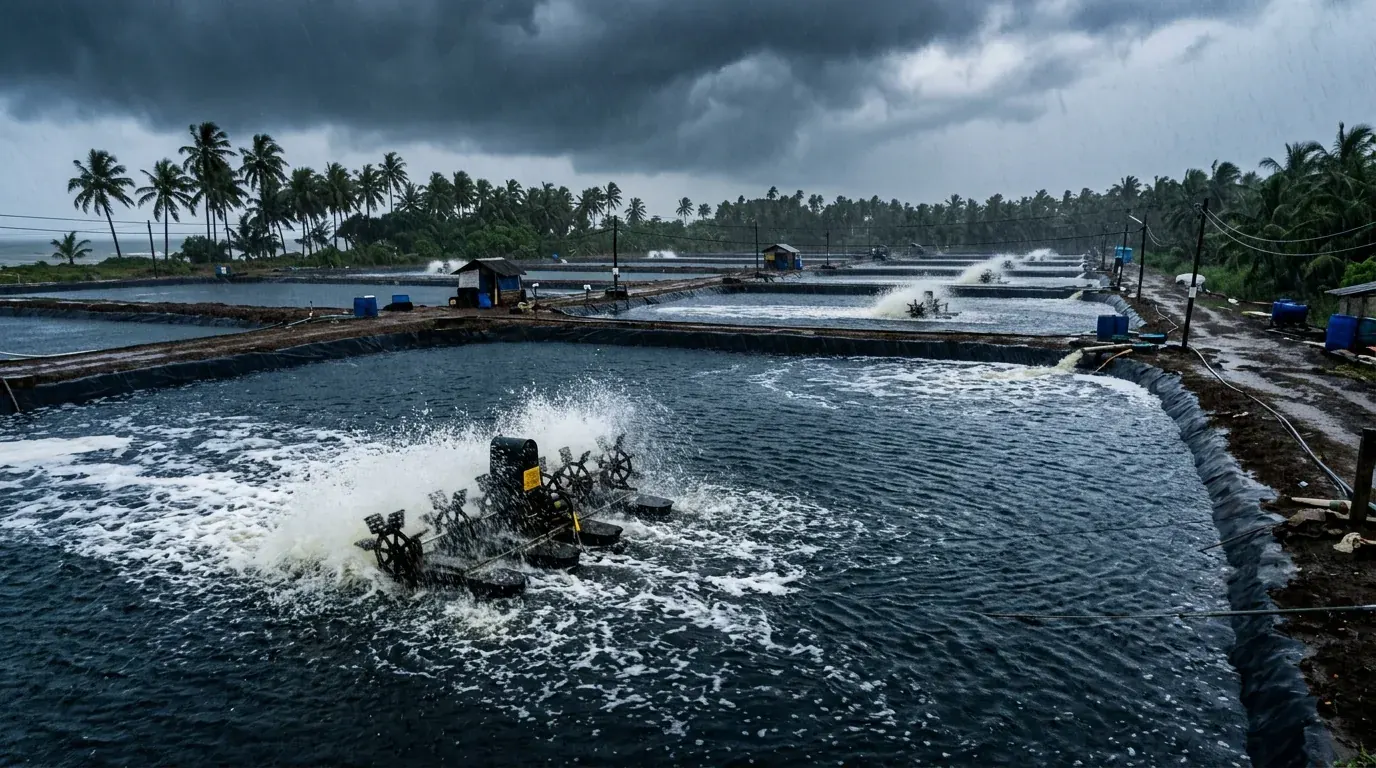
Executive Summary & Key Takeaways
- Standard Engineering Rule: Deploy 1 Horsepower (HP) of mechanical aeration for every 300 to 350 kg of standing shrimp biomass in intensive ponds.
- Dissolved Oxygen must be maintained strictly above 4.8 mg/L between 3:00 AM and 6:00 AM to prevent respiratory stress and Vibrio opportunistic outbreaks.
- Aerator positioning geometry determines whether waste settles randomly across feeding zones or concentrates neatly into a central sludge cone.
- Venturi and bottom diffusion aeration combined with paddlewheels eliminate temperature and salinity stratification in deep ponds (> 1.4m depth).
- Emergency oxygen tablets (sodium percarbonate @ 5-10 kg/acre) must be stored on site for sudden generator failures or post-monsoon phytoplankton die-offs.
Field Case Study: 10-Acre Intensive Shrimp Farm
Verified telemetry from a 10-acre site demonstrated that upgrading from static 6 HP aeration to an automated 14 HP biomass-scaled schedule with dual-speed long-arm paddlewheels reduced night mortality by 94%, achieving an 89.4% survival rate at 28 count harvest.
1. Nighttime Oxygen Dynamics & Biological Oxygen Demand (BOD)
In high-density aquaculture ponds, oxygen dynamics follow a dramatic diel cycle. During daylight hours, dense blooms of green microalgae and diatoms produce copious dissolved oxygen through photosynthesis, often driving surface DO levels above 9.0 mg/L (supersaturation).
However, after sunset, photosynthesis ceases completely. Microalgae, shrimp biomass, decomposing organic sludge, and aerobic nitrifying bacteria all switch simultaneously to oxygen consumption. In a pond carrying 4 tons of shrimp per acre, the total Biological Oxygen Demand (BOD) peaks between 3:30 AM and 5:30 AM.
If total mechanical aeration capacity is inadequate, DO levels plunge below the critical 3.5 mg/L threshold. Under chronic low DO, shrimp lose appetite, digestive enzyme activity collapses, moult failures (incomplete exuviation) spike, and pathogens like Vibrio harveyi invade weakened hemolymph tissues.
2. The Mathematical Biomass-to-HP Formula
To maintain night-time DO safely above 4.8 mg/L without wasting electrical power, deploy 1 HP of standard 4-paddle electric aeration per 300 to 350 kg of expected standing biomass.
For example, in a 1-hectare pond stocked at 50 PL/m² targeting 8 tons (8,000 kg) of final harvest biomass, total aeration requirement at harvest is 24 HP (configured as six 4-HP long-arm paddlewheel aerators or eight 3-HP units).
Crucially, aeration must be scaled dynamically across the culture timeline. In the first 30 DOC (biomass < 800 kg/ha), only 4 HP is needed for basic circulation and water blending. By DOC 75 (biomass > 4,500 kg/ha), aeration must ramp up to 16 HP, reaching full 24 HP capacity during the final 30 days prior to harvest.
| Culture Stage / DOC | Estimated Biomass (per Acre) | Minimum HP Required | Night Operating Schedule (10 PM – 6 AM) |
|---|---|---|---|
| DOC 1 – 30 | 200 – 600 kg | 2 to 3 HP | Run 2 HP intermittently (4 hrs night) |
| DOC 31 – 60 | 1,200 – 2,200 kg | 5 to 7 HP | Run 5 HP continuously all night |
| DOC 61 – 90 | 2,800 – 4,000 kg | 9 to 12 HP | Run 10 HP continuously + 2 HP daytime |
| DOC 91 – Harvest | 4,500 – 6,000 kg | 14 to 18 HP | Run 100% capacity (all aerators on) |
3. Hydrodynamic Positioning: Creating the Central Sludge Cone
Mechanical aerators serve two distinct physical functions: oxygen mass transfer across the air-water interface and hydrodynamic water propulsion. Aerators should be installed in a perimeter racetrack configuration angled parallel to pond dikes.
This circular water velocity (maintained at 0.15 to 0.25 m/sec) sweeps organic fecal waste, discarded moult carapaces, and uneaten feed particles toward the center of the pond, forming a concentrated 'central sludge cone.'
Concentrating sludge in the center preserves clean sandy feeding zones along the pond perimeter where checktrays are located. If aerators are misaligned, sludge scatters across feeding areas, causing black soil toxic zones and gill clogging.
4. Thermal & Salinity Stratification Management
During hot summer afternoons and heavy monsoon rainstorms, ponds develop severe stratification. Hot, low-salinity freshwater forms a lighter top layer, while cold, dense, deoxygenated water sits at the pond bottom.
Surface paddlewheels primarily agitate the upper 40 cm of water. In ponds deeper than 1.3 meters, install submerged Venturi injectors or spiral bottom diffusion tubes to force deep vertical mixing and break thermal thermoclines.
5. Energy Optimization & PMMSY Solar Subsidies
Electricity tariffs represent up to 14% of operational costs in commercial shrimp farming. Upgrading from inefficient local gearboxes to helical bevel gear units saves 18% to 22% in kilowatt-hour consumption.
Under the Pradhan Mantri Matsya Sampada Yojana (PMMSY), state fisheries departments offer 40% to 60% capital subsidies for grid-tied solar aerator systems equipped with variable frequency drives (VFD), significantly reducing lifetime farm overhead.
6. Emergency Low-DO Field Protocols
When power grid outages or sudden algae crashes cause DO to plunge below 2.5 mg/L: Immediately broadcast coated Sodium Percarbonate granules (@ 5 to 8 kg per acre) directly over the feeding zones. Sodium percarbonate dissolves instantly, releasing pure gaseous oxygen into the benthic water layer.
Simultaneously start tractor PTO-driven aerators or emergency diesel generator banks. Never broadcast feed while DO is recovering; wait until DO exceeds 4.5 mg/L for at least 3 consecutive hours.
Summary Operational Action Checklist
Frequently Asked Questions
Q: How many hours per day should aerators run at DOC 70?
At DOC 70 with biomass exceeding 3 tons per acre, aerators should run continuously from 9:00 PM to 7:00 AM (10 hours night) and for 3 to 4 hours during the afternoon (12:00 PM to 4:00 PM) to prevent thermal stratification.
Q: What is the difference between paddlewheel and long-arm aerators?
Standard paddlewheel aerators feature 2 or 4 impellers driven by a central motor, ideal for smaller ponds. Long-arm aerators extend 8 to 16 impellers along extended stainless steel shafts, delivering massive water propulsion and superior current velocity in large 1-hectare ponds.
Q: Why do shrimp surface and swim along the dikes in the early morning?
Surfacing and dike swimming at dawn (known as piping) is a definitive indicator of acute hypoxia (DO < 2.5 mg/L). Shrimp swim near the surface film where passive atmospheric oxygen diffusion is highest.
Team AquaSangham
Aquaculture Research & Technical Desk
Contributing Senior Technical Writer & Aqua Consultant at AquaSangham.
Recommended Farming Guides
Western Blue Shrimp (Penaeus stylirostris) Intensive Culture: Lessons from New Caledonia
Read Article →Farming TechGreen Tiger Prawn (Penaeus semisulcatus) Culture Protocols for Gulf of Mannar Coastal Ponds
Read Article →Farming TechKuruma Prawn (Penaeus japonicus) Culture in Sandy Substrates: High-Value Export SOP
Read Article →Get Live Farm Advice on AquaSangham Mobile App
Download India's #1 Aquaculture Super App for real-time market prices, precision tools, and community advice.
Download Free Android App