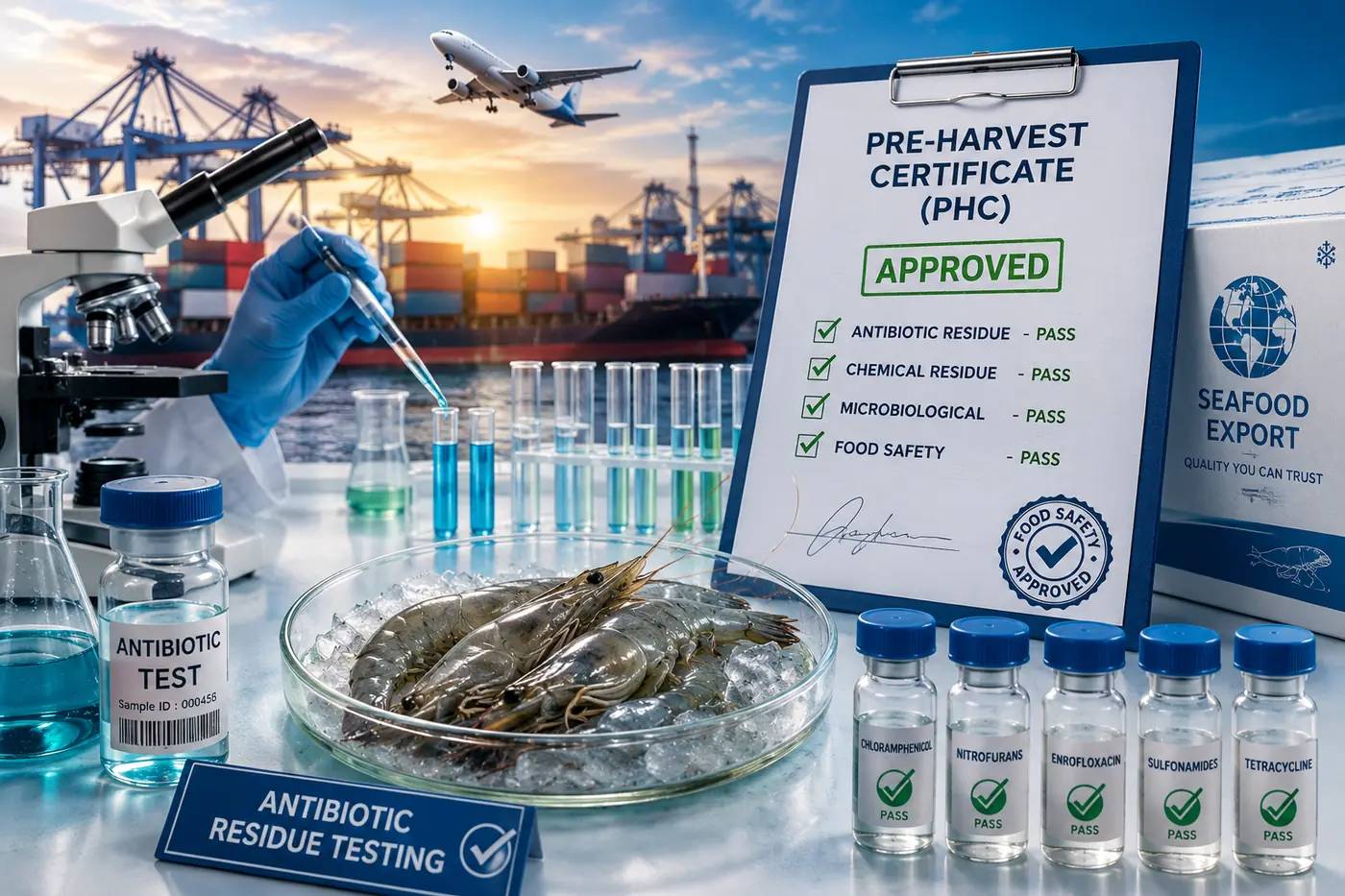
Executive Summary & Key Takeaways
- Global seafood regulatory bodies (USFDA, European Commission DG SANTE, Japan MHLW) enforce strict zero-tolerance policies with Minimum Required Performance Limits (MRPL) as low as 0.3 ppb for Chloramphenicol and 0.5–1.0 ppb for Nitrofuran metabolites.
- A failed Pre-Harvest Certificate (PHC) test bars the harvest from all MPEDA-registered export processing factories, forcing the farmer into local distress brokerage channels with penalties ranging from ₹35 to ₹60 per kilogram.
- Nitrofuran parent drugs degrade rapidly within hours, but their reactive metabolites (AOZ, AMOZ, AHD, SEM) bind covalently to structural muscle proteins (actin and myosin), remaining detectable in frozen tissue for months.
- False-positive Semicarbazide (SEM) detections frequently arise from non-antibiotic sources, such as azodicarbonamide foaming agents in PVC water plumbing, poultry feather meal hydrolysates, or hypochlorite disinfection side-reactions.
- Major on-farm contamination vectors include adulterated hatchery feeds, unbranded pond probiotics, animal manure fertilizers, and shared drainage canal back-siphoning during regional disease emergencies.
- Executing sample collection 10 to 14 days prior to harvest through EIA/MPEDA-accredited testing laboratories provides sufficient lead time to verify clearance and lock in direct processing plant purchase contracts.
Field Case Study: 16-Acre Commercial Farm Export Contract Recovery
A 16-acre commercial farm operating 8 ponds in the Bhimavaram cluster faced a catastrophic harvest rejection when pre-harvest ELISA screening flagged trace Semicarbazide (SEM) @ 0.8 ppb in 2 ponds, threatening a ₹9,60,000 distress sale discount from local brokers. Working with our regulatory advisory desk, root-cause LC-MS/MS testing traced the contamination to an uncertified imported gut probiotic containing adulterated nitrofurazone binders. The farm immediately halted the supplement, executed a 12-day bio-filtered water flushing and organic acid depuration protocol, and re-tested clean (< 0.1 ppb MRPL) through an EIA-accredited lab, successfully shipping 28 metric tons of 30-count Vannamei directly to an EU-certified processing plant at full contract price of ₹510/kg.
1. Global Seafood Import Regulations: USFDA, EU DG SANTE & Japan MHLW
India is the world's premier exporter of frozen warm-water shrimp, shipping over 700,000 metric tons valued at $5.5+ billion annually to North America, the European Union, Japan, and China. However, maintaining access to these lucrative international markets depends strictly upon meeting international sanitary and phytosanitary (SPS) food safety standards.
Importing food safety agencies—specifically the United States Food and Drug Administration (USFDA), the European Commission's Directorate-General for Health and Food Safety (DG SANTE), and Japan's Ministry of Health, Labour and Welfare (MHLW)—enforce an absolute zero-tolerance standard for non-approved pharmacologically active veterinary drugs in seafood.
Under European Union Decision 2002/657/EC and subsequent implementing regulations (EU 2021/808), the concept of a Maximum Residue Limit (MRL) does not apply to prohibited substances. Instead, regulatory enforcement is governed by the Minimum Required Performance Limit (MRPL)—the lowest analytical threshold that accredited laboratories must detect and confirm with 95% statistical confidence. For Chloramphenicol, the MRPL is established at a minuscule 0.3 parts per billion (0.3 µg/kg), while for Nitrofuran metabolites, the limit is strictly set at 0.5 to 1.0 ppb.
A. USFDA Import Alerts & Refusal Cascades (Import Alert 16-124 & 16-129)
When USFDA border customs inspectors detect prohibited residues in a single container lot from an Indian exporter, the entire processing conglomerate is placed on Detention Without Physical Examination (DWPE) under Import Alert 16-124 (for Chloramphenicol) or 16-129 (for Nitrofurans and Fluoroquinolones).
Removal from an Import Alert requires the processor to pay for five consecutive clean commercial shipments audited by third-party US private laboratories, costing upwards of $50,000 in testing and demurrage fees. Consequently, processing plants enforce draconian pre-harvest verification protocols before accepting a single crate from any farmer.
B. EU 50% Mandatory Border Sampling Mandate
Following historical detections of nitrofurans in Indian aquaculture consignments, the European Union mandates that 50% of all frozen aquaculture consignments arriving from India undergo mandatory physical sampling and LC-MS/MS testing at European border inspection posts (BIPs).
A single positive detection results in immediate destruction or re-dispatch of the multi-million-rupee container, suspension of the factory's EU export license, and severe regulatory audits across the supplying Indian state by the Export Inspection Council (EIC) and MPEDA.
Never harvest without an authentic, QR-coded Pre-Harvest Certificate (PHC) issued by an EIC/MPEDA-recognized laboratory. Processing factories will not permit uncertified harvest trucks to unload at plant gates, forcing immediate distress dumping at local spot markets.
2. Prohibited Pharmacologically Active Substances: Chemistry & Metabolites
Understanding the chemical persistence and metabolic degradation pathways of prohibited veterinary drugs is vital for every farm manager and aquaculture technician.
Prohibited drugs fall into three primary pharmacologic classes: Nitrofurans, Chloramphenicol/Phenicols, and Fluoroquinolones. Each class presents distinct chemical characteristics, tissue-binding dynamics, and laboratory detection profiles.
A. The Biochemistry of Nitrofuran Tissue Binding
When parent nitrofuran drugs (Furazolidone, Furaltadone, Nitrofurantoin, Nitrofurazone) enter the shrimp's biological system, the parent molecules are rapidly metabolized and eliminated from body fluids within 4 to 8 hours.
However, their reactive intermediate metabolites (AOZ, AMOZ, AHD, and SEM) form covalent chemical bonds with structural muscle proteins (actin and myosin) in shrimp tail tissue. These protein-bound residues remain permanently embedded within muscle fibers throughout the animal's lifetime and persist through freezing, ice glazing, and commercial cooking.
In testing laboratories, chemists perform acid hydrolysis and derivatization with 2-nitrobenzaldehyde (2-NBA) to cleave these covalently bound metabolites and quantify them via LC-MS/MS down to 0.1 parts per billion.
B. Chloramphenicol (CAP) Toxicity and Global Ban
Chloramphenicol is a broad-spectrum antibiotic strictly banned in food animals worldwide due to its idiosyncratic ability to trigger fatal, non-dose-dependent aplastic anemia in genetically susceptible human consumers.
Because even sub-nanogram exposures pose severe public health risks, the international detection limit of 0.3 ppb is enforced with uncompromising severity. A single microgram of CAP powder carried on a technician's hands can contaminate an entire 20-ton harvest lot.
| Pharmacological Drug Class | Prohibited Parent Drug | Target Tissue-Bound Metabolite | Analytical Detection MRPL | Export Regulatory Impact |
|---|---|---|---|---|
| Nitrofuran | Furazolidone | 3-amino-2-oxazolidinone (AOZ) | 0.5 ppb (µg/kg) | Immediate consignment rejection & EU border alert |
| Nitrofuran | Furaltadone | 3-amino-5-morpholinomethyl-2-oxazolidinone (AMOZ) | 0.5 ppb (µg/kg) | USFDA DWPE import alert listing |
| Nitrofuran | Nitrofurantoin | 1-aminohydantoin (AHD) | 0.5 ppb (µg/kg) | Total factory procurement ban |
| Nitrofuran | Nitrofurazone | Semicarbazide (SEM) | 0.5 – 1.0 ppb | High false-positive risk from PVC/curing agents |
| Amphenicol | Chloramphenicol | Chloramphenicol parent compound (CAP) | 0.3 ppb (µg/kg) | Absolute global zero-tolerance (Aplastic anemia risk) |
| Fluoroquinolone | Enrofloxacin & Ciprofloxacin | Ciprofloxacin marker residue | 1.0 ppb / Zero in US | USFDA import alert; EU non-compliant |
| Tetracycline (Unapproved) | Oxytetracycline / Chlortetracycline | Parent compound residues | 100 ppb (MRL in EU) / Zero in US | US border rejections if unapproved for aquaculture |
Beware of so-called 'herbal' or 'ayurvedic' bacterial cures sold by informal peddlers in aquaculture villages. Independent HPLC testing by CIBA has repeatedly revealed that over 60% of unbranded liquid 'herbal' anti-vibrio tonics are secretly spiked with raw Furazolidone or Enrofloxacin powder.
3. Hidden Farm Cross-Contamination Vectors: Feed Additives, Hatcheries & PVC Pipes
Over 85% of verified antibiotic rejections in Indian aquaculture occur not from deliberate antibiotic administration by farmers, but from accidental cross-contamination through raw feed ingredients, adulterated chemical additives, infected hatchery seed, and plumbing materials.
Commercial farm biosecurity protocols must systematically identify and eliminate every potential secondary entry vector.
A. The Semicarbazide (SEM) False-Positive Paradox: Azodicarbonamide & Bleach
Semicarbazide (SEM) is the recognized marker metabolite for the banned drug Nitrofurazone. However, scientific investigations by ICAR-CIBA and the European Food Safety Authority (EFSA) have proven that SEM can be synthesized through non-pharmacological chemical reactions.
1. PVC Pipe Plasticizers: Azodicarbonamide (ADC) is widely used as a thermal foaming agent in commercial PVC plastic pipes and vinyl pond liners. When new PVC pipes are exposed to sunlight and chlorinated pond water, ADC degrades thermally, releasing trace SEM directly into the pond water.
2. Hypochlorite Disinfection: Heavy chlorination of water containing natural nitrogenous compounds (urea and ammonium) can generate trace semicarbazide-like chemical artifacts.
3. Poultry Feather Meal: Hydrolyzed poultry feather meal used as a cheap protein filler in unauthorized feeds contains natural semicarbazide cross-linkages that trigger false-positive SEM flags during ELISA testing.
B. Hatchery Sourcing & Trans-Generational Carryover
If unscrupulous seed hatcheries dose prophylactic antibiotics (Chloramphenicol or Oxytetracycline) during the delicate zoea and mysis larval stages to boost survival, tissue-bound metabolites can persist in the postlarvae.
While dilution occurs as the shrimp grows from 0.005g PL to 30g harvest size, trace residues can still linger in the hepatopancreas and gills, failing pre-harvest screening. Always demand SPF broodstock certification and batch-specific CAA testing certificates from seed hatcheries.
C. Unapproved Probiotics, Vitamin Premixes & Mineral Binders
Imported probiotics and unbranded feed top-dressing binders purchased from grey-market distributors are notorious sources of illegal drug adulteration. Manufacturers sometimes fortify their 'gut-clearing' tonics with prohibited fluoroquinolones to guarantee visible short-term efficacy against Vibrio, unknowingly poisoning the farmer's standing biomass.
Never install unwashed, freshly extruded PVC pipes directly into active culture ponds. Always flush new plastic piping with clean water and expose to sunlight for 7 days prior to pond installation to volatilize residual azodicarbonamide foaming residues.
4. Step-by-Step SOP for Pre-Harvest Certificate (PHC) Sampling & Chain of Custody
The Pre-Harvest Certificate (PHC) system administered by MPEDA and EIC is the legal gatekeeper for commercial seafood harvesting in India. Executing sample collection with strict aseptic protocols ensures test integrity and eliminates sample contamination risks.
A. The 10 to 14-Day Advance Timeline
Initiate PHC sample collection exactly 10 to 14 days before your anticipated harvest netting date. This timeline provides 3 to 4 days for laboratory sample transit, extraction, and LC-MS/MS analysis, and leaves an 8-day buffer to execute corrective water flushing or enter into binding factory spot contracts upon receipt of clean results.
B. Representative Pond Sampling Protocol
1. Collect at least 25 to 30 live, active shrimp from 5 distinct pond locations (4 corners and center checktray zones) using a clean, non-contaminated cast net.
2. Inspect the animals to ensure they represent the average harvest weight and normal shell condition. Total aggregate sample weight must be at least 500 grams.
3. Immediately place the live shrimp into sterile, food-grade polyethylene ziplock bags without adding pond water. Never wrap samples in printed newspaper or industrial plastic bags, as printing inks contain semicarbazide derivatives.
4. Pack the sample bags in an insulated thermocol ice box with a 1:1 ratio of sterile ice flakes to maintain sample core temperature between 0°C and 4°C during courier dispatch.
C. Chain of Custody & Laboratory Selection
Submit samples exclusively to NABL-accredited and EIA/MPEDA-approved laboratories (e.g., MPEDA Regional QC Labs in Bhimavaram, Nellore, Vizag, or Kochi).
Ensure the Chain of Custody form accurately records the CAA pond registration number, GPS coordinates, farmer identification, date of stocking, estimated biomass, and exact antibiotic panel requested.
Wear sterile powder-free nitrile gloves during cast-net sampling and packaging. Human skin oils, topical antibiotic creams (e.g., Neosporin or eye drops containing chloramphenicol), and tobacco residues can transfer trace contaminants to the shrimp sample and cause false-positive laboratory rejections.
5. Analytical Laboratory Methodologies: ELISA Screening vs LC-MS/MS Chromatography
Commercial testing laboratories employ two distinct analytical tiers: Enzyme-Linked Immunosorbent Assay (ELISA) for initial rapid screening, and Liquid Chromatography-Tandem Mass Spectrometry (LC-MS/MS) for legally binding confirmation.
Understanding the difference between these two technologies prevents costly misinterpretations of preliminary lab reports.
A. ELISA (Enzyme-Linked Immunosorbent Assay) Rapid Screening
ELISA uses antibody-antigen binding reactions to detect target drug molecules rapidly and economically (results available in 4 to 6 hours).
However, ELISA antibody kits suffer from cross-reactivity with natural biological proteins, matrix interferences in high-salinity shrimp muscle, and false-positive rates of 8% to 15%. An initial ELISA 'suspect positive' result should NEVER trigger panic harvesting or distress dumping; it must always be sent for confirmatory mass spectrometry.
B. LC-MS/MS (Liquid Chromatography-Tandem Mass Spectrometry) Gold Standard
LC-MS/MS is the definitive global gold standard for antibiotic confirmation. The instrument first separates individual chemical compounds using high-performance liquid chromatography (HPLC) based on retention time.
The separated molecules are then ionized and accelerated into a triple quadrupole mass spectrometer, which shatters the parent molecule into characteristic product ion fragments. By measuring the exact mass-to-charge ratio (m/z) of two distinct transition product ions, LC-MS/MS achieves 100% molecular specificity and quantitative precision down to 0.05 ppb, completely eliminating false positives.
If an ELISA test returns a borderline positive (e.g., SEM @ 0.6 ppb), immediately request an urgent LC-MS/MS confirmation from the lab. In over 70% of borderline ELISA cases, high-resolution LC-MS/MS reveals that the sample is completely clean (< 0.1 ppb).
6. On-Farm Remediation & Depuration Protocols for Trace Residue Clearance
If confirmatory testing reveals genuine trace antibiotic residues in standing pond biomass prior to harvest, executing a biological depuration protocol can often clear the residues before final commercial harvest.
A. Immediate Cessation of All Feed Additives & Inputs
Immediately stop using all commercial gut probiotics, vitamin packs, chemical binders, and tonics across the entire farm cluster. Switch to 100% plain, certified antibiotic-free commercial extruded feed backed by a manufacturer Certificate of Analysis (CoA).
B. Intensive Water Exchange & Depuration Flushing
Execute daily 20% to 30% water exchanges using clean, bio-filtered, aged seawater or reservoir water to flush out excreted drug residues from the water column. In poikilotherms, active water turnover stimulates renal and branchial excretion of water-soluble metabolic byproducts.
C. Organic Acid & Activated Charcoal Gut Cleanse
Top-dress feed with a natural depuration cocktail for 7 to 10 days:
1. Microencapsulated Sodium Butyrate & Citric Acid (@ 5.0 g/kg feed): Lowers gut pH and accelerates epithelial cellular turnover.
2. Pharmaceutical-Grade Activated Charcoal (@ 2.0 g/kg feed): Binds free-floating intestinal endotoxins and drug residues, preventing enterohepatic reabsorption.
Re-sample and submit muscle tissue for LC-MS/MS testing on Day 10 of depuration to verify complete metabolic clearance below the MRPL limit.
Maintain high water temperatures (28°C–31°C) and robust dissolved oxygen (> 5.0 mg/L) during the depuration window. Warm water and elevated metabolic activity accelerate hepatic enzyme breakdown and renal excretion of xenobiotics by over 40% compared to cold water.
7. Commercial Economics: Direct Processing Contracts vs Failed PHC Distress Sales
The commercial financial difference between selling a verified, PHC-cleared harvest directly to an export processing plant versus dumping a non-certified crop through local distress commission brokers represents the single largest swing factor in aquaculture profitability.
A. Eliminating the Middleman Distress Tax
When an uncertified crop cannot enter formal processing facilities, local commission dalals exploit the farmer's panic by offering below-market spot cash, extracting up to ₹60/kg in artificial discounts and introducing arbitrary 'soft-shell deductions'.
By maintaining rigorous PHC compliance and listing verified harvest lots on the AquaSangham Trade Portal 10 days in advance, farmers bypass predatory brokerage chains and connect directly with competing export procurement managers who pay top dollar for certified Grade-A biomass.
| Commercial Parameter | Direct Export Factory Sale (Clean PHC) | Local Middleman Distress Sale (Failed/No PHC) | Net Financial Variance (Per 10-Ton Crop) |
|---|---|---|---|
| 30-Count Realization (₹/kg) | ₹ 505 – ₹ 520 / kg | ₹ 445 – ₹ 460 / kg | - ₹ 60,000 per Metric Ton |
| Commission Agent Brokerage | 0% (Zero Brokerage on Direct Trade) | 2.5% – 3.5% Broker Deduction | - ₹ 1,25,000 commission loss |
| Weight & Soft Shell Cuts | Digital scale; transparent grading | Arbitrary 5% – 8% 'quality discount' | - ₹ 2,20,000 weight leakage |
| Payment Settlement Term | Direct Bank Wire within 48–72 Hrs | Delayed 30–60 day informal credit note | High cash-flow & default risk |
| Total Net Crop Realization | ₹ 51,00,000 (10 Tons @ ₹510) | ₹ 43,55,000 (Net after deductions) | ₹ 7,45,000 Net Margin Difference |
Upload your digital PHC test certificate directly to your AquaSangham harvest listing. Verified test certificates trigger priority bidding from top-tier processing conglomerates, unlocking instant ₹15–25/kg contract premiums over standard market rates.
Summary Operational Action Checklist
Frequently Asked Questions
Q: What is the difference between an MRL and an MRPL in seafood antibiotic testing?
A Maximum Residue Limit (MRL) is a legally permissible concentration of an approved veterinary medicine (such as Oxytetracycline in the EU, set at 100 ppb) that does not pose human health risks. In contrast, for non-approved or prohibited substances (such as Nitrofurans and Chloramphenicol), no MRL exists (zero tolerance). Regulatory enforcement instead relies on the Minimum Required Performance Limit (MRPL)—the strict analytical detection limit (0.3 to 1.0 ppb) that accredited laboratories must verify using high-resolution LC-MS/MS.
Q: Why did my pond test positive for Semicarbazide (SEM) when I never used Nitrofurazone?
Semicarbazide (SEM) false positives frequently occur from non-antibiotic environmental sources. The most common causes include thermal degradation of azodicarbonamide (ADC) foaming plasticizers in new PVC water pipes, reactions between hypochlorite bleach and dissolved nitrogen compounds during intensive disinfection, or poultry feather meal fillers in unapproved feeds. Requesting an LC-MS/MS confirmatory re-test can differentiate true drug contamination from benign chemical artifacts.
Q: Can boiling, freezing, or cooking remove antibiotic residues from harvested shrimp?
No. Nitrofuran metabolites (AOZ, AMOZ, AHD, SEM) and Chloramphenicol are thermally stable and covalently bound to structural muscle proteins (actin and myosin). Freezing, commercial ice glazing, cooking, and canning do not degrade or eliminate these chemical residues. They remain completely intact and detectable by border mass spectrometry inspection.
Q: How long does a Pre-Harvest Certificate (PHC) remain legally valid?
A Pre-Harvest Certificate (PHC) issued by an authorized MPEDA/EIA testing laboratory is legally valid for 15 days from the date of sample collection. If harvest is delayed past 15 days due to weather, molting, or market logistics, a fresh sample must be collected and re-tested before processing plants can accept the biomass.
AquaSangham Policy Desk
Export Quality & Regulatory Compliance Division
Contributing Senior Technical Writer & Aqua Consultant at AquaSangham.
Recommended Farming Guides
Western Blue Shrimp (Penaeus stylirostris) Intensive Culture: Lessons from New Caledonia
Read Article →Farming TechGreen Tiger Prawn (Penaeus semisulcatus) Culture Protocols for Gulf of Mannar Coastal Ponds
Read Article →Farming TechKuruma Prawn (Penaeus japonicus) Culture in Sandy Substrates: High-Value Export SOP
Read Article →Get Live Farm Advice on AquaSangham Mobile App
Download India's #1 Aquaculture Super App for real-time market prices, precision tools, and community advice.
Download Free Android App