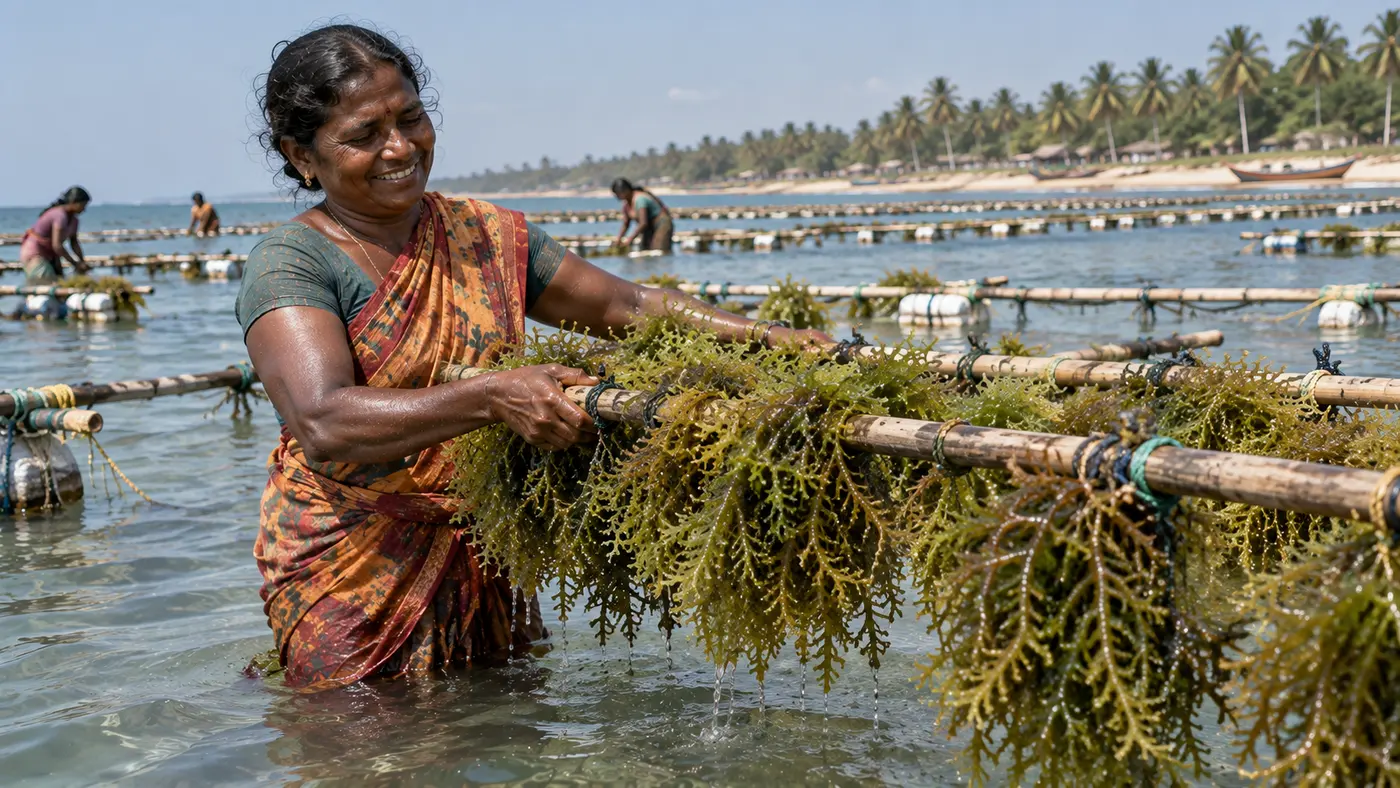
Executive Summary & Key Takeaways
- Seaweed farming (phycoculture) is India's most egalitarian coastal livelihood, requiring zero fresh water, zero commercial feed, zero chemical fertilizers, and zero electrical grid power.
- The biological growth velocity of Kappaphycus alvarezii is extraordinary: 100 kg of vegetative seed tied to a bamboo raft multiplies into 800 to 1,000 kg of fresh biomass in just 45 days (an 8x to 10x expansion).
- Operating a staggered 45-raft cluster allows a coastal family to harvest one raft every single day, pulling 200 to 250 kg of fresh seaweed daily and securing a predictable monthly cash surplus of ₹42,000 to ₹62,000.
- Floating Bamboo Rafts (3m x 3m) are the dominant farming method in calm shallow lagoons (Palk Bay, Gulf of Mannar), costing under ₹1,200 per raft and delivering exceptional sunlight exposure and wave agitation.
- In open-sea coastal areas with stronger tidal currents (Gujarat, Maharashtra), Monoline Tube-Net Longlines are superior, resisting heavy storm swells and preventing frond breakage.
- Preventing 'Ice-Ice' Disease: Elevated sea temperatures (>33°C) and sudden salinity drops during monsoons cause fronds to turn chalky white and dissolve; lowering rafts 30cm deeper or harvesting early prevents crop loss.
- Corporate buyback agreements with carrageenan processors (for dairy, confectionary, cosmetics) and organic liquid seaweed fertilizer (LFS) manufacturers guarantee 100% harvest off-take at fixed benchmark rates.
Community Mariculture Case Study: How a Women's SHG Generated ₹5.85 Lakhs Net Profit Operating a 45-Raft Seaweed Cluster
A ten-member coastal women's Self-Help Group (SHG) in Olaikuda village, Ramanathapuram district, previously dependent on erratic daily wage labor, established a community seaweed mariculture cooperative along the calm, shallow lagoons of Palk Bay. Partnering with AquaSangham mariculture advisory and ICAR-CSMCRI protocols, the group deployed a 45-raft floating bamboo system: (1) Constructed 45 modular floating rafts (3m x 3m) using seasoned bamboo poles tied with 4mm polypropylene rope and anchored with 25kg sand-filled HDPE bags, at a total turnkey capital cost of ₹54,000; (2) Sourced 4,500 kg of healthy vegetative Kappaphycus alvarezii seed fragments (seeding 100 kg per raft in 20 hanging rope braids); (3) Staggered planting dates so that exactly one raft reached the 45-day harvest maturity every single day; (4) Mitigated summer 'ice-ice' syndrome by lowering anchor lines during midday peak heat to submerge rafts 30 cm beneath the surface; and (5) Sun-dried harvested fronds on raised bamboo slatted drying platforms to keep sand content below 1.5% and moisture at 32%. Over 12 months, the cluster harvested 24.5 metric tons of fresh biomass, producing 2,450 kg of Grade-A sun-dried seaweed sold directly to industrial carrageenan and agricultural biostimulant processing plants in Madurai at ₹88/kg dry weight (and fresh slurry at ₹10/kg). The cooperative secured a gross revenue of ₹6.72 Lakhs against minimal maintenance costs of ₹87,000, distributing an audited net profit of ₹5.85 Lakhs directly to village households.
1. The Zero-Input Blue Revolution: Why Seaweed Is India's Most Accessible Coastal Goldmine
In modern commercial aquaculture, the barriers to entry are notoriously steep. Establishing an intensive shrimp or marine finfish farm demands significant capital investment: acquiring expensive coastal land, excavating earthen ponds or installing concrete tanks, purchasing high-horsepower paddlewheel aerators, and budgeting hundreds of thousands of rupees for commercial feed and diesel backup. For smallholder coastal fisherfolk, women Self-Help Groups (SHGs), and artisanal fishing families, these capital requirements are prohibitive.
However, along India's tropical coastal shelf lies a transformative mariculture enterprise that operates with **zero feed expenditure, zero freshwater consumption, zero chemical inputs, and zero electrical power bills**: **Commercial Seaweed Farming (Phycoculture)**.
Seaweed is not a plant with true roots, stems, or leaves; it is macroscopic marine benthic algae that absorbs 100% of its required nutrients—nitrogen, phosphorus, potassium, and trace marine minerals—directly from ambient ocean seawater through its cellular frond surfaces, powered exclusively by solar photosynthesis. The coastal farmer does not feed the crop; the ocean tides deliver endless dissolved nutrients with every lunar cycle.
The economic velocity of tropical red seaweeds—most notably *Kappaphycus alvarezii*—is staggering. When a 100-gram vegetative seed fragment is tied to a floating bamboo raft in the sun-drenched coastal waters of Tamil Nadu (Palk Bay, Gulf of Mannar) or Gujarat (Saurashtra coast), it undergoes rapid cell division. In just **45 days**, that single fragment expands into an 800 to 1,000-gram dense, succulent bush—a **multiplication factor of 8X to 10X in six short weeks**.
A smallholder family managing a cluster of **45 floating bamboo rafts** (an operational footprint of less than half an acre of shallow intertidal water) staggers their planting schedule by one day per raft. By Day 46, the farm enters a perpetual daily harvesting rhythm: the family harvests exactly one raft every morning, pulling **200 to 250 kg of fresh seaweed daily**, replanting 100 kg as vegetative seed for the subsequent cycle, and selling the remaining 120 to 150 kg to industrial processing plants.
At prevailing farmgate rates of ₹8 to ₹12 per kg fresh (or ₹75 to ₹110 per kg sun-dried for carrageenan processing), this micro-mariculture enterprise injects **₹1,500 to ₹2,200 in clean daily cash income** directly into the household—securing a monthly net income of **₹42,000 to ₹62,000 (netting over ₹5.0 Lakhs annually)** with virtually zero operational financial risk.
Never allow harvested seaweed to touch coastal beach sand during sun-drying. Sand contamination reduces industrial carrageenan gel extraction efficiency; international and domestic buyers reject any dried seaweed consignment with a silica sand content exceeding 1.5%. Always sun-dry on raised bamboo slatted platforms or clean UV-stabilized plastic tarpaulins.
2. Species Biology & Commercial Strains: Kappaphycus alvarezii vs Gracilaria edulis
In the Indian seaweed processing industry, commercial demand is anchored in the extraction of high-value hydrocolloids—naturally occurring polysaccharides utilized as gelling, stabilizing, and emulsifying agents across global food, pharmaceutical, and agricultural sectors. Two primary red seaweed species (Rhodophyta) dominate commercial cultivation in India:
1. *Kappaphycus alvarezii* (formerly *Eucheuma cottonii*): The premier commercial seaweed of India. It is a robust, fleshy, branching red alga with cylindrical, cartilaginous thalli varying in color from emerald green to golden-olive and reddish-brown. Kappaphycus is the world's primary commercial source of **Kappa-Carrageenan**—an indispensable hydrocolloid used to stabilize dairy products (chocolate milk, ice cream), plant-based alternative meats, pet foods, cosmetics, and soft-gel pharmaceutical capsules.
Furthermore, a booming domestic market has emerged for **Liquid Seaweed Fertilizer (LFS)** derived from the fresh sap of Kappaphycus alvarezii. Agricultural field trials conducted by the Indian Council of Agricultural Research (ICAR) prove that foliar spraying of Kappaphycus sap increases crop yields in paddy, sugarcane, wheat, and vegetables by 20% to 35%, creating insatiable corporate demand from major Indian fertilizer and agrochemical corporations.
2. *Gracilaria edulis* and *Gracilaria dura*: Delicate, dark reddish-purple branching seaweeds indigenous to the coral reefs of the Gulf of Mannar and Lakshadweep. Gracilaria is the primary source of **Agar-Agar** (bacteriological culture media, confectionery jellies, and dental impression materials). While Gracilaria commands higher dry prices (₹110 to ₹140/kg), its daily growth rate (3.5% to 4.5% SGR) is slightly slower than Kappaphycus (6.0% to 8.5% SGR), making Kappaphycus the undisputed favorite for high-volume commercial cultivation.
Environmental Siting Parameters for Commercial Rafts
Water Salinity: Optimal growth occurs between 28 ppt and 35 ppt. Kappaphycus is stenohaline and cannot tolerate prolonged salinity drops below 22 ppt. Avoid siting rafts near river mouths or storm drains where monsoon runoff creates fresh water plumes.
Water Depth & Substrate: Ideal water depth is 1.2 to 2.5 meters at low tide, over sandy, coral rubble, or seagrass beds. Avoid deep water (>5m) where wave energy snaps anchor ropes, and soft mud bottoms where silt smothers seaweed fronds.
Water Current Velocity: A gentle, continuous tidal current of 0.2 to 0.4 meters per second (12 to 25 meters per minute) is ideal. Water movement continuously washes away metabolic wastes, prevents sediment deposition on fronds, and supplies fresh dissolved carbon dioxide and nitrogen.
3. Bamboo Rafts vs Monoline Longlines: Engineering, Rigging & Siting Hydraulics
To cultivate Kappaphycus alvarezii in coastal marine waters, Indian mariculture operators deploy two proven infrastructure systems: Floating Bamboo Rafts and Monoline Longlines.
System 1: Floating Bamboo Raft (The Golden Standard for Shallow Lagoons). The floating bamboo raft is the most productive, user-friendly cultivation method in calm, sheltered lagoons such as Palk Bay and the Gulf of Mannar. A standard commercial raft measures **3.0 meters by 3.0 meters** (9 m² surface area).
Construction Specifications: (1) Frame: Four stout, seasoned bamboo poles (minimum 8cm to 10cm diameter, 3.5m length) lashed together at the four corners using 4mm UV-stabilized polypropylene rope in cross-diagonal knots; (2) Cultivation Lines: Twenty parallel strands of 4mm polypropylene rope spaced 15 cm apart are strung tightly across the frame; (3) Fish Protection Skirt: A 1.0-meter deep skirt of 26mm HDPE knotless fish netting is hung beneath the raft perimeter to physically block herbivorous grazing fish; (4) Anchoring: The raft is anchored using two 25kg sand-filled HDPE bags or concrete sinker blocks attached via 8mm polypropylene anchor warps pitched at a 3:1 scope (anchor rope length = 3x water depth). Turnkey cost to construct one complete raft is only **₹1,150 to ₹1,350**, with a working lifespan of 12 to 18 months.
System 2: Monoline Longline / Tube-Net System (For Open-Sea & Deeper Waters). In open-sea coastal areas subject to seasonal swells and heavy monsoon wave action (such as the coastlines of Gujarat, Maharashtra, and Andhra Pradesh), rigid bamboo frames snap under heavy wave impact. Farmers deploy **Submerged Monoline Longlines**.
A longline consists of a 50-meter main line (8mm polypropylene rope) suspended 30cm beneath the sea surface using 150mm spherical PVC floats spaced every 2 meters and anchored at both ends with 50kg granite or iron anchors. Seed fragments are placed inside tubular HDPE diamond-mesh sleeves (tube nets) and lashed along the main line. Longlines flex with passing waves, shedding hydrodynamic drag and surviving coastal swells that would shatter bamboo rafts.
Rigging Raft Clusters into 20-Unit Grids
Never anchor rafts in isolation; lone rafts spin erratically in tidal currents. Anchor rafts in modular grids of 20 rafts (arranged in 2 rows of 10), tied together with 1.5-meter spacer ropes.
A 20-raft grid creates a stabilized floating breakwater that attenuates incoming chop, allowing farmers to walk or paddle small wooden outriggers down the central channel for effortless daily inspection.
4. The 45-Day Vegetative Growth Cycle: Seeding, Braiding & 10X Biomass Multiplication
Kappaphycus alvarezii does not reproduce through seeds or spores in commercial culture; it propagates entirely through asexual vegetative fragmentation. Every healthy fragment of living thallus possesses apical meristematic cells capable of continuous division when exposed to sunlight and nutrient-rich seawater.
The Seeding Protocol (Day 0): Healthy, vigorously growing vegetative seed fronds (bright olive-green or golden-brown, free from white lesions or epiphytes) are selected from a mature harvest. Technicians use sharp stainless-steel knives to cut seed fragments into **100-gram to 120-gram seed bunches**.
Braiding onto Cultivation Lines: Each 3.0-meter rope strand on the bamboo raft accommodates 20 seed bunches spaced 15 cm apart. Each seed bunch is secured to the rope using a 20cm strip of soft, flexible plastic ribbon (locally called 'tie-tie' or raffia twine) tied in a non-slip half-hitch knot. A standard 20-line raft holds **400 seed bunches**, requiring a total initial seed stocking of **40 to 45 kilograms** (or up to 100 kg on high-density rafts).
The 45-Day Somatic Explosion: Once moored in the coastal lagoon, the biological expansion follows a dramatic exponential curve:
Days 1 to 10 (Acclimation & Apical Budding): The fragments heal from cutting trauma; hundreds of microscopic bright-green apical buds sprout from every node.
Days 11 to 30 (Rapid Branching & Biomass Doubling): Specific growth rate (SGR) peaks between 6.5% and 8.5% per day. Primary branches thicken and send out secondary and tertiary branchlets, forming dense, spherical bushes. By Day 25, the initial 45 kg of seed has doubled to 120 kg.
Days 31 to 45 (Peak Carrageenan Maturation): The bushes expand into massive, interlocking vegetative clumps spanning the entire raft. Total biomass reaches **400 to 500 kilograms per raft**—a verified **9X to 11X biomass multiplier**. Harvesting at Day 45 captures the absolute peak concentration of kappa-carrageenan (35% to 38% dry weight basis) before aging fronds become brittle and prone to wave detachment.
The Staggered 45-Raft Rotational Production Calendar
To transform seasonal farming into a steady daily cash salary, a coastal family constructs 45 rafts and seeds exactly one raft every single day for 45 consecutive days.
Starting on Day 46, Raft #1 is fully mature (45 days old) and harvested. The family harvests 450 kg of fresh biomass: 45 kg is immediately tied back onto Raft #1 as seed for the next cycle, and the remaining 405 kg is sold fresh or sun-dried. On Day 47, Raft #2 is harvested and re-seeded. This generates guaranteed daily cash income 365 days a year.
5. Biosecurity & Health: Managing 'Ice-Ice' Syndrome and Herbivorous Fish Grazing
While seaweed culture requires zero expensive veterinary medicines or antibiotic screenings, farmers must actively manage two environmental and biological threats: 'Ice-Ice' disease and herbivorous grazing fish.
1. The 'Ice-Ice' Phenomenon (Physiological Stress & Secondary Bacterial Attack): 'Ice-Ice' is not caused by an exotic virus; it is an environmental stress reaction. When sea surface temperatures soar above **33°C to 34°C during peak summer months (April–May)**, or when heavy monsoon rains cause salinity to suddenly plummet below 22 ppt, the seaweed experiences severe osmotic and thermal shock. The stressed thallus releases defense organic compounds, losing its pigmentation and turning stark, chalky white—resembling ice (hence the name 'Ice-Ice').
Opportunistic marine bacteria (*Vibrio* and *Cytophaga* species) attack the softened white segments, producing agarase and carrageenase enzymes that dissolve the cell walls. Within 48 hours, the white segments snap, causing massive fragments of seaweed to break off and drift away with the tide.
Ice-Ice Mitigation Protocol: (1) Summer Deepening: During hot summer months, lower the raft anchor warps so the bamboo frame floats **20cm to 30cm beneath the surface**, where water is 2°C to 3°C cooler; (2) Shifting to High-Flow Channels: Move rafts from stagnant inner lagoons to outer channels receiving strong tidal flushing; (3) Immediate Harvesting: If Ice-Ice lesions appear on more than 10% of fronds, harvest the entire raft immediately to salvage biomass before disintegration.
2. Herbivorous Grazing Fish (Rabbitfish & Sea Turtles): In coral reef ecosystems, herbivorous marine fish—particularly Rabbitfish (*Siganus canaliculatus* and *Siganus javus*, locally called *Oora*), Surgeonfish (*Acanthurus* spp.), and Green Sea Turtles—are voracious grazers of tender Kappaphycus shoots. A school of rabbitfish can strip a 45-day raft clean to bare ropes overnight.
Exclusion SOP: Every raft must feature a 1.0-meter deep perimeter skirt of **26mm HDPE knotless netting** hung beneath the bamboo frame, weighted with lead sinkers. The net skirt creates an impenetrable physical cage that keeps grazing fish out while permitting unrestricted seawater circulation.
Epiphytic Filamentous Algae (EFA) Control
During calm neap tides, fine filamentous red algae (Polysiphonia and Ceramium) can settle on Kappaphycus branches, smothering sunlight absorption and competing for nutrients.
Technicians must shake each cultivation rope vigorously in the water twice a week. Mechanical shaking dislodges epiphytic filaments and loose silt, keeping fronds pristine and green.
6. Harvesting, Sun-Drying Standards & Corporate Buyback Contracts (Full Cluster P&L)
Harvesting a seaweed raft is simple, joyful work requiring zero specialized machinery. The farmer pulls the bamboo raft to the shallow beach berm or catwalk, unties the cultivation ropes, and shakes the massive seaweed clumps onto clean tarpaulins. The required seed fraction (45 to 50 kg) is immediately separated and tied onto fresh ropes for the next cycle.
Post-Harvest Sun-Drying Protocol: The remaining fresh harvest can be sold directly as fresh wet biomass to local liquid fertilizer processing units (₹8 to ₹12/kg), or sun-dried for the carrageenan industry. Sun-drying reduces the moisture content from 90% in fresh seaweed down to **32% to 35% in commercial export-grade dry seaweed** (a dry ratio of roughly 1:10, meaning 10 kg fresh yields 1 kg dry).
Sun-Drying Standards: Never dry seaweed directly on the sand! Spread fresh seaweed on **Raised Bamboo Slatted Drying Racks (1.0 meter above ground)** lined with black 50% shade netting. Sun-dry for 3 to 4 days under bright sunlight. The seaweed bleaches to a dark golden-amber color with a light crystalline salt crust on its surface. When squeezed, it should feel leathery and pliable without feeling moist or brittle. Pack into 50kg woven HDPE gunny sacks.
Corporate Buyback Contracts: In Tamil Nadu and Gujarat, commercial seaweed farming operates under formal, government-backed corporate buyback agreements. Major agrochemical and industrial processing corporations (including Tata Chemicals, AquAgri Processing, IFFCO, and SNAP Natural) maintain permanent procurement hubs in coastal villages, purchasing 100% of dried and fresh production with direct bank transfers to farmers' accounts within 48 hours of delivery.
Full Commercial Cluster P&L: The financial audit below demonstrates the verified annual economics of a standard **45-Raft Family Cluster** operating across 8 production cycles per year in coastal India.
| Operational & Financial Parameter | Unit Metric & Quantity | Cost / Realization (INR ₹) | Commercial Impact on Household |
|---|---|---|---|
| Turnkey Raft Infrastructure (45 Rafts) | Bamboo poles, 4mm rope, anchors, net skirts | ₹ 54,000 (One-time Capex) | Lifespan: 14 to 18 months |
| Initial Seed Fronds (One-Time) | 45 rafts @ 45 kg seed = 2,025 kg @ ₹10/kg | ₹ 20,250 (Self-replenishing) | Never purchased again; self-propagated |
| Annual Raft Maintenance & Replacement | Bamboo repair, anchor ropes, sun-drying nets | ₹ 22,500 / Year | Minor annual maintenance outlay |
| Feed, Fertilizer, Power & Fuel Costs | Zero commercial feed, zero electricity | ₹ 0 / Nil | 100% powered by sun & ocean tides |
| Total Fresh Biomass Harvested / Year | 45 rafts x 8 cycles = 360 raft harvests @ 400kg | 1,44,000 kg (144 Metric Tons) | Massive biological biomass volume |
| Replanted Seed Retention (360 cycles) | 360 harvests x 45 kg seed replanted | 16,200 kg retained | Guarantees perpetual cycle continuity |
| Net Commercial Fresh Biomass Sold | 1,44,000 kg - 16,200 kg replanted | 1,27,800 kg (127.8 Tons Fresh) | Sold 50% fresh sap / 50% sun-dried |
| GROSS ANNUAL SALES REALIZATION | Fresh sap sales + 6.4 Tons dry seaweed @ ₹90/kg | ₹ 6,38,000 / Year | Predictable, daily cash-flow velocity |
| NET ANNUAL HOUSEHOLD PROFIT | Gross Sales (₹6.38 L) - Annual Expenses (₹42,750) | ₹ 5,95,250 / Year | ₹ 49,600 NET MONTHLY CASH SALARY |
Form a cluster with 5 to 10 neighboring families to buy bamboo and polypropylene rope in bulk directly from wholesale timber depots. Bulk procurement cuts your raft capital expenditure by over 30%, lowering cost per raft from ₹1,350 to under ₹900.
7. Operational Field SOP Checklist & Frequently Asked Questions
To achieve the verified benchmark of 8X to 10X biomass multiplication, zero disease loss, and ₹50,000+ monthly net household income, coastal operators must maintain disciplined adherence to standard operating procedures. Below is the non-negotiable operational checklist for commercial seaweed farming, followed by expert answers to critical field questions.
The 6-Rule Field SOP Action Checklist for Seaweed Farming
1. 45-Day Strict Harvest Discipline: Never harvest before Day 40 (low carrageenan) or after Day 50 (brittle, self-detaching fronds); harvest strictly at Day 45.
2. Bi-Weekly Rope Shaking: Shake every cultivation rope in the sea twice a week to dislodge loose silt and epiphytic filamentous algae.
3. 1.0-Meter Net Skirt Maintenance: Inspect perimeter net skirts weekly for tears to ensure grazing rabbitfish cannot enter the raft enclosure.
4. Summer 30cm Submergence: During April and May when sea temperatures exceed 32°C, lower anchor lines to submerge rafts 30cm to prevent 'Ice-Ice'.
5. Raised Slatted Sun-Drying: Dry harvested seaweed exclusively on raised bamboo platforms; never dry directly on beach sand.
6. 32%–35% Moisture Endpoint: Pack dried seaweed into woven sacks only when moisture content reaches 32% to 35% with a clean crystalline salt bloom.
Summary Operational Action Checklist
Frequently Asked Questions
Q: Can anyone start seaweed farming in coastal India, or do I need government permission?
Under the Coastal Aquaculture Authority (CAA) and the Pradhan Mantri Matsya Sampada Yojana (PMMSY), seaweed farming is recognized as an eco-friendly green mariculture livelihood. Coastal artisanal fisherfolk, traditional communities, and women Self-Help Groups (SHGs) do not require complex industrial clearances. However, rafts must be registered with the local State Fisheries Department to receive PMMSY subsidies (which cover 40% to 60% of raft capital costs) and to ensure rafts are not sited in commercial shipping navigation lanes or marine protected national parks (like the Gulf of Mannar Marine National Park core islands).
Q: What happens to the rafts during the coastal monsoon season?
Along the Tamil Nadu coast (Palk Bay), farming operates smoothly for 9 to 10 months a year. During peak rough monsoon months (October–November in the Coromandel, or June–July in the Arabian Sea), open-water bamboo rafts are vulnerable to heavy surf. Farmers either: (1) Harvest all biomass and dry it for storage; (2) Move rafts to sheltered inner mangrove creeks; or (3) Transition to submerged Monoline Tube-Net longlines anchored below the breaking wave zone.
Q: Why can't I use chemical fertilizers to make the seaweed grow faster?
Applying synthetic fertilizers in the open ocean is completely illegal, environmentally hazardous, and biologically unnecessary. The natural coastal ocean contains ample dissolved inorganic nitrogen (DIN) and phosphorus from tidal upwelling and estuarine flows. Seaweed fronds absorb these natural marine minerals directly. Chemical fertilizers would immediately wash away with the tide, wasting money and causing harmful algal blooms.
Q: How do I secure a corporate buyback agreement for my seaweed harvest?
Major processing corporations (such as AquAgri Processing, SNAP Natural, and IFFCO Kisan) maintain permanent field offices and collection centers across Ramanathapuram, Pudukkottai, Tuticorin, and the Gujarat coast. Farmers register their raft clusters with company field coordinators, who provide certified seed starter cultures and sign multi-year buyback agreements guaranteeing minimum support purchase prices with bi-weekly direct bank transfers.
AquaSangham Commercial Mariculture Desk
Marine Phycoculture & Coastal Livelihoods Division
Contributing Senior Technical Writer & Aqua Consultant at AquaSangham.
Recommended Farming Guides
The 3 AM Oxygen Trap: Why Fish and Shrimp Die at Dawn (And The 4.0 ppm Rule That Saves Them)
Read Article →Water QualityWhy Sudden Monsoon Rain Wipes Out Shrimp Overnight (And The 30-Minute Emergency Lime Protocol That Saves Your Pond)
Read Article →Market AnalysisEU & US Seafood Traceability Audits: Keeping Digital Farm Logs to Secure ₹15-₹20/kg Premium from Exporters
Read Article →Get Live Farm Advice on AquaSangham Mobile App
Download India's #1 Aquaculture Super App for real-time market prices, precision tools, and community advice.
Download Free Android App