Executive Summary & Key Takeaways
- Despite Indian aquaculture exporting over ₹60,000 Crores annually, less than 2.5% of shrimp and fish farms carry active crop insurance, driven by historical underwriter losses, complex claim conditions, and high base premium rates (7% to 12% of input costs).
- Under the Pradhan Mantri Matsya Sampada Yojana (PMMSY) and National Fisheries Development Board (NFDB) frameworks, general category farmers receive a 40% government subsidy on insurance premiums, while women, SC, ST, and fisheries cooperatives receive up to 60% direct subsidy support.
- Comprehensive aquaculture policies cover specific named perils—such as cyclonic storms, storm surges, riverine floods, mechanical aerator power failure (exceeding 8 consecutive hours), and epidemic diseases (WSSV, EHP, AHPND)—provided the farm strictly adheres to CAA registration and verified SPF seed stocking.
- Over 70% of repudiated or rejected aquaculture insurance claims in India stem from a single failure: missing the mandatory 24-to-48-hour formal notification window following mass mortality, or failing to preserve formal physical evidence (carcasses, water logs, frozen samples) before disposing of dead stock.
- Policies operate on an 'Input Cost Valuation' model rather than speculative harvest market value; payouts are calculated on verified, stage-wise expenditure incurred up to the Day of Culture (DOC) of mortality, less an agreed policy excess/deductible (typically 15% to 20%).
- AquaSangham's digital farm logbook generates tamper-evident, geo-referenced daily operational records—recording feed consumption, dissolved oxygen levels, seed PCR certificates, and electrical uptime—transforming routine farm data into an unassailable insurance claim portfolio.
Cyclone Michaung Crop Loss Claim Realization: Securing ₹18.40 Lakhs Insurance Settlement
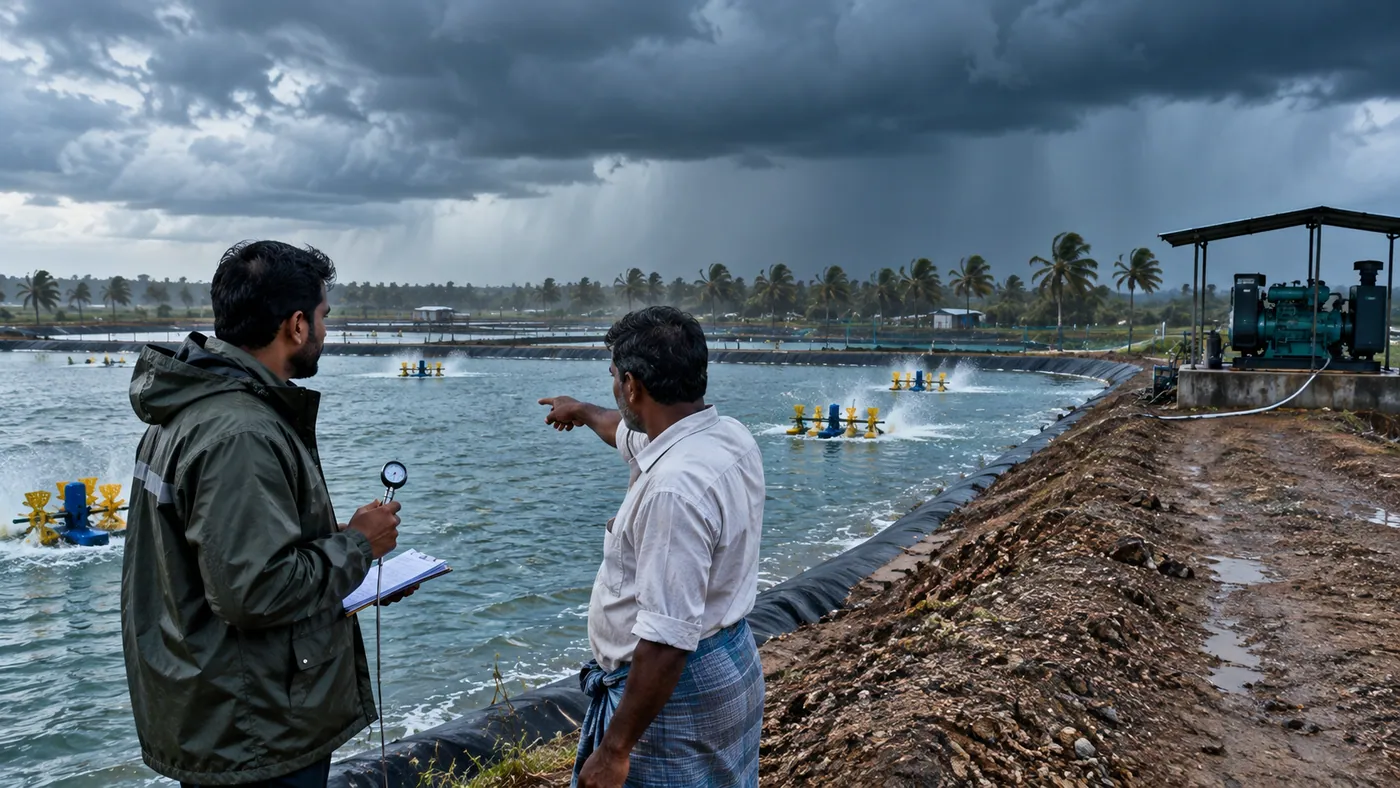
A progressive Vannamei farmer running a 6-hectare farm in Kavali, Nellore district, was hit by Cyclone Michaung at DOC 68 (standing crop value exceeding ₹35 Lakhs). Severe estuarine tidal surges overtopped the outer protection dykes, contaminating three culture ponds with heavy silt and crashing dissolved oxygen, resulting in 90% acute mortality within 36 hours. Because the farmer had enrolled in the NFDB-backed aquaculture insurance policy underwritten by Oriental Insurance: (1) He immediately dispatched a geo-tagged incident alert and video log via the insurer's portal within 14 hours of the storm surge; (2) Preserved dead shrimp samples in formalin and ice under the supervision of the local Assistant Director of Fisheries (ADF); (3) Maintained flawless daily record books including CAA-approved hatchery SPF seed receipts, purchase invoices for commercial feeds, power bills, and water test records; (4) Accompanied the chartered insurance loss assessor during the physical spot survey at DOC 70; and (5) Cleared the claim audit without technical deduction, receiving ₹18.40 Lakhs directly into his bank account within 48 days, enabling immediate pond restoration and re-stocking for the subsequent summer crop.
1. The Great Coverage Paradox: Why 98% of Indian Aqua Crops Are Uninsured
In terrestrial Indian agriculture, crop insurance under the Pradhan Mantri Fasal Bima Yojana (PMFBY) covers tens of millions of hectares of paddy, wheat, and cotton, backed by automated satellite yield assessments and subsidized premium caps as low as 1.5% to 2.0%. Yet in coastal aquaculture—an industry that generates over ₹60,000 Crores in annual seafood exports and carries production investments exceeding ₹8,00,000 to ₹12,00,000 per hectare per cycle—a staggering paradox exists: less than 2.5% of commercial shrimp and finfish ponds hold any form of active crop insurance. When a cyclonic storm makes landfall in the Bay of Bengal or an virulent outbreak of White Spot Syndrome Virus (WSSV) sweeps through an estuary, the typical Indian aqua farmer absorbs the catastrophic loss out of pocket, often wiping out years of accumulated equity and plunging the household into private debt.
To understand why aquaculture insurance is notoriously difficult to procure in India, one must examine the history of insurance underwriting in the sector. During the early commercial boom of the 1990s and the transition to Litopenaeus vannamei in 2009–2012, public sector general insurers (such as New India Assurance, Oriental Insurance, and United India Insurance) launched shrimp crop schemes. However, these early portfolios suffered disastrous loss ratios exceeding 300% to 500%. In the absence of rigorous biosecurity verification, unscrupulous operators reported fabricated disease crashes, under-reported salvage harvests, or stocked uncertified post-larvae in unlicenced, flood-prone mangrove mudflats. Burned by massive loss payouts, major underwriters withdrew their products or introduced punitive covenants—demanding base premiums of 10% to 15%, imposing 30% deductibles, and requiring burdensome paperwork that virtually no traditional farmer could satisfy.
The consequences of this insurance vacuum are profound. Commercial banks routinely refuse to sanction working capital crop loans to aquaculture operators without insurance collateral, leaving farmers dependent on informal credit lines from input dealers and commission agents at predatory interest rates of 18% to 36% per annum. However, between 2023 and 2026, a structural transformation began. Through the Department of Fisheries, the National Fisheries Development Board (NFDB), and specialized agricultural insurers like ICICI Lombard, Oriental Insurance, and Agriculture Insurance Company of India (AIC), modernized parametric and indemnity policies have emerged. These schemes leverage DGPS farm mapping, verified CAA registrations, and digital hatchery traceability to create affordable, bankable crop insurance for Indian aquaculture.
Do not wait until your ponds are filled with water and stocked with post-larvae to inquire about insurance. Insurance underwriters mandate a mandatory 15-day pre-stocking notice window. A policy can never be bound after post-larvae have been released into the pond.
2. What Does Aquaculture Insurance Actually Cover? (Perils vs. Exclusions)
The single greatest source of disputes between aquaculture operators and insurance surveyors lies in the misunderstanding of policy scope. Aquaculture insurance is not a comprehensive profit guarantee; it is an 'Input Cost Indemnity' policy designed to protect against unforeseen, catastrophic, and exogenous perils beyond the farmer's reasonable operational control. Standard policies categorize perils into two distinct buckets: Insurable Natural Catastrophes & Epidemics, and Non-Insurable Operational Negligence.
Under standard NFDB-aligned multi-peril shrimp policies, covered events include: (1) Natural Catastrophes: Storms, cyclones, hurricanes, tidal inundation, flash floods, earthquakes, and lightning strikes that structurally breach dykes or cause acute mortality; (2) Mechanical & Electrical Failures: Accidental interruption of commercial three-phase electrical power supply exceeding 8 to 12 consecutive hours that causes hypoxia, provided the farm maintains a functional backup diesel generator that suffered an independent, documented mechanical breakdown; (3) Uncontrollable Epidemic Pathogens: Verified outbreaks of White Spot Syndrome Virus (WSSV), Acute Hepatopancreatic Necrosis Disease (AHPND/EMS), and Yellow Head Virus (YHV), provided the farmer stocked SPF seed from a CAA-registered hatchery and maintained PCR clearance records; and (4) Environmental Toxicity: Catastrophic pollution of intake water from industrial chemical spills or toxic coastal algal blooms (red tides) verified by state pollution control or fisheries authorities.
Conversely, policy exclusions are strictly enforced. Insurers will summarily repudiate claims arising from: (1) Running unapproved stocking densities exceeding CAA statutory limits (e.g., stocking 80 PL/m² when licensed for 30 PL/m²); (2) Stocking uncertified seed from unregistered backyard hatcheries; (3) Chronic parasitic infections like Enterocytozoon hepatopenaei (EHP) or Running Mortality Syndrome (RMS) that result from poor bottom soil preparation; (4) Intentional poisoning, theft, or predatory bird/crab predation due to missing perimeter netting; and (5) The detection of any of the 20 CAA-banned antibiotics or pharmacologically active substances in tissue analysis.
Comprehensive Peril Coverage Matrix: What Is Paid vs. What Is Repudiated
The table below details the exact underwriting treatment of common coastal aquaculture production risks under standard Indian multi-peril policies:
| Event / Production Hazard | Coverage Status | Mandatory Pre-Condition for Payout | Common Reason for Repudiation |
|---|---|---|---|
| Cyclonic Storm & Dyke Inundation | Fully Covered | IMD coastal cyclone warning issued; visible physical overtopping/breach of outer dyke | Dykes built below historical high flood level (HFL) without adequate freeboard |
| White Spot Syndrome Virus (WSSV) | Covered (Specific Rider) | Stocked 100% CAA-certified SPF seed; PCR negative test certificate submitted at stocking | Missing hatchery seed invoice or PCR certificate; delayed mortality notification |
| Grid Power Outage Hypoxia Crash | Covered (with Rider) | DISCOM log proving outage > 8 hrs; maintenance log of on-site backup DG set | Failure to keep backup diesel generator in working condition or lack of diesel fuel on-site |
| Enterocytozoon hepatopenaei (EHP) | Strictly Excluded | Treated as an endemic management condition causing slow growth rather than acute mortality | Insurers do not compensate for size disparity or elevated Feed Conversion Ratio (FCR) |
| Intake Water Chemical Pollution | Covered | Verified contamination from external upstream source certified by State Pollution Control Board | Self-inflicted toxicity from excessive chemical overdosing (e.g., copper sulfate/bleaching) |
| Low Salinity Post-Rain Osmotic Shock | Conditional Coverage | Record of rainfall exceeding 150mm in 24 hours verified by local IMD weather station | Routine seasonal rainfall without catastrophic structural dyke failure |
Always review whether your policy includes an 'Epidemic Disease Rider'. Many base policies only cover meteorological perils (cyclones and floods) and charge an additional 1.5% to 2.5% premium for viral disease coverage. Stocking without verifying the disease rider leaves your crop exposed to WSSV.
4. The Pre-Stocking Underwriting Audit: What Surveyors Inspect Before Issuing Coverage
Unlike life or motor insurance, an aquaculture insurance policy is never issued purely on paperwork. Before binding coverage and collecting premium cheques, the underwriter dispatches an empaneled Chartered Loss Assessor or Fisheries Technical Surveyor to conduct a thorough Pre-Stocking Biosecurity and Engineering Audit of the farm facility.
The surveyor's objective is to quantify risk exposure and ensure that the farm is structurally capable of withstanding seasonal coastal stress. Ponds constructed with low, uncompacted dykes or lacking perimeter biosecurity are deemed 'uninsurable' and rejected outright. The technical audit focuses on four critical physical inspection vectors: (1) Dyke Engineering & Crest Width: Surveyors measure the elevation of the perimeter dykes against the historical High Flood Level (HFL) of the adjacent tidal creek or sea. The dyke crest must measure at least 1.5 to 2.0 meters in width, with a minimum 0.5-meter freeboard above maximum operating pond water depth; (2) Aeration & Auxiliary Power Redundancy: The surveyor calculates total installed aeration horsepower (HP) against proposed stocking density (mandating at least 1 HP per 300–400 kg of projected biomass) and inspects the backup diesel generator (DG) set. The DG set must possess an automatic transfer switch (AMF panel) or demonstrated manual start capability within 15 minutes of grid failure, with at least 48 hours of on-site diesel fuel storage; (3) Water Intake Biosecurity: The intake canal must feature functional multi-mesh filtration systems (minimum 60-mesh outer, 100-mesh inner) to exclude wild carrier crustaceans, along with a dedicated reservoir pond capable of aging and chlorinating intake water; and (4) Physical Protection Barriers: Ponds must have bird scare lines or overhead monofilament bird netting, along with a continuous 0.5-meter crab-proof perimeter fence made of stiff HDPE sheet or woven nylon to prevent wild mud crabs from introducing White Spot virus.
Upon completing the field inspection, the surveyor drafts a Pre-Acceptance Inspection Report (PAIR). If minor deficiencies are discovered (such as a damaged crab fence section or missing DG logbook), the surveyor issues a 'Subject to Rectification' clearance, granting the farmer 7 days to remediate the defect and submit geo-tagged photographic proof before the policy is formally bound.
During the pre-stocking inspection, ensure your diesel generator maintenance log is up to date, showing recent oil/filter changes and battery voltage testing. A surveyor who notes a dead DG battery or empty diesel fuel drums will immediately fail the power-failure rider.
5. The 48-Hour Emergency Claim Protocol: How to Prevent Claim Rejections
In the unfortunate event of a catastrophic crop loss, the difference between recovering ₹15 Lakhs or suffering an outright claim rejection is determined within the first 48 hours. Insurance statistics reveal that over 70% of repudiated aquaculture claims in India fail not because the loss was illegitimate, but because the farmer committed fatal procedural errors during the emergency crisis.
The fundamental rule of aquaculture claims is the Mandatory 24-to-48-Hour Incident Notification. The moment severe mortality is observed (> 20% to 30% of standing biomass) or a storm dyke breach occurs, the farm operator must officially notify the insurance branch manager and claim desk via email, official mobile app, or registered SMS. A casual phone call to a local agent does not constitute legal notification. Delaying notice beyond 48 hours gives the insurer legal grounds to claim that the cause of loss could not be independently verified.
Equally vital is the Preservation of Evidence Protocol. Farmers frequently make the catastrophic mistake of immediately netting out dead, decomposing shrimp and burying or discarding them before the insurance surveyor arrives on site. Disposing of the evidence destroys the legal basis of the claim. The farmer must immediately: (1) Capture high-resolution geo-tagged photographs and video footage showing dead shrimp on feeding checktrays, pond edges, and aeration zones; (2) Collect 50 to 100 moribund and dead shrimp specimens, preserve half in 70% ethanol or 10% buffered formalin for laboratory pathology, and freeze the other half in clean plastic containers on ice; (3) Record immediate water parameters (DO, salinity, temperature, pH, ammonia) using calibrated meters and log them in the presence of an independent witness; and (4) Contact the local Assistant Director of Fisheries (ADF) or Mandal Fisheries Development Officer to conduct a spot inspection and issue an official Joint Spot Verification Certificate.
The 5-Step Emergency Claim Roadmap
Follow this chronological operational protocol immediately upon observing mass mortality or environmental damage:
| Time Horizon | Operational Action Required | Evidence to Generate | Critical Mistake to Avoid |
|---|---|---|---|
| Hour 0 – 12 | Dispatch Formal Loss Intimation to Insurer | Email / App notification with Policy Number, Date, Time, and estimated affected ponds | Relying on verbal notice to local commission agent or feed dealer |
| Hour 12 – 24 | Collect Biological Samples & Preserve Evidence | 50+ moribund shrimp in 10% formalin + frozen samples; geo-tagged video of checktrays | Disposing of or burying carcasses before physical surveyor verification |
| Hour 24 – 36 | Summon Government Fisheries Officer for Joint Audit | Official Spot Verification Certificate signed by Assistant Director of Fisheries (ADF) | Conducting self-inspection without an independent government fisheries officer present |
| Hour 36 – 48 | Facilitate Surveyor Physical Site Audit | Accompany surveyor; verify dyke breach measurements or aerator inspection notes | Refusing to sign survey sheet or arguing with surveyor over market valuations |
| Day 3 – 15 | Submit Complete Financial Dossier to Underwriter | Certified feed bills, electricity logs, seed invoices, labor payments, and water test reports | Submitting unverified handwritten receipts or estimates without GST invoices |
Keep a clean bottle of 10% buffered neutral formalin (available at any veterinary or medical supply shop) in your farm office at all times. Storing dead shrimp in ordinary water causes rapid tissue decomposition within hours, rendering PCR viral tissue tests inconclusive.
6. Premium Calculations, Deductibles (Excess) & True Financial Economics
To evaluate whether aquaculture crop insurance makes financial sense for your operation, one must understand how premiums and claim settlements are mathematically calculated. Aquaculture insurance does not indemnify anticipated profits; you cannot insure a pond for ₹10,00,000 simply because you expected to sell 5 tons of shrimp at ₹400/kg. Instead, policies operate on an 'Input Cost Valuation' schedule, which pegs maximum liability to actual verified operational expenses incurred up to the Day of Culture (DOC) when the loss occurred.
Under standard underwriting tables, input expenditure is structured on a progressive curve: at DOC 15, input expenditure is modest (primarily seed cost, pond preparation, and initial electricity, representing ~20% of total cycle budget). By DOC 60, expenditure rises to ~60% (as high-protein feed consumption accelerates). By DOC 90 to 100, expenditure reaches 100% of the budgeted cost (typically ₹6.00 to ₹7.50 Lakhs per acre or ₹15 to ₹18 Lakhs per hectare). If an acute mortality event occurs at DOC 45, the gross claim is calculated against the 45-day cost benchmark (approximately ₹3.50 Lakhs per acre), not the full 100-day harvest value.
Furthermore, every policy includes an agreed 'Deductible' (also called 'Policy Excess')—the percentage of the loss that the farmer must absorb before the insurance payout begins. In Indian aquaculture policies, the deductible typically ranges from 15% to 20% of the assessed gross loss. For example, if a farmer running a 2-hectare farm incurs a verified input loss of ₹12,00,000 at DOC 70 due to cyclonic flooding, and the policy carries a 20% deductible, the deductible amount is ₹2,40,000. The net settlement paid to the farmer is ₹9,60,000 (₹12,00,000 minus ₹2,40,000). While the farmer absorbs ₹2.40 Lakhs, the ₹9.60 Lakhs cash infusion prevents corporate insolvency and funds immediate pond restoration.
Comprehensive Cost-Benefit Financial Model: 5-Hectare Farm Over 3 Years
The table below contrasts the financial resilience of an insured farm versus an uninsured farm operating in a high-risk coastal cyclone zone over a 3-year timeline (6 culture cycles):
| Financial Metric (5-Hectare Farm) | Uninsured Farm (Self-Risk) | Insured Farm (PMMSY Subsidized) | Net Risk Advantage |
|---|---|---|---|
| Gross Input Capex per Cycle | ₹35,00,000 | ₹35,00,000 | Equal production standards |
| Annual Insurance Premium (2 Cycles) | ₹0 | ₹2,10,000 (after 50% PMMSY subsidy) | Net cost of ₹1.05 L / cycle |
| Cycle 1 to 3: Normal Harvests Net Profit | + ₹42,00,000 | + ₹38,85,000 (net of premiums) | Uninsured ahead by ₹3.15 L |
| Cycle 4: Catastrophic Cyclone Loss (DOC 65) | - ₹26,00,000 (100% loss out-of-pocket) | + ₹18,20,000 (Insurance payout net of excess) | + ₹20,30,000 financial rescue |
| Cycle 5 to 6: Post-Disaster Operations | Halted (Unable to raise bank working capital) | Fully operational (Restocked on insurance cash) | Uninsured suffers operational bankruptcy |
| 3-Year Net Cumulative Wealth Realized | + ₹16,00,000 (High debt, idle ponds) | + ₹44,50,000 (Thriving commercial enterprise) | + ₹28,50,000 Superior Net Realization |
Always pay your insurance premiums using official banking channels (NEFT, RTGS, or Account Payee Cheque) linked to your farm's registered current account. Never pay cash to freelance intermediaries; cash payments lack statutory underwriter audit receipts.
7. Digital Biosecurity Logs: How AquaSangham Builds Unassailable Claim Portfolios
In the traditional claims paradigm, the greatest barrier between a distressed farmer and their insurance payout is documentation fatigue. When disaster strikes, compiling six months of handwritten feed logs, finding faded paper invoices for water probiotics, and tracking down seed purchase receipts from another state creates weeks of administrative friction. Insurance adjusters are trained to scrutinize paperwork: any missing feed voucher, inconsistent water quality log, or unverified stocking date becomes justification for claim deductions or protracted arbitration.
AquaSangham permanently solves this challenge through its integrated Enterprise Digital Farm Logbook and Regulatory Vault, designed specifically to meet the evidentiary standards required by Indian public and private insurers. By utilizing the AquaSangham mobile platform, every routine daily farm action is automatically transformed into a cryptographically secure, tamper-evident audit record.
When stocking post-larvae, farmers scan and upload the CAA Hatchery SPF Seed Certificate and PCR test report directly into the app, which geo-tags the pond location and locks the baseline stocking date into the cloud. Daily water quality readings—dissolved oxygen, pH, salinity, temperature, and ammonia—are recorded directly from digital probes or entered via standardized input cards. Feed issues are automatically cross-referenced with commercial brand invoices and bag lot numbers. If an emergency mortality event occurs, the farmer triggers the 'Emergency Incident Protocol' inside the AquaSangham app: with a single tap, the platform compiles a comprehensive, audit-ready Insurance Claim Dossier—complete with time-stamped environmental histories, feeding charts, seed certifications, and geo-referenced photo logs—and exports it as a certified PDF packet directly to the insurance surveyor and district fisheries office.
Use the AquaSangham app to record morning and evening dissolved oxygen readings consistently. When claiming for hypoxia losses under the power-outage rider, an unbroken 30-day baseline log proving normal DO levels prior to the electrical failure is the single most powerful document to defeat underwriter disputes.
Summary Operational Action Checklist
Frequently Asked Questions
Q: Can an aquaculture farmer get crop insurance without having a Coastal Aquaculture Authority (CAA) registration certificate?
No. Under the Coastal Aquaculture Authority Act and General Insurance Council guidelines, coastal aquaculture operations situated within 2 km of the High Tide Line must possess a valid CAA Form-II registration. Operating without CAA registration is legally categorized as unauthorized coastal activity, and Indian public and private insurers are legally prohibited from underwriting or settling claims on unregistered holdings.
Q: How is the claim settlement amount determined if my shrimp die at Day of Culture (DOC) 50?
Aquaculture crop insurance operates on an 'Input Cost Valuation' schedule rather than projected market sales value. At DOC 50, the insurer calculates the audited actual expenditure incurred up to that day (typically seed cost, pond preparation, 50 days of commercial feed, electricity/diesel, and bio-inputs—approximately 50% to 55% of the full-cycle budget). The verified input cost is then paid to the farmer, minus the agreed policy deductible (usually 15% to 20%).
Q: What is the single most common reason why aquaculture insurance claims are rejected in India?
The most frequent cause of claim repudiation is delayed intimation. Policies strictly require written notification of mortality or disaster within 24 to 48 hours of occurrence. If a farmer waits several days, nets out the dead shrimp, and disposes of carcasses before the chartered insurance surveyor can conduct a physical inspection, the underwriter will reject the claim due to lack of verifiable evidence.
Q: Does aquaculture insurance cover slow growth and size disparity caused by Enterocytozoon hepatopenaei (EHP)?
No. Standard aquaculture insurance policies strictly cover acute catastrophic mortality resulting from specified external perils (cyclones, floods, toxic pollution, power failure) and sudden epidemic pathogens like White Spot Syndrome Virus (WSSV). Chronic microsporidian infections like EHP, which cause slow growth, size variation, and poor feed conversion without sudden mass die-offs, are classified as manageable operational hazards and are excluded from coverage.
AquaSangham Policy Desk
Aquaculture Risk Management & Crop Insurance Advisory
Contributing Senior Technical Writer & Aqua Consultant at AquaSangham.
Recommended Farming Guides
The 3 AM Oxygen Trap: Why Fish and Shrimp Die at Dawn (And The 4.0 ppm Rule That Saves Them)
Read Article →Water QualityWhy Sudden Monsoon Rain Wipes Out Shrimp Overnight (And The 30-Minute Emergency Lime Protocol That Saves Your Pond)
Read Article →Market AnalysisEU & US Seafood Traceability Audits: Keeping Digital Farm Logs to Secure ₹15-₹20/kg Premium from Exporters
Read Article →Get Live Farm Advice on AquaSangham Mobile App
Download India's #1 Aquaculture Super App for real-time market prices, precision tools, and community advice.
Download Free Android App