Executive Summary & Key Takeaways
- Growth in penaeid shrimp follows a sigmoidal S-curve: early growth is exponential, mid-stage growth is linear, and late-stage growth hits a physiological plateau where up to 75% of consumed feed energy is burned solely on basal metabolic maintenance.
- The Marginal FCR (mFCR)—the feed required to produce the next single kilogram of shrimp after Day 85—frequently surges above 2.4 to 3.0, making additional biomass gain financially negative even if mandi prices are rising.
- Holding shrimp to jump from 35-count to 30-count requires an average of 14 to 18 additional culture days, consuming ₹1,60,000 to ₹2,50,000 per hectare in feed, electricity, and probiotics, while generating only ₹1,40,000 in incremental revenue.
- Pond carrying capacity is real: once biomass exceeds 6.5 to 8.0 tons per hectare in semi-intensive earthen ponds, benthic redox potential plunges into negative zones (<-150 mV), hydrogen sulfide spikes, and chronic daily mortality quietly erodes standing crop weight.
- Partial harvesting (thinning out 30% to 40% of large shrimp at Day 70–75) decompresses pond biomass, recharges water carrying capacity, provides immediate cash flow, and accelerates the remaining shrimp to 25-count with superior FCR.
- Harvest timing must be synchronized strictly with lunar ecdysis rhythms: executing harvest 3 to 5 days after the full moon or new moon guarantees hardened Stage C shells and completely eliminates punitive factory soft-shell deductions.
Harvest Timing Optimization: Kavali Commercial Farmer Reclaims ₹8.4 Lakhs Across 4 Ponds by Halting The 'One More Week' Feed Trap
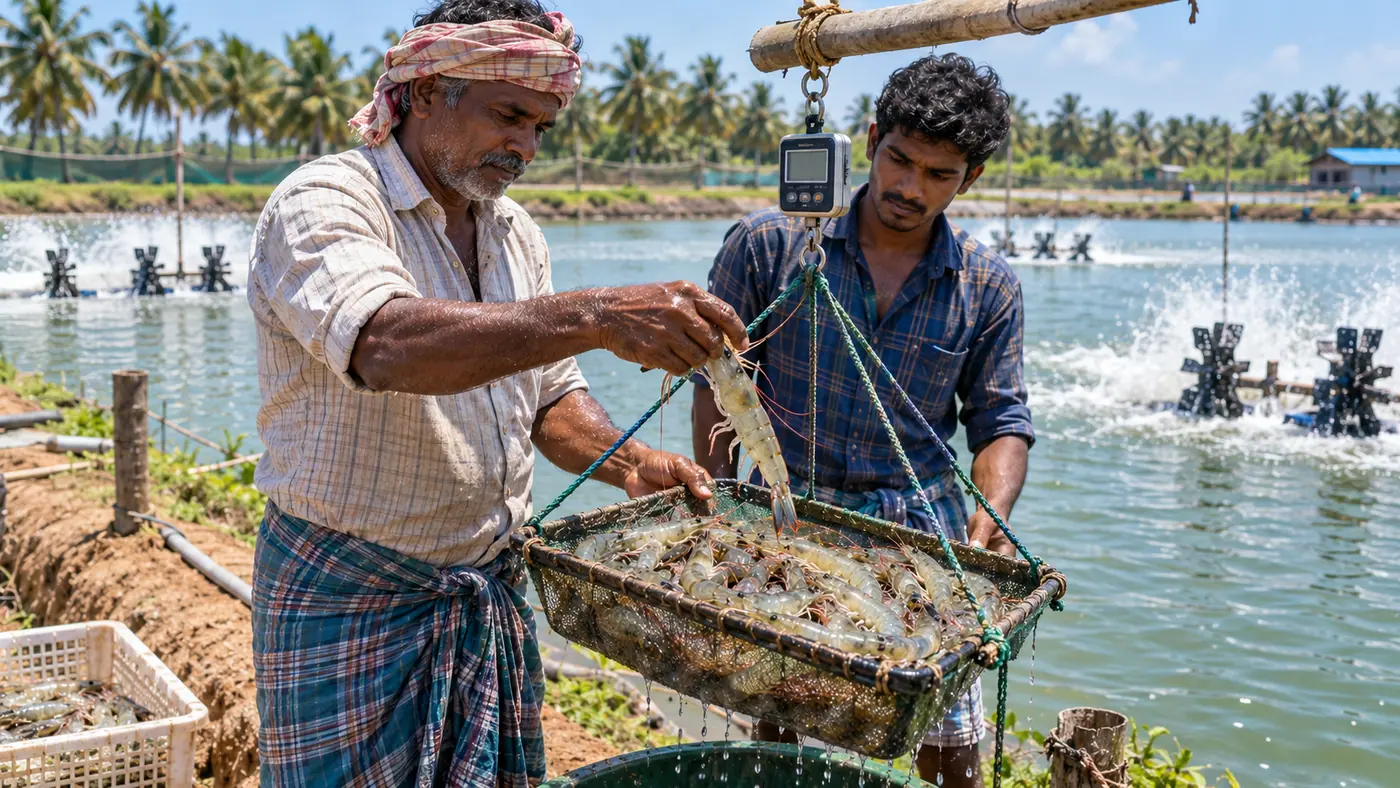
A progressive commercial shrimp producer in Kavali operating four 1-hectare earthen ponds consistently held his Litopenaeus vannamei crops past Day 100 in an attempt to reach prestigious 25-to-28-count size. Over two consecutive cycles, the final 18 days of culture consumed 3,200 kg of feed per pond (costing ₹2,88,000/pond), but generated only 2.1 grams of individual weight gain (reducing count from 34-count to 30-count). Worse, accumulated benthic sludge and deteriorating water quality triggered late-stage Vibrio and White Gut outbreaks, dropping survival from 82% to 68%. Net farm realization collapsed despite harvesting larger shrimp. Partnering with AquaSangham's Bio-Economic Modeling Desk, the farmer instituted the Marginal Revenue vs Marginal Cost (MR = MC) Harvesting Rule: tracking daily biomass growth against daily feed and electrical spend. On his subsequent cycle, when weekly average daily growth (ADG) dipped below 0.22 g/day and marginal FCR breached 2.2 at Day 88, the farmer executed immediate harvest at 33-count. The operation saved ₹8,40,000 in unburned feed and electricity, achieved 86% survival, and turned ponds around for an extra third annual crop cycle.
1. The 'Just One More Week' Trap: How Farmers Accidentally Burn Their Profits
In commercial shrimp aquaculture across Andhra Pradesh, Tamil Nadu, and Gujarat, there is an all-too-familiar psychological phenomenon that plays out every season: the 'Just One More Week' trap. A farmer reaches Day 85 of culture with a pond full of healthy, active Litopenaeus vannamei. Cast-net sampling indicates the shrimp have reached an average body weight of 28.5 grams (approximately 35-count). The local mandi spot price for 35-count is ₹350 per kilogram.
The farmer calculates that if they can just push the shrimp to 33.3 grams (30-count), the published farmgate rate jumps to ₹390 per kilogram—an enticing ₹40/kg premium. Tempted by the prospect of pocketing an extra ₹3,20,000 on an 8-ton standing crop, the farmer decides to hold: 'Let's feed heavily for just 10 more days, drop the count into the 30s, and then harvest.'
Two weeks later, the reality check hits with devastating financial force. Over those 14 days, the pond consumed 2,800 kg of premium commercial feed (at ₹92/kg, an expense of ₹2,57,600) and burned ₹45,000 in grid electricity and diesel aeration. However, due to declining biological growth rates and accumulated benthic waste, the shrimp gained only 2.2 grams, reaching 30.7 grams (32.5-count). Worse, accumulated organic stress triggered late-stage white gut and chronic mortality, causing standing biomass to drop from 8,200 kg to 7,650 kg. The farmer harvests larger shrimp, but ends up with ₹1,80,000 less cash in their bank account than if they had harvested on Day 85. Mastering the science of optimal harvest timing is the single most potent lever to maximize net aquaculture profitability.
The Illusion of Size vs The Reality of Bank Profit
In coastal farming culture, status is often measured by the size of the shrimp harvested: farmers take pride in showing off 25-count or 20-count specimens to neighbors. But shrimp farming is a business of capital turnover and net margin, not personal vanity. A farmer who produces three fast, high-survival cycles of 38-to-40-count shrimp per year generates nearly double the annualized return on capital compared to a farmer who slogs through two protracted, high-risk cycles trying to grow 25-count giants.
Every single day a crop remains in the water past Day 80, the daily operational burn rate escalates. Large shrimp require vast quantities of daily feed simply to support basal metabolic respiration, swimming energy, and osmoregulation. If the market price increase generated by that day's growth does not exceed the daily operational expenditure, the farmer is effectively subsidizing the shrimp's existence out of their own savings.
The Compounding Risk Horizon
Aquaculture risk is not static; it compounds non-linearly with culture duration. A pond on Day 30 has minimal organic sludge, low pathogen loads, and negligible biological oxygen demand (BOD). A pond on Day 95 contains metric tons of accumulated faecal matter, decaying molts, and bacterial blooms.
A sudden monsoon downpour, a 3:00 AM electrical transformer failure, or a sudden spike in blue-green algae can wipe out an entire crop in four hours. Holding mature shrimp to chase an incremental ₹15/kg price gain represents an asymmetric gamble: risking ₹25 Lakhs of established crop equity to win ₹1.5 Lakhs in speculative margin.
Never decide your harvest date based on hope or mandi speculation. Calculate your daily 'Marginal Cost of Holding'. If your pond consumes ₹22,000 per day in feed, electricity, and labor, but your standing biomass is only adding ₹16,000 in net commercial market value, drain the pond immediately.
2. The Biological S-Curve: Average Daily Growth (ADG) vs Metabolic Maintenance
To identify the exact day to harvest, cultivators must understand the physiological growth mechanics of penaeid crustaceans. Animal growth does not follow a straight, linear trajectory; it follows a classic Sigmoidal S-Curve consisting of three distinct physiological phases: the Lag Phase (Days 1 to 25), the Exponential Phase (Days 25 to 75), and the Asymptotic Plateau Phase (Day 80 onwards).
During the exponential growth phase (juvenile stage from 3g to 18g), Litopenaeus vannamei exhibits astonishing feed efficiency. Average Daily Growth (ADG) routinely exceeds 0.35 to 0.45 grams per day (g/day), with weekly weight gains of 2.5 to 3.2 grams. During this golden window, over 65% of dietary protein and metabolic energy is channeled directly into somatic muscle accretion, resulting in an exceptional Feed Conversion Ratio (FCR) of 1.05 to 1.20.
However, as shrimp cross 22 to 25 grams in body weight, their metabolic thermodynamics undergo a fundamental shift. Under Kleiber's Law of Metabolic Scaling, total metabolic maintenance costs scale with body mass, but respiratory surface area (gill lamellae relative to body volume) decreases. By Day 90, when shrimp reach 28 to 32 grams, ADG plummets to 0.12 to 0.18 g/day (less than 1.0g per week). Up to 70% to 75% of every pellet consumed is burned solely to maintain baseline cellular homeostasis, organ function, and swimming activity. Only 25% remains available for physical weight gain.
Cumulative FCR vs Marginal FCR (mFCR): The Critical Distinction
The most dangerous metric that blinds farmers to late-stage losses is Cumulative FCR. When a farmer harvests at Day 100 and calculates total feed divided by total harvested weight, the cumulative FCR might display a respectable 1.45. The farmer believes feed management was successful.
However, this cumulative average masks the devastating reality of Marginal FCR (mFCR)—the specific feed conversion ratio achieved during the final 14 days of culture. While cumulative FCR is 1.45, the mFCR during Days 86 to 100 frequently breaches 2.6 to 3.4:1. Producing that final 1.0 kg of shrimp biomass required 3.0 kg of commercial feed (costing ₹276/kg in feed alone). When the incremental selling price for that weight gain is only ₹210/kg, the farmer lost ₹66 in pure cash for every single kilogram gained during those two weeks.
The ADG Inflection Threshold: The 0.20g Rule
In modern bio-economic farm auditing, the '0.20g Rule' serves as the primary biological harvest trigger. Pond supervisors must execute weekly cast-net sampling, weighing a minimum of 100 shrimp on digital scales to calculate precise Average Daily Growth: ADG = (Current Mean Weight - Previous Mean Weight) / 7 Days.
When ADG remains above 0.28 g/day, the biological engine is operating profitably. When ADG slows to between 0.20 and 0.25 g/day, the pond has entered the transition warning zone. The moment weekly ADG dips below 0.20 g/day (equivalent to less than 1.4 grams per week), somatic growth has stalled. Continued commercial feeding is burning cash; immediate harvest must be scheduled within 72 hours.
Graph your pond's weekly ADG on a simple chart. The exact day the growth curve flattens—changing slope from steep upward momentum to horizontal stagnation—is your biological harvest date. Continuing to feed past this inflection point is the number one cause of farm insolvency.
3. The Marginal Economic Crossover: When Marginal Cost (MC) Exceeds Marginal Revenue (MR)
In classical microeconomics, the profit-maximizing output for any production system occurs at the precise point where Marginal Revenue equals Marginal Cost (MR = MC). In aquaculture, Marginal Revenue (MR) is the additional money received from selling the additional biomass gained over a given time interval, while Marginal Cost (MC) is the total operational expense required to keep the pond alive and growing over that same interval.
As long as MR exceeds MC (MR > MC), holding the shrimp generates positive net profit, expanding total farm wealth. The moment Marginal Cost breaches Marginal Revenue (MC > MR), every additional day in the pond actively destroys capital. The challenge for commercial cultivators is calculating this crossover point in real time.
To operationalize this principle on commercial farms, AquaSangham's Bio-Economic Modeling Desk developed the Daily Marginal Profit Equation: Daily Net Marginal Margin (₹/day) = [Daily Biomass Gain (kg) x New Expected Mandi Price (₹/kg)] + [Existing Standing Biomass (kg) x Count-Drop Price Premium (₹/kg)] - [Daily Feed Spend (₹) + Daily Electricity & Fuel (₹) + Daily Probiotics & Minerals (₹) + Daily Mortality Loss (₹)]. When this equation yields a negative number, the financial tipping point has been breached.
The Bio-Economic Harvesting Simulation: Day 85 vs Day 95 vs Day 105
The following comparative financial model simulates a standard 1.0-hectare semi-intensive pond in coastal Andhra Pradesh stocked at 40 PL/m² (estimated standing population of 300,000 shrimp), comparing the financial realization of harvesting at Day 85, Day 95, and Day 105 under prevailing 2026 commercial feed and mandi rates.
| Operational & Financial Parameter | Harvest at Day 85 (Optimal Window) | Harvest at Day 95 (Transition Zone) | Harvest at Day 105 (Over-Held Loss) |
|---|---|---|---|
| Average Individual Body Weight | 27.0 grams (37-count) | 30.5 grams (32.8-count) | 32.2 grams (31.0-count) |
| Pond Survival Rate | 84.0% (Clean water / high DO) | 79.5% (Sludge accumulation) | 71.0% (Late Vibrio mortality) |
| Total Harvested Biomass | 6,804 kg | 7,279 kg (+475 kg net gain) | 6,858 kg (-421 kg net loss!) |
| Cumulative Feed Consumption | 8,845 kg (Cumulative FCR: 1.30) | 11,280 kg (Cumulative FCR: 1.55) | 13,370 kg (Cumulative FCR: 1.95) |
| Feed Cost Incurred (at ₹92/kg) | ₹8,13,740 | ₹10,37,760 (+₹2,24,020) | ₹12,30,040 (+₹4,16,300) |
| Mandi Realization Price | ₹340 / kg (37-count) | ₹365 / kg (33-count bracket) | ₹380 / kg (31-count bracket) |
| Gross Farmgate Revenue | ₹23,13,360 | ₹26,56,835 (+₹3,43,475) | ₹26,06,040 (+₹2,92,680) |
| Net Operational Profit (After Feed/Power) | ₹10,85,000 | ₹11,42,000 (+₹57,000 gain) | ₹8,68,000 (-₹2,17,000 loss!) |
Look closely at the data: pushing the pond from Day 95 to Day 105 consumed an extra ₹1,92,000 in feed, but harvested biomass actually DECLINED by 421 kg due to subtle, unobserved daily natural mortality. The farmer lost ₹2,74,000 in net profit simply by waiting 10 days too long.
5. The Mandi Price Bracket Calculus: Simulating 30-Count vs 35-Count vs 40-Count Payouts
To execute a profitable harvest timing strategy, cultivators must master the commercial dynamics of the Mandi Price Matrix. Seafood processing factories and commission agents do not pay for shrimp on a smooth, continuous sliding scale; pricing is grouped into discrete, rigid Count Brackets: 20-count, 25-count, 30-count, 35-count, 40-count, 50-count, and 60-count.
Each bracket transition represents a sharp commercial step. The critical commercial skill is calculating whether the biological cost of crossing into the next bracket is justified by the step-up in farmgate rate.
Consider the common operational dilemma: deciding whether to harvest at 40-count (25.0g body weight) or hold for 30-count (33.3g body weight). Moving from 40-count to 30-count requires an individual weight gain of 8.3 grams. In a healthy pond, this jump requires 24 to 28 additional days of culture. If market prices are surging due to international holiday demand, holding may be justified. However, if international markets are entering seasonal tariff slowdowns or monsoon disease pressures are rising, pushing for that bracket jump is a catastrophic commercial gamble.
The Count-Bracket Price Sensitivity Matrix
Examine the typical farmgate price spreads across primary Indian landing centers: 50-count sells at ₹270/kg; 40-count at ₹320/kg (a ₹50/kg jump for 5.0g gain = ₹10.00/g value); 35-count at ₹355/kg (a ₹35/kg jump for 3.5g gain = ₹10.00/g value); and 30-count at ₹390/kg (a ₹35/kg jump for 4.8g gain = ₹7.29/g value).
Notice the mathematical diminishing return: the monetary value gained per gram of growth drops significantly when moving from 35-count to 30-count compared to moving from 50-count to 40-count. At the same time, the biological cost of producing that gram of growth doubles. The economic sweet spot for commercial Vannamei profitability across Andhra Pradesh and Tamil Nadu is consistently between 33-count and 37-count.
Accounting for the Seasonal Mandi Drop
Mandi prices are highly dynamic and fluctuate based on seasonal harvest gluts. In coastal India, mass harvesting occurs during May–June (pre-monsoon summer crops) and October–November (pre-winter crops). During these peak 3-week harvesting windows, processing plants become overwhelmed with raw material, and factory gate rates drop by ₹20 to ₹35 per kilogram across all counts.
A farmer who holds their crop for 10 days to reach larger size often ends up harvesting directly into a seasonal mandi price crash. Gaining ₹20/kg in size premium while losing ₹30/kg to market oversupply results in a net loss of ₹10/kg—after spending lakhs on additional feed. Savvy commercial operators harvest 10 days ahead of the seasonal peak, locking in clean, un-discounted off-peak prices.
Consult the AquaSangham Live Mandi Spot Price Tracker daily. If regional harvest arrivals are surging and processing plants are beginning to lengthen their intake waiting queues, harvest immediately at 35-count rather than waiting for 30-count. Capturing an early, high spot rate beats chasing larger counts in a falling market.
6. Partial Harvesting (Thinning) vs Total Depletion: Squeezing Extra Tons from Carrying Capacity
What if you want the high prices of 25-count shrimp, but your pond is rapidly approaching its biological carrying capacity? The proven operational strategy deployed by elite commercial cultivators across Thailand, Vietnam, and progressive Indian farms is Partial Harvesting—commonly known as 'Pond Thinning'.
In a conventional culture cycle, 100% of the pond biomass is harvested on a single day (Total Depletion). If a farmer stocked 50 PL/m² in a 1-hectare pond, total standing biomass reaches 7.5 to 8.5 tons by Day 75. At this high biomass density, water quality begins to degrade, growth slows to a crawl, and the risk of catastrophic oxygen collapse multiplies.
Instead of forcing the pond into crisis or harvesting everything prematurely, the farmer executes a Partial Harvest at Day 70 to 75: deploying specialized large-mesh drag nets or trap nets to harvest 30% to 40% of the standing crop (typically 2.5 to 3.0 tons of 40-to-45-count shrimp). This single operational intervention fundamentally resets the biological clock of the pond.
The 4 Biological and Financial Benefits of Partial Harvesting
1. Instant Biomass Decompression: Removing 3.0 tons of shrimp immediately slashes total pond oxygen consumption and metabolic waste excretion by 35%. Dissolved oxygen levels rebound, redox potential improves, and carrying capacity is recharged.
2. Compensatory Growth Surge in Remaining Stock: With biomass density reduced from 50 animals/m² down to 30 animals/m², the remaining 5.0 tons of shrimp experience a dramatic surge in compensatory growth. Weekly ADG jumps back up from 0.18g to 0.35g/day, allowing the remaining shrimp to rapidly hit 25-count in just 20 additional days.
3. Immediate Cash Flow & De-Risking: Selling 3 tons of 45-count shrimp at Day 70 generates ₹9,00,000 in immediate cash realization, covering 100% of accumulated feed and seed expenditures and de-risking the entire crop investment.
4. Total Crop Yield Expansion: By resetting carrying capacity, the total cumulative biomass produced from that single hectare expands from 8.0 tons up to 10.5 tons across the two harvests, generating an extra ₹6,50,000 in net profit.
The Operational SOP for Stress-Free Partial Harvesting
Partial harvesting must be executed with extreme surgical care to avoid stressing the remaining population: Net Selection: Use knotless, soft-nylon drag nets with a calibrated mesh size (e.g., 18 mm to 22 mm mesh) that captures only large shrimp while allowing smaller cohorts to pass through uninjured.
Timing: Execute netting strictly between 2:00 AM and 5:00 AM under cool temperatures. Keep paddlewheel aerators running in the un-netted sections of the pond to maintain DO >6.0 mg/L.
Post-Harvest Water Treatment: Immediately following net removal, broadcast pure non-iodized solar salt (NaCl) @ 50 kg/ha and potassium chloride (KCl) @ 20 kg/ha to mitigate osmotic shock, combined with a biofloc/probiotic booster to digest disturbed bottom sediments.
Never execute a partial harvest if your checktray sampling shows more than 4% of shrimp are in soft-shell molt stage (Stage A/B). Dragging nets through a molting population causes physical trauma, cannibalism, and massive secondary bacterial mortality in the remaining stock.
7. The 7-Day Pre-Harvest Decision Matrix: Step-by-Step Harvesting Audit SOP
Harvesting is not an emergency reaction to a problem; it is a meticulously calculated, step-by-step operational audit executed over the final seven days of culture. To ensure complete clarity and eliminate costly emotional guesswork, commercial farm managers must follow AquaSangham's 7-Day Pre-Harvest Decision Matrix.
This standardized protocol integrates biological growth monitoring, water chemistry analysis, lunar cycle synchronization, pre-harvest laboratory clearance, and factory price sheet locking into a seamless operational workflow.
By following this disciplined checklist, commercial producers protect themselves against soft-shell deductions, count downgrades, chemical rejections, and seasonal mandi crashes, ensuring that 100% of earned crop value safely converts into bankable cash.
The Day-by-Day Pre-Harvest Operational Timeline
T-7 Days (Biological & Chemical Audit): Execute a 100-shrimp cast-net sampling pass across all 4 corners and center. Record mean weight, calculate 7-day ADG, and verify molt percentage. Submit official representative samples to an EIC/NABL-accredited laboratory for Pre-Harvest Certificate (PHC) antibiotic screening (chloramphenicol, nitrofurans, fluoroquinolones).
T-5 Days (Lunar Alignment & Factory Negotiation): Check the lunar calendar. Ensure your targeted harvest date falls strictly between Day 3 and Day 5 post-Full Moon or post-New Moon to guarantee hardened Stage C shells. Submit your clean PHC lab report to 2 or 3 competing export processors; lock in formal written Purchase Orders with fixed count brackets and transparent tare deduction terms.
T-3 Days (Pond Environment & Hardening Preparation): Inspect central sludge cone. If water visibility drops below 25 cm or blue-green algae blooms appear, initiate gentle surface flushing and increase aeration. Cease application of uncertified chemicals, binders, or medicated feeds.
T-2 Days (The 48-Hour Mineral Surge): Broadcast Magnesium Chloride (MgCl2) @ 40 kg/ha and Potassium Chloride (KCl) @ 25 kg/ha at 18:00 hrs. Top-dress final feeds with dietary cholesterol (5 g/kg) and calcium phosphate to accelerate cuticle sclerotization.
T-1 Day (Feed Withdrawal & Nighttime Aeration): Withdraw 100% of commercial feed 18 to 24 hours prior to harvest. An empty gut prevents post-harvest faecal contamination and bacterial autolysis in ice crates. Run 100% of mechanical aerators continuously from midnight to sunrise.
Harvest Morning (The Execution): Net shrimp between 2:00 AM and 6:00 AM. Immediately execute the 1:1 Saline Slurry Chill-Kill (-1.0°C) at the pond dyke. Weigh crates on calibrated digital scales, apply serialized container seals, and dispatch under the 4-Hour Processing Window.
Post a laminated copy of this 7-Day Pre-Harvest Decision Matrix on the wall of your farm office and feed shed. When every technician, feeder, and harvest contractor follows identical standardized rules, operational errors vanish and farm profitability surges.
Summary Operational Action Checklist
Frequently Asked Questions
Q: How do I know if holding my shrimp for larger count size is actually making me money or losing money?
Use the Marginal Cost vs Marginal Revenue test: calculate your pond's daily operational expenditure (daily feed cost + electricity/diesel + minerals + estimated 0.5% daily mortality value). Next, calculate the daily revenue gain: multiply the estimated daily biomass gain (current population x daily weight gain in kg) by the expected mandi price, and add any count-bracket step-up premium across existing stock. If daily operational spend is higher than daily revenue gain, you are actively losing money every day you keep the shrimp in the water.
Q: Why does shrimp growth suddenly stall after Day 85 even though I am feeding the best commercial feed?
Late-stage growth stalls due to two biological factors: (1) Metabolic Scaling: as shrimp grow larger (past 25g), basal metabolic maintenance costs increase exponentially, meaning up to 75% of consumed feed is burned just to stay alive; and (2) Benthic Carrying Capacity: accumulated organic sludge and negative redox potential on the pond bottom generate toxic hydrogen sulfide (H2S) and nocturnal hypoxia, suppressing digestive enzymes and food assimilation.
Q: Is it better to harvest 40-count shrimp with high survival or risk waiting for 30-count?
In over 75% of commercial production scenarios, harvesting 38-to-40-count shrimp with high survival (>85%) yields superior annualized return on investment compared to risking culture past Day 100. Fast harvests de-risk capital, lower cumulative FCR (1.15 vs 1.65), eliminate seasonal disease exposure, and free up ponds to execute an additional crop cycle per year.
Q: What is the biggest mistake farmers make during partial harvesting (thinning)?
The biggest mistake is executing a partial harvest while a significant portion of the population is actively molting (within 48 hours of a full or new moon). Dragging nets through soft-shelled shrimp causes severe cuticle tearing, eye punctures, and mortality. The second mistake is failing to apply supportive minerals (NaCl, KCl, and MgCl2) immediately after netting to help the remaining stressed shrimp recover osmotic equilibrium.
AquaSangham Technical Advisory
Bio-Economics & Aquaculture Farm Optimization Desk
Contributing Senior Technical Writer & Aqua Consultant at AquaSangham.
Recommended Farming Guides
The 3 AM Oxygen Trap: Why Fish and Shrimp Die at Dawn (And The 4.0 ppm Rule That Saves Them)
Read Article →Water QualityWhy Sudden Monsoon Rain Wipes Out Shrimp Overnight (And The 30-Minute Emergency Lime Protocol That Saves Your Pond)
Read Article →Market AnalysisEU & US Seafood Traceability Audits: Keeping Digital Farm Logs to Secure ₹15-₹20/kg Premium from Exporters
Read Article →Get Live Farm Advice on AquaSangham Mobile App
Download India's #1 Aquaculture Super App for real-time market prices, precision tools, and community advice.
Download Free Android App