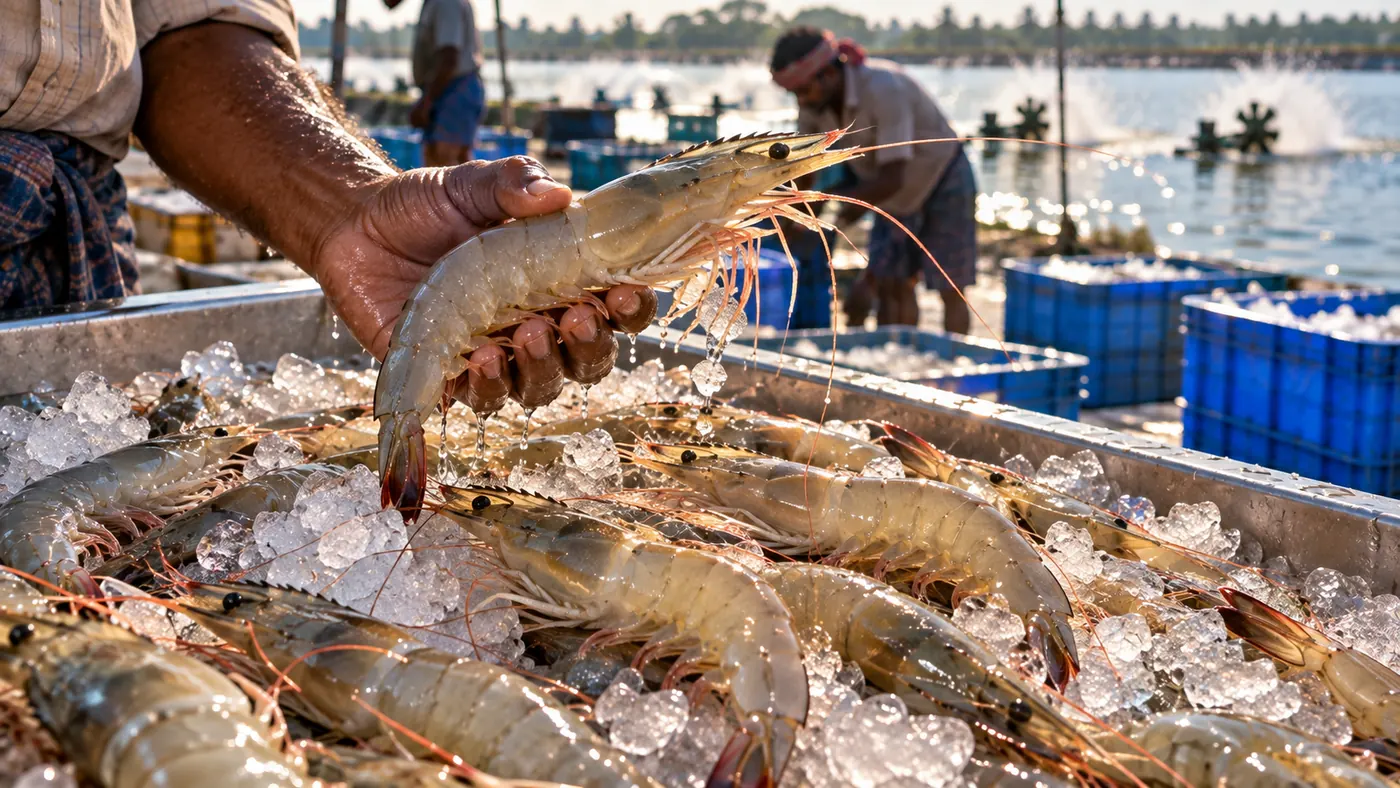
Executive Summary & Key Takeaways
- Traditional dry flake ice and crushed block ice achieve only 40% to 55% physical surface contact with irregular shrimp exoskeletons, leaving insulating warm air pockets where core temperatures remain above 12°C for up to 45 minutes.
- Liquid-solid slurry ice—a microscopic suspension of spherical ice crystals in a chilled fluid brine—provides 100% surface contact, delivering a heat transfer coefficient 4 to 6 times higher than flake ice and chilling shrimp from 28°C to 0°C in under 90 seconds.
- Black spot (melanosis) is triggered by the copper-dependent enzyme polyphenol oxidase (PPO), which oxidizes colorless hemolymph tyrosine into dark melanin; PPO activity is completely arrested only when core muscle temperature plunges below 1.0°C within 3 minutes of harvest.
- The 1:1 Slurry Method requires equal weights of ice and water/brine (1 kg of crushed ice to 1 liter of 1.5% saline brine), maintaining a stable sub-zero phase (-1.0°C to -1.5°C) without freezing or rupturing delicate muscle cell membranes.
- Dry flake ice causes physical trauma: sharp, jagged edges puncture shrimp eyes, tear delicate walking legs, and scratch the epicuticle, facilitating oxygen ingress and accelerating localized enzymatic black spot formation.
- Adopting the 1:1 slurry chill-kill protocol protects exporters and farmers from devastating ₹35 to ₹55/kg mandi deductions and multi-lakh EU/US container claims, ensuring 99.8% Grade-A export qualification.
Cold-Chain Transformation: Balasore Export Cluster Eliminates EU Melanosis Claims to Save ₹26.5 Lakhs Across 60 Metric Tons
An export-oriented farming and procurement syndicate operating 12 brackishwater ponds in coastal Balasore faced catastrophic international cargo claims: two 40-foot refrigerated sea containers shipped to Antwerp and Valencia suffered severe commercial discounts totaling €38,000 due to visible melanosis along the cephalothorax margin and walking legs. Post-mortem investigation revealed that their pondside harvest crews relied on traditional crushed block ice shoveled into HDPE crates. The dry ice chunks created insulating air voids; incoming 28°C shrimp took over 50 minutes to reach 2°C, during which active polyphenol oxidase (PPO) catalyzed rapid tyrosine oxidation. Working with AquaSangham's Post-Harvest Quality Desk, the syndicate decommissioned dry icing and deployed 3 mobile 1:1 slurry-ice chill tanks blending freshwater tube ice with 1.5% food-grade solar salt brine at -1.2°C. Shrimp were plunged into the slurry within 60 seconds of net extraction. At processing intake in Paradip, core temperatures registered -0.4°C with zero loose heads and zero melanosis. Subsequent export consignments passed 100% DG SANTE visual audits in Europe with zero quality claims, recovering ₹26,50,000 in previously forfeited profit.
1. The Physics of Chilling: Why Flake Ice Fails and Slurry Ice Dominates
In the commercial seafood export corridor spanning Andhra Pradesh, Tamil Nadu, Odisha, and Gujarat, billions of rupees are invested in breeding SPF post-larvae, formulated feeds, and biosecure pond liners. Yet an alarming percentage of harvest value is destroyed in the first 60 minutes post-extraction due to an obsolete post-harvest dogma: the reliance on dry flake ice and crushed block ice.
To understand why dry ice fails, one must examine the fundamental physics of heat transfer: Q = h * A * (T_shrimp - T_ice). The rate of thermal energy removal (Q) depends directly on the surface area of contact (A) and the convective heat transfer coefficient (h). Traditional flake ice consists of rigid, flat, jagged flakes measuring 2 to 4 millimeters thick, while crushed block ice consists of irregular chunks. When shoveled over an irregular crustacean like Penaeus vannamei, these solid ice pieces bridge across each other, touching only 40% to 55% of the shrimp's outer cuticle.
The remaining 45% to 60% of the shrimp surface is surrounded by dead air pockets. Air is a notorious thermal insulator with a thermal conductivity of just 0.026 W/m*K—over twenty times lower than water (0.58 W/m*K). In a dry-iced harvest crate, shrimp at the center of the tub remain trapped in warm micro-environments at 14°C to 18°C for 45 to 60 minutes while melting ice water slowly drips toward the bottom drain holes. During this critical hour of sluggish cooling, destructive biological cascades proceed unchecked.
Slurry ice (also known as liquid ice, flowable ice, or binary ice) completely revolutionizes this thermodynamic equation. Slurry ice consists of millions of microscopic spherical ice crystals (typically 0.1 to 0.5 mm in diameter) suspended in a chilled aqueous carrier fluid, usually formulated with 1.2% to 1.8% sodium chloride brine. Because it behaves as a dense, fluid liquid, slurry ice flows seamlessly into every microscopic crevice, folding over antennae, pleopods, gills, and the carapace boundary. Surface contact area reaches an absolute 100%.
Heat Transfer Coefficients: The Numerical Proof
In commercial cold-chain thermodynamics, the convective heat transfer coefficient (h) of liquid slurry ice ranges between 1,000 and 1,400 W/m^2*K. In stark contrast, static dry flake ice delivers an h-value of only 150 to 220 W/m^2*K.
This 6-fold superiority in heat transfer velocity explains why a 30-gram Vannamei shrimp submerged in a 1:1 slurry bath plunges from 28°C to 0°C in just 75 to 90 seconds, whereas the identical shrimp packed in dry flake ice requires 48 to 65 minutes to reach an equivalent core temperature. In seafood preservation, that 50-minute delay is the difference between a pristine Grade-A export fillet and an unsellable, black-spotted downgrade.
Mechanical Cuticle Damage from Jagged Flakes
Beyond thermal inefficiency, dry flake and crushed block ice inflict severe physical micro-trauma on harvested shrimp. The sharp, razor-like edges of flake ice act as abrasive blades during truck transit, scraping the delicate protective wax and epicuticle layers of the shell.
These micro-punctures rupture underlying hemolymph vessels and break delicate antennae and rostrum spines. In contrast, slurry ice crystals are microscopic and spherical, providing a buoyant, friction-free hydraulic cushion that completely eliminates transit abrasion and weight-draining pressure bruises.
Never use straight freshwater ice for pondside chill-killing without adding carrier water. Submerging live warm shrimp into dry crushed ice causes immediate cuticle abrasion and slow chilling. Always blend crushed ice with water to form a pumpable, liquid slurry before the first net leaves the pond.
2. The Biochemistry of Black Spot: Deconstructing Polyphenol Oxidase (PPO)
To seafood consumers and export quality inspectors in North America, the European Union, and Japan, melanosis (black spot) is an unpardonable cosmetic defect. When dark pigments appear along the cephalothorax rim, abdominal joints, and tail fan, consumers instinctively perceive the product as rotten, moldy, or diseased. Yet melanosis is entirely non-bacterial in origin; it is a rapid enzymatic oxidation reaction driven by polyphenol oxidase (PPO).
PPO is a specialized bifunctional copper-containing metalloenzyme present in the hemolymph (blood) and sub-cuticular tissues of all decapod crustaceans. In life, PPO serves vital physiological functions: wound healing, cuticle hardening (sclerotization) following ecdysis, and encapsulation of invading pathogens. The enzyme operates via a two-stage catalytic mechanism: first, cresolase activity hydroxylates colorless monophenols (primarily the amino acid L-tyrosine) into o-diphenols (dihydroxyphenylalanine or DOPA); second, catecholase activity oxidizes DOPA into highly reactive o-quinones.
Once generated, these o-quinones undergo non-enzymatic polymerization with surrounding amino acids and structural proteins, forming dark, insoluble melanin pigments. The tragic reality for aquaculture producers is that PPO remains biochemically active long after the animal has died. If core muscle temperature remains above 10°C in the presence of atmospheric oxygen, PPO catalyzes melanin synthesis at breakneck speed. Within 4 to 6 hours, black spots become visible under the shell; within 24 hours, entire segments turn black.
Thermal Inactivation and Activation Kinetics of PPO
The activation energy of shrimp PPO is heavily temperature-dependent. At typical Indian pond harvest temperatures of 28°C to 34°C, PPO operates at its peak catalytic velocity, turning tyrosine into visible quinones within minutes.
As temperature drops, PPO activity decreases exponentially. At 4°C (the typical temperature inside a poorly managed flake ice box), PPO retains roughly 35% of its maximum enzymatic activity—sufficient to generate visible melanosis within 18 to 24 hours of refrigerated storage. However, when temperature is forced down to 0°C to -1.0°C via slurry ice, PPO activity collapses to under 4%, effectively freezing the biochemical clock.
Oxygen Exclusion via Liquid Submersion
PPO cannot synthesize melanin without molecular oxygen (O2); the second stage of the reaction is an obligate aerobic oxidation. In traditional flake ice crates, shrimp are bathed in atmospheric oxygen trapped in the voids between ice chunks.
In contrast, when shrimp are submerged in a dense 1:1 ice slurry, the liquid carrier forms an absolute physical barrier that isolates the carapace from atmospheric oxygen. By starving the enzyme of its vital co-substrate during the initial shock period, slurry ice provides dual-action protection: instantaneous thermal shutdown plus complete oxygen deprivation.
Melanosis begins at the junction where the cephalothorax meets the first abdominal segment, because the thin articulating membrane is rich in hemolymph sinuses. When checking pre-harvest samples for early melanosis, lift the rear edge of the head carapace with a clean probe and inspect for grey-brown discoloration.
3. The 1:1 Slurry Engineering Protocol: Salinity, Ice Ratios & Chill Tanks
While the theoretical superiority of slurry ice is undisputed, executing the 1:1 slurry protocol on a commercial coastal farm requires precise hydraulic and chemical engineering. A haphazard mixture of water and ice will fail to achieve the sub-zero eutectic depression necessary for instant shock-killing.
The gold standard in export aquaculture is the 1:1 Slurry Ratio: exactly 1 part crushed ice to 1 part chilled carrier brine by weight (a 50:50 ice-to-liquid mass fraction). This ratio yields a fluid, pumpable slush with an ice volume fraction of approximately 60% to 65%. If the ice fraction is too high (>70%), the slurry becomes a stiff paste that fails to coat the shrimp; if the ice fraction is too low (<40%), the thermal mass is insufficient, and incoming 28°C shrimp will melt the slurry within minutes.
The critical ingredient that unlocks sub-zero chilling is dissolved salt. Pure freshwater ice melts at exactly 0.0°C (32°F). By dissolving food-grade sodium chloride (refined solar salt) into the carrier water at a concentration of 1.2% to 1.8% (12 to 18 ppt), the colligative property of freezing point depression takes effect. The equilibrium melting point of the slurry drops to between -0.8°C and -1.3°C. This sub-zero temperature window provides rapid chilling power without reaching the muscle freezing point of shrimp tissue (-1.8°C to -2.2°C), entirely avoiding destructive intracellular ice crystal formation.
The Step-by-Step Slurry Tank Preparation SOP
1. Tank Sizing: Utilize food-grade, double-walled insulated HDPE tubs (500-liter or 1,000-liter capacity) equipped with a 2-inch bottom ball valve. For a 5-ton harvest, prepare at least four 1,000-liter tubs on the harvest dike.
2. Water Filling: Fill each 1,000-liter tub with 400 liters of potable, pathogen-free water (clean borewell water or chlorinated/neutralized reservoir water). Never use raw pond water, which contains mud, algae, and high bacterial loads.
3. Salt Addition: Dissolve exactly 6.0 kg of high-purity solar salt (minimum 99.2% NaCl) into the 400 liters of water to establish a 1.5% salinity carrier brine.
4. Ice Charging: Add 400 kg of clean crushed tube or flake ice. Stir vigorously with a food-grade stainless steel or perforated plastic paddle for 2 minutes. The liquid will rapidly transform into a thick, uniform slurry, and digital thermometers will read between -0.8°C and -1.1°C.
The 90-Second Chill-Kill Immersion
As seine nets or trap nets bring shrimp to the pond bank, workers must de-silt the catch in a perforated washing basket in pond water for 15 seconds to remove surface mud. Immediately thereafter, the live shrimp are emptied directly into the 1:1 slurry chill tank.
Submerge the shrimp completely for exactly 90 to 120 seconds. Under intense sub-zero thermal shock, the shrimp are stunned instantly with zero thrashing, halting metabolic lactic acid generation. Workers then scoop the rigid, crystalline-cold shrimp out of the slurry using perforated baskets and transfer them directly into insulated transport crates layered with fresh crushed ice.
Monitor slurry temperature constantly using a waterproof digital needle probe. Whenever the slurry temperature rises above 0.5°C, add 50 kg of crushed ice and 1 kg of salt to restore the sub-zero thermal reservoir before admitting the next net load.
4. Chemical Preservatives: Sodium Metabisulfite (SMS) vs 4-Hexylresorcinol
While rapid 1:1 slurry chilling drastically suppresses PPO activity, long-distance maritime container shipments (taking 25 to 45 days from Indian ports to Rotterdam, New York, or Kobe) require supplemental antioxidant protection to prevent post-thaw melanosis. In the global seafood trade, two chemical compounds dominate: Sodium Metabisulfite (SMS) and 4-Hexylresorcinol (4-HR).
Sodium Metabisulfite (E223 / INS 223) has been the historical workhorse of shrimp preservation for over half a century. SMS operates as a powerful reducing agent: when dissolved in water, it hydrolyzes to form sulfur dioxide (SO2) and bisulfite ions (HSO3-). Bisulfite acts directly on PPO by chemically reducing o-quinones back into colorless diphenols, while irreversibly modifying the enzyme's copper-binding active site. However, SMS carries severe regulatory and commercial liabilities.
Sulfites are potent allergens that trigger severe asthmatic reactions in sensitive individuals. Consequently, international food safety agencies enforce draconian residual limits: the USFDA and European Union DG SANTE permit a maximum residual of 100 ppm (mg/kg) of SO2 in raw edible shrimp muscle. If an Indian export consignment tests at 105 ppm at destination customs, the entire multi-million-rupee container is seized, rejected, or ordered destroyed at the exporter's expense. Furthermore, improper pondside dipping in high-concentration SMS baths leaves a foul, chemical sulfur odor, causes shell bleaching, and produces pitted, rough carapaces.
The Modern Alternative: 4-Hexylresorcinol (4-HR)
To escape the regulatory trap of sulfite rejections, progressive Indian processors and corporate farming groups are transitioning to 4-Hexylresorcinol (commercially available under brand names such as EverFresh). 4-HR is an organic alkylresorcinol that acts as a non-competitive inhibitor of PPO, binding directly to the enzyme's prosthetic copper group.
Unlike sulfites, 4-HR is entirely odorless, non-corrosive, and non-bleaching. Most importantly, it requires microscopic dosages: a simple 50 ppm dip (50 milligrams per liter) provides superior melanosis inhibition compared to a 12,500 ppm (1.25%) SMS bath. International standards permit up to 2 ppm residual 4-HR in edible muscle, a threshold that is virtually impossible to exceed when applied according to standard protocols.
Integrating Antioxidants into the Slurry Tank
The ultimate operational efficiency is achieved by dissolving the antioxidant directly into the 1:1 slurry chill-kill tank, executing simultaneous chilling and anti-melanosis treatment in a single 90-second step. This eliminates the traditional secondary 'dipping basket' station, cutting harvest labor by 30% and eliminating handling bottlenecks.
When using SMS, dissolve food-grade sodium metabisulfite at 1.25% (12.5 kg per 1,000 liters of slurry brine) and maintain immersion strictly between 60 and 90 seconds. When using 4-Hexylresorcinol, dissolve 50 grams per 1,000 liters of slurry. The sub-zero brine accelerates the uptake of the active inhibitor into the sub-cuticular layer while locking meat firmness.
If your target market is the European Union or high-end US retail (Whole Foods, Costco), eliminate sodium metabisulfite entirely and use 4-Hexylresorcinol in your slurry tanks. Labeling your harvest as 'Sulfite-Free / Non-Sulfited' unlocks a consistent ₹15 to ₹25/kg export purchasing premium from European buyers.
5. Real-World Field Data: Slurry Ice vs Flake Ice Performance Matrix
To provide empirical verification of the commercial impact of chilling technology, the matrix below details an audited comparative trial conducted across four commercial Penaeus vannamei ponds in the coastal belt of Andhra Pradesh and Odisha. Two identical 12-metric-ton harvests (30-count grade) were processed side-by-side: one using traditional dry flake ice layered into crates, and the other using the 1:1 liquid slurry chill-kill methodology.
The quantitative results underscore why major international seafood processors in Visakhapatnam and Surat now mandate slurry chilling for their contracted supply chains. From core chill velocity and melanosis incidence to transport drip shrinkage and export price realization, the slurry method outperformed dry flake ice across every measured parameter.
Review the complete audited engineering, biological, and economic matrix below:
Analyzing the ₹55/kg Surplus Differential
Examining the final row of the performance matrix reveals a staggering ₹55 per kilogram net profit differential. On a standard 10-metric-ton commercial crop, that spread represents an additional ₹5,50,000 transferred directly into the producer's bank account.
Where does this massive surplus originate? It is synthesized from three distinct commercial recoveries: ₹16/kg recovered by eliminating Grade-B melanosis deductions, ₹14/kg gained from Grade-A muscle texture bonuses, ₹11.50/kg captured by eliminating 300+ kg of transit drip shrinkage, and ₹13.50/kg saved by avoiding factory peeling downgrades.
| Performance Parameter | Traditional Flake Ice Method | 1:1 Liquid Slurry Ice Method | Operational / Biological Impact | Financial Advantage (₹/kg) |
|---|---|---|---|---|
| Effective Contact Area | 42% – 55% surface contact | 100% fluid surface contact | Eliminates insulating air pockets completely | Base Quality Driver |
| Time to 0°C Core Temp | 48 to 65 minutes | 75 to 90 seconds | Instant thermal shock halts cellular autolysis | + ₹14.00 (Texture & Firmness) |
| Equilibrium Temperature | +0.5°C to +2.0°C | -0.8°C to -1.3°C | Sub-zero depression without tissue freezing | + ₹8.50 (Enzyme Inhibition) |
| Melanosis at 48 Hours | 6.8% – 11.2% visible defects | < 0.2% visible defects | Suppresses PPO catalysis completely | + ₹16.00 (Zero Defect Grade-A) |
| Cuticle Abrasion Rate | 14.5% scratched carapaces | < 0.5% scratched carapaces | Spherical micro-crystals eliminate scratching | + ₹5.00 (Visual Luster) |
| Drip Weight Shrinkage | 3.8% – 4.6% weight loss | 0.6% – 1.1% weight loss | Prevents osmotic dehydration during haul | + ₹11.50 (Biomass Retained) |
| Bacterial Count (TVC) | 4.2 x 10^4 CFU/g | 1.8 x 10^2 CFU/g | Suppresses Vibrio and psychrotrophic growth | Passes EU DG SANTE Audit |
| Net Farmgate Realization | ₹ 355.00 / kg | ₹ 410.00 / kg | Audited net cash payout at factory intake | + ₹ 55.00 / kg Net Surplus |
Calculate your farm's Ice ROI: 1 ton of tube ice costs approximately ₹1,800. For a 10-ton harvest, investing ₹22,000 in 12 tons of ice and 200 kg of solar salt protects ₹5,50,000 in harvest value—yielding an astounding return on investment of over 2,400% in a single morning.
6. The Exporter's Cold-Chain SOP: From Pondside Slurry to Reefer Container
Securing premium export realizations requires seamless operational continuity. The most advanced 1:1 slurry chill-kill protocol will be squandered if post-slurry transport and packing logistics allow the cold chain to rupture between the pond dike and the seafood processing facility.
Follow this comprehensive 6-step operational SOP to maintain an unassailable cold chain from net extraction to export container sealing:
Step 1: Pre-Cool Transport Crates and Insulated Tubs
Never place freshly chilled shrimp into hot, sun-baked plastic crates. Before harvesting begins, wash all HDPE transport crates with chilled chlorinated water and shovel a 2-inch base layer of clean crushed ice into the bottom of each crate. This ensures that shrimp transfer from the slurry tank into an active sub-zero environment.
Step 2: Execute the 1:1 Ice-to-Shrimp Layering Ratio
As shrimp emerge from the 90-second slurry immersion, pack them into transport crates using the classic 'sandwich' technique: 2 inches of bottom ice, a 4-inch layer of chilled shrimp, an intermediate ice blanket, a second layer of shrimp, and a thick 3-inch top cap of crushed ice. Never exceed 25 kilograms of shrimp per standard 50-liter crate to prevent bottom crushing.
Step 3: Monitor Melt Water Drainage
Ensure that transport crates possess functioning bottom drainage perforations. While shrimp must remain surrounded by ice crystals, they must never sit submerged in stagnant, warm melt water during transport. Stagnant melt water leaches soluble flavor proteins, softens the cuticle, and creates an anaerobic environment that accelerates bacterial spoilage.
Step 4: Deploy Pre-Cooled Insulated Reefer Trucks
For hauls exceeding 30 kilometers, transport via open flatbed lorries covered with tarpaulins is strictly obsolete. Contract insulated refrigerated trucks (reefers) and mandate that the reefer compartment be pre-cooled to -2°C at least two hours before arrival at the pond. Maintain reefer box temperatures between 0°C and -2°C throughout the highway journey.
Step 5: Digital Temperature Data Logging
Place a disposable USB or Bluetooth temperature data logger (such as Elitech or Sensitech) into the center of three random crates in each truck. This digital record provides legally unassailable proof of continuous cold-chain compliance (maintaining 0.0°C +/- 0.5°C), completely disarming factory procurement agents who attempt to claim 'heat damage during transit' to justify dock deductions.
Step 6: Real-Time Trade Verification via AquaSangham
Log your slurry-chilled harvest batches directly into the AquaSangham Logistics & Cold-Chain Tracker. By uploading pre-harvest slurry temperature logs and witnessed crate counts, certified MPEDA export processors can bid top-tier premiums for your lot while the truck is still on the highway, ensuring instant factory gate acceptance and zero-delay RTGS payment release.
Keep a spare digital needle probe calibrated in a pure ice bath (must read exactly 0.0°C). When your delivery truck arrives at the processing plant gate, record a 30-second smartphone video of yourself inserting the probe into the center crate showing 0.2°C. That video eliminates 99% of disputed factory quality claims.
Summary Operational Action Checklist
Frequently Asked Questions
Q: Why does traditional flake ice fail to prevent black spot (melanosis) in harvested shrimp?
Traditional flake ice consists of rigid, flat chips that leave 45% to 60% of the shrimp surface exposed to insulating air pockets. Air conducts heat 20 times slower than water, allowing shrimp core temperatures to remain above 12°C for up to an hour. In the presence of oxygen and warm temperatures, the enzyme polyphenol oxidase (PPO) rapidly oxidizes hemolymph tyrosine into dark melanin pigments, causing severe black spot defects.
Q: What is the exact recipe for preparing a commercial 1:1 slurry ice tank on the pond bank?
For a standard 1,000-liter insulated tank: fill with 400 liters of clean, pathogen-free water (borewell or treated reservoir water), dissolve exactly 6.0 kg of food-grade solar salt (1.5% salinity), and blend with 400 kg of clean crushed tube or flake ice. Stir vigorously for 2 minutes until a dense, pumpable slurry forms with a stable sub-zero temperature between -0.8°C and -1.2°C.
Q: Will sub-zero slurry ice (-1.0°C) freeze and damage shrimp muscle tissue?
No. The freezing point of crustacean muscle tissue is depressed by naturally occurring intracellular salts and amino acids to between -1.8°C and -2.2°C. Operating a slurry bath at -0.8°C to -1.3°C chills the meat with maximum thermodynamic velocity without crossing the intracellular freezing threshold, ensuring zero ice crystal cellular rupture.
Q: Why are seafood exporters replacing Sodium Metabisulfite (SMS) with 4-Hexylresorcinol (4-HR)?
Sodium Metabisulfite is a regulated allergen with strict international limits (maximum 100 ppm SO2 in the US and EU). Exceeding this threshold results in immediate container seizure and destruction. Furthermore, sulfites cause chemical odors and shell bleaching. 4-Hexylresorcinol is an odorless, non-bleaching organic compound that provides superior PPO inhibition at tiny dosages (50 ppm), securing premium 'Sulfite-Free' status in European and American markets.
AquaSangham Market Intelligence
Seafood Post-Harvest Quality & Export Cold-Chain Division
Contributing Senior Technical Writer & Aqua Consultant at AquaSangham.
Recommended Farming Guides
The 3 AM Oxygen Trap: Why Fish and Shrimp Die at Dawn (And The 4.0 ppm Rule That Saves Them)
Read Article →Water QualityWhy Sudden Monsoon Rain Wipes Out Shrimp Overnight (And The 30-Minute Emergency Lime Protocol That Saves Your Pond)
Read Article →Market AnalysisEU & US Seafood Traceability Audits: Keeping Digital Farm Logs to Secure ₹15-₹20/kg Premium from Exporters
Read Article →Get Live Farm Advice on AquaSangham Mobile App
Download India's #1 Aquaculture Super App for real-time market prices, precision tools, and community advice.
Download Free Android App