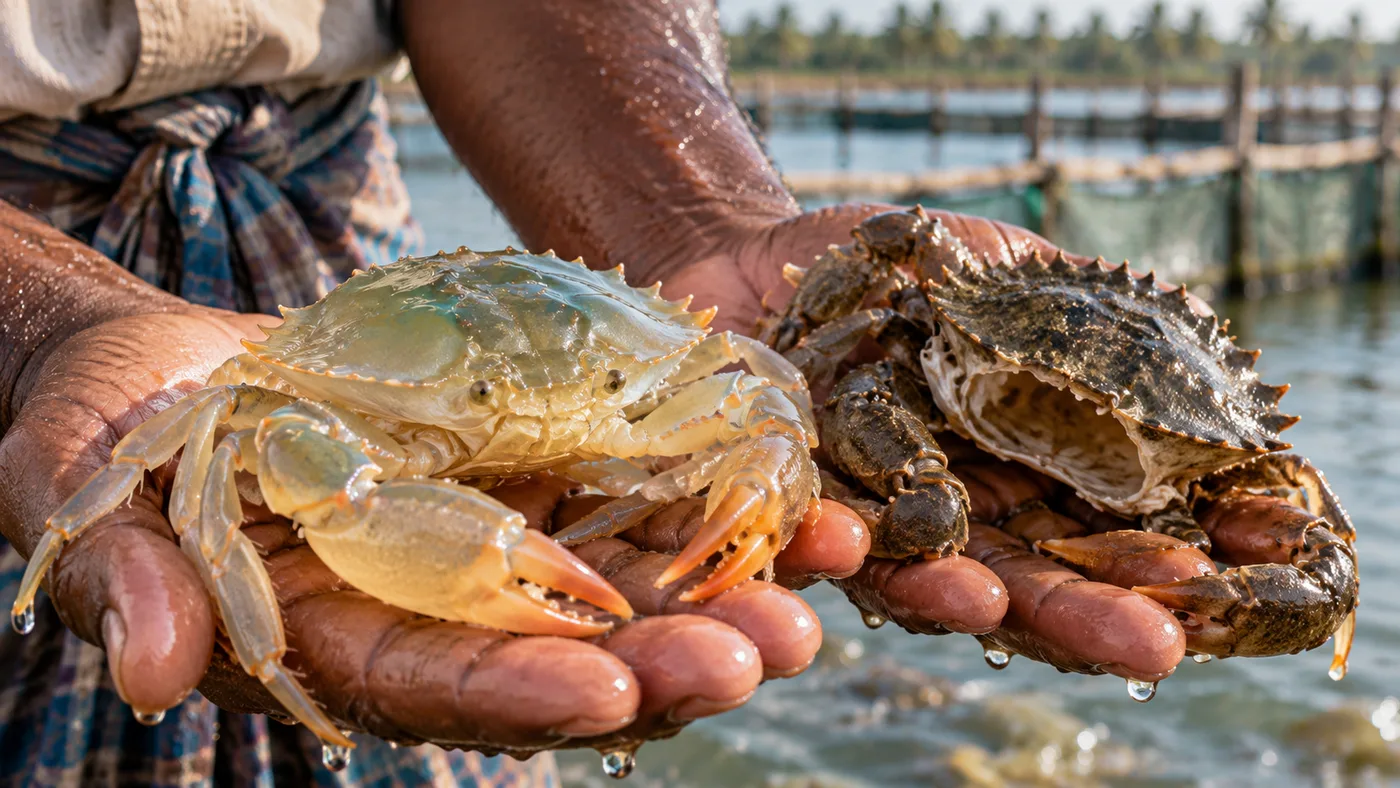
Executive Summary & Key Takeaways
- Soft-shell crab farming is the single highest value-multiplier in coastal aquaculture, transforming small 80g–150g juvenile crabs (worth ₹40–₹60 each as hard crabs) into ₹200–₹350 export-grade culinary assets.
- The entire business model hinges on a strict biological countdown: cuticular sclerotization (the enzymatic tanning and calcification of the new shell) begins within 2 hours of ecdysis and turns the shell leathery and unsaleable within 4 hours.
- Pre-sorting 'peeler crabs' is mandatory: examining the inner rim of the swimming paddle (dactylus) reveals transparent, white, and red pre-molt suture lines that predict ecdysis within 24 to 72 hours.
- Lowering salinity in the final molting cell to 10–14 ppt delays cuticular calcification by up to 90 minutes by restricting available calcium and carbonate ions in the ambient water column.
- Immediate post-harvest shock in a chilled freshwater bath (4°C for 30–45 minutes) stops calcium uptake, cleanses the crab, and halts the enzymatic tanning process completely before processing.
- Flash-freezing at -20°C to -25°C in Individual Quick Frozen (IQF) vacuum pouches prevents cellular moisture drip loss, preserving the velvety texture and culinary mouthfeel prized by international chefs.
- With 24/7 shift monitoring and direct export logistics, a 3,000-to-5,000-box soft-shell facility produces consistent gross profit margins exceeding 45% to 55%.
Coastal Mariculture Case Study: Eliminating Nighttime Molting Losses to Scale a 4,000-Box Soft-Shell Crab Export Unit
A commercial mariculture partnership operating a 4,000-box floating perforated tidal pontoon farm along the Vedaranyam backwaters struggled with erratic harvest recoveries. In their initial three months, over 35% of crabs molted between midnight and 05:00 AM; by the time morning inspection teams arrived at 07:30 AM, ambient brackishwater salinity (24 ppt) had already triggered cuticular calcification, turning premium soft crabs into unsaleable 'paper-shell' rejects fetching only standard hard crab rates. Partnering with AquaSangham trade and mariculture advisory, the team instituted three structural interventions: (1) Transitioned to a rotating 3-shift, 24/7 inspection schedule, physically checking every individual floating cell every 180 minutes; (2) Trained technicians on sub-carapace paddle fin pigmentation (identifying Stage D3–D4 peeler crabs with a distinctive crimson suture on the swimming paddle) to pre-sort imminent molters into specialized, low-salinity (12 ppt) molting tanks; (3) Standardized post-harvest handling with an immediate 45-minute chilled freshwater dip (4°C) to arrest enzymatic chitin tanning, followed by gill de-sponging and blast-freezing at -25°C in barrier vacuum pouches. Across the subsequent 120 days, soft-shell recovery rose to 94.8%. The facility processed 1,120 kg of export-grade soft crabs monthly (averaging 120g–160g sizes), sold directly to air-cargo exporters serving Singapore and Tokyo at ₹2,150/kg, generating ₹24.08 Lakhs gross revenue against ₹12.53 Lakhs operational expenditure and netting ₹3.85 Lakhs average monthly profit.
2. The Biology of Ecdysis: The 4-Hour Sclerotization Clock & Cuticle Chemistry
To capture premium export value, a farm operator must master the underlying biochemistry of decapod crustacean molting. Like all arthropods, a mud crab is encased in a rigid chitinous exoskeleton that cannot expand. To grow, the crab must periodically shed this restrictive armor through ecdysis, rapidly absorb water to expand its body dimensions by 15% to 25%, and then harden the new cuticle into a larger permanent shell.
The crustacean molting cycle is governed by hormonal signaling. As the molt approaches, the Y-organ accelerates the synthesis of ecdysteroid hormones, initiating apolysis—the detachment of the old cuticle from the underlying hypodermis. Simultaneously, the crab resorbs organic minerals (particularly calcium carbonate and phosphorus) from its inner shell layers, storing them temporarily in internal blood hemolymph and digestive hepatopancreas tissues.
When the molt commences, the crab absorbs ambient water through its gut and branchial gills, building immense internal hydrostatic pressure. This hydrostatic pressure forces open the epimeral suture—a horizontal seam running along the lateral margin of the carapace. Backing slowly out of the split, the crab completely withdraws its body, chelipeds, eyes, antennae, and internal stomach lining, leaving behind an intact, translucent ghost shell (the exuvia).
The moment the crab emerges, a lethal biochemical timer starts ticking: cuticular sclerotization. The newly exposed soft epicuticle is composed of flexible chitin and soft protein chains. In natural seawater containing dissolved calcium (Ca2+) and bicarbonate (HCO3-) ions, the enzyme polyphenol oxidase initiates phenolic tanning, cross-linking protein chains while calcium carbonate crystals rapidly precipitate within the chitin matrix.
The sclerotization countdown follows a rigid progression: (1) 0 to 60 minutes: The crab is completely soft, velvety, and pliable—the supreme 'Grade-A Prime' export condition; (2) 60 to 120 minutes: Cuticular cross-linking begins, but the shell remains tender and flexible; (3) 120 to 240 minutes: Cuticular tanning accelerates; the edges of the claws and carapace turn leathery (the 'paper-shell' stage); (4) Beyond 240 minutes: Mineral calcification locks the shell into semi-rigid chitin. If harvested after 4 hours, international buyers reject the batch as defective hard crab, reducing its value from ₹2,000/kg back down to ₹450/kg.
The Role of Water Salinity in Cuticular Hardening Speed
Ambient water chemistry directly dictates the speed of cuticular sclerotization. In high-salinity brackishwater (28 to 35 ppt), dissolved calcium ions are abundant, accelerating enzymatic cross-linking and causing the carapace to harden noticeably within just 90 to 120 minutes of ecdysis.
In contrast, holding imminent molters in controlled lower-salinity water (10 to 14 ppt) significantly retards calcium precipitation. This simple ionic manipulation expands the harvest safety window by an additional 45 to 60 minutes, granting farm operators critical extra time to collect the soft crab before paper-shell tanning takes hold.
Hydrostatic Swelling & Size Multiplier
During the 30 minutes immediately following emergence, the soft crab drinks water aggressively to inflate its flexible new skin before the cuticle sets. A 100-gram hard crab expands to approximately 118 to 124 grams of fresh soft crab, giving the farmer an immediate 18% to 24% weight bonus purely from hydrostatic volume expansion.
3. Spotting the 'Peeler' Stage: 5 Diagnostic Visual Signs 24 Hours Before Ecdysis
In a commercial facility housing 3,000 to 10,000 individual crab boxes, inspecting every single box every 15 minutes is physically impossible. To operate profitably, commercial farms deploy a precision sorting system that identifies crabs in the late pre-molt phase—known throughout the international seafood trade as 'Peeler Crabs'.
When crabs are categorized into peeler stages, they are transferred from the general holding racks into specialized 'Intensive Molting Units' where inspection frequency is concentrated. Master technicians rely on five infallible biological and anatomical markers to pinpoint the exact hours remaining until ecdysis.
The primary anatomical marker is the paddle fin (dactylus of the swimming fifth pereiopod). Technicians hold the crab firmly by the dorsal carapace and gently inspect the translucent flattened margin of the paddle fin under natural daylight or an LED torch. Over the 72 hours preceding ecdysis, the developing new cuticle separates from the old shell, creating distinct color shifts visible through the transparent paddle edge.
Stage D1 (White Line / 3–5 Days to Molt): A thin, faint white line appears along the interior margin of the paddle fin. The crab is feeding actively and can remain in general holding racks.
Stage D2 (Pink Line / 48–72 Hours to Molt): The line thickens and develops a distinct pale pink or salmon-colored tint. The crab's appetite declines noticeably, and feeding rations should be reduced by 50%.
Stage D3–D4 (Red / Crimson Suture / 12–24 Hours to Molt): A deep crimson-red line runs continuously along the perimeter of the paddle fin. When light pressure is applied to the epimeral seam below the lateral carapace margin, the shell flexes and yields. The crab has ceased feeding completely and must be transferred immediately to the zero-current, low-salinity Intensive Molting Tray.
The 5 Infallible Diagnostic Markers of Imminent Ecdysis
1. Crimson Swimming Paddle Rim: A bold, dark-red or purple margin beneath the translucent edge of the fifth paddle fin, confirming that the new pigmented cuticle has detached from the outer shell.
2. Abdominal Suture Softening: The pleural suture running along the underside junction between the carapace and walking legs becomes soft, spongy, and pliable when pressed gently with the index finger.
3. Total Feed Refusal: Crabs in the final 24 hours of pre-molt refuse even the freshest fish meat or clam flesh; their digestive gut is completely evacuated to prevent fecal fouling during withdrawal.
4. Carapace Dullness & Micro-Pitting: The shiny wax-like epicuticle of the hard shell becomes dull, matte, and greyish as internal minerals and proteins are enzymatically resorbed.
5. Restless Pushing & Suture Gap: In the final 2 to 4 hours, the crab tilts its body upward, wedging its claws against the box wall and pushing its posterior carapace, opening a distinct 2mm to 4mm horizontal fissure at the rear waist seam.
4. Production Infrastructure: Floating Tidal Pontoon Boxes vs Indoor RAS
To rear peeler crabs and capture the 4-hour molting window, two commercial farming infrastructures dominate the Indian coastal landscape: Floating Tidal Pontoon Systems and Indoor Recirculating Aquaculture Systems (RAS).
Floating Tidal Pontoon Systems are installed in protected coastal estuaries, brackishwater creeks, and mangrove lagoons (such as Pulicat Lake, Coringa, and the backwaters of Nagapattinam and Kollam). The system comprises modular wooden catwalks or high-density polyethylene (HDPE) pontoon frames floating on empty 200-liter PVC barrels. Slotted plastic crab apartment boxes (typically 20x15x15 cm) are suspended directly in the tidal water column.
The overwhelming advantage of the floating tidal system is low capital expenditure. Because natural tides provide continuous water exchange, natural dissolved oxygen, and ambient planktonic buffering, the farmer requires zero pumps, zero biofilters, and zero 24/7 electrical grid power. Capex for a 3,000-box floating pontoon setup is approximately ₹2.8 to ₹3.6 Lakhs. However, the system is completely vulnerable to external weather: sudden monsoon rainstorms can crash salinity, high summer heatwaves can elevate water temperatures above 33°C, and night inspection during heavy coastal downpours is arduous.
Indoor Recirculating Aquaculture Systems (RAS) house thousands of stackable crab condo boxes within a covered, biosecure facility. Water is continuously recirculated through micro-screen drum filters, moving bed biofilm reactors (MBBR), protein skimmers, and UV sterilizers. Indoor RAS gives the producer 100% control over salinity (precisely set to 14 ppt in the molting section), water temperature (chilled to 26°C), and lighting, creating ideal conditions that allow staff to harvest round the clock under clean, brightly lit factory conditions.
While indoor RAS Capex is significantly higher (₹8.5 to ₹12.0 Lakhs for 1,000 boxes), the harvest recovery rate reaches 95% to 98% with near-zero weather losses, making it the preferred vehicle for high-capital institutional export packing houses.
If operating a floating tidal pontoon farm, install 12V marine battery-powered LED strip lights along the central catwalks. Dark, shadowy walkways lead to missed nighttime molts; bright, raking inspection light makes translucent soft carapaces visible from five paces away.
5. Harvest Extraction & Cold-Chain SOP: The Chilled Freshwater Bath & IQF Freezing
Harvesting a soft-shell crab is a surgical process where clumsy handling destroys hundreds of rupees in value in seconds. The newly emerged soft crab is utterly defenseless, fluid-filled, and fragile. If picked up roughly by a single claw or leg, the limb will instantly tear off (autotomy). A soft-shell crab missing a claw is immediately downgraded from Grade-A to Grade-B or Grade-C, losing 40% of its export price.
Technicians must use both bare, wet hands to cradle the crab gently from beneath its abdominal plastron, lifting it smoothly out of the water box and placing it into a perforated transfer tray padded with damp sponge sheeting.
Step 1: The Chilled Freshwater Shock Bath. Within 5 minutes of harvest, the live soft crab must be transferred into a food-grade insulated tank containing clean, dechlorinated freshwater chilled to 4°C to 6°C (using ice bags or titanium cooling coils). This chilled freshwater shock accomplishes two vital functions: (1) Osmotic Desalting: It halts cuticular sclerotization dead in its tracks by removing all ambient calcium and saltwater minerals, while chilling slows down cellular metabolic enzymes; (2) Cleansing: It purges residual estuarine mud and salt film from the gill chambers.
Step 2: Dressing (Culinary Preparation). For premium export markets (Japan, USA, Europe), buyers demand either 'whole round' soft crabs or 'dressed' soft crabs. Dressing involves three micro-cuts performed with sterilized stainless-steel surgical scissors: (1) Snipping off the ocular eye stalks and mouthparts (chelicerae); (2) Lifting the lateral points of the soft carapace to snip away the grey, spongy branchial gill arches (which can harbor bitter muddy flavors); and (3) Trimming the abdominal apron flap. The crab is gently patted dry with food-grade lint-free linen.
Step 3: Individual Vacuum Packing & Blast-Freezing (-25°C). The soft crab must never be frozen in bulk blocks; freezing in bulk causes crabs to fuse into an icy mass that tears legs off during defrosting. Each crab is individually laid flat on a food-grade silicone sheet, sealed inside a high-barrier multi-layer nylon vacuum pouch, and placed in a -25°C contact blast freezer for 90 minutes. Blast-freezing locks cellular water within microscopic ice crystals, completely eliminating drip loss upon thawing and preserving the crab's natural tender texture for up to 12 months in cold storage.
The Strict Post-Harvest Quality Audit
Shell Integrity: The carapace must be completely pliable and soft to the touch, resembling smooth lambskin leather. Any stiffness, crunch, or brittle resistance along the claw ridges disqualifies the specimen from Grade-A classification.
Limb Completeness: 100% of appendages—both chelipeds (claws), all six walking legs, and both swimming paddles—must be intact and symmetrically attached.
Microbiological Standards: Frozen soft-shell crabs destined for European or Japanese export must test negative for Vibrio cholerae, Salmonella spp., and have total aerobic plate counts (APC) below 5 x 10^5 CFU/g.
6. Commercial Pricing, Size Grading (Jumbo vs XL) & Export Channel Economics
In international seafood trade, soft-shell mud crabs are graded strictly by individual piece weight. Smaller crabs (under 70 grams) are categorized as bait or low-grade cocktail, while crabs weighing between 100 grams and 200 grams represent the commercial sweet spot for export air cargo.
The primary global grading tiers established by the Marine Products Export Development Authority (MPEDA) and international importers are: (1) Whale / Jumbo (>200 grams); (2) Extra-Large / XL (150 to 199 grams); (3) Large / L (100 to 149 grams); and (4) Medium / M (70 to 99 grams).
Understanding this grading matrix allows Indian coastal mariculture operators to calculate their exact financial upside. A 100g hard crab purchased from coastal artisanal fishermen costs ₹40 to ₹50. After molting and expanding to 120g, it grades as Size Large (L), selling for ₹2,100 per kilogram—translating to a gross realization of ₹252 per crab. Deducting procurement cost (₹45), box space overhead (₹35), feed and labor (₹25), and vacuum packaging with blast-freezing (₹22), the net profit per individual crab exceeds ₹125.
A modest commercial facility processing just 1,000 soft crabs per week generates over ₹1.25 Lakhs in net profit weekly, or approximately ₹5.0 Lakhs in monthly operating surplus. The data table below provides the full comparative pricing and margin breakdown across all commercial soft-shell grades.
| Commercial Grade | Individual Crab Weight | Hard Crab Raw Procurement | Export Selling Price (IQF Frozen) | Net Profit Margin / Crab | Primary Destination Market |
|---|---|---|---|---|---|
| Whale / Jumbo | > 200 grams | ₹110 – ₹140 / piece | ₹2,200 – ₹2,450 / kg | ₹210 – ₹260 / piece | USA, Japan & 5-Star Metros |
| Extra-Large (XL) | 150 – 199 grams | ₹75 – ₹95 / piece | ₹2,050 – ₹2,250 / kg | ₹165 – ₹205 / piece | Singapore, Taiwan & Hong Kong |
| Large (L) - Sweet Spot | 100 – 149 grams | ₹45 – ₹60 / piece | ₹1,950 – ₹2,150 / kg | ₹125 – ₹155 / piece | Japan (Sushi Tempura) & EU |
| Medium (M) | 70 – 99 grams | ₹25 – ₹35 / piece | ₹1,650 – ₹1,850 / kg | ₹80 – ₹105 / piece | Domestic Metro Hotel Chains |
| Paper-Shell Reject | Any Weight (>4 hrs late) | Standard hard cost | ₹450 – ₹600 / kg | Negative to Breakeven | Downgraded to Local Curry Mandi |
Never sell your soft-shell harvest through local wholesale wet-market commission agents; they do not possess sub-zero cold chains and will discount your harvest as 'damaged dead crabs'. Partner directly with MPEDA-registered frozen seafood export packers in Kochi, Chennai, or Visakhapatnam who operate established IQF air-freight routes to East Asia.
7. Operational Field SOP Checklist & Frequently Asked Questions
To eliminate nighttime cuticular sclerotization losses and ensure 95%+ Grade-A recovery, farm operators must enforce disciplined, non-negotiable standard operating procedures. Below is the operational checklist for commercial soft-shell facilities, followed by technical answers to critical production questions.
The 6-Rule Field SOP Action Checklist for Soft-Shell Farming
1. 180-Minute Audit Interval: Execute physical box inspections every 3 hours (03:00, 06:00, 09:00, 12:00, 15:00, 18:00, 21:00, and 24:00) without exception.
2. Crimson-Line Pre-Sorting: Move all crabs showing red swimming paddle margins (Stage D3) into the low-salinity (12 ppt) Intensive Molting Section immediately.
3. Two-Hand Underside Handling: Never grab soft crabs by chelipeds or walking legs; cradle both hands under the abdominal sternum to prevent claw autotomy.
4. Immediate 4°C Freshwater Bath: Submerge newly emerged soft crabs in chilled 4°C freshwater for exactly 35 to 45 minutes to halt enzymatic cuticular tanning.
5. Individual Vacuum Barrier Packing: Seal each dressed crab in an individual food-grade nylon vacuum pouch; never freeze multiple crabs touching each other.
6. Direct IQF Blast Freezing: Transfer pouches immediately to a -25°C blast freezer within 60 minutes of dressing; maintain continuous cold chain at -18°C during export transport.
Summary Operational Action Checklist
Frequently Asked Questions
Q: Can I artificially induce mud crabs to molt faster to increase monthly turnover?
In commercial mariculture, some overseas producers practice eyestalk ablation (snipping one eyestalk to reduce Molt-Inhibiting Hormone, MIH). While ablation accelerates ecdysis, it causes high mortality (30% to 45%) and severe stress in Scylla serrata. The superior, sustainable commercial method is dietary and environmental stimulation: feeding high-protein fresh clam meat rich in cholesterol (the biochemical precursor to ecdysone) and inducing a 4 ppt to 6 ppt salinity drop during tidal water exchanges, which naturally stimulates synchronous molting with near-zero mortality.
Q: What happens if a crab molts in 30 ppt saltwater and I find it after 3 hours?
By hour 3 in 30 ppt seawater, cuticular sclerotization is well underway. The carapace enters the 'paper-shell' stage—it will feel like flexible cardboard or stiff leather rather than soft velvet. When fried, the shell will be tough, fibrous, and unpalatable. This crab cannot be sold as Grade-A soft-shell export product. You must either discount it by 60% as Grade-C domestic product or allow it to remain in the box for another 18 days to fatten into a standard hard meat crab.
Q: What equipment do I need to begin soft-shell crab export processing?
A baseline processing unit requires: (1) An insulated 500-liter freshwater immersion chiller tank maintained at 4°C; (2) Stainless-steel dressing tables with surgical trimming scissors; (3) A chamber vacuum sealer capable of drawing 99.8% vacuum on multi-layer nylon pouches; and (4) A commercial blast freezer capable of pulling product down to -25°C within 90 minutes, followed by a dedicated deep-freeze storage unit (-18°C to -22°C).
Q: Why do soft-shell crabs sometimes lose claws during the molting process?
Claw loss during ecdysis (incomplete molting or molt-death syndrome) occurs primarily due to nutritional mineral deficiencies and dehydration. If crabs lack sufficient dietary lipids, cholesterol, or vitamin E in their pre-molt diet, their muscle tissues adhere to the interior of the old claw shell during withdrawal, forcing the crab to autotomize (drop) the claw to escape. Ensuring regular feedings of fresh marine bivalves (rich in natural phospholipids) completely eliminates incomplete claw withdrawal.
AquaSangham Trade & Mariculture Desk
Crustacean Export Logistics & Value-Addition Division
Contributing Senior Technical Writer & Aqua Consultant at AquaSangham.
Recommended Farming Guides
The 3 AM Oxygen Trap: Why Fish and Shrimp Die at Dawn (And The 4.0 ppm Rule That Saves Them)
Read Article →Water QualityWhy Sudden Monsoon Rain Wipes Out Shrimp Overnight (And The 30-Minute Emergency Lime Protocol That Saves Your Pond)
Read Article →Market AnalysisEU & US Seafood Traceability Audits: Keeping Digital Farm Logs to Secure ₹15-₹20/kg Premium from Exporters
Read Article →Get Live Farm Advice on AquaSangham Mobile App
Download India's #1 Aquaculture Super App for real-time market prices, precision tools, and community advice.
Download Free Android App