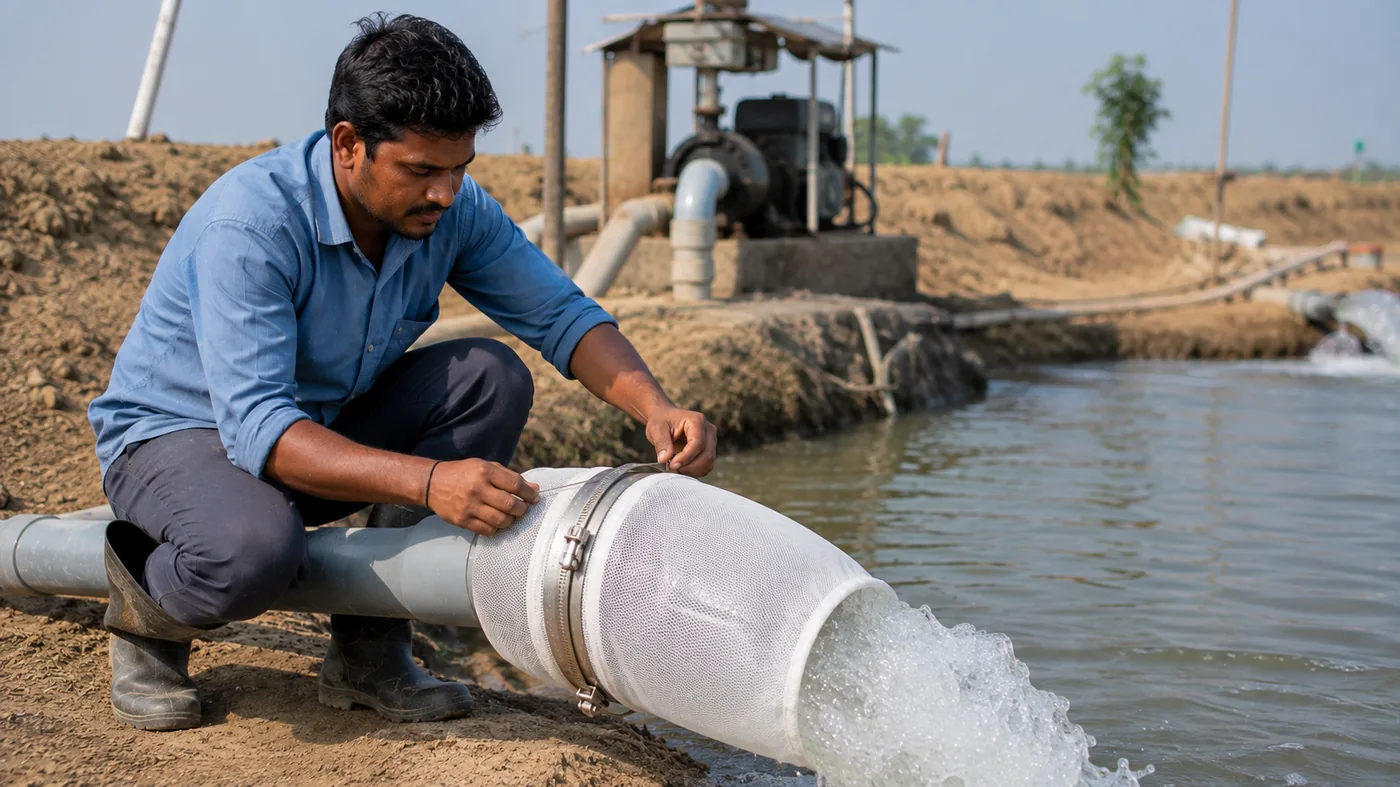
Executive Summary & Key Takeaways
- Over 70% of viral disease introductions (WSSV, EHP, IMNV) in coastal shrimp aquaculture originate from wild planktonic crustacean vectors pumped in during un-filtered estuarine intake operations.
- A 100-mesh (150 µm) pore aperture is the non-negotiable global biosecurity standard, mathematically sized to exclude microscopic crab zoeae (250–350 µm) and adult calanoid copepods (160–240 µm metasome width).
- Pumping raw water through a single fine bag causes rapid pore blinding, pressure surges (>2.5 bar), and catastrophic seam blowouts; engineering a three-tier telescopic system (20-mesh trash cage -> 60-mesh sleeve -> 100-mesh sock) ensures continuous high-flow filtration.
- Filter bags must be fabricated exclusively from 100% virgin monofilament nylon 6/6 bolting cloth with heat-set square apertures; avoid cheap multifilament cloth that stretches under pressure and traps bacteria.
- Secure filter bags behind a welded pipe spigot collar using heavy-duty 316 stainless steel T-bolt clamps, and support the water-filled bag in a smooth concrete plunge trough to prevent abrasive wear against dyke soil.
- Implement a dual-manifold rotation protocol with 6-to-8-hour bag washing cycles, including high-pressure inside-out washing, 50 ppm chlorine disinfection baths, and backlight table inspections for micro-tears.
Field Case Study: 8-Hectare Farm Intake Filtration Overhaul
An 8-hectare farm pumping from an estuarine creek suffered recurring WSSV crashes despite heavy pond bleaching. Microscopic analysis revealed that the farm was using single-layer, coarse 40-mesh wire screens that allowed microscopic crab zoeae (300 µm) and gravid Acartia copepods (180 µm) to pass directly into reservoirs. Under AquaSangham engineering advisory, the farm installed a three-tier telescopic manifold on its 10-inch delivery pipes: a 40-mesh primary trash basket, an outer 60-mesh sacrificial sleeve, and an inner 100-mesh monofilament nylon filter sock (4.5 meters length) secured with dual marine-grade 316 stainless steel T-bolt clamps. The farm instituted an 8-hour bag rotation and pressure-washing SOP. Plankton net sampling of intake water showed zero wild crustacean larvae entering the reservoir. Across 4 consecutive crops, the farm achieved 100% crop survival, harvesting 49.2 tons of Vannamei with an average FCR of 1.21 and saving ₹4.2 Lakhs in emergency chemical treatments.
1. The Physical Barrier Paradigm: Mechanical Filtration vs. Pathogens
In modern coastal aquaculture, biosecurity begins not at the pond edge with chemical disinfectants, but at the intake pump nozzle with physical mechanical filtration. Across the estuarine shrimp farming landscapes of Andhra Pradesh, Gujarat, Tamil Nadu, Odisha, and West Bengal, catastrophic viral epidemics—predominantly White Spot Syndrome Virus (WSSV), Enterocytozoon hepatopenaei (EHP), and Infectious Myonecrosis Virus (IMNV)—continue to devastate commercial crops. Comprehensive epidemiological studies conducted by the Central Institute of Brackishwater Aquaculture (ICAR-CIBA) and the Marine Products Export Development Authority (MPEDA) confirm that over 70% of viral introductions into culture ponds are directly mediated by wild estuarine crustacean vectors pumped into reservoirs and ponds during water intake operations.
A single liter of raw, unfiltered tidal creek water can contain hundreds of microscopic vectors: calanoid and cyclopoid copepods (Acartia, Oithona, Calanus, Pseudodiaptomus), planktonic mysid shrimp, wild larval sergestids (Lucifer hanseni), and swimming crab zoeae (Portunus pelagicus, Scylla serrata). These wild organisms are asymptomatic carriers and amplification hosts for WSSV and EHP. When pumped into an unprotected pond, a single gravid female copepod or a dozen wild crab zoeae will reproduce, die, and be consumed by foraging shrimp post-larvae, initiating an explosive viral replication cycle that liquidates standing biomass within 72 to 96 hours.
While chemical disinfection (chlorination) is a vital secondary sterilization barrier, relying on chemicals alone without rigorous prior mechanical filtration is an operational failure. Macro-vectors and zooplankton settle into anaerobic mud layers or shelter inside organic flocs where chemical oxidizers fail to achieve uniform lethal penetration. Furthermore, dead vector carcasses leave behind billions of intact, highly infectious viral nucleocapsids. Mechanical multi-mesh filtration acts as an absolute physical firewall, physically barring the entry of wild vectors, macro-parasites, and aquatic insects before they ever enter the farm ecosystem. This master technical guide details the aperture physics, biological vector sizing, multi-tier engineering designs, hydraulic clamping, and operational maintenance protocols for commercial aquaculture intake filtration.
The Vector Infiltration Mechanism
1. Viral Amplification: Wild estuarine copepods and crab larvae harbor sub-clinical WSSV and EHP titers. Once inside a nutrient-rich culture pond, they multiply rapidly, shedding viral particles into the water.
2. Chemical Shielding: Silt, organic mud, and living zooplankton consume chlorine rapidly, creating localized chemical dead zones where pathogens survive.
3. Physical Exclusion Priority: Intercepting living vectors at the intake eliminates the biological host entirely, ensuring that subsequent chemical chlorination operates on clean, clarified water.
| Mesh Count | Pore Aperture (µm) | Open Area (%) | Flow Capacity (m³/hr/m²) | Target Organisms Excluded | Back-Pressure Risk | Recommended Farm Application |
|---|---|---|---|---|---|---|
| 20 Mesh | 850 µm | 52% | 450 – 600 m³ | Floating debris, weed fish, adult crabs | Near Zero | Intake foot valve & pump trash cage |
| 40 Mesh | 400 µm | 44% | 350 – 480 m³ | Jellyfish, large mysids, shrimp fry | Very Low | Primary intake screen basket |
| 60 Mesh | 250 µm | 38% | 250 – 380 m³ | Adult mysids, Lucifer shrimp, crab megalopae | Low to Moderate | Intermediate protective outer sleeve |
| 100 Mesh | 150 µm | 34% | 140 – 220 m³ | Adult copepods, crab zoeae, barnacle cyprids | Moderate (Requires dual-tier) | Gold Standard: Primary vector exclusion |
| 150 Mesh | 100 µm | 30% | 80 – 140 m³ | Copepod nauplii, small larvae, large diatoms | High (Blinds rapidly) | Secondary reservoir polish & nursery hapas |
| 200 Mesh | 74 µm | 24% | 40 – 70 m³ | Micro-plankton, rotifers, dinoflagellates | Extremely High | Indoor SPF hatcheries & lab raceways |
Never compromise by using generic nylon mosquito netting or fishing nets on intake pipes. Mosquito nets have irregular, flexible apertures varying from 800 to 1,500 microns that allow crab zoeae and copepods to slip through effortlessly. Always insist on certified monofilament bolting cloth with calibrated square pore dimensions.
2. Mesh Geometry & Pore Aperture Physics: 60 vs. 100 vs. 150 Mesh
To select the appropriate filtration media, farm managers must understand the standardized relationship between Mesh Count (the number of openings per linear inch) and Pore Aperture (the actual physical clearance between adjacent threads, measured in microns [µm]):
- 1 Micron (µm) = 0.001 millimeters. A human hair averages 70 to 100 microns in diameter.
- 40 Mesh (approx. 400 to 420 µm aperture): Coarse screen designed solely to exclude small weed fish, macro-crabs, and floating debris. It provides zero protection against zooplankton vectors.
- 60 Mesh (approx. 250 µm aperture): Standard protective filter. Successfully blocks adult mysid shrimp, Lucifer shrimp, and late-stage crab megalopae. However, microscopic crab zoeae and adult copepods slip through unimpeded.
- 100 Mesh (approx. 150 µm aperture): The golden biosecurity benchmark for coastal shrimp aquaculture. A 100-mesh monofilament screen physically excludes all adult copepods, crab zoeae, barnacle cyprids, and wild crustacean larvae.
- 150 Mesh (approx. 100 µm aperture): Ultra-fine biosecurity screen. Excludes early copepod copepodite stages, barnacle nauplii, and large diatom chains. However, it exhibits a low open area percentage (~30%) and blinds rapidly in turbid waters.
- 200 Mesh (approx. 74 µm aperture): Micro-filtration screen used primarily in indoor SPF shrimp hatcheries and nursery raceways. Impractical for raw estuarine intake pumping due to near-instantaneous clogging.
Material Science: Monofilament vs. Multifilament: Filter bags must be fabricated exclusively from 100% virgin nylon 6/6 or polyester monofilament bolting cloth. Monofilament cloth consists of single, smooth, uniform synthetic filaments woven into a square grid with precision heat-set apertures. The smooth surface resists bacterial slime adhesion and can be cleaned easily with a water jet. In contrast, cheap multifilament cloth (made of twisted fibers, such as cotton canvas or recycled nylon sacks) features irregular, fibrous pores that trap silt internally, harbors pathogenic biofilms, blinds within minutes, and stretches under hydraulic pressure, expanding pore apertures and allowing vectors to bypass the filter.
Check your filter fabric under an inexpensive 40x pocket field microscope. Genuine monofilament bolting cloth exhibits perfectly identical, square pore windows with smooth fused intersections, whereas cheap synthetic cloth shows loose, fibrous threads that easily distort under fingertip pressure.
3. Biological Target Matching: Vector Size vs. Mesh Selection Matrix
Effective filtration requires matching mesh aperture sizes to the exact morphological dimensions of targeted estuarine vectors:
1. Brachyuran Crab Zoeae and Megalopae (Portunus pelagicus, Scylla serrata): Adult crabs are primary WSSV reservoirs. A single female mud crab releases 1 to 3 million microscopic swimming zoeae into estuarine waters. Zoeal Dimensions: Stage 1 zoeae possess a carapace width of 280 to 350 µm with dorsal and rostral spines extending total length to over 800 µm. Required Mesh: 60-mesh allows zoeae to pass under pump pressure. A 100-mesh (150 µm) bag provides 100% physical exclusion.
2. Planktonic Copepods (Acartia spinicauda, Oithona similis): Copepods are the most dangerous vectors in coastal aquaculture, harboring high titers of both WSSV and Enterocytozoon hepatopenaei (EHP) spores. Adult Dimensions: Body length 800 to 1,200 µm; metasome width 160 to 240 µm. Required Mesh: Adult copepods are completely excluded by 100-mesh (150 µm). Early naupliar stages (80–120 µm) require 150-mesh.
3. Sergestid Shrimp (Lucifer hanseni) and Mysids (Mesopodopsis orientalis): These hyper-abundant estuarine crustaceans swarm in coastal creeks during high tides. Body length 2.0 to 8.0 mm; width 400 to 800 µm. Required Mesh: Completely stopped by 60-mesh (250 µm).
During new moon and full moon spring tides, planktonic copepod and crab zoeal densities in coastal creeks surge by 300% to 500%. Schedule intake pumping during daytime hours on spring tides and reduce pump throttling slightly to minimize hydraulic pressure against the filter socks.
4. Multi-Tiered Telescopic Sock-Bag Engineering & Blowout Prevention
The single greatest failure point in aquaculture intake filtration is the 'Single-Bag Syndrome': clamping a single layer of fine 100-mesh cloth directly onto a high-output pump discharge pipe.
When raw, turbid estuarine water is pumped through a single fine bag at 300 to 500 cubic meters per hour, heavy sand, floating debris, and suspended organic matter strike the fine cloth simultaneously. Within 15 to 30 minutes, the fine pores blind completely. Internal hydrostatic pressure surges from a normal 0.2 bar to over 2.5 bar. The bag balloons violently, the longitudinal stitching rips open, or the bag blows off the pipe, instantly dumping thousands of trapped wild vectors directly into the reservoir.
The Three-Tier Telescopic Filtration Engineering Solution: To achieve high flow rates without blinding or blowouts, farm engineers must design a multi-tiered, cascading filtration manifold:
- Tier 1: Primary Coarse Trash Cage (20 Mesh / 850 µm): A rigid stainless steel 316 or heavy-gauge perforated PVC basket mounted directly over the pump intake foot-valve or primary discharge. This excludes sticks, jellyfish, fish, and large crabs.
- Tier 2: Secondary Intermediate Protective Sleeve (60 Mesh / 250 µm): An outer, heavy-duty monofilament sleeve (diameter 50 cm, length 3.5 meters) that intercepts sand, coarse silt, mysids, and Lucifer shrimp.
- Tier 3: Tertiary Vector-Exclusion Sock Bag (100 Mesh / 150 µm or 150 Mesh / 100 µm): The primary biosecurity core, fitted telescopically inside the 60-mesh sleeve. By removing coarse debris in Tiers 1 and 2, Tier 3 filters only fine water, extending continuous operating run-time from 20 minutes to over 6 to 8 hours without pressure surge.
Calculating Mandatory Filter Surface Area: Filter bag dimensions must be calculated based on pump discharge volume. The total open filtration area of the bag must be at least 15 to 20 times greater than the cross-sectional area of the discharge pipe: For an 8-inch (200 mm) delivery pipe (discharge capacity ~250 m³/hr), cross-sectional area is 0.031 m², requiring minimum 0.55 m² of active filter area (recommended bag: 40 cm diameter × 3.5 m length, delivering 4.4 m² surface area). For a 10-inch pipe (~400 m³/hr), use 50 cm diameter × 4.5 m length.
Construct your filter bags with triple-stitched flat-felled seams using heavy-gauge bonded nylon or PTFE thread. Never use cotton or polyester domestic stitching thread, which rots and bursts under continuous seawater hydraulic pressure within 10 days.
5. Installation Engineering, Clamping & Discharge Velocity Controls
Filter bags operating under high-output axial or mixed-flow pumps experience tremendous hydraulic shear forces. Improvising attachments with nylon rope, twine, or rubber tire strips is a hazardous practice that frequently results in bag detachment:
1. The Pipe Collar Spigot: Intake discharge pipes must feature an integrated external welded PVC retaining collar (a raised ring 15 mm high, positioned 10 cm from the pipe edge) or a barbed discharge nozzle. The collar creates a positive mechanical stop that prevents filter bags from slipping forward under pressure.
2. Marine-Grade Stainless Steel T-Bolt Clamps: Secure filter bags using heavy-duty 316 stainless steel T-bolt hose clamps (width 25 mm) fitted with high-torque tightening bolts. Never use perforated worm-gear hose clamps, which strip under high torque and cut through the nylon fabric.
3. Discharge Energy Dissipation: Never allow a pressurized filter bag to hang unsupported in mid-air or drag against rough earthen dyke soil. The abrasive friction of vibrating nylon against sand quickly wears holes through the fabric. Install a smooth, food-grade fiberglass or epoxy-lined concrete plunge trough directly beneath the discharge pipe. The trough supports the water-filled bag, absorbs hydraulic turbulence, and allows filtered water to cascade gently into the reservoir without eroding the earthen embankment.
Always wrap 2 to 3 layers of soft rubber mastic tape around the PVC pipe spigot before sliding on the filter bag sleeve and tightening the stainless steel clamp. The rubber tape provides positive mechanical grip and prevents metal-to-plastic slippage under intense hydraulic vibration.
6. Operational Maintenance: Bag Rotation, Washing & Disinfection
Even the highest quality 100-mesh filter bag becomes ineffective if biological maintenance is neglected:
- The Dual-Manifold Rotation System: Commercial intake pump stations must feature a dual-line delivery manifold fitted with isolation butterfly valves. When the active filter bag begins to blind and internal pressure rises, the operator opens the alternate line valve and closes the first, redirecting water flow to a fresh, clean filter bag without shutting down high-capacity diesel or electric pumps.
- Washing and Inversion Protocol: Blinded filter bags must be immediately unbolted, inverted inside-out, and washed down thoroughly using a commercial high-pressure water washer (80 to 120 bar) fitted with a fan-spray nozzle. Wash water must be directed outward, discharging trapped silt and vectors onto dry ground outside the farm dykes; never wash filter bags inside the culture pond or reservoir.
- Chemical Disinfection Soaking: Washing alone does not kill microscopic pathogen spores adhering to synthetic threads. Following pressure washing, bags must be submerged for 2 hours in a 200L plastic drum containing a 50 ppm active chlorine solution (150 g Calcium Hypochlorite per 100L water) or 200 ppm potassium permanganate. The disinfectant denatures any trapped WSSV virions or fungal spores.
- Solarization and Backlight Inspection: Hang disinfected bags on stainless steel drying racks in direct tropical sunlight for 24 hours. Once dry, technicians must inspect the bag against a bright light source (or backlight table) to verify that seams, stitching, and monofilament grids are 100% free of tears, needle-hole expansions, or mechanical snags. Any bag with an aperture defect exceeding 200 microns must be retired immediately.
Maintain a strict numbering and logging system for every filter bag on the farm. Mark each bag with a permanent barcode or ID tag on the reinforcement collar. Record the date of commissioning and retire bags after 250 hours of active pumping or 6 months of sun exposure to prevent sudden fabric fatigue blowouts.
7. Commercial Sourcing, Quality Benchmarks & Biosecurity ROI
From a financial perspective, investing in premium monofilament multi-mesh filtration delivers the highest return on investment (ROI) of any biosecurity infrastructure on a shrimp farm:
- Cost of Protection: Equipping a 10-hectare commercial farm with 6 commercial-grade virgin nylon 100-mesh filter bags, 316 stainless steel T-bolt clamps, and a dual-manifold plunge trough costs approximately ₹25,000 to ₹35,000.
- Cost of Failure: A single WSSV or EHP outbreak resulting from un-filtered creek water causes total crop liquidation, loss of post-larval seed investment, wasted feed, bleaching chemical costs, and months of lost production—a direct financial loss ranging from ₹18 Lakhs to over ₹45 Lakhs on a 10-hectare estate.
- Conclusion: Multi-mesh filtration is not an operational expense; it is the fundamental, low-cost mechanical insurance policy that guarantees crop biosecurity from Day 1 of water pumping.
When purchasing commercial filter bags, always verify technical specifications with your supplier: demand 100% virgin polyamide (Nylon 6/6), UV-stabilized, with certified warp and weft counts. Beware of cheap imported polyester bags that degrade rapidly when soaked in chlorine disinfection baths.
Summary Operational Action Checklist
Frequently Asked Questions
Q: Why is a 60-mesh filter bag insufficient to prevent White Spot Syndrome Virus (WSSV)?
A 60-mesh filter has an average pore aperture of 250 microns. While it successfully blocks large organisms like adult mysids and weed fish, the microscopic swimming zoeae of marine crabs (Portunus and Scylla)—which measure 280 to 350 µm in carapace width—can easily compress and squeeze through 250 µm pores under pump discharge pressure. Furthermore, adult calanoid copepods (Acartia) have metasome widths of only 160 to 220 µm. Since both wild crab zoeae and copepods are confirmed clinical carriers of WSSV, a 60-mesh bag allows millions of viral vectors into the pond. A 100-mesh (150 µm) filter is mandatory to provide true physical exclusion.
Q: What causes filter bags to balloon and blow out, and how does the telescopic design prevent it?
Filter bags balloon and rupture when fine pore apertures blind rapidly with suspended sand, colloidal silt, and jellyfish debris. As water flow is blocked, internal hydraulic back-pressure surges from a normal 0.2 bar to over 2.5 bar, ripping seams open or blowing the bag off the pipe. A multi-tier telescopic design solves this by placing an outer 60-mesh coarse sleeve around the inner 100-mesh fine sock, preceded by a 20-mesh trash cage. The coarse layers intercept heavy sand and debris, allowing the fine 100-mesh inner sock to filter only pre-clarified water without pore blinding or pressure spikes.
Q: What is the difference between monofilament nylon bolting cloth and ordinary multifilament filter cloth?
Monofilament cloth is woven from single, smooth, continuous synthetic strands (like fishing line) creating uniform, rigid, square apertures that do not stretch or distort under pressure. Smooth monofilament surfaces shed dirt easily during washing and resist bacterial biofilm formation. Multifilament cloth (such as canvas, cotton, or twisted polyester yarn) consists of braided bundles of microscopic fibers. These fibrous pores trap silt deep within the thread weave, stretch under water pressure (expanding pore sizes and letting vectors through), and cannot be thoroughly disinfected, becoming breeding grounds for Vibrio.
Q: How should blinded filter bags be cleaned and disinfected without damaging the nylon weave?
Blinded bags should never be beaten against stones or scraped with wire brushes, which damages thread intersections. Follow the 4-step SOP: 1) Unclamp and invert the bag completely inside-out, 2) Use a commercial high-pressure water washer (80 to 120 bar) with a wide 40-degree fan nozzle to blast trapped silt outward, 3) Submerge the clean bag in a 200L plastic drum containing a 50 ppm active chlorine solution for 2 hours to kill viral nucleocapsids and fungal spores, and 4) Rinse with fresh water, sun-dry for 24 hours, and inspect on a backlight table for tears.
Q: Can 150-mesh or 200-mesh filter bags be used directly on raw creek intake pumps?
No. While 150-mesh (100 µm) and 200-mesh (74 µm) offer ultra-fine filtration that excludes even early copepod nauplii, their open area percentage is very low (under 28% to 30%). When clamped directly onto high-output estuarine intake pumps (which carry heavy silt and organic debris), these ultra-fine bags blind completely within 10 to 15 minutes, causing pump overheating and immediate bag blowouts. 150-mesh should only be used as a secondary polish filter when transferring pre-settled water from Stage 1 to Stage 2 reservoirs, or in closed indoor nursery raceways.
AquaSangham Technical Advisory
Biosecurity Engineering & Mechanical Filtration Desk
Contributing Senior Technical Writer & Aqua Consultant at AquaSangham.
Recommended Farming Guides
Total Ammonia Nitrogen (TAN) Mass Balance Math: Sizing Biofilters in Commercial RAS
Read Article →Farming TechThe Recirculating Aquaculture System (RAS) Master Guide: Design, Hydraulics & Mass Balance
Read Article →Farming TechIndigenous Magur (Clarias batrachus) Induced Breeding & Nursery Rearing SOPs
Read Article →Get Live Farm Advice on AquaSangham Mobile App
Download India's #1 Aquaculture Super App for real-time market prices, precision tools, and community advice.
Download Free Android App