Key Operating Takeaways
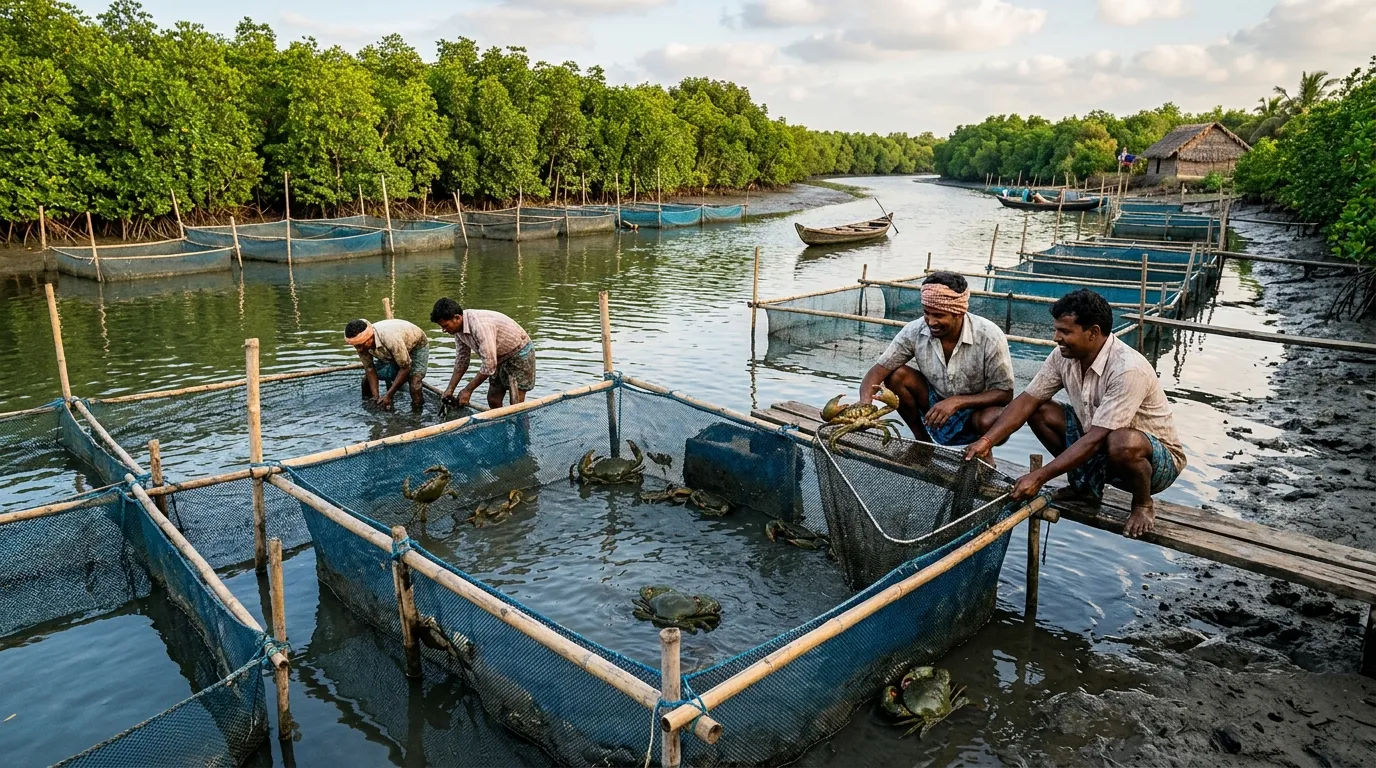
- Mud crab fattening (turning lean 'water crabs' into hard-shelled meat crabs) yields 100%+ ROI in just 21 to 28 days.
- Individual box systems and partitioned bamboo cages prevent cannibalism during molting.
- Feed low-cost trash fish, marine clams, and squid offal @ 5% to 8% body weight daily.
- Maintain water salinity between 15 and 30 ppt with regular tidal flushing.
1. Species Selection: Scylla serrata vs Scylla olivacea
Scylla serrata (Giant Green Mangrove Crab) grows up to 1.5–2.0 kg and commands premium live export prices in Singapore, Malaysia, and Hong Kong. Scylla olivacea (Orange/Brown Mud Crab) reaches 400g to 700g, ideal for domestic coastal trade.
2. Box Fattening vs Pond Grow-Out Systems
In box fattening systems, lean 'water crabs' (recently molted crabs with soft, watery meat) are placed in individual perforated plastic crab boxes in tidal ponds. Crabs are fed intensively for 21 to 30 days until the body cavity fills completely with solid muscle and orange egg mass (coral), doubling market value.
3. Trash Fish & Mollusc Feeding Protocols
Crabs are voracious carnivores. Feed fresh chopped trash fish, bivalve molluscs (clams), and slaughterhouse offal @ 5% body weight daily in late evening.
4. Salinity, Dissolved Oxygen & Water Quality
Maintain salinity at 15–28 ppt and DO > 4.0 mg/L. Mud crabs are sturdy but highly sensitive to hydrogen sulfide (H2S); ensure weekly tidal exchange.