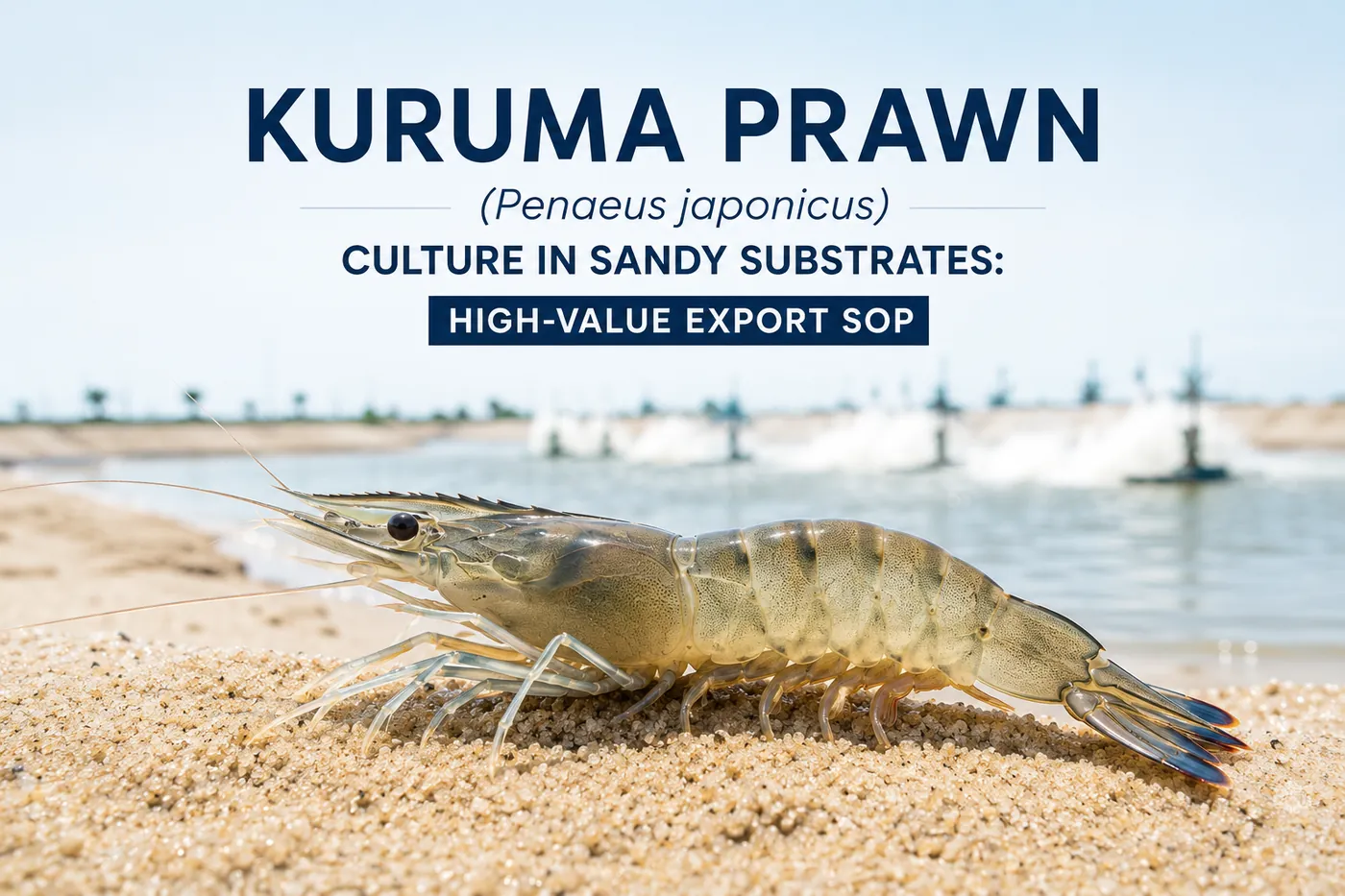
Executive Summary & Key Takeaways
- The Kuruma Prawn (Penaeus japonicus) is the world's most lucrative commercial penaeid species, commanding premium auction prices of $35 to $55 per kg in Japan's live sashimi, sushi, and Tempura markets.
- Penaeus japonicus is an obligate burrowing crustacean that spends daytime hours buried beneath 5 to 10 cm of clean, washed silica sand (grain size 0.2 to 0.5 mm); culturing without sand causes chronic stress, shell blackening, and zero survival.
- Optimal water quality requires oceanic, hyper-saline conditions (30 to 36 ppt), cool water temperatures (22°C to 28°C), high dissolved oxygen (> 5.5 ppm), and zero tolerance for bottom anaerobic sludge (H2S = 0.00 ppm).
- Nutritional formulations must contain 45% to 48% crude protein and 8% to 10% marine lipids, heavily enriched with fresh or freeze-dried marine polychaete worms (Nereis spp.), squid meal, and cholesterol.
- The revolutionary 12°C cold-hibernation protocol lowers prawn metabolic respiration to near zero, allowing live prawns to be packed in chilled, dry pine sawdust without water for 24 to 36-hour international air-freight transport with > 98% survival.
- While raceway infrastructure requires higher initial CAPEX (₹40 to ₹50 Lakhs/ha for sand filtration and chillers), individual crop net profit margins exceed ₹18 Lakhs per hectare—delivering full capital payback within 2.5 crop cycles.
Field Case Study: 4-Acre Sandy-Substrate Kuruma Raceway Mariculture
A precision mariculture enterprise in the Mandvi coastal corridor engineered four 0.4-hectare concrete raceways layered with 12 cm of washed silica sand, utilizing 34 ppt deep-sea intake water. By sourcing SPF Penaeus japonicus post-larvae, feeding 46% high-protein polychaete-fortified diets, maintaining bottom sand fluidization through subsurface aeration pipes, and chilling prawns to 12°C for dry pine-sawdust live packing, the farm exported 4.8 metric tons of live sashimi-grade Kuruma prawns to Tokyo's Toyosu and Osaka central wholesale markets. Realizing an average net price of ₹2,150/kg, the operation generated a record net profit of ₹18,40,000 per hectare.
1. The Tokyo Live Auction Market: Why Kuruma Prawns Command $40+/kg Sashimi Realizations
In the hierarchy of global seafood gastronomy, the Kuruma Prawn (Penaeus japonicus), known in Japan as 'Odori Ebi' (dancing prawn) or 'Kuruma-ebi', occupies the absolute pinnacle of commercial value. Unlike standard commodity shrimp (such as Vannamei or Monodon) that are traded frozen in mass container loads for $5 to $10/kg, live Kuruma prawns are sold individually at premier seafood auctions such as Tokyo's Toyosu Market and Osaka Central Wholesale Market at premium prices ranging from $35.00 to $65.00 per kilogram (₹2,900 to ₹5,400/kg).
Japanese culinary traditions demand live presentation for high-end Edomae sushi and authentic tempura. The living prawn is admired for its striking aesthetic morphology—alternating dark chocolate-brown zebra stripes across a creamy porcelain carapace, radiant lemon-yellow abdominal bands, and iridescent electric-blue trim along the caudal uropods (tail fan). When prepared raw as sashimi, the meat delivers a crisp, firm muscular crunch followed by an explosion of natural sweetness derived from dense concentrations of free glycine, betaine, and glutamic acid.
Domestic wild fisheries and coastal aquaculture in Japan, Taiwan, and Australia produce less than 3,500 metric tons annually, creating a massive, year-round supply deficit. Coastal regions in India—specifically the high-salinity oceanic corridors of Gujarat (Kutch and Saurashtra), Tamil Nadu (Ramanathapuram and Tuticorin), and the Andaman Islands—possess ideal environmental parameters to emerge as the world's premier export hub for live sashimi-grade Kuruma prawns.
Market Specifications & Grading Standards
Live export markets categorize Kuruma prawns into three strict commercial grades: Super Jumbo (40g+ / 20–25 count), Jumbo (30 to 38g / 28–32 count), and Standard Sashimi (25 to 30g / 35–40 count).
Prawns must arrive 100% alive, fully active, with zero broken antennae, intact rostral spines, and flawless exoskeleton pigmentation. Even minor shell melanosis or limpness results in immediate price downgrades of 60%.
| Seafood Market Tier | Primary Export Destination | Target Size (g) | Target Price FOB ($/kg) | Farmgate Realization (₹/kg) |
|---|---|---|---|---|
| Live Auction / Toyosu Top-Grade | Tokyo, Osaka, Kyoto (Japan) | 32 – 42 g (Live) | $ 42.00 – 58.00 | ₹ 2,200 – 2,800 / kg |
| Live High-End Foodservice | Taipei, Kaohsiung (Taiwan) | 28 – 35 g (Live) | $ 34.00 – 44.00 | ₹ 1,800 – 2,200 / kg |
| Live Casino & Resort Dining | Macau, Hong Kong, Singapore | 30 – 40 g (Live) | $ 36.00 – 48.00 | ₹ 1,900 – 2,400 / kg |
| IQF Blast-Frozen Sashimi (HOSO) | Seoul (South Korea), EU | 30 – 38 g (Frozen) | $ 18.00 – 24.00 | ₹ 1,200 – 1,500 / kg |
| Standard Commercial Vannamei | Global Mass Commodity | 25 – 30 g (Frozen) | $ 4.80 – 6.20 | ₹ 380 – 460 / kg |
Target live shipments during key Japanese festival peak windows: Obon festival (August), Year-End corporate banquets (December), and New Year celebrations (January), when auction prices regularly surge past $55 to $65 per kg FOB.
2. Burrowing Biology & Sandy Substrate Engineering: Grain Size, Sand Fluidization & Bio-fouling Prevention
Understanding the specialized behavioral ecology of Penaeus japonicus is the absolute prerequisite for successful commercial mariculture. Unlike pelagic penaeids that swim continuously in the water column, Kuruma prawns are strictly fossorial (burrowing) organisms. In nature, adult Kuruma prawns remain completely buried in sandy seabed sediments throughout the daylight hours, using their uropods and pleopods to dig backwards into the sand until only their stalked compound eyes and antennal scales protrude.
If cultured in standard muddy earthen ponds or bare concrete tanks, Kuruma prawns suffer severe chronic physiological stress. In the absence of a sandy substrate, prawns experience constant swimming exhaustion, erratic jump-collisions against tank walls, antennal abrasion, bacterial shell necrosis, and near-total mortality within 30 days. Prawns must be provided with a permanent 10 to 15 cm deep layer of washed, round-grained silica sand across the pond or raceway bottom.
Sand selection is critical: use washed quartz silica sand with a grain diameter strictly between 0.2 mm and 0.5 mm (fine to medium sand). Coarse gravelly sand (> 1.0 mm) damages the delicate abdominal cuticle during burrowing, while fine silty clay (< 0.1 mm) compacts into an impenetrable, anaerobic layer that suffocates the buried prawns.
Subsurface Sand Fluidization & Bio-Filter Aeration
To prevent organic feces and uneaten feed from decaying beneath the sand, install a subsurface perforated pipe grid (25 mm UPVC pipes spaced 1.0m apart with 1.0 mm laser-drilled orifices) beneath the sand layer.
Inject filtered seawater and low-pressure air (from Roots blowers) through the subsurface grid for 15 minutes twice daily. This gentle bottom-up fluidization lifts organic fines into the water column for surface skimming and keeps the sand bed oxygenated (Redox potential > +150 mV), preventing toxic black-sand hydrogen sulfide (H2S) formation.
| Substrate Parameter | Optimal Specification | Unacceptable / Toxic Condition | Operational Risk |
|---|---|---|---|
| Sand Grain Size | 0.20 mm – 0.50 mm (Washed Silica) | < 0.10 mm (Silt) or > 1.2 mm (Gravel) | Cuticle abrasion or sediment compaction |
| Sand Bed Thickness | 10 – 15 cm continuous layer | < 5 cm (Shallow exposure) | Prawns cannot burrow; stress & cannibalism |
| Sand Bed Redox (ORP) | + 120 mV to + 250 mV | < - 50 mV (Anaerobic black sand) | Lethal H2S generation & gill melanosis |
| Silt / Clay Fraction | < 1.5% by weight | > 5.0% organic silt | Clogs gill lamellae; mortality during molt |
| Fluidization Cycle | 15 mins twice daily (08:00 & 16:00) | Zero bottom fluidization | Organic matter traps beneath sand bed |
Test sand cleanliness weekly using the core syringe test: draw a 10 cm sand core from the tank bottom. If the lower sand shows any black sulfide discoloration or sulfur odor, immediately increase sand fluidization duration and dose specialized sulfur-oxidizing Paracoccus denitrificans bacteria.
3. Oceanic Water Quality Management: High Salinity (32 to 38 ppt), Low Temperature & Dissolved Oxygen Dynamics
Penaeus japonicus is an oceanic marine species that evolved in pristine, hyper-saline coastal bays and open marine waters. It possesses minimal tolerance for estuarine salinity fluctuations or elevated organic nutrient loads. Culture facilities must operate on pristine deep-sea intake water filtered through multi-media pressurized sand filters and UV sterilizers.
Salinity must be maintained strictly between 32 and 36 ppt (tolerating up to 38 ppt). Salinity drops below 28 ppt cause immediate osmotic swelling, lethargy, loss of carapace firmness, and suppressed appetite. Total alkalinity must be buffered between 130 and 160 ppm CaCO3 using sodium bicarbonate (NaHCO3) and pure dolomite.
Temperature control is another critical operational parameter. While tropical vannamei thrives at 30°C to 33°C, Kuruma prawns prefer cooler subtropical water temperatures between 22°C and 27°C. When water temperatures exceed 30°C, Kuruma prawns exhibit elevated metabolic respiration, reduced burrowing, premature soft-shell molting, and vulnerability to Vibrio nigrifaciens black spot disease. Mariculture raceways utilize shade netting (80% thermal block) and deep 1.5 to 1.8m water columns to buffer summer surface heat.
Dissolved Oxygen & Continuous Water Flow SOP
Buried Kuruma prawns draw oxygenated water downward through their sand burrow channels using rhythmic scaphognathite (gill bailer) movements. If bottom dissolved oxygen drops below 4.5 ppm, prawns are forced out of the sand during daylight, exposing them to stress.
Maintain continuous dissolved oxygen strictly above 5.5 to 6.5 ppm at the sand-water interface. Concrete raceways and circular mariculture tanks operate on a continuous flow-through or recirculating aquaculture system (RAS) basis, maintaining a 200% to 300% daily water exchange rate with centralized protein skimmers.
Install continuous optical dissolved oxygen probes 5 cm above the sand bed linked to automated liquid oxygen injection systems. If bottom DO drops below 5.0 ppm, micro-bubble oxygen diffusers automatically engage to safeguard buried stock.
4. Specialized 45–48% Crude Protein Nutrition: Polychaete Worms, Squid Liver & Sinking Paste Feeds
The nutritional biology of Penaeus japonicus is strictly carnivorous and specialized. In nature, buried Kuruma prawns feed almost exclusively on live benthic polychaetes (sand worms), small bivalve mollusks, and amphipods that crawl across the nocturnal sand substrate. To sustain rapid growth and develop the rich, sweet free-amino-acid profile demanded by sashimi chefs, formulated diets must deliver 45% to 48% crude protein and 8% to 10% crude lipid.
Commercial feeds incorporate premium marine animal ingredients: low-temperature Chilean fish meal (35–40%), defatted marine squid liver powder (15–20%), freeze-dried polychaete meal (Nereis virens / Marphysa @ 8–12%), krill meal (5%), and refined fish oil / marine phospholipids (6%). Synthetic cholesterol (0.5%) and astaxanthin (80 ppm) are mandatory to ensure complete hormonal ecdysis and vibrant red-orange post-cook pigmentation.
Because Kuruma prawns remain buried during daylight, 100% of the daily feed ration must be applied during darkness across 3 nocturnal meals: 40% at 19:00 PM (dusk emergence), 35% at 23:30 PM (midnight grazing), and 25% at 04:00 AM (pre-burrowing meal). Use dense sinking extruded pellets (1.8 to 2.5 mm) with extraordinary water stability (> 4 hours).
Live Polychaete Conditioning Protocol (Final 30 Days)
During the final 30 days of grow-out (DOC 115 to 145), supplement pelleted feed twice weekly with live farmed marine polychaete worms (5% biomass rate).
Live worm feeding stimulates intense predatory feeding, cleanses the digestive hepatopancreas, and elevates muscle glycine and betaine concentrations, guaranteeing an unmatched sashimi flavor profile that commands top-tier auction bids.
| Culture DOC Window | Prawn ABW (g) | Feed Pellet Size | Crude Protein (%) | Daily Feed % Biomass | Nocturnal Feeding Schedule |
|---|---|---|---|---|---|
| DOC 1 – 30 (Nursery) | 0.02 – 2.0 g | Starter Crumble #1 | 48% CP (Polychaete rich) | 10.0% – 6.0% | 19:00 (50%), 23:00 (50%) |
| DOC 31 – 60 (Early) | 2.1 – 8.5 g | Pellet 1.4 – 1.6 mm | 46% – 48% CP | 5.5% – 4.0% | 19:00 (40%), 23:30 (35%), 04:00 (25%) |
| DOC 61 – 100 (Mid) | 8.6 – 18.0 g | Pellet 1.8 – 2.0 mm | 45% – 46% CP | 3.8% – 2.8% | 19:00 (40%), 23:30 (35%), 04:00 (25%) |
| DOC 101 – 145 (Finishing) | 18.1 – 35.0+ g | Pellet 2.2 mm + Live Worms | 45% CP + Live Feed | 2.5% – 1.8% | 19:00 (40%), 23:30 (35%), 04:00 (25%) |
Top-dress daily feeds with fresh squid oil (20 mL/kg) and natural Betaine attractant (5 g/kg). Betaine activates the chemosensory antennules of buried prawns, inducing immediate, synchronized emergence from the sand within 5 minutes of feed broadcasting.
5. Raceway and Circular Tank SOPs: Bottom Water Velocity, Waste Centralization & Siphon Purging
Commercial Kuruma prawn mariculture is conducted in specialized concrete raceways (typically 40m length × 5m width × 1.6m depth) or circular HDPE-lined tanks (15m to 20m diameter) engineered with central drainage drains and directional water inlet jets.
Water inlet nozzles are positioned along the raceway walls to maintain a continuous, laminar water velocity of 0.08 to 0.12 m/s. This gentle rotational current is calibrated to sweep light organic fecal particles and uneaten feed debris across the surface of the sand bed toward a central bottom drain pit, without displacing or eroding the 12 cm silica sand layer.
Stocking densities in intensive sand raceways range from 35 to 55 post-larvae (PL15) per square meter. Prawns are stocked at early dawn following careful 2-hour temperature and salinity acclimation. Once released, healthy post-larvae immediately swim downward and burrow into the sand substrate within 30 seconds.
Daily Siphon & Central Drain Purge SOP
Operate the central bottom drain purge valve for 30 seconds every morning at 07:30 AM (after prawns have burrowed for the day). This flushes all accumulated fecal solids out of the tank before decomposition can impact water quality.
Twice weekly, farm technicians use a specialized venturi siphon wand to vacuum detritus from tank perimeter corners, maintaining immaculate cleanliness across the sand surface.
Maintain continuous dim, blue-green ambient illumination (0.5 to 1.0 lux) over raceways during night feeding hours. This natural moonlight spectrum stimulates synchronized foraging activity without triggering alarm-escape jumping.
6. The 12°C Hibernation Protocol: Dry Sawdust Packaging, Air-Freight Logistics & 98%+ Live Survival
The greatest technological breakthrough enabling high-value live Kuruma prawn export is the 'Dry Cold Hibernation Protocol'. Unlike other shrimp species that suffocate outside water within minutes, Penaeus japonicus possesses rigid, heavily gill-shielded branchial chambers that can retain oxygenated moisture for up to 48 hours if the prawn's metabolic respiration rate is artificially depressed through controlled cooling.
Harvesting is conducted at night (22:00 to 02:00) using gentle beam-trawl nets fitted with soft rubber tickler chains that lift buried prawns out of the sand without abrasive injury. Harvested prawns are immediately transferred to clean, aerated holding tanks maintained at ambient temperature (24°C) for 1 hour to recover from netting stress.
Prawns are then transferred into a multi-stage computerized cooling bath: water temperature is lowered gradually from 24°C down to 12°C at a precise cooling rate of 2.0°C every 30 minutes. At 12°C to 13°C, Kuruma prawns enter a state of complete metabolic dormancy (torpor)—their heart rate drops from 120 bpm to under 15 bpm, pleopod movement ceases, and oxygen consumption drops by over 92%.
Dry Pine Sawdust Packaging SOP
Dormant prawns are lifted from the chill bath, gently drained, and packed into insulated expanded polystyrene (EPS) boxes layered with dry, chilled (10°C), sterilized Cryptomeria pine or cedar sawdust.
Prawns are arranged in neat rows separated by 3 cm layers of sawdust, with frozen gel ice-packs secured in the box lid to maintain an internal temperature of 10°C to 12°C. The dry sawdust absorbs external moisture, prevents physical contact between prawns, and maintains a humid micro-atmosphere. Packed boxes are air-freighted under temperature-controlled cargo to Tokyo Narita or Osaka Kansai airports within 24 to 30 hours, achieving verified live survival rates above 98%.
| Packaging Step | Temperature Target | Material / Medium | Operational Objective | Critical Quality Control |
|---|---|---|---|---|
| Pre-Harvest Fasting | 24°C ambient | Clean filtered seawater | Complete gastric evacuation (6 hrs) | Prevents bacterial foul during shipment |
| Multi-Stage Chilling | 24°C down to 12°C | Computerized water chiller | Induce metabolic dormancy / torpor | Cooling rate max 2.0°C / 30 mins |
| Sawdust Pre-Cooling | 10°C – 11°C | Sterilized pine/cedar sawdust | Thermal buffer & humidity matrix | Must be dry, sifted & resin-free |
| EPS Box Packing | 10°C – 12°C internal | Insulated EPS box + Gel packs | Layer prawns in alternating rows | 2.0 kg prawns per 5-liter box |
| Air-Freight Transit | 10°C – 14°C cargo hold | Direct temperature-controlled flight | Door-to-door delivery < 30 hrs | 98%+ live awakening rate at auction |
Upon arrival at the destination seafood auction in Tokyo, wholesalers unpack the dormant prawns and submerge them in aerated 18°C seawater; within 5 to 10 minutes, the prawns fully awaken, restore normal swimming activity, and are auctioned as live 'Odori Ebi' at peak prices.
7. Commercial Mariculture Economics: 1-Hectare Sandy Raceway Capital CAPEX & ROI Breakdown
Commercial Kuruma prawn mariculture represents a high-capital, ultra-high-return enterprise. Below is an authentic financial model for a 1.0-hectare precision mariculture facility comprising eight 0.125-ha concrete sandy raceways (total water spread area 10,000 m²), stocked with 450,000 SPF post-larvae (45 PL/m²), harvested at DOC 145 with a 75% survival rate and an average body weight of 32.0 grams, yielding 10,800 kg of live sashimi-grade prawns.
Initial capital expenditure (CAPEX) for concrete raceway construction, washed silica sand filtration beds, subsurface fluidization piping, commercial water chillers, and automated packing equipment totals approximately ₹48,00,000 per hectare (depreciated over 10 years at ₹4,80,000/year). Operational expenditures (OPEX) including SPF seed, 46% protein feed, live polychaete conditioning, electricity, air-freight logistics, and packing total ₹1,12,40,000 per crop.
At an average realized export price of ₹2,100 per kg ($25.00/kg net after freight and Tokyo auction commission), gross commercial revenue reaches ₹2,26,80,000. After deducting total OPEX and annualized CAPEX depreciation, net farm profit stands at ₹1,09,60,000 per single crop cycle (ROI > 97% per crop), delivering full capital payback within 1.5 crop cycles.
Financial Comparison: Kuruma Prawn vs Vannamei
The table below illustrates the unmatched profit realization of live Kuruma prawn mariculture. While operational rigor and live cold-chain logistics are demanding, the profit generated from 1 hectare of Kuruma prawns equals that of 6 to 8 hectares of intensive commodity Vannamei farming.
| Financial Line Item | Kuruma Prawn Live Export (1.0 Ha Raceway) | Standard Commodity Vannamei (1.0 Ha Earthen) | Commercial Variance |
|---|---|---|---|
| Post-Larvae Seed OPEX | 4,50,000 PLs (@ ₹1.40 = ₹ 6,30,000) | 5,00,000 PLs (@ ₹0.40 = ₹ 2,00,000) | Higher seed cost for SPF Kuruma |
| Formulated Feed & Live Worms | 15,336 kg feed + Worms (₹ 24,50,000) | 13,500 kg feed @ ₹88 (₹ 11,88,000) | Premium 46% CP feed + polychaetes |
| Electricity, Chillers & Oxygen | ₹ 18,50,000 (Raceway power & cooling) | ₹ 3,80,000 (Paddlewheel aeration) | Higher power for chillers & filtration |
| Sawdust, Packaging & Air-Freight | ₹ 38,80,000 (Tokyo air-freight logistics) | ₹ 0 (Sold at pond bank) | Direct international cold-chain air cargo |
| Labor, Management & Compliance | ₹ 24,30,000 (Specialized technicians) | ₹ 6,50,000 | High-precision operational labor |
| Total Operational Cost (OPEX) | ₹ 1,12,40,000 | ₹ 24,18,000 | Capital-intensive export OPEX |
| Total Harvest Biomass | 10,800 kg (32g avg / Live Export) | 10,000 kg (25g avg / Frozen Pond-Bank) | Comparable biomass volume |
| Average Realized Price | ₹ 2,100 / kg (Live Tokyo Auction) | ₹ 410 / kg (Frozen Domestic Factory) | + ₹ 1,690 / kg gross realization (+412%) |
| Gross Commercial Revenue | ₹ 2,26,80,000 | ₹ 41,00,000 | + ₹ 1,85,80,000 gross revenue |
| Net Farm Profit / Hectare | ₹ 1,09,60,000 / crop (ROI: 97.5%) | ₹ 16,82,000 / crop (ROI: 69.5%) | + ₹ 92,78,000 (+551% net profit!) |
Partner directly with accredited Japanese live seafood import houses through the AquaSangham Live Trade Desk to secure guaranteed seasonal Letter of Credit (LC) purchase contracts with advance price floors before stocking raceways.
Summary Operational Action Checklist
Frequently Asked Questions
Q: Why do Kuruma prawns require a sandy substrate for aquaculture?
Penaeus japonicus is an obligate burrowing crustacean that spends daylight hours buried beneath 5 to 10 cm of sand to avoid predators and metabolic fatigue. In bare tanks or muddy ponds, the prawns suffer chronic stress, exhaust themselves swimming, develop shell abrasions and bacterial necrosis, and fail to survive.
Q: How can live Kuruma prawns survive transport in dry sawdust without water?
Through the 12°C Cold Hibernation Protocol, the prawn's body temperature is lowered to induce metabolic dormancy (torpor). In this state, oxygen consumption drops by over 92%. The prawn's rigid gill chambers trap moisture from the pre-chilled, damp pine sawdust, allowing it to survive for 24 to 36 hours during international air-freight transport.
Q: What is the optimal water salinity and temperature for Penaeus japonicus?
Kuruma prawns require high-salinity oceanic seawater between 32 and 36 ppt. Salinities below 28 ppt cause osmotic stress. Optimal water temperature ranges from 22°C to 27°C; temperatures above 30°C cause thermal distress, reduced burrowing, and elevated mortality.
Q: What protein level is required in Kuruma prawn feed?
Kuruma prawns are strictly carnivorous and require 45% to 48% crude protein and 8% to 10% crude lipid diets enriched with marine squid liver, fish meal, krill, cholesterol, and marine polychaete worms. Feeding must occur exclusively at night across 3 meals as prawns remain buried all day.
AquaSangham Market Intelligence
High-Value Mariculture & Live Seafood Export Division
Contributing Senior Technical Writer & Aqua Consultant at AquaSangham.
Recommended Farming Guides
Western Blue Shrimp (Penaeus stylirostris) Intensive Culture: Lessons from New Caledonia
Read Article →Farming TechGreen Tiger Prawn (Penaeus semisulcatus) Culture Protocols for Gulf of Mannar Coastal Ponds
Read Article →Farming TechGiant Freshwater Prawn (Macrobrachium rosenbergii / Scampi) Hatchery to Harvest SOP
Read Article →Get Live Farm Advice on AquaSangham Mobile App
Download India's #1 Aquaculture Super App for real-time market prices, precision tools, and community advice.
Download Free Android App