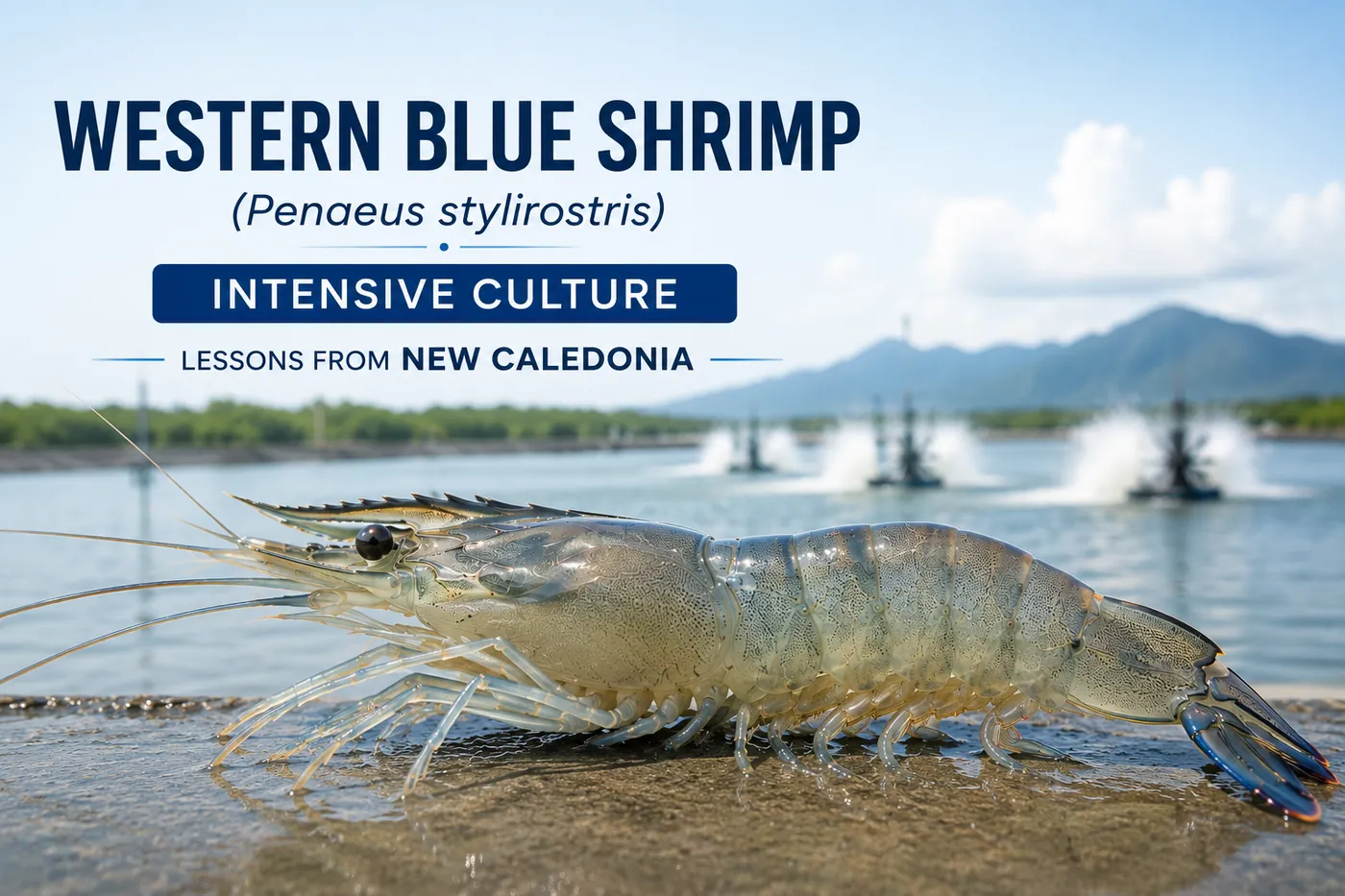
Executive Summary & Key Takeaways
- The Western Blue Shrimp (Penaeus stylirostris) is a premier penaeid species renowned for rapid growth, robust cold-water tolerance (18°C to 32°C), and firm, sweet-tasting meat highly prized in sashimi and fine-dining markets.
- New Caledonia pioneered the world's most successful captive domestication program, developing 35+ generations of Specific Pathogen Resistant (SPR) 'Super-Shrimp' completely immune to Infectious Hypodermal and Hematopoietic Necrosis Virus (IHHNV).
- Unlike Litopenaeus vannamei, which becomes lethargic and stops feeding when pond water temperatures drop below 23°C, P. stylirostris continues active grazing and growth at 18°C–22°C, making it an ideal winter-crop candidate for northern and central Indian coastal belts.
- Stylirostris thrives on lower protein dietary formulations (32% to 36% CP) supplemented with high-quality marine phospholipids (cholesterol 0.4–0.6%, lecithin 1.5%), reducing nitrogenous waste discharge by up to 22% compared to Asian tiger shrimp feeds.
- Strict biosecurity, zero-antibiotic certification, low-density nursery staging (Phase-1 indoor raceways), and oceanic water exchange are mandatory to prevent seasonal vibriosis (Syndrome 93 / Vibrio penaeicida).
- For Indian aquaculture entrepreneurs, P. stylirostris represents a transformative diversification opportunity to escape the global low-price commodity trap of Vannamei and tap into ultra-premium niche export markets in Japan, France, and North America.
Field Case Study: 4-Hectare High-Density Lined Raceway Pilot
A commercial marine aquaculture estate operating 8 HDPE-lined raceway ponds (0.5 ha each) stocked 32nd-generation SPF/SPR Blue Shrimp (Penaeus stylirostris) at 42 PL/m². Despite sub-tropical winter temperatures dropping to 20.5°C where tropical white shrimp cease feeding, the stylirostris stock maintained steady specific growth rates (SGR of 1.72%/day) on a specialized 34% CP marine-phospholipid extruded diet. Utilizing central sludge siphons, bottom dissolved oxygen levels maintained above 5.8 ppm, and zero prophylactic antibiotics, the facility harvested 47.1 metric tons across 118 DOC. Packed in ultra-rapid nitrogen cryogenic IQF master cartons for direct air-freight to Tokyo and Paris gourmet seafood distributors, the crop realized an average farmgate price of $31.50/kg (approx. ₹2,610/kg), delivering net profit margins exceeding 44% above operational expenditure.
1. The Domestication Journey: How New Caledonia Created the 'Super-Shrimp' SPR Lineage
The Western Blue Shrimp (Penaeus stylirostris, formerly Litopenaeus stylirostris) is native to the Eastern Pacific coastline from the Gulf of California down to Peru. In the 1970s and 1980s, the global shrimp farming industry was devastated by Infectious Hypodermal and Hematopoietic Necrosis Virus (IHHNV). In wild and unselected stocks of P. stylirostris, IHHNV caused catastrophic acute mortality rates exceeding 90%, driving commercial hatcheries across Central and South America to abandon the species in favor of the more tolerant Litopenaeus vannamei.
However, French overseas territory researchers from IFREMER (French Research Institute for Exploitation of the Sea) stationed in New Caledonia took a revolutionary scientific gamble. Rather than abandoning stylirostris, they isolated the few surviving individuals from disease outbreaks and established a closed-cycle, family-based selective breeding program in the pristine coral-lagoon environment of New Caledonia.
Over 35 consecutive generations of strict pedigreed breeding under zero-antibiotic conditions, New Caledonian geneticists developed the famous 'Super-Shrimp'—a fully domesticated, Specific Pathogen Resistant (SPR) strain of Penaeus stylirostris. This strain demonstrated 100% genetic resistance to IHHNV, complete freedom from TSV (Taura Syndrome Virus), and remarkable physiological vigor.
Today, New Caledonia's boutique aquaculture industry produces approximately 2,000 metric tons annually of P. stylirostris, branded internationally as 'Obsiblue' and 'Crevette de Nouvelle-Calédonie'. It is the only shrimp species in the world to be awarded the prestigious French government 'Label Rouge' quality certification, served in three-star Michelin restaurants in Paris and Tokyo at wholesale prices 4 to 5 times higher than standard commercial white shrimp.
Key Genetic Benchmarks of the SPR Domestication Lineage
Complete IHHNV Immunity: Through generations of viral challenge and marker-assisted selection, the SPR stylirostris genome possesses stable inherited resistance that halts IHHNV viral replication inside cellular nuclei.
Broad Genetic Diversity: To avoid inbreeding depression across 35+ closed generations, broodstock mating matrices utilize genealogical tracking of over 120 distinct maternal and paternal families.
Uniform Growth & High Meat Yield: The domesticated strain exhibits a highly predictable growth curve, reaching 30 to 35 grams in 110 to 125 days with an exceptional edible meat-to-shell ratio of 64% (compared to 58% in standard commercial penaeids).
2. Viral Genetics & Biosecurity: Overcoming IHHNV, TSV, and Seasonal 'Syndrome 93'
Understanding the pathology of Penaeus stylirostris is essential for any farm operator planning intensive culture. While the domesticated SPR strain is entirely impervious to IHHNV, the species possesses distinct immunological sensitivities compared to L. vannamei and P. monodon.
The most critical seasonal health challenge documented in New Caledonian mariculture is 'Syndrome 93' (also termed Summer Syndrome or Cold-Shock Vibriosis). This pathology is caused by virulent strains of Vibrio penaeicida and Vibrio nigripulchritudo. These opportunistic pathogens strike primarily during rapid temperature transitions—such as the sudden drop from 28°C to 20°C during autumn, or severe cold fronts accompanied by heavy rainfall.
When water temperatures fluctuate abruptly, the shrimp's total hemocyte count (THC) and phenoloxidase (PO) enzyme activity drop by 35% to 50%, creating a window of immunosuppression. Vibrio bacteria penetrate the cuticular epithelium and multiply rapidly in the lymphoid organ and connective tissues, causing focal melanization, cloudy muscle opacity, and lethargy.
Comprehensive Viral & Bacterial Susceptibility Matrix
IHHNV (Parvovirus): 100% Resistant in certified SPR domesticated lines. Zero clinical pathology or 'Runt Deformity Syndrome' (RDS).
WSSV (White Spot Syndrome Virus): Susceptible. Requires strict physical biosecurity, crab fencing, double-layer water filtration (60-mesh intake + 150-mesh final bag), and zero-exchange reservoir aging.
Vibrio penaeicida (Syndrome 93): Opportunistic in temperature-stressed animals. Controlled via continuous probiotic priming (Bacillus subtilis and B. licheniformis @ 1.5 ppm twice weekly) and strict organic sediment siphoning.
EHP (Enterocytozoon hepatopenaei): Moderately susceptible. Broodstock must be strictly SPF-quarantined with real-time PCR verification of fecal and tissue samples.
To prevent Syndrome 93 during cold fronts, avoid all pond water exchanges 48 hours before and after a temperature drop. Dose stabilized beta-glucans (2.0 g/kg feed) and spray-dried spirulina (10.0 g/kg feed) into the morning feed 7 days prior to forecasted winter cold fronts to boost circulating hemocyte phagocytic capacity.
3. Subtropical Thermal & Salinity Dynamics: Thriving in 18°C–32°C and Oceanic Salinities
One of the single greatest physiological advantages of Penaeus stylirostris over Litopenaeus vannamei is its extraordinary tolerance for lower water temperatures. In major Indian aquaculture hubs like Gujarat, West Bengal, Odisha, and coastal Andhra Pradesh, winter water temperatures regularly dip to 19°C–22°C between November and February.
Under these conditions, L. vannamei experiences severe metabolic slowdown: feed intake plummets by 60% to 80%, molt intervals double from 12 days to 26 days, and FCR surges past 1.95, forcing most farmers to leave ponds fallow or risk disastrous crop losses.
In sharp contrast, Penaeus stylirostris evolved in the deep, oceanic, and subtropical waters of the Pacific. In New Caledonia, commercial ponds operate continuously through winter water temperatures of 18.5°C to 22.0°C. Stylirostris continues active benthic foraging, maintains steady protein synthesis, and exhibits robust feed intake down to 18°C.
Regarding salinity, P. stylirostris is a stenohaline-to-moderately euryhaline marine species. It achieves peak physiological performance in full-strength oceanic seawater ranging from 28 to 38 ppt. While it can tolerate gradual acclimation down to 15 ppt, it does not perform well in ultra-low salinity inland borewell waters (< 5 ppt) where vannamei dominates.
| Biological Parameter | Penaeus stylirostris (SPR Blue) | Litopenaeus vannamei (White) | Penaeus monodon (Black Tiger) |
|---|---|---|---|
| Optimal Water Temp | 20°C – 29°C (Tolerates 18°C–32°C) | 26°C – 32°C (Fails below 22°C) | 28°C – 34°C (Fails below 24°C) |
| Optimal Salinity Window | 28 – 38 ppt (Full Oceanic Seawater) | 10 – 30 ppt (Euryhaline 1–45 ppt) | 15 – 30 ppt (Brackish/Estuarine) |
| IHHNV Vulnerability | Zero (100% Resistant in SPR strain) | Tolerant (Carries RDS stunting) | Highly Susceptible (High mortality) |
| Dietary Protein (CP) | 32% – 36% Crude Protein | 34% – 38% Crude Protein | 38% – 44% Crude Protein |
| Dietary Phospholipids | High (0.5% Cholesterol, 2% Lecithin) | Standard (0.2% Cholesterol) | High (0.4% Cholesterol) |
| Edible Meat Yield (%) | 62% – 65% Meat Recovery | 56% – 59% Meat Recovery | 58% – 61% Meat Recovery |
| Global Market Price | $28 – $35 / kg (Label Rouge / Sashimi) | $4.80 – $6.50 / kg (Commodity) | $8.50 – $13.00 / kg (Large Count) |
4. Multi-Phase Intensive Culture: Indoor Raceways, Central Siphons & Density Protocols
Commercial success with Penaeus stylirostris demands a multi-phase culture strategy that maximizes biosecurity and environmental control during early post-larval development. Because stylirostris post-larvae are sensitive to high organic silt loads and benthic hydrogen sulfide (H2S), direct stocking into large earthen grow-out ponds yields unpredictable survival rates.
The New Caledonian master protocol utilizes a two-phase production system: Phase-1 intensive nursery raceways (DOC 0 to 35/45) followed by Phase-2 lined grow-out ponds (DOC 45 to harvest).
Phase-1 Nursery Engineering: Indoor or polyhouse-covered circular or oval concrete/HDPE raceways (50 to 200 m³ volume) equipped with central bottom drain sumps, Venturi aeration injectors, and continuous micro-bubble diffuser grids. Water depth is maintained at 1.1 to 1.3 meters with continuous hydraulic rotational current (water velocity 0.08 to 0.12 m/s).
Nursery Stocking & Water Quality: Post-larvae (PL8 to PL10) are stocked at densities of 1,200 to 2,000 PL/m³. Water is filtered through 1-micron cartridge filters and treated with UV sterilization. Daily water exchange is kept minimal (0% to 5%) during the first 14 days by maintaining a light, mature probiotic biofloc (Imhoff cone floc volume 4 to 8 mL/L) dominated by Bacillus and nitrifying consortia.
Phase-2 Grow-Out Lined Pond Specifications
Pond Lining: 0.75mm to 1.0mm HDPE geomembrane lining across all dikes and pond bottoms, with a central 1:100 slope directing all organic detritus to a central stainless-steel bottom drain siphon.
Stocking Density: Stocking transfers occur at DOC 35–45 when juveniles achieve 1.5 to 2.5 grams average body weight. Grow-out density is set between 25 and 45 juveniles/m² depending on aeration capacity.
Aeration Sizing: Minimum 1.0 HP mechanical aeration per 350 kg anticipated standing biomass (equivalent to 24 to 32 HP per hectare) utilizing dual-speed paddlewheels and submerged aspirator aerators arranged to maintain continuous circular sweep toward the central drain.
Sludge Purging Protocol: The central bottom siphon must be purged for 90 seconds twice daily (06:00 AM and 05:00 PM) to evacuate all settled fecal matter and uneaten feed before anaerobic fermentation can generate toxic H2S.
5. Nutritional Engineering: 32%–36% CP Formulations, Marine Lipids & Nitrogen Efficiency
Feeding Penaeus stylirostris requires an understanding of its unique digestive physiology and nutrient assimilation kinetics. In the wild, stylirostris is an active predator and scavenger on benthic polychaetes, small mollusks, and epibenthic micro-invertebrates.
Unlike Penaeus monodon which requires costly 40% to 44% crude protein diets, P. stylirostris excels on moderate crude protein levels (32% to 36% CP) provided the amino acid profile is strictly balanced with synthetic methionine and lysine, and the dietary lipid fraction is rich in essential polyunsaturated fatty acids (PUFAs).
The critical nutritional limiting factor for stylirostris is dietary phospholipid and sterol content. Because crustaceans cannot synthesize cholesterol de novo, stylirostris requires a minimum of 0.45% to 0.60% pure cholesterol and 1.8% to 2.2% high-grade marine soybean lecithin in the finished feed pellet.
Deficiencies in marine phospholipids manifest rapidly in stylirostris as incomplete ecdysis (molt-death syndrome), brittle uropods, and blanched body coloration. Incorporating 3% to 5% cold-pressed squid liver oil and wild-harvested marine krill meal provides the necessary eicosapentaenoic acid (EPA, 20:5n-3) and docosahexaenoic acid (DHA, 22:6n-3) to ensure seamless ecdysis, vibrant electric-blue pigmentation, and high survival.
Standard Commercial Diet Profile for Penaeus stylirostris Grow-Out
Crude Protein: 34.0% minimum (derived from Peruvian steam-dried fishmeal, squid meal, and defatted soy protein concentrate).
Crude Lipid: 7.5% to 9.0% (fortified with squid liver oil and DHA-rich marine microalgal oil).
Crude Fiber: 2.8% maximum; Moisture: 10.0% maximum; Ash: 11.0% maximum.
Phospholipids & Sterols: Cholesterol ≥ 0.50%, Soya Lecithin ≥ 2.0%, Astaxanthin (natural) ≥ 45 mg/kg feed.
Because stylirostris is an active daytime and crepuscular feeder, distribute daily feed rations across 4 distinct feeding windows: 25% at 06:30 AM, 20% at 11:30 AM, 25% at 04:30 PM, and 30% at 09:30 PM. Checktrays (4 trays per 0.5 ha pond) should be inspected exactly 1 hour and 45 minutes after broadcasting.
6. Harvest Protocols & Sashimi Cold Chain: Direct Nitrogen Freezing for Top-Tier Export
The commercial value of Penaeus stylirostris is realized entirely through superior product presentation and uncompromised post-harvest biochemistry. While standard commodity shrimp is destined for block-frozen peeled and deveined (P&D) bulk sales, stylirostris is marketed almost exclusively as Head-On Shell-On (HOSO) Sashimi-Grade or live-air-freighted luxury seafood.
In New Caledonia, the harvest protocol is engineered to prevent all mechanical stress, crushing, and melanosis without the use of chemical preservatives (such as sodium metabisulfite).
Pre-Harvest Preparation: Feeding is ceased exactly 24 hours prior to harvest to ensure total gut evacuation. Ponds are harvested exclusively at night between 01:00 AM and 05:00 AM when water temperatures are at their lowest and shrimp shells are completely hardened (no molting within the previous 48 hours).
Direct Slurry Ice Stun & Nitrogen IQF: Shrimp are gathered using soft-mesh catch basins at the pond drainage gate and transferred within 90 seconds into an insulated, food-grade slurry ice bath maintained at -1.5°C to 0.0°C (1:1 ratio of flake ice to clean 35 ppt seawater). This instantaneous thermal shock causes humane immediate anesthesia and preserves raw meat translucency.
Within 45 minutes of pond extraction, the graded shrimp arrive at the on-site HACCP processing facility. They are sorted into count grades (15–20 count, 20–25 count, 25–30 count), hand-placed into presentation trays, and blasted in cryogenic liquid nitrogen (-80°C) tunnels for 8 minutes before vacuum packaging.
7. Strategic Roadmap for India: Import Protocols, CAA Guidelines & Economic Diversification
India's aquaculture sector stands at a critical historical crossroads. With over 90% of national production concentrated in a single exotic monoculture (Litopenaeus vannamei), Indian farmers face severe structural vulnerabilities: chronic price depression in US commodity markets, anti-dumping duties, countervailing tariffs, and pervasive endemic pathogens (EHP, WSSV, RMS).
Introducing Penaeus stylirostris through certified Specific Pathogen Free (SPF) and Specific Pathogen Resistant (SPR) broodstock channels represents a game-changing diversification strategy for India's coastal economy.
Regulatory & Import Pathway: Under Coastal Aquaculture Authority (CAA) and Department of Fisheries (DoF) guidelines, commercial introduction requires establishing dedicated Aquatic Quarantine Facilities (AQF) in Chennai or Visakhapatnam, modeled on the successful SPF Vannamei and Monodon quarantine protocols.
Ideal Indian Agro-Climatic Zones: Coastal Gujarat (Surat, Navsari, Valsad, Bhavnagar) and the Konkan belt of Maharashtra are prime candidates. These regions experience high ambient oceanic salinities (32 to 38 ppt) and sharp winter temperature drops (18°C–22°C) where Vannamei farming becomes unviable. Deploying P. stylirostris enables farmers in these regions to run profitable, high-value winter crops, converting idle winter ponds into lucrative $30/kg export enterprises.
By adopting New Caledonia's gold-standard biosecurity, zero-antibiotic traceability, and precision raceway engineering, Indian aquaculture entrepreneurs can capture premium gourmet markets in Japan, France, South Korea, and the Middle East, cementing India's reputation as a world-class producer of ultra-premium sustainable seafood.
Summary Operational Action Checklist
Frequently Asked Questions
Q: Why is Penaeus stylirostris called the 'Super-Shrimp' in New Caledonia?
Through over 35 generations of selective breeding under zero-antibiotic conditions, New Caledonian researchers developed a domesticated Specific Pathogen Resistant (SPR) strain that is 100% genetically immune to IHHNV virus, highly resistant to Taura Syndrome Virus, and capable of active growth in cold water (18°C–22°C).
Q: Can Penaeus stylirostris be cultured in low-salinity freshwater ponds (0 to 5 ppt)?
No. Unlike Litopenaeus vannamei which is highly euryhaline and can adapt to low-salinity inland borewell water, Penaeus stylirostris is a stenohaline marine species that requires high-salinity oceanic seawater (28 to 38 ppt) to maintain proper osmoregulation and shell calcification.
Q: How does the cold-water tolerance of Penaeus stylirostris benefit Indian farmers?
In coastal Gujarat, West Bengal, and Odisha, water temperatures drop to 19°C–22°C during winter, causing standard Vannamei to cease feeding and experience severe stunting. Penaeus stylirostris continues active feeding and growth down to 18°C, enabling a highly profitable winter crop cycle.
Q: What export prices does Western Blue Shrimp achieve compared to commercial white shrimp?
Because it is marketed as a luxury sashimi-grade seafood with 'Label Rouge' quality standards in Japan, France, and high-end global dining markets, Penaeus stylirostris commands farmgate prices of $28 to $35/kg (₹2,300 to ₹2,900/kg), compared to $4.50 to $6.50/kg for standard commercial commodity shrimp.
AquaSangham Technical Advisory
Global Crustacean Genetics & Intensive Mariculture Desk
Contributing Senior Technical Writer & Aqua Consultant at AquaSangham.
Recommended Farming Guides
Green Tiger Prawn (Penaeus semisulcatus) Culture Protocols for Gulf of Mannar Coastal Ponds
Read Article →Farming TechKuruma Prawn (Penaeus japonicus) Culture in Sandy Substrates: High-Value Export SOP
Read Article →Farming TechGiant Freshwater Prawn (Macrobrachium rosenbergii / Scampi) Hatchery to Harvest SOP
Read Article →Get Live Farm Advice on AquaSangham Mobile App
Download India's #1 Aquaculture Super App for real-time market prices, precision tools, and community advice.
Download Free Android App