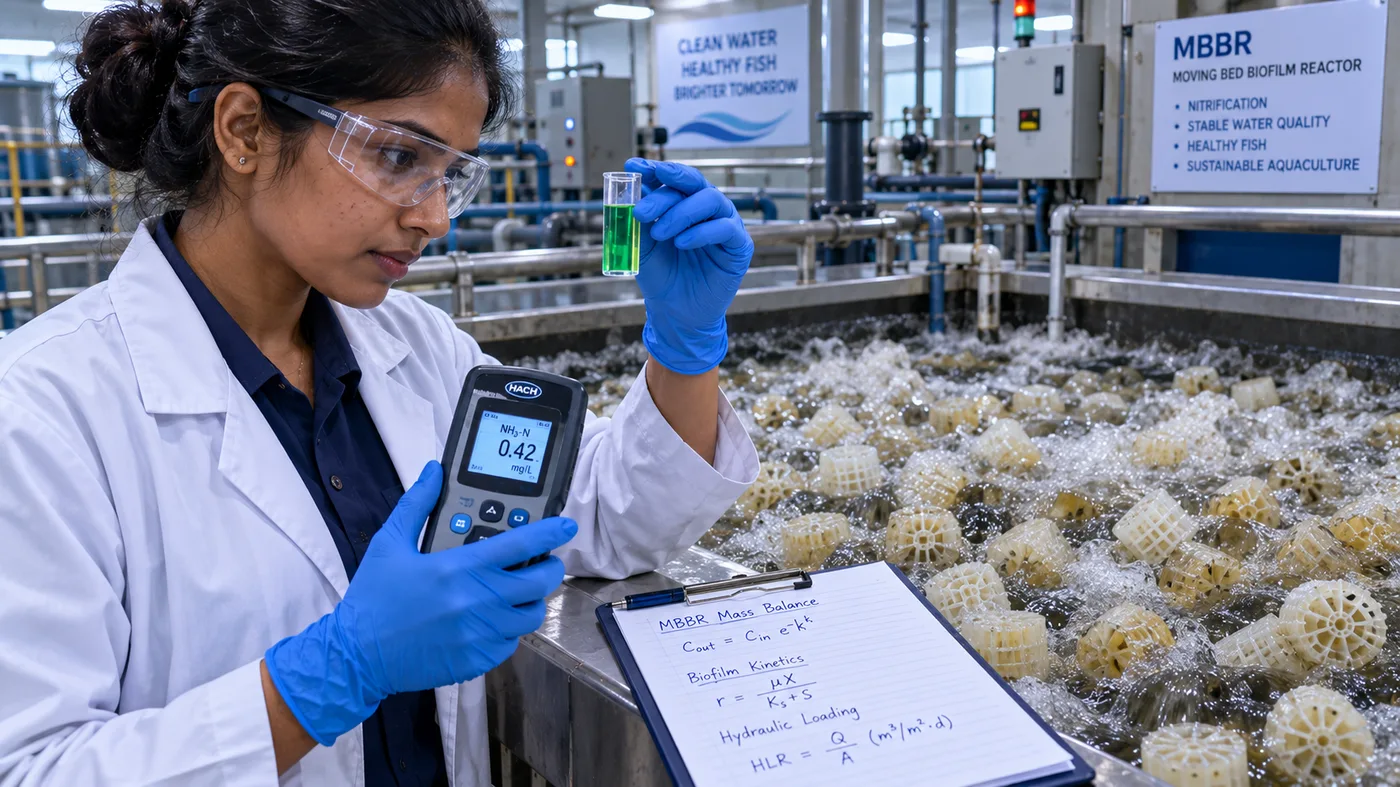
Executive Summary & Key Takeaways
- Never size an aquaculture biofilter based on standing fish biomass; always size biofilters based on the Maximum Daily Feed Rate (kg feed/day) and the dietary Crude Protein percentage.
- Every kilogram of commercial 40% crude protein feed metabolized by fish produces approximately 30 to 35 grams of Total Ammonia Nitrogen (TAN) in the water column.
- Biological nitrification is a two-step autotrophic process: Ammonia-Oxidizing Bacteria (AOB) convert NH4+ to NO2-, and Nitrite-Oxidizing Bacteria (NOB) convert NO2- to non-toxic NO3-.
- Oxidizing 1.0 gram of TAN consumes exactly 4.57 grams of dissolved oxygen (DO) and devours 7.14 grams of total alkalinity (expressed as CaCO3 equivalent).
- Biofilter sizing requires calculating active protected Specific Surface Area (SSA): Kaldnes K3 provides 584 m²/m³ of protected internal area, while Mutag BioChip delivers up to 1,200 m²/m³.
- The Volumetric Nitrification Rate (VNR) is heavily temperature-dependent: warm-water systems (26–28°C) achieve 0.40–0.55 g TAN/m²/day, whereas cold-water salmonid systems (12–14°C) achieve only 0.18–0.25 g TAN/m²/day.
- Maintain the media filling fraction (FF) strictly between 45% and 60% of MBBR tank volume to ensure complete fluidization, avoid media clumping, and prevent hydraulic channeling.
- Incorporate automated continuous chemical dosing of Sodium Bicarbonate (NaHCO3) to anchor system alkalinity strictly between 120 and 160 mg/L, preventing catastrophic pH collapses below 6.8.
Commercial Retrofit Case Study: Correcting an Undersized Biofilter in an 80-Ton/Year Barramundi RAS Facility
A commercial recirculating facility culturing Asian Seabass (Lates calcarifer) at 75 kg/m³ experienced recurrent toxic nitrite (NO2-) spikes and severe appetite suppression whenever daily feeding exceeded 65 kg of 42% CP feed. The original system had been designed using arbitrary 'rule-of-thumb' vendor sizing that drastically overestimated biofilter nitrification capacity. Water testing revealed Total Ammonia Nitrogen (TAN) hovering at 1.8 ppm and toxic nitrite peaking at 4.2 ppm, forcing emergency water flushing that violated the farm's zero-discharge permit. The facility retained AquaSangham to perform a comprehensive Nitrogen Mass Balance Audit. Stoichiometric calculations proved that 85 kg of daily peak feed generated 3,284 grams of TAN per day. The existing submerged bio-block filter provided only 4,200 m² of active surface area with an actual VNR of 0.32 g/m²/day, creating a 52% nitrification deficit. The facility executed an engineering retrofit: converted the vessel into a fluidized Moving Bed Biofilm Reactor (MBBR) by adding 8.0 m³ of virgin Kaldnes K3 media (protected SSA 584 m²/m³), installed a medium-bubble aeration grid delivering 1.8 m³/min of air for fluidization, and integrated automated proportional sodium bicarbonate dosing. Within 14 days of biofilm maturation, system TAN dropped to 0.35 ppm and nitrite stabilized at 0.12 ppm under a maximum feeding load of 92 kg/day, rescuing the farm from biological collapse.
1. The Stoichiometric Imperative: Why Guesswork Fails in RAS Biofiltration
In the engineering hierarchy of commercial Recirculating Aquaculture Systems (RAS), the biological filter—specifically the autotrophic nitrifying biofilter—represents the absolute central nervous system of the production facility. If a primary mechanical drum filter underperforms, water clarity declines; if a pump throttles down, water velocity slows; but if the biological filter is undersized, miscalculated, or chemically unbalanced, catastrophic total-herd mortality from acute ammonia or nitrite intoxication occurs within hours.
Historically, many commercial RAS installations failed because system integrators relied on crude, unscientific 'rules of thumb'—such as sizing biofilters based on a fixed ratio of tank volume (e.g., 'biofilter volume equals 20% of tank volume') or based on standing fish biomass (e.g., '1 m³ of media per 1,000 kg of fish'). Such approximations are fundamentally flawed. Fish do not excrete ammonia based on their physical presence in the water; they excrete ammonia as a direct metabolic consequence of deaminating dietary amino acids contained in ingested feed.
A tank holding 10,000 kg of mature broodstock on a fasting or maintenance ration (0.2% body weight daily = 20 kg feed) generates a fraction of the nitrogenous waste produced by 5,000 kg of rapidly growing juvenile fingerlings consuming a 3.0% daily satiation ration (150 kg feed). Sizing biofilters based on biomass would result in massive over-sizing in the first scenario and catastrophic biological collapse in the second.
Commercial process engineering mandates that every component of the bio-filtration loop must be sized strictly through Mass Balance Stoichiometry. By tracking the mass flow of elemental nitrogen from the raw formulation of the feed pellet, through gastrointestinal digestion and hepatic deamination, to branchial gill diffusion, engineers can determine the precise grams of Total Ammonia Nitrogen (TAN) entering the water column every hour. From this empirical baseline, bio-carrier surface area, tank fluidization volumes, dissolved oxygen demand, and stoichiometric alkalinity replenishment can be calculated with surgical mathematical precision.
Core Sizing Axioms in Commercial RAS Engineering
1. Feed is the Sole Nitrogen Source: All ammonia in a recirculating system originates from dietary crude protein. Size biofilters for the Maximum Daily Peak Feed Load.
2. Surface Area is King: Nitrification capacity is determined entirely by active, protected biofilm surface area ($m^2$), not by the gross physical volume of the biofilter vessel.
3. Environmental Constraints: Biological oxidation rates fluctuate wildly based on water temperature, dissolved oxygen, ambient pH, and salinity.
Always size the biofilter for the worst-case operating scenario: maximum projected daily feeding rate at peak summer water temperatures, assuming the highest crude protein tier and a safety margin of at least 20% to accommodate post-grading feeding surges.
2. The Nitrogen Mass Balance Equation: Mathematical Derivation (P_TAN)
To size a commercial biofilter, the design engineer must first derive the daily Total Ammonia Nitrogen production rate ($P_{ ext{TAN}}$, in grams or kilograms of TAN per day). The mathematical derivation rests upon elemental stoichiometry:
Step 1: Nitrogen Content of Commercial Feed ($N_{ ext{feed}}$):
Dietary protein consists of strings of amino acids containing carbon, hydrogen, oxygen, and nitrogen. Across virtually all commercial aquaculture formulations, protein averages exactly 16% elemental nitrogen by weight ($N_{ ext{ratio}} = 0.16$). Thus, for a daily feed input $F$ (in kg/day) with a fractional crude protein content $PC$ (where 40% CP = 0.40):
$$N_{ ext{feed}} = F imes PC imes 0.16$$
For example, feeding 100 kg of 40% CP feed daily introduces: $100 imes 0.40 imes 0.16 = 6.40, ext{kg of elemental Nitrogen}$.
Step 2: Nitrogen Assimilation and Excretion Pathways:
When ingested by finfish, this dietary nitrogen follows three distinct physiological fates:
1. Somatic Assimilation ($N_{ ext{retained}}$): Approximately 30% to 35% of ingested nitrogen is absorbed across the intestinal wall and synthesized into new muscle protein, scales, and skeletal tissue ($N_{ ext{retained}} approx 0.32$).
2. Solid Fecal Excretion ($N_{ ext{fecal}}$): Approximately 12% to 18% of ingested nitrogen is indigestible and excreted as solid particulate matter in fecal pellets ($N_{ ext{fecal}} approx 0.15$). In a properly engineered RAS, this fraction is rapidly removed by the mechanical drum filter.
3. Soluble Nitrogenous Excretion ($N_{ ext{soluble}}$): The remaining 50% to 55% of ingested nitrogen represents surplus amino acids deaminated in the liver. The resulting amino groups are converted into free ammonia, which diffuses down a concentration gradient across the gill epithelium directly into the culture water as dissolved Total Ammonia Nitrogen ($N_{ ext{soluble}} approx 0.53$).
Step 3: The Universal TAN Production Equation:
Combining these empirical coefficients yields the standard Timmons and Ebeling mass balance equation for finfish aquaculture:
$$P_{ ext{TAN}} = F imes PC imes 0.16 imes 0.53 = F imes PC imes 0.0848 approx F imes PC imes 0.092$$
Where the coefficient $0.092$ accounts for the minor bacterial breakdown of residual uncaptured fecal fines in the sump. Using this established standard formula:
$$P_{ ext{TAN}} ( ext{g/day}) = F ( ext{kg feed/day}) imes PC ( ext{fraction}) imes 92$$
Calculated Example: For an intensive commercial facility feeding 120 kg of 38% CP extruded pellets daily ($PC = 0.38$):
$$P_{ ext{TAN}} = 120 imes 0.38 imes 92 = 4,195.2, ext{grams TAN/day}quad (4.20, ext{kg TAN/day})$$
This 4,195.2 grams of dissolved ammonia must be biologically converted into nitrate every 24 hours to prevent system toxicity.
Keep in mind that 1.0 kg of 40% crude protein feed generates approximately 36.8 grams of TAN, whereas 1.0 kg of 28% protein feed generates only 25.8 grams of TAN. Accurately knowing your feed protein tier prevents under-sizing the biofilter by up to 30%.
3. Nitrification Biochemistry: Two-Step Oxidation & Chemical Demands
Biological nitrification is performed exclusively by chemolithoautotrophic bacteria. Unlike heterotrophic bacteria that derive energy from organic carbon (sugars), nitrifiers derive cellular energy strictly from the oxidation of inorganic nitrogen compounds, utilizing dissolved inorganic carbon (carbonates and bicarbonates, $HCO_3^-$) as their sole carbon source for synthesizing cell biomass.
The Two-Step Biological Oxidation Cascade:
Reaction 1: Ammonia Oxidation to Nitrite (The AOB Step):
Ammonia-Oxidizing Bacteria (AOB, primarily Nitrosomonas europaea, Nitrosococcus, and Nitrosospira) catalyze the oxidation of toxic ammonium ($NH_4^+$) to toxic nitrite ($NO_2^-$):
$$NH_4^+ + 1.5,O_2 longrightarrow NO_2^- + H_2O + 2,H^+ + Delta G^circ (-240, ext{kJ/mol})$$
Reaction 2: Nitrite Oxidation to Nitrate (The NOB Step):
Nitrite-Oxidizing Bacteria (NOB, primarily Nitrobacter winogradskyi, Nitrospira marina, and Nitrococcus) catalyze the subsequent oxidation of nitrite ($NO_2^-$) to relatively benign nitrate ($NO_3^-$):
$$NO_2^- + 0.5,O_2 longrightarrow NO_3^- + Delta G^circ (-75, ext{kJ/mol})$$
Overall Complete Stoichiometric Reaction (Including Bacterial Cell Synthesis):
When bacterial biomass synthesis ($C_5H_7O_2N$) is incorporated into the thermodynamic stoichiometry, the complete biochemical equation reveals the true operational cost of biofiltration:
$$NH_4^+ + 1.83,O_2 + 1.97,HCO_3^- longrightarrow 0.021,C_5H_7O_2N + 0.979,NO_3^- + 1.866,H_2O + 0.042,CO_2 + 1.88,H^+$$
Critical Mass Stoichiometric Coefficients per Gram of TAN Oxidized:
1. Oxygen Demand: Oxidizing 1.0 gram of Total Ammonia Nitrogen consumes exactly 4.57 grams of dissolved oxygen (DO) ($3.43, ext{g } O_2$ for Step 1 + $1.14, ext{g } O_2$ for Step 2). In an MBBR processing 4,000 grams of TAN daily, the bacterial biofilm alone consumes $18.28, ext{kg}$ of pure oxygen daily, independent of the fish respiration.
2. Alkalinity Consumption: The oxidation releases hydrogen ions ($H^+$), neutralizing dissolved bicarbonate buffers. Oxidizing 1.0 gram of TAN consumes exactly 7.14 grams of total alkalinity expressed as Calcium Carbonate ($CaCO_3$) equivalent (or $8.64, ext{g}$ of Sodium Bicarbonate, $NaHCO_3$).
If alkalinity is not continuously replenished, the pH of the system will crash below 6.5 within hours. Below pH 6.5, autotrophic nitrifiers are severely inhibited; below pH 5.8, nitrification halts entirely, triggering immediate, lethal unionized ammonia accumulation.
Never allow total alkalinity in an RAS biofilter loop to drop below 100 mg/L as CaCO3. Maintain a target operating buffer of 120 to 160 mg/L. Adequate alkalinity ensures abundant bicarbonate substrates for autotrophic nitrifiers and provides a robust chemical cushion against rapid pH drops.
4. Environmental Kinetics: Modeling VNR Across Temperature & Salinity
The speed at which a biofilm converts ammonia into nitrate is termed the Volumetric Nitrification Rate (VNR, expressed in grams of TAN oxidized per square meter of active media surface per day: $ ext{g TAN}/ ext{m}^2/ ext{day}$). VNR is not a static constant; it is an active biological kinetic rate dictated by environmental conditions.
Key Environmental Drivers of Nitrification Kinetics:
1. Operating Water Temperature ($T$): Nitrifying bacteria exhibit high thermal sensitivity. Enzyme kinetics follow the Arrhenius relationship: maximum nitrification rates occur between 26°C and 30°C. In cold-water salmonid or trout systems operating at 12°C to 14°C, enzymatic reaction rates drop by more than 50% compared to warm-water tilapia or seabass systems at 28°C. A biofilter designed for warm water will fail catastrophically if operated at cold temperatures without doubling the media surface area.
2. System Salinity: Marine and brackishwater RAS (15 to 35 ppt salinity) experience lower nitrification rates than pure freshwater systems. Elevated osmotic pressure and high sodium/chloride ion concentrations create physiological stress for nitrifiers, reducing VNR by 20% to 30%. Furthermore, transitioning a freshwater biofilter into saline water (or vice versa) causes acute osmotic shock, temporarily killing up to 80% of the active nitrifying population.
3. Ambient System pH: The optimal pH range for Ammonia-Oxidizing Bacteria (AOB) is 7.5 to 8.2, while Nitrite-Oxidizing Bacteria (NOB) prefer 7.2 to 7.8. At pH levels below 7.0, un-ionized ammonia ($NH_3$) substrate availability decreases rapidly because ammonia is protonated into ionized ammonium ($NH_4^+$), slowing AOB kinetics. At pH below 6.0, nitrification decreases by over 70%.
4. Dissolved Oxygen Thresholds within the Biofilm: Biofilms are three-dimensional matrix structures. While the bulk water may display 5.0 ppm DO, oxygen diffusion into the deep inner layers of the biofilm is limited. To maintain peak nitrification kinetics and prevent internal biofilm hypoxia, dissolved oxygen in the biofilter vessel must be maintained strictly above 4.5 to 5.5 mg/L.
| Culture System Type | Operating Water Temp (°C) | Salinity (ppt) | Optimal Operating pH | Design VNR (g TAN / m² / day) | Design Safety Factor |
|---|---|---|---|---|---|
| Warm-Water Freshwater (Tilapia / Pangasius) | 26°C – 28°C | 0 – 2 ppt | 7.2 – 7.6 | 0.45 – 0.55 g/m²/day | 1.20 (Standard) |
| Warm-Water Marine (Asian Seabass / Cobia) | 26°C – 28°C | 20 – 32 ppt | 7.4 – 7.8 | 0.35 – 0.42 g/m²/day | 1.30 (Elevated) |
| Cool-Water Freshwater (Carp / Perch) | 18°C – 22°C | 0 – 2 ppt | 7.0 – 7.5 | 0.28 – 0.35 g/m²/day | 1.25 (Moderate) |
| Cold-Water Marine (Atlantic Salmon Grow-out) | 12°C – 15°C | 28 – 34 ppt | 7.2 – 7.6 | 0.18 – 0.24 g/m²/day | 1.35 (High) |
| Cold-Water Freshwater (Rainbow Trout) | 12°C – 14°C | 0 – 1 ppt | 7.0 – 7.4 | 0.20 – 0.26 g/m²/day | 1.30 (High) |
When operating in marine or brackish water, always size the biofilter using a conservative baseline VNR of 0.35 g TAN/m²/day (instead of 0.50). Marine nitrifiers take twice as long to colonize and are significantly more sensitive to sudden ammonia spikes than freshwater strains.
5. Bio-Carrier Media Physics: Comparing K1, K3, K5 & Mutag BioChip SSA
In a Moving Bed Biofilm Reactor (MBBR), the physical carrier media serves as the structural substrate upon which autotrophic bacteria attach, secrete extracellular polymeric substances (EPS), and establish active nitrifying biofilms. Selecting the correct bio-carrier media is an engineering decision governed by physical geometry, specific surface area, hydrodynamic fluidization drag, and mechanical durability.
Total vs Protected Specific Surface Area (SSA):
Bio-carrier manufacturers frequently advertise the 'Total Specific Surface Area' ($m^2/m^3$) of their media. However, in an active fluidized MBBR, bio-carriers continuously collide with one another and scrape against tank walls under heavy aeration turbulence. Any biofilm growing on the outer perimeter of the carrier is continually sheared off by mechanical friction.
Nitrification occurs almost exclusively within the protected internal voids, fins, and serrated channels shielded from mechanical abrasion. Therefore, design engineers must size systems based strictly on the Protected Active Specific Surface Area ($SSA_{ ext{protected}}$), never on total theoretical surface area.
Comparing Commercial Bio-Carrier Technologies:
1. Kaldnes K1: The classic cylindrical wheel design with 4 internal compartments and external fins. Dimensions: 10mm diameter × 7mm length. Total SSA = $800, ext{m}^2/ ext{m}^3$; Protected SSA = $500, ext{m}^2/ ext{m}^3$. Excellent fluidization kinetics with low blower energy, ideal for small to medium-scale systems and nursery hatcheries.
2. Kaldnes K3: The commercial industrial workhorse. Dimensions: 25mm diameter × 10mm length. Total SSA = $800, ext{m}^2/ ext{m}^3$; Protected SSA = $584, ext{m}^2/ ext{m}^3$. Due to its larger physical diameter, K3 can be retained by heavy, non-clogging wedge-wire screens with 15mm slots, reducing hydraulic head loss across the reactor outlet.
3. Kaldnes K5: Heavy-duty large-format carrier. Dimensions: 25mm diameter × 3.5mm length. Total SSA = $600, ext{m}^2/ ext{m}^3$; Protected SSA = $410, ext{m}^2/ ext{m}^3$. Highly resistant to bio-clogging in systems with elevated organic carbon loading, but requires larger reactor tank volumes due to lower SSA.
4. Mutag BioChip 30™: Ultra-high surface area parabolic porous disk. Dimensions: 30mm diameter × 1.1mm thickness. Total SSA = $5,500, ext{m}^2/ ext{m}^3$; Protected SSA = $1,200, ext{m}^2/ ext{m}^3$. Manufactured from high-purity virgin HDPE, the BioChip provides more than double the protected surface area of traditional K3, allowing engineers to reduce physical biofilter tank footprints by up to 50%. However, BioChips require precision aeration manifold placement to prevent dead-zone packing.
| Bio-Carrier Media Brand / Type | Material Construction | Physical Dimensions (mm) | Total SSA (m²/m³) | Protected Active SSA (m²/m³) | Specific Gravity (g/cm³) | Screen Mesh Retention Size |
|---|---|---|---|---|---|---|
| Kaldnes K1 (Classic Wheel) | Virgin Virgin HDPE | 10mm dia × 7mm len | 800 m²/m³ | 500 m²/m³ | 0.95 – 0.96 (Buoyant) | 6.0 – 8.0 mm slot screen |
| Kaldnes K3 (Commercial Standard) | Virgin Virgin HDPE | 25mm dia × 10mm len | 800 m²/m³ | 584 m²/m³ | 0.95 – 0.96 (Buoyant) | 12.0 – 16.0 mm slot screen |
| Kaldnes K5 (Clog-Resistant) | Virgin Virgin HDPE | 25mm dia × 3.5mm len | 600 m²/m³ | 410 m²/m³ | 0.95 – 0.96 (Buoyant) | 12.0 – 16.0 mm slot screen |
| Mutag BioChip 30™ (High-Density) | Virgin Virgin HDPE | 30mm dia × 1.1mm thk | 5,500 m²/m³ | 1,200 m²/m³ | 0.95 – 0.97 (Neutral) | 20.0 – 22.0 mm slot screen |
| Structured Cross-Fluted Blocks | PVC Corrugated Sheet | Fixed block sheets | 240 m²/m³ | 200 m²/m³ | Submerged Fixed Bed | N/A (Fixed block media) |
Never purchase recycled black plastic bio-media. Recycled plastics contain unpredictable plasticizers, heavy metals, and variable polymer densities that cause media to either sink like stones or float permanently without fluidizing. Always specify virgin, food-grade HDPE with a certified specific gravity of 0.95 to 0.96 g/cm³.
6. Step-by-Step MBBR Sizing: Mathematical Engineering Blueprint
To illustrate the complete industrial engineering methodology, consider a commercial indoor RAS facility designed to produce 100 metric tons of Asian Seabass annually, operating at peak production:
Design Parameters:
- Maximum Daily Feed Input ($F$): 100 kg of commercial extruded feed per day.
- Feed Crude Protein Content ($PC$): 42% ($PC = 0.42$).
- Operating Water Temperature: 27°C; Salinity = 20 ppt; Operating pH = 7.5.
- Selected Bio-Media: Virgin Kaldnes K3 ($SSA_{ ext{protected}} = 584, ext{m}^2/ ext{m}^3$).
Step 1: Calculate Daily TAN Generation Rate ($P_{ ext{TAN}}$):
$$P_{ ext{TAN}} = F imes PC imes 92 = 100 imes 0.42 imes 92 = 3,864, ext{grams TAN/day}quad (3.864, ext{kg TAN/day})$$
Step 2: Select the Design Volumetric Nitrification Rate (VNR):
Consulting empirical benchmarks for brackishwater (20 ppt) seabass culture at 27°C, the base VNR is $0.38, ext{g TAN}/ ext{m}^2/ ext{day}$. Incorporating a conservative 20% engineering safety factor ($SF = 1.20$):
$$VNR_{ ext{design}} = 0.38 div 1.20 = 0.3167, ext{g TAN}/ ext{m}^2/ ext{day}$$
Step 3: Calculate Required Protected Biofilm Surface Area ($A_{ ext{biofilm}}$):
$$A_{ ext{biofilm}} = P_{ ext{TAN}} div VNR_{ ext{design}} = 3,864, ext{g/day} div 0.3167, ext{g/m}^2/ ext{day} = 12,201, ext{m}^2$$
The system requires exactly 12,201 square meters of active protected biofilm surface.
Step 4: Calculate Required Volume of Kaldnes K3 Bio-Media ($V_{ ext{media}}$):
$$V_{ ext{media}} = A_{ ext{biofilm}} div SSA_{ ext{protected}} = 12,201, ext{m}^2 div 584, ext{m}^2/ ext{m}^3 = 20.89, ext{m}^3 ext{ of K3 Media}$$
Step 5: Determine Total MBBR Tank Vessel Volume ($V_{ ext{tank}}$):
To ensure complete hydrodynamic fluidization without media jamming, the Media Filling Fraction ($FF$) must be maintained between 50% and 55%. Using $FF = 0.50$ (50% fill):
$$V_{ ext{tank}} = V_{ ext{media}} div FF = 20.89, ext{m}^3 div 0.50 = 41.78, ext{m}^3$$
Rounding up for operational safety, the facility requires an MBBR vessel volume of $42.0, ext{m}^3$ (e.g., a rectangular basin $5.0, ext{m} ext{ length} imes 3.5, ext{m} ext{ width} imes 2.4, ext{m} ext{ depth}$ with an operating water depth of $2.4, ext{m}$).
Step 6: Sizing Fluidization Aeration Airflow ($Q_{ ext{air}}$):
Fluidizing 20.9 m³ of K3 media requires a continuous medium-to-coarse bubble aeration grid. Sizing standard: $0.025, ext{m}^3 ext{ air per minute per m}^3 ext{ of tank volume}$ to provide both fluidization rolling torque and bacterial oxygen demand:
$$Q_{ ext{air}} = 42.0, ext{m}^3 imes 0.025 = 1.05, ext{m}^3/ ext{min}quad (37.1, ext{CFM})$$
This airflow is delivered via a stainless-steel 316L diffuser grid positioned across the tank floor, powered by a rotary side-channel blower operating against 25 kPa hydrostatic pressure.
Divide the total MBBR biofilter volume into two equal chambers connected in series (Stage 1 and Stage 2). Stage 1 will naturally process 75% of the TAN, while Stage 2 will operate under low ammonia substrate, allowing Nitrite-Oxidizing Bacteria (NOB) to flourish and preventing toxic nitrite leakage into culture tanks.
7. Alternative Configurations: Trickling Filters, Bead Filters & Submerged Beds
While fluidized Moving Bed Biofilm Reactors (MBBR) represent the dominant commercial technology, alternative biofilter designs serve vital niches in specific aquaculture applications:
1. Trickling Filters (Biological Towers): Consist of tall vertical columns packed with corrugated structured PVC blocks. Water is pumped to the top and trickles downward by gravity over the media, while air is drawn through by natural draft or low-pressure fans.
- Advantages: Simultaneously performs nitrification and carbon dioxide degassing in a single footprint; zero electrical power required for aeration; highly resilient to power outages (passive air contact).
- Disadvantages: Massive pumping head requirement (water must be lifted 2.5 to 3.5 meters); lower Specific Surface Area (150 to 240 m²/m³), requiring 3x larger vessel footprints than MBBRs.
2. Pressurized Propeller-Washed Bead Filters: Enclosed fiberglass pressure vessels filled with buoyant microscopic polyethylene beads (SSA 1,100 to 1,400 m²/m³).
- Advantages: Functions as both a mechanical solids clarifier (capturing particles down to 20 microns) and a biological biofilter simultaneously. Excellent for quarantine stations, broodstock systems, and small footprint hatcheries.
- Disadvantages: Trapped fecal solids remain in the vessel between backwashes, consuming dissolved oxygen and stimulating heterotrophic bacteria; high hydraulic head loss across the bead bed; not suitable for large-scale grow-out systems feeding >50 kg/day.
3. Submerged Fixed-Bed Biofilters: Tanks packed with stationary structured cross-fluted PVC sheets or submerged Japanese filter mats with bottom aeration.
- Advantages: Very low operational energy; silent operation; stable biofilm development.
- Disadvantages: High risk of hydraulic short-circuiting and dead zones; accumulated sludge clogs the fixed matrix over time, requiring manual chemical shutdowns and labor-intensive pressure washing.
If energy cost is your facility's primary operational bottleneck, consider a hybrid biofilter: use a low-head trickling filter positioned directly above the fish tank. Gravity return eliminates secondary biofilter lift pumps, cutting electrical consumption by up to 22%.
8. Automated Buffering, Biofilm Inoculation & AquaSangham Sizing Suite
A mathematically sized biofilter is useless if chemical buffering is neglected or if the biological commissioning protocol is botched.
Automated Stoichiometric Alkalinity Buffering:
As derived in Section 3, oxidizing 1.0 gram of TAN destroys 7.14 grams of $CaCO_3$ alkalinity. In our 100 kg feed/day design example ($P_{ ext{TAN}} = 3,864, ext{g/day}$):
$$ ext{Daily Alkalinity Consumed} = 3,864, ext{g TAN} imes 7.14 = 27,589, ext{g } CaCO_3, ext{equivalent}quad (27.59, ext{kg } CaCO_3/ ext{day})$$
To replenish this using technical-grade Sodium Bicarbonate ($NaHCO_3$, which contains 59.5% $CaCO_3$ equivalent):
$$ ext{Required } NaHCO_3 = 27.59, ext{kg} div 0.595 = 46.37, ext{kg of Sodium Bicarbonate per day}$$
Commercial facilities must never add 46 kg of sodium bicarbonate in a single daily batch dump. Sudden dosing causes localized pH spikes that convert non-toxic ammonium ($NH_4^+$) into lethal unionized ammonia gas ($NH_3$). Sizing standard: Install an automated industrial chemical dosing skid comprising a 500-liter chemical batch tank with continuous mechanical agitation, coupled to a diaphragm dosing pump controlled by an inline pH controller, trickling saturated bicarbonate liquor continuously over 24 hours into the MBBR inlet channel.
Biofilter Commissioning & Seeding SOP (The 30-Day Maturation Protocol):
Never stock valuable fish into an un-conditioned biofilter. Autotrophic nitrifiers reproduce exceptionally slowly (doubling time 24 to 36 hours). Conditioning protocol:
- Fill system with clean water, heat to 27°C, stabilize alkalinity at 140 mg/L, and establish continuous MBBR fluidization.
- Dose pure chemical Ammonium Chloride ($NH_4Cl$) to establish a baseline TAN of 3.0 to 5.0 mg/L. Add Sodium Nitrite ($NaNO_2$) at 1.0 mg/L to prime NOB species.
- Inoculate the MBBR with commercial concentrated nitrifying bacterial consortia (certified live Nitrosomonas and Nitrospira cultures) or introduce 5% seeded media borrowed from an active pathogen-free sister RAS facility.
- Monitor daily: TAN will peak around Day 8 to 12; Nitrite ($NO_2^-$) will surge dramatically between Day 14 and 22; by Day 25 to 28, nitrite will plummet to zero, and nitrate ($NO_3^-$) will climb steadily. Once the biofilter clears 3.0 ppm of TAN to zero within 12 hours, the system is fully mature and certified for commercial fish stocking.
Designing Systems with the AquaSangham RAS Suite:
To eliminate costly calculation errors, commercial RAS operators and EPC contractors rely on the AquaSangham RAS Engineering & Mass Balance Suite. By inputting target biomass, species, feed protein, temperature, and salinity, the software automatically computes TAN production, MBBR carrier requirements, aeration CFM, and chemical dosing schedules, guaranteeing high-performance biological security.
During biofilter commissioning, never add organic carbon (molasses, sugar, or feed). Organic carbon stimulates explosive heterotrophic bacteria blooms that outcompete and suffocate slow-growing autotrophic nitrifiers. Feed only pure inorganic ammonium chloride and sodium bicarbonate during the initial 30-day conditioning phase.
Summary Operational Action Checklist
Frequently Asked Questions
Q: Why should a biofilter never be sized based on standing fish biomass?
Fish do not excrete ammonia based on their physical presence in the tank; they excrete ammonia as a metabolic by-product of digesting and deaminating dietary protein. A tank holding 10,000 kg of non-feeding broodstock produces almost zero ammonia, whereas 3,000 kg of juvenile fingerlings consuming a 3.5% daily ration of high-protein feed produces massive ammonia loads. Sizing based on biomass results in catastrophic biofilter undersizing during juvenile grow-out stages.
Q: What is the exact mathematical relationship between feed protein and ammonia production?
Feed protein averages 16% elemental nitrogen by weight. Finfish assimilate approximately 32% of ingested nitrogen into body tissue and excrete 15% as solid fecal nitrogen. The remaining ~53% is excreted across the gills as dissolved Total Ammonia Nitrogen. This yields the universal Timmons equation: P_TAN (grams/day) = Feed (kg/day) × Protein Content (decimal) × 92. For example, 100 kg of 40% CP feed yields: 100 × 0.40 × 92 = 3,680 grams of TAN per day.
Q: How does water temperature affect the Volumetric Nitrification Rate (VNR)?
Autotrophic nitrifiers are highly temperature-dependent. At warm-water temperatures (26°C to 28°C), nitrifiers achieve a peak VNR of 0.45 to 0.55 g TAN/m²/day. In cold-water salmonid systems (12°C to 14°C), enzyme kinetics slow dramatically, dropping the VNR to 0.18 to 0.24 g TAN/m²/day. Consequently, a cold-water biofilter requires more than double the protected media surface area of a warm-water biofilter to process the exact same feed load.
Q: Why does biological nitrification consume so much water alkalinity?
During the first step of nitrification, Ammonia-Oxidizing Bacteria (AOB) oxidize ammonium ions (NH4+) to nitrite (NO2-), releasing two hydrogen ions (H+) for every molecule of ammonia oxidized. These hydrogen ions neutralize dissolved bicarbonate buffers (HCO3-). Stoichiometrically, oxidizing 1.0 gram of TAN destroys exactly 7.14 grams of alkalinity expressed as CaCO3 equivalent. If not continuously replenished with sodium bicarbonate, water pH will collapse below 6.0, halting nitrification.
Q: What is the difference between total surface area and protected surface area in bio-carriers?
Total surface area includes all exterior and interior surfaces of the plastic carrier. However, in an active fluidized MBBR, carriers continuously collide with one another and scrape against walls, shearing off any biofilm growing on the outer perimeter. Protected surface area refers only to the sheltered internal fins and channels where the biofilm is protected from physical abrasion. Biofilters must always be sized based strictly on protected surface area.
AquaSangham Technical Advisory
RAS Process Engineering & Water Chemistry Desk
Contributing Senior Technical Writer & Aqua Consultant at AquaSangham.
Recommended Farming Guides
The Recirculating Aquaculture System (RAS) Master Guide: Design, Hydraulics & Mass Balance
Read Article →Farming TechIndigenous Magur (Clarias batrachus) Induced Breeding & Nursery Rearing SOPs
Read Article →Farming TechPangasius Meat Whitening Techniques: Feed Formulation to Prevent Yellow Fillets
Read Article →Get Live Farm Advice on AquaSangham Mobile App
Download India's #1 Aquaculture Super App for real-time market prices, precision tools, and community advice.
Download Free Android App