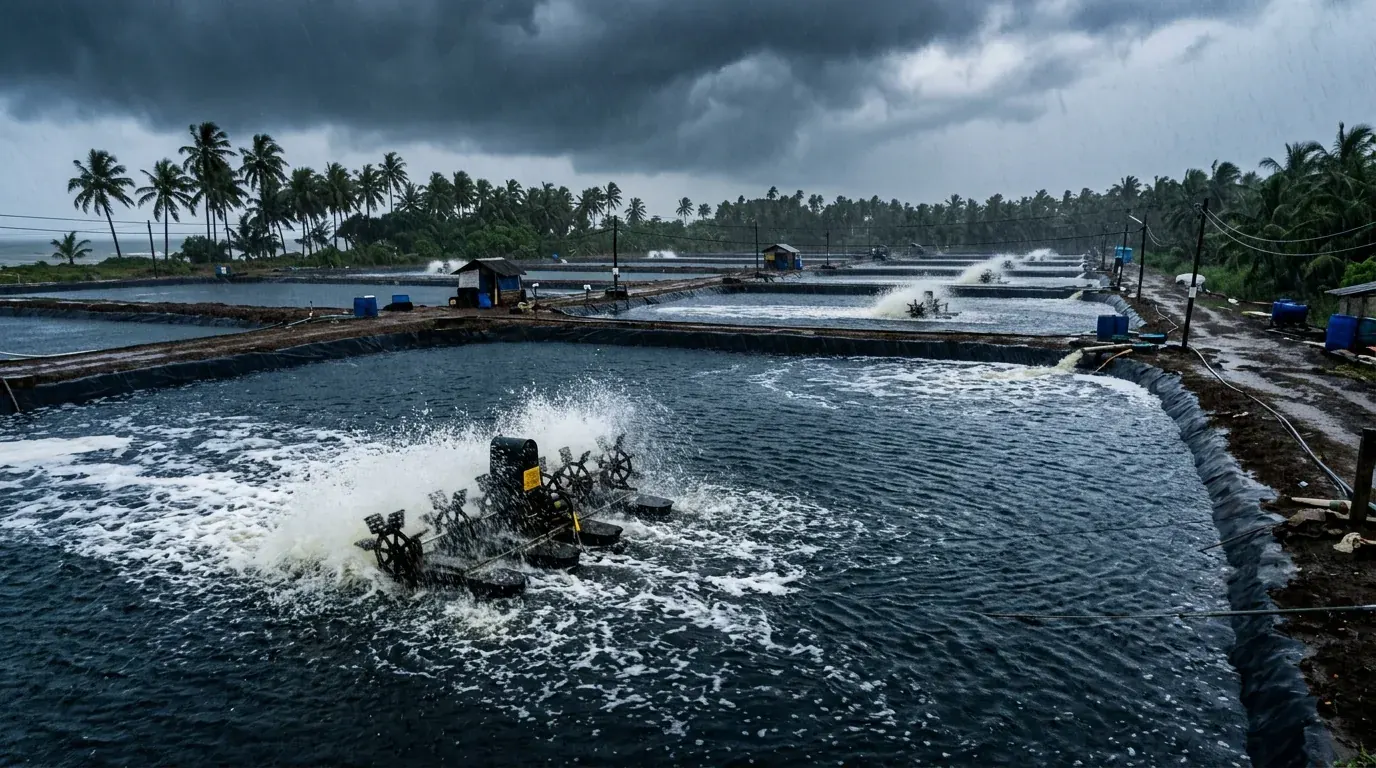
Key News Bulletins & Findings
- Low pressure area over West-Central Bay of Bengal to bring heavy rainfall across Nellore, Bapatla, and Guntur districts.
- Sudden freshwater influx risks rapid salinity dilution and pH drops below 7.2.
- Overcast skies to reduce natural algal photosynthesis, requiring 24-hour mechanical aeration.
1. Meteorological System Overview & Affected Coastal Districts
The India Meteorological Department (IMD) has tracked a well-marked low-pressure area over the West-Central Bay of Bengal, moving west-northwestwards toward the South Andhra Pradesh and North Tamil Nadu coasts.
The system is forecast to trigger widespread squally winds (45–55 km/h) and moderate to heavy rainfall (65 to 115 mm) across Nellore, Prakasam, Bapatla, Krishna, and West Godavari districts over the next 72 hours.
2. Water Quality Threats: Salinity Dilution, pH Crashes & Anoxia
Heavy rainfall directly into open ponds creates a dense top layer of cold, acidic freshwater. Salinity can drop abruptly by 5 to 10 ppt within a 12-hour period, inducing severe osmotic shock and premature molting in Vannamei shrimp.
Persistent overcast cloud cover eliminates sunlight-driven algal photosynthesis. Phytoplankton blooms can experience sudden die-offs (crash), turning pond water brown or clear and consuming all available dissolved oxygen as dead algae decompose.
3. 72-Hour Emergency Farm Management SOP
1. Feed Management: Cut all feeding rations by 50% immediately. If rain is continuous, cease feeding completely for 24 hours to prevent uneaten feed from rotting on the pond bottom.
2. Alkalinity Buffering: Broadcast Agricultural Limestone (CaCO3) @ 100 kg/acre or Dolomite @ 75 kg/acre along pond dykes before and during rainfall to buffer against acid runoff.
3. Drain Surface Freshwater: Open top-water surface drainage pipes to skim off the lighter freshwater layer without losing saline bottom water.
4. Continuous Aeration: Run all paddlewheel and long-arm aerators 24 hours a day to prevent thermal stratification and maintain DO above 4.5 mg/L.
Adverse weather may cause temporary supply disruptions and localized panic harvesting. Farmers with robust aeration and lime buffers should avoid premature harvest.
Immediate Farmer Action Plan
Frequently Asked Questions
Q: Why should feeding be reduced during heavy rainfall?
Shrimp do not feed actively during rainstorms due to temperature drops and barometric pressure shifts. Uneaten pellets decompose in bottom sludge, releasing toxic ammonia and consuming vital oxygen.
More Market News & Advisories
Coastal Aquaculture Authority (CAA) Mandates Geo-Tagging & Digital QR Licenses for All Brackishwater Ponds by Dec 2026
Read Bulletin →Government PolicyAndhra Pradesh & Gujarat Power Discoms Expand Subsidized ₹1.50/Unit Aqua Power Slab to High-Density Commercial Farms
Read Bulletin →Feed & InputsGlobal Fishmeal & Soybean Meal Price Spikes: Commercial Feed Mills Announce ₹3.50/kg Surcharge Across Coastal Belts
Read Bulletin →Get Live Farmgate Price Push Notifications
Download India's #1 Aquaculture Super App for real-time market prices, news, and tools.
Download Free Android App