Key News Bulletins & Findings
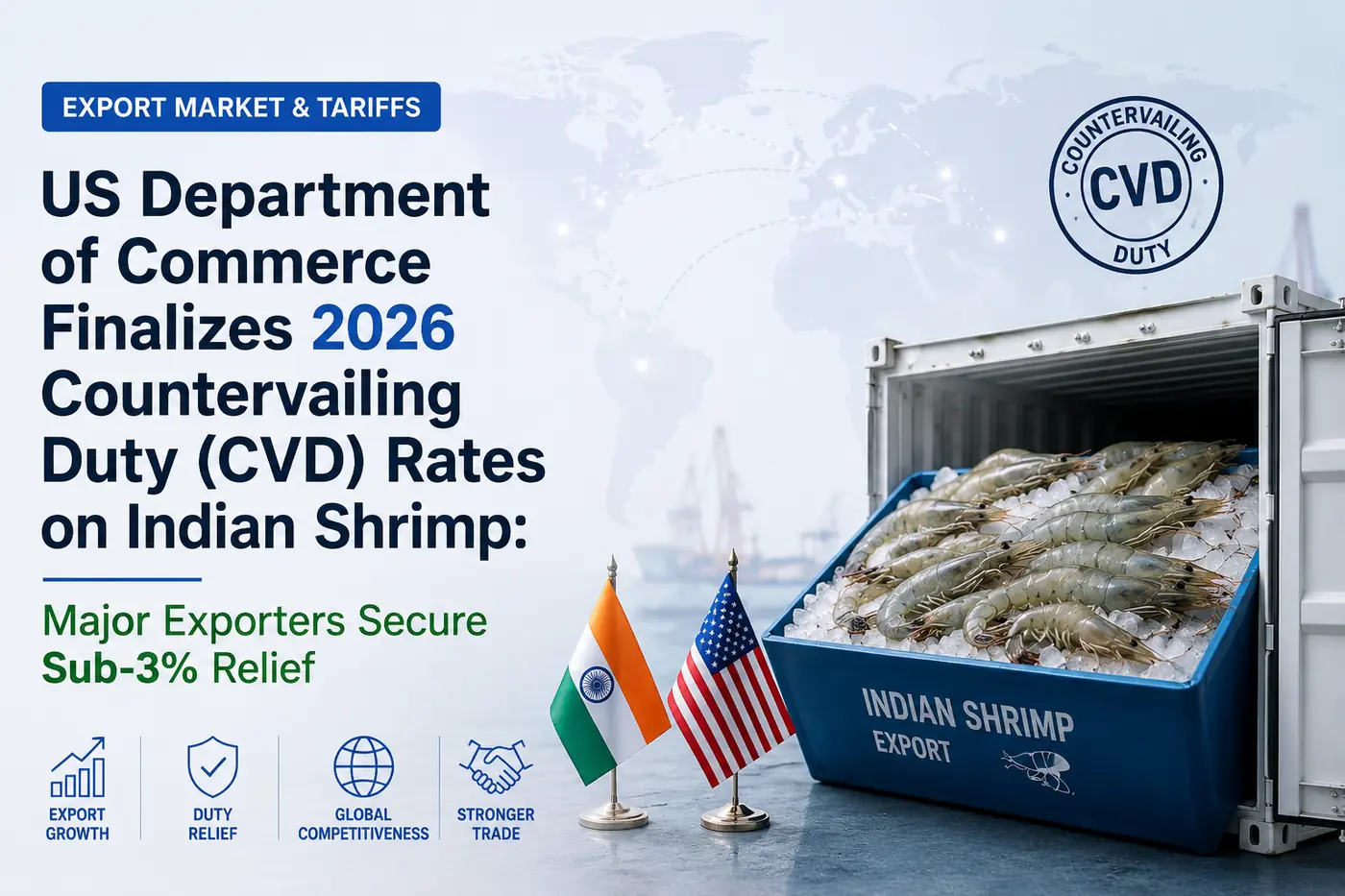
- US Department of Commerce determines final Countervailing Duty (CVD) rate of 2.84% for mandatory Indian exporter respondents, removing severe market uncertainty.
- Competitor tariff spreads place Indian shrimp at a competitive advantage against Ecuador (facing rising logistics/power costs) and Vietnam (higher AD margins).
- Processing facilities in coastal Andhra Pradesh and Gujarat experience a 22% surge in new purchase orders from North American supermarket buyers.
- Farmgate rates for 30-count shrimp solidify at ₹505–₹520/kg, providing strong harvest revenue stability through the third quarter.
1. US DOC Final Determination & CVD Margin Breakdown
The United States Department of Commerce (DOC) has officially issued its final determination in the countervailing duty (CVD) investigation concerning frozen warmwater shrimp imported from India. Ending months of acute market speculation that had dampened exporter forward contract bookings, the DOC established a final net countervailable subsidy rate of 2.84% for mandatory Indian respondents—a substantial reduction from the preliminary 4.72% rate announced earlier in the year.
For other cooperating Indian seafood processing conglomerates not individually audited, the DOC calculated an 'All-Others' CVD rate of 3.12%. Under US trade law, the investigation—initiated following petitions filed by the American Shrimp Processors Association (ASPA)—evaluated alleged government subsidy programs, including the Remission of Duties and Taxes on Exported Products (RoDTEP), state agro-power subsidies, and duty-free import authorisations for aquaculture inputs.
Legal trade counsel representing the Seafood Exporters Association of India (SEAI) and the Marine Products Export Development Authority (MPEDA) successfully demonstrated that government infrastructure and electricity initiatives reflect non-actionable agricultural support schemes rather than targeted, distortive export subsidies, securing a favorable final margin that ensures Indian seafood remains commercially viable on American retail shelves.
2. Global Competitor Tariff Spread: India vs Ecuador & Vietnam
To assess the macroeconomic impact of the 2026 tariff determination, industry analysts must evaluate India's combined duty burden against its primary global competitors: Ecuador, Vietnam, and Indonesia. In the United States market, Indian shrimp is subject to both Anti-Dumping (AD) duties and Countervailing Duties (CVD).
With the latest 19th Administrative Review setting India's weighted-average AD duty at 3.88%, the addition of the 2.84% CVD rate results in a combined effective tariff rate of 6.72% for top-tier Indian exporters. By comparison, Vietnam faces a combined tariff burden of 7.42% (2.84% CVD + 4.58% AD), leaving Indian exporters with a distinct pricing advantage in large and medium-count categories.
While Ecuador was assessed a CVD rate of 3.78% with zero anti-dumping duties, the South American producer is currently battling severe domestic challenges, including widespread hydroelectric power outages across Guayas processing hubs, high logistics costs, and security overheads. Consequently, major North American supermarket buyers—including Walmart, Costco, and Sysco—have maintained multi-million-pound purchase contracts with Indian suppliers to guarantee supply chain redundancy.
3. Processing Plant Procurement & Container Booking Dynamics
Following the release of the final determination, processing plants across the primary seafood export clusters of Visakhapatnam, Kakinada, Nellore, Chennai, and Surat reported an immediate 22% week-on-week surge in confirmed purchase order bookings from North American importers.
Cold storage inventory levels in major US distribution hubs (Los Angeles, Houston, and New Jersey) remain 11% below five-year historical averages ahead of the crucial fourth-quarter holiday consumption window. US importers, who had previously adopted a cautious 'hand-to-mouth' spot procurement strategy due to tariff uncertainty, are now aggressively issuing 60-day to 90-day forward purchase contracts.
Ocean container reefer freight rates from East Coast Indian ports (Chennai/Vizag) to US West Coast ports have stabilized at $3,750 per 40-foot container (FEU), down from $5,400 in early summer, further expanding processing margins and incentivizing aggressive farmgate procurement.
4. Count-Wise Farmgate Price Trends Across Coastal Belts
In direct response to heightened processing plant procurement targets, farmgate spot prices in coastal Andhra Pradesh, Tamil Nadu, and Gujarat have rallied strongly over the past 72 hours, particularly for large and medium-count Vannamei shrimp.
In SPSR Nellore and Prakasam districts, spot quotes for premium 30-count (33g+ ABW) Vannamei touched ₹505 to ₹520 per kilogram—representing an ₹18 to ₹25/kg gain compared to late-July levels. 40-count shrimp climbed to ₹430–₹445/kg, while 50-count lots moved to ₹370–₹385/kg.
Smaller counts (70-count to 100-count) have demonstrated stable price realization at ₹305/kg and ₹248/kg respectively, supported by strong domestic urban foodservice demand and secondary export markets in China and Southeast Asia.
5. Strategic Advisory for Shrimp Farmers: Harvest & Contract Timing
With the removal of tariff uncertainty and strong export demand confirmed through the third and fourth quarters, aquaculture farmers are advised to adopt a proactive, strategic approach to harvest management and contract execution:
1. Biomass Retention for Size Premium: If standing crops are healthy, water parameters (DO, alkalinity, salinity) are optimal, and bacterial loads are controlled, farmers in the 38 to 44-count bracket should hold culture for an additional 12 to 15 days to cross the high-margin 30-count threshold (₹510+/kg).
2. Direct Marketplace Bidding: Bypass predatory village brokers who attempt to use outdated 'tariff panic' rhetoric to negotiate artificial deductions. Utilize the AquaSangham Trade Portal to connect directly with export factory procurement desks offering spot electronic payment settlements.
3. Strict Pre-Harvest Certification (PHC): Maintain rigorous sample collection protocols 10 to 14 days before harvest through EIA/MPEDA-approved laboratories. Export processing plants will reject consignments failing antibiotic residue tests regardless of tariff margins.
Market Data & Rates Breakdown
| Exporting Nation / Exporter Group | Final CVD Rate (%) | Anti-Dumping (AD) Rate (%) | Combined US Duty Impact | Commercial Export Competitiveness |
|---|---|---|---|---|
| India (Mandatory Respondents - Devi / Sandhya) | 2.84% | 3.88% | 6.72% Total Effective Duty | Highly Competitive (Strong US retail supermarket demand) |
| India (All-Others Rate) | 3.12% | 3.94% | 7.06% Total Effective Duty | Stable (Sustained spot procurement volumes) |
| Ecuador (Mandatory Exporters) | 3.78% | N/A (CVD Only) | 3.78% Total Duty | Competitive on price, but constrained by domestic energy crises |
| Vietnam (Warmwater Shrimp) | 2.84% | 4.58% | 7.42% Total Effective Duty | Moderate (Focusing on value-added breaded product lines) |
| Indonesia (Marine Cultured) | 3.90% | 0.00% | 3.90% Total Duty | Competitive (Strong presence in US food service sector) |
The finalization of sub-3% CVD rates removes the single largest downside risk overhang that has suppressed Indian farmgate spot pricing for the past six months. With North American retail inventory cycles entering mandatory pre-holiday restocking and Indian duties remaining within commercial absorption thresholds, farmgate realizations for 30 to 50-count shrimp are projected to maintain an upward trajectory into October.
Immediate Farmer Action Plan
Frequently Asked Questions
Q: What is the difference between Countervailing Duty (CVD) and Anti-Dumping Duty (AD)?
Countervailing Duty (CVD) is an import tariff imposed by a government to offset foreign government subsidies (such as power subsidies or export tax rebates) granted to producers, ensuring fair competition. In contrast, Anti-Dumping Duty (AD) is imposed when a foreign exporter sells products in the importing country at prices below their fair market value or domestic cost of production. In the US market, Indian seafood exporters are subject to both CVD and AD determinations.
Q: Will US importers pass the 2.84% CVD tariff cost down to Indian farmers?
Because the final 2.84% CVD rate is significantly lower than the anticipated 5% to 8% range, US importers and Indian processors are absorbing the duty within their standard operating margins. Furthermore, low cold storage inventories in the US and stable shipping freight rates mean that farmgate spot prices in India are actually rising rather than facing downward pressure.
Q: How does India's combined tariff compare to Ecuador in the US retail sector?
While Ecuador benefits from a lower combined duty rate (3.78% CVD only, with 0% AD), its domestic production is currently constrained by severe energy crises, higher processing costs, and logistics bottlenecks. Indian exporters possess superior peeling, deveining, and value-added processing capabilities, making them the preferred supplier for large North American supermarket chains.
Q: How long will the 2026 Countervailing Duty rates remain in effect?
The final CVD rates established by the US Department of Commerce will remain in effect until the conclusion of the next annual Administrative Review cycle in 2027, providing at least 12 months of stable, predictable regulatory conditions for Indian exporters and aquaculture farmers.
More Market News & Advisories
Coastal Aquaculture Authority (CAA) Mandates Geo-Tagging & Digital QR Licenses for All Brackishwater Ponds by Dec 2026
Read Bulletin →Government PolicyAndhra Pradesh & Gujarat Power Discoms Expand Subsidized ₹1.50/Unit Aqua Power Slab to High-Density Commercial Farms
Read Bulletin →Feed & InputsGlobal Fishmeal & Soybean Meal Price Spikes: Commercial Feed Mills Announce ₹3.50/kg Surcharge Across Coastal Belts
Read Bulletin →Get Live Farmgate Price Push Notifications
Download India's #1 Aquaculture Super App for real-time market prices, news, and tools.
Download Free Android App